


What Makes You You?

Note: If you want to print this post or read it offline, the PDF is probably the way to go. You can buy it here.

When you say the word “me,” you probably feel pretty clear about what that means. It’s one of the things you’re clearest on in the whole world—something you’ve understood since you were a year old. You might be working on the question, “Who am I?” but what you’re figuring out is the who am part of the question—the part is obvious. It’s just you. Easy.

But when you stop and actually think about it for a minute—about what “me” really boils down to at its core—things start to get pretty weird. Let’s give it a try.

The Body Theory

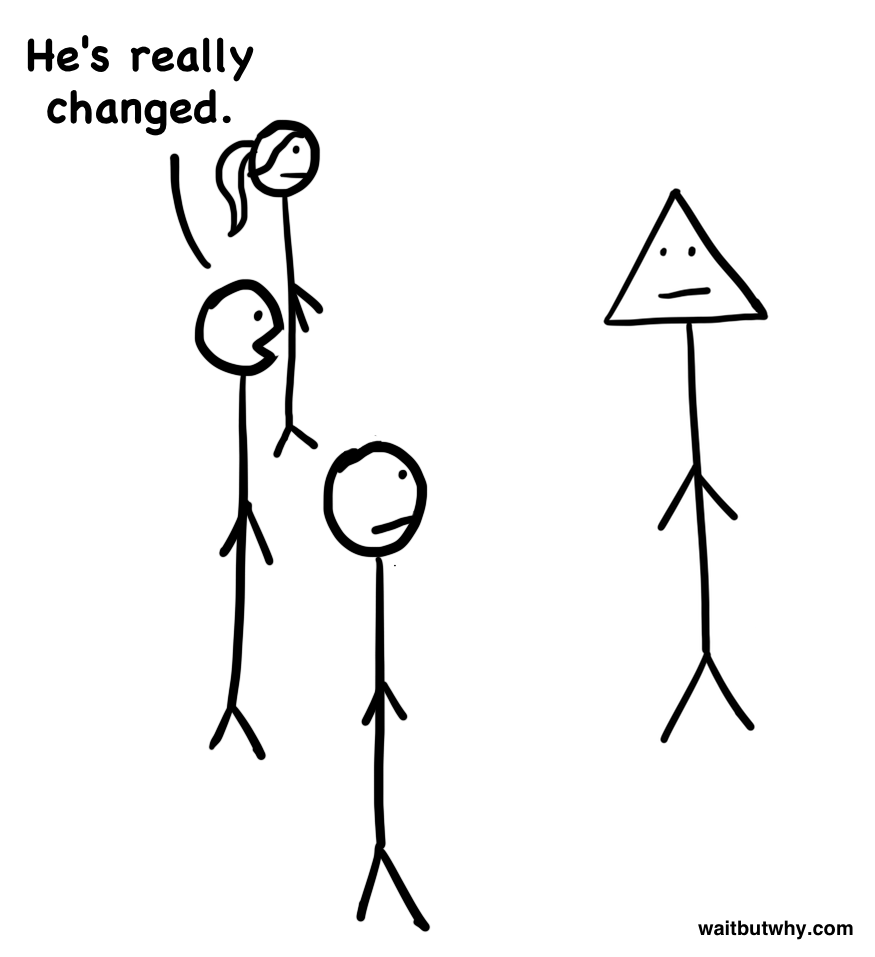
We’ll start with the first thing most people equate with what a person is—the physical body itself. The Body Theory says that that’s what makes you you. And that would make sense. It doesn’t matter what’s happening in your life—if your body stops working, you die. If Mark goes through something traumatic and his family says, CH“It really changed him—he’s just not the same person anymore,” they don’t literally mean Mark isn’t the same person—he’s changed, but he’s still Mark, because Mark’s body is Mark, no matter what he’s acting like. Humans believe they’re so much more than a hunk of flesh and bone, but in the end, a physical ant is the ant, a squirrel’s body is the squirrel, and a human is its body. This is the Body Theory—let’s test it:
So what happens when you cut your fingernails? You’re changing your body, severing some of its atoms from the whole. Does that mean you’re not you anymore? Definitely not—you’re still you.

How about if you get a liver transplant? Bigger deal, but definitely still you, right?

What if you get a terrible disease and need to replace your liver, kidney, heart, lungs, blood, and facial tissue with synthetic parts, but after all the surgery, you’re fine and can live your life normally. Would your family say that you had died because most of your physical body was gone? No, they wouldn’t. You’d still be you. None of that is needed for you to be you.

Well maybe it’s your DNA? Maybe that’s the core thing that makes you you, and none of these organ transplants matter because your remaining cells all still contain your DNA, and they’re what maintains “you.” One major problem—identical twins have identical DNA, and they’re not the same person. You are you, and your identical twin is most certainly not you. DNA isn’t the answer.

So far, the Body Theory isn’t looking too good. We keep changing major parts of the body, and you keep being you.

But how about your brain?

The Brain Theory

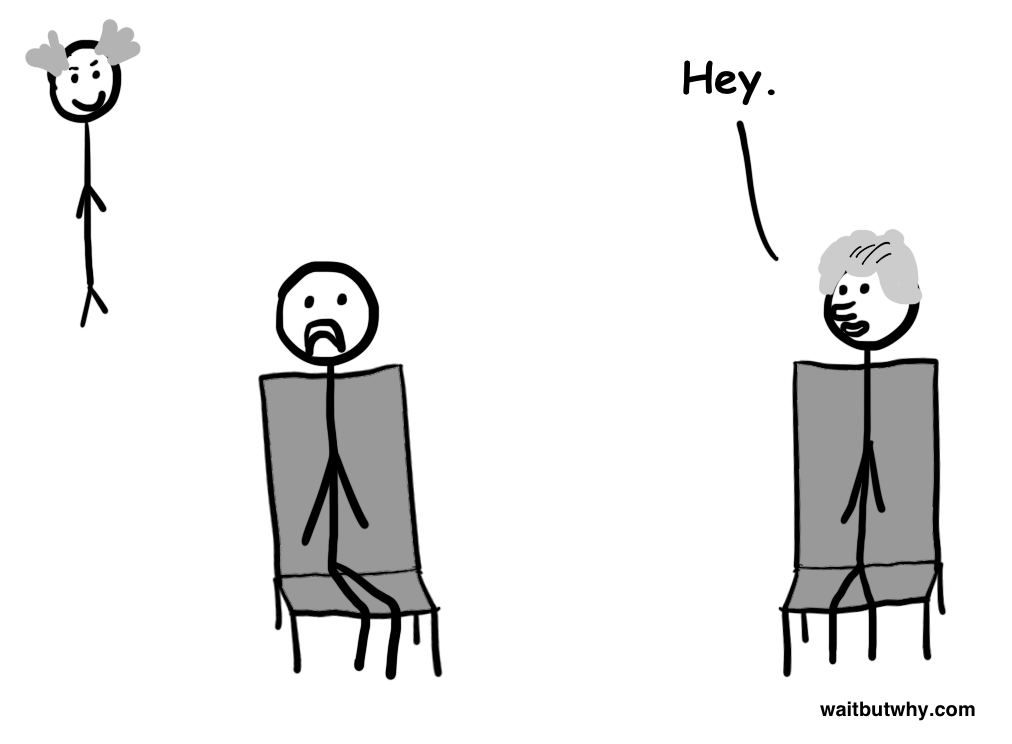
Let’s say a mad scientist captures both you and Bill Clinton and locks the two of you up in a room.
CH

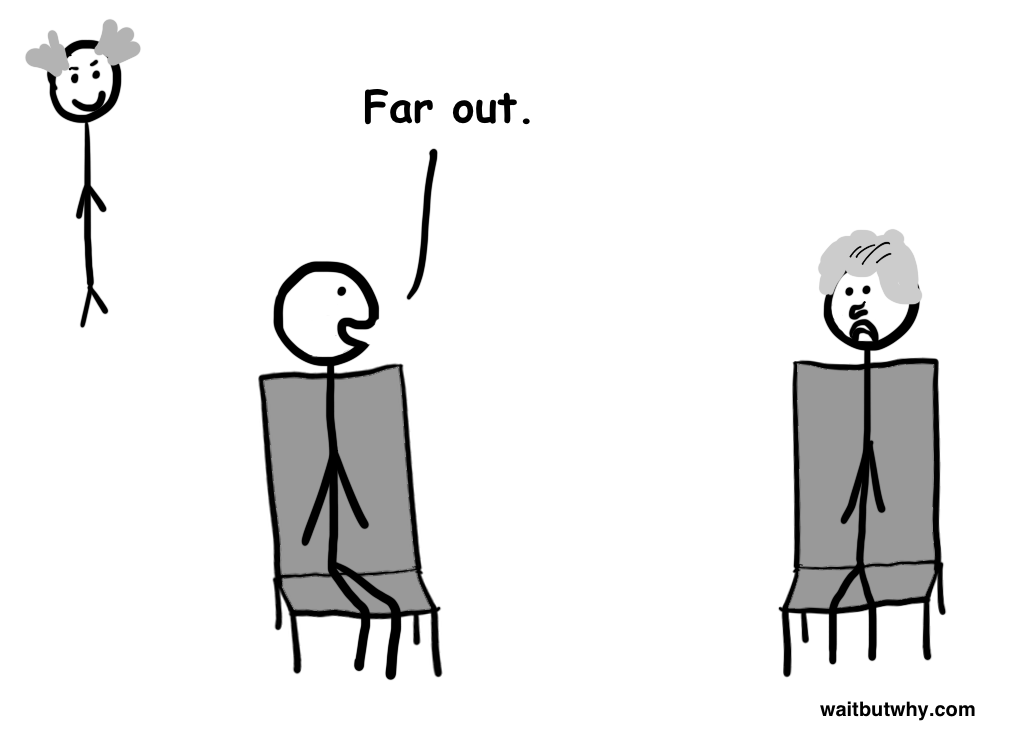
The scientist then performs an operation on both of you, whereby he safely removes each of your brains and switches them into the other’s head. Then he seals up your skulls and wakes you both up. You look down and you’re in a totally different body—Bill Clinton’s body. And across the room, you see your body—with Bill Clinton’s personality.
CFO

Now, are you still you? Well, my intuition says that you’re you—you still have your exact personality and all your memories—you’re just in Bill Clinton’s body now. You’d go find your family to explain what happened:


CF1

CF2

So unlike your other organs, which could be transplanted without changing your identity, when you swapped brains, it wasn’t a brain transplant—it was a body transplant. You’d still feel like you, just with a different body. Meanwhile, your old body would not be you—it would be Bill Clinton. So what makes you you must be your brain. The Brain Theory says that wherever the brain goes, you go—even if it goes into someone else’s skull.

The Data Theory

Consider this—

What if the mad scientist, after capturing you and Bill Clinton, instead of swapping your physical brains, just hooks up a computer to each of your brains, copies every single bit of data in each one, then wipes both of your brains completely clean, and then copies each of your brain data onto the other person’s physical brain? So you both wake up, both with your own physical brains in your head, but you’re not in your body—you’re in Bill Clinton’s body. After all, Bill Clinton’s brain now has all of your thoughts, memories, fears, hopes, dreams, emotions, and personality. The body and brain of Bill Clinton would still run out and go freak out about this to your family. And again, after a significant amount of convincing, they would indeed accept that you were alive, just in Bill Clinton’s body.

Philosopher John Locke’s memory theory of personal identity suggests that what makes you you is your memory of your experiences. Under Locke’s definition of you, the new Bill Clinton in this latest example is you, despite not containing any part of your physical body, not even your brain. 

This suggests a new theory we’ll call The Data Theory, which says that you’re not your physical body at all. Maybe what makes you you is your brain’s data—your memories and your personality.

We seem to be homing in on something, but the best way to get to concrete answers is by testing these theories in hypothetical scenarios. Here’s an interesting one, conceived by British philosopher Bernard Williams:

The Torture Test

Situation 1: The mad scientist kidnaps you and Clinton, switches your brain data with Clinton’s, as in the latest example, wakes you both up, and then walks over to the body of Clinton, where you supposedly reside, and says, “I’m now going to horribly torture one of you—which one should I torture?”

What’s your instinct? Mine is to point at my old body, where I no longer reside, and say, “Him.” And if I believe in the Data Theory, then I’ve made a good choice. My brain data is in Clinton’s body, so I’m now in Clinton’s body, so who cares about my body anymore? Sure, it sucks for anyone to be tortured, but if it’s between me and Bill Clinton, I’m choosing him.

Situation 2: The mad scientist captures you and Clinton, except he doesn’t do anything to your brains yet. He comes over to you—normal you with your normal brain and body—and asks you a series of questions. Here’s how I think it would play out:

Mad Scientist: Okay so here’s what’s happening. I’m gonna torture one of you. Who should I torture?

You: [pointing at Clinton] Him.

MS: Okay but there’s something else—before I torture whoever I torture, I’m going to wipe both of your brains of all memories, so when the torture is happening, neither of you will remember who you were before this. Does that change your choice?

You: Nope. Torture him.

MS: One more thing—before the torture happens, not only am I going to wipe your brains clean, I’m going to build new circuitry into your brain that will convince you that you’re Bill Clinton. By the time I’m done, you’ll think you’re Bill Clinton and you’ll have all of his memories and his full personality and anything else that he thinks or feels or knows. I’ll do the same thing to him, convincing him he’s you. Does that change your choice?

You: Um, no. Regardless of any delusion I’m going through and no matter who I think I am, I don’t want to go through the horrible pain of being tortured. Insane people still feel pain. Torture him.

So in the first situation, I think you’d choose to have your own body tortured. But in the second, I think you’d choose Bill Clinton’s body—at least I would. But the thing is—they’re the exact same example. In both cases, before any torture happens, Clinton’s brain ends up with all of your data and your brain has his—the difference is just at which point in the process you were asked to decide. In both cases, your goal is for you to not be tortured, but in the first situation, you felt that after the brain data swap, you were in Clinton’s body, with all of your personality and memories there with you—while in the second situation, if you’re like me, you didn’t care what was going to happen with the two brains’ data, you believed that you would remain with your physical brain, and body, either way.

Choosing your body to be the one tortured in the first situation is an argument for the Data Theory—you believe that where your data goes, you go. Choosing Clinton’s body to be tortured in the second situation is an argument for the Brain Theory, because you believe that regardless of what he does with your brain’s data, you will continue to be in your own body, because that’s where your physical brain is. Some might even take it a step further, and if the mad scientist told you he was even going to switch your physical brains, you’d still choose Clinton’s body, with your brain in it, to be tortured. Those that would torture a body with their own brain in it over torturing their own body believe in the Body Theory.

Not sure about you, but I’m finishing this experiment still divided. Let’s try another. Here’s my version of modern philosopher Derek Parfit’s teletransporter thought experiment, which he first described in his book Reasons and Persons

The Teletransporter Thought Experiment

It’s the year 2700. The human race has invented all kinds of technology unimaginable in today’s world. One of these technologies is teleportation—the ability to transport yourself to distant places at the speed of light. Here’s how it works—

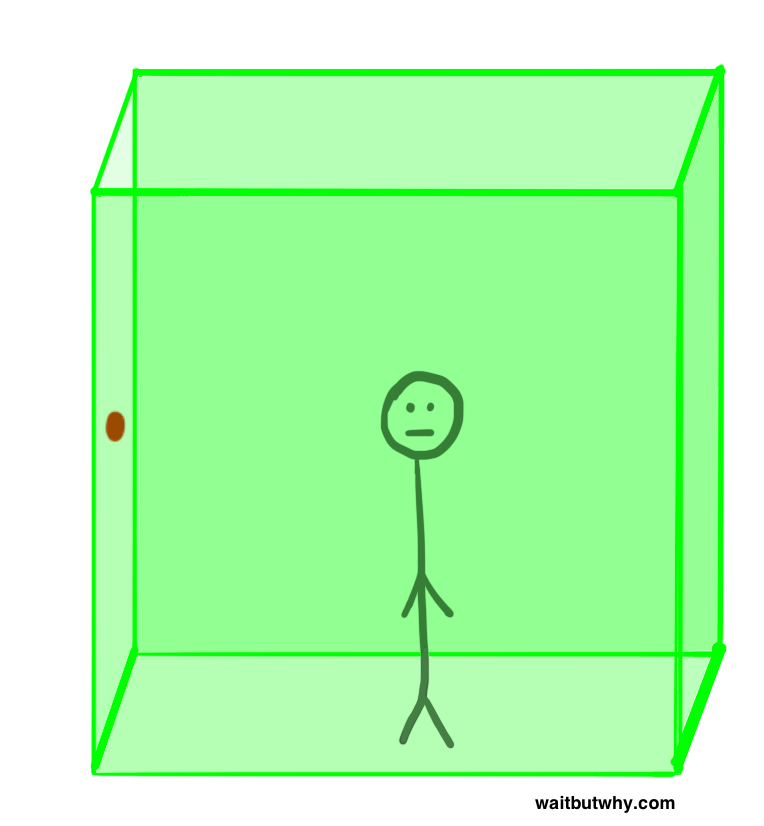
You go into a Departure Chamber—a little room the size of a small cubicle.
cube stand

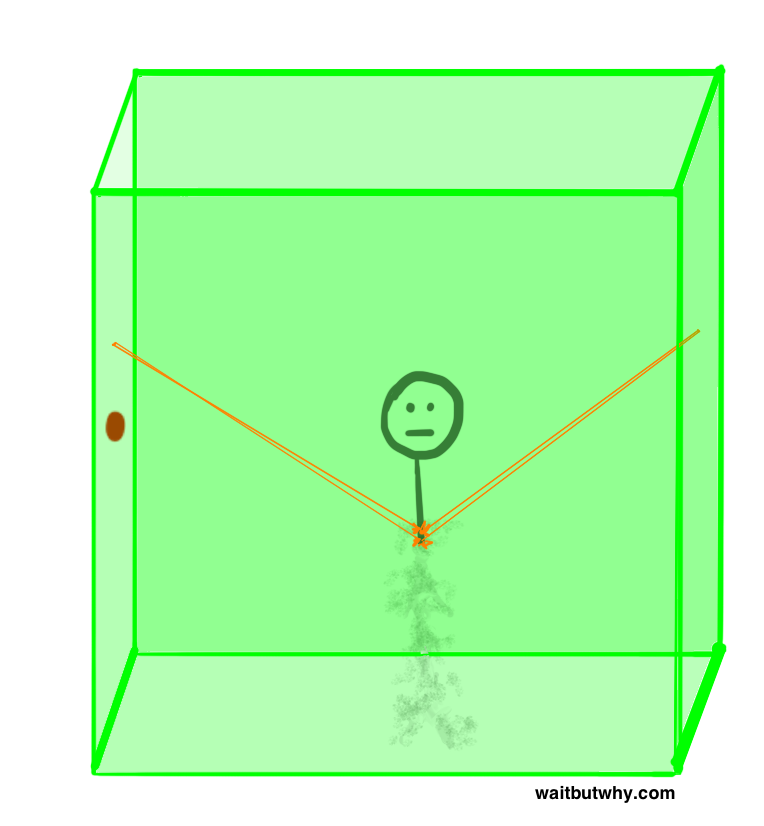
You set your location—let’s say you’re in Boston and your destination is London—and when you’re ready to go, you press the button on the wall. The chamber walls then scan your entire body, uploading the exact molecular makeup of your body—every atom that makes up every part of you and its precise location—and as it scans, it destroys, so every cell in your body is destroyed by the scanner as it goes.
cube beam

When it’s finished (the Departure Chamber is now empty after destroying all of your cells), it beams your body’s information to an Arrival Chamber in London, which has all the necessary atoms waiting there ready to go. The Arrival Chamber uses the data to re-form your entire body with its storage of atoms, and when it’s finished you walk out of the chamber in London looking and feeling exactly how you did back in Boston—you’re in the same mood, you’re hungry just like you were before, you even have the same paper cut on your thumb you got that morning.

The whole process, from the time you hit the button in the Departure Chamber to when you walk out of the Arrival Chamber in London, takes five minutes—but to you it feels instantaneous. You hit the button, things go black for a blink, and now you’re standing in London. Cool, right?

In 2700, this is common technology. Everyone you know travels by teleportation. In addition to the convenience of speed, it’s incredibly safe—no one has ever gotten hurt doing it.

But then one day, you head into the Departure Chamber in Boston for your normal morning commute to your job in London, you press the big button on the wall, and you hear the scanner turn on, but it doesn’t work.
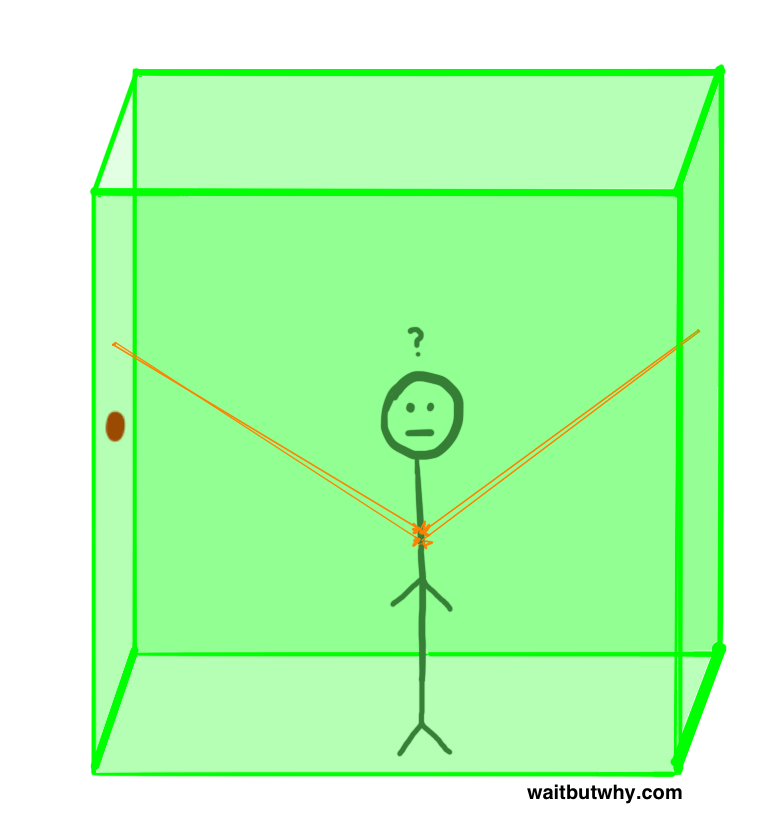
cubicle broken

The normal split-second blackout never happens, and when you walk out of the chamber, sure enough, you’re still in Boston. You head to the check-in counter and tell the woman working there that the Departure Chamber is broken, and you ask her if there’s another one you can use, since you have an early meeting and don’t want to be late.

She looks down at her records and says, “Hm—it looks like the scanner worked and collected its data just fine, but the cell destroyer that usually works in conjunction with the scanner has malfunctioned.”

“No,” you explain, “it couldn’t have worked, because I’m still here. And I’m late for this meeting—can you please set me up with a new Departure Chamber?”

She pulls up a video screen and says, “No, it did work—see? There you are in London—it looks like you’re gonna be right on time for your meeting.” She shows you the screen, and you see yourself walking on the street in London.

“But that can’t be me,” you say, “because I’m still here.”

At that point, her supervisor comes into the room and explains that she’s correct—the scanner worked as normal and you’re in London as planned. The only thing that didn’t work was the cell destroyer in the Departure Chamber here in Boston. “It’s not a problem, though,” he tells you, “we can just set you up in another chamber and activate its cell destroyer and finish the job.”

And even though this isn’t anything that wasn’t going to happen before—in fact, you have your cells destroyed twice every day—suddenly, you’re horrified at the prospect.

“Wait—no—I don’t want to do that—I’ll die.”

The supervisor explains, “You won’t die sir. You just saw yourself in London—you’re alive and well.”

“But that’s not me. That’s a replica of me—an imposterI’m the real me—you can’t destroy my cells!”

The supervisor and the woman glance awkwardly at each other. “I’m really sorry sir—but we’re obligated by law to destroy your cells. We’re not allowed to form the body of a person in an Arrival Chamber without destroying the body’s cells in a Departure Chamber.”

You stare at them in disbelief and then run for the door. Two security guards come out and grab you. They drag you toward a chamber that will destroy your cells, as you kick and scream…

__________

If you’re like me, in the first part of that story, you were pretty into the idea of teletransportation, and by the end, you were not.

The question the story poses is, “Is teletransportation, as described in this experiment, a form of traveling? Or a form of dying?

This question might have been ambiguous when I first described it—it might have even felt like a perfectly safe way of traveling—but by the end, it felt much more like a form of dying. Which means that every day when you commute to work from Boston to London, you’re killed by the cell destroyer, and a replica of you is created.Writing this post has made me obsessed with thinking about what would happen if I cloned myself. My first instinct is that we could be teammates in life and it would solve all my problems. We’d split all the work, accomplish way more, and we could take turns living my life while whoever wasn’t dealing with that could just hang out and do nothing. It sounds pretty great. Then I realized that there would come some point when it would probably just be too risky to have both of us around, and I’d secretly plan to kill him before he killed me, except he’d be thinking the same thing and we’d fall into a spiral of paranoia and one of us would be dead pretty soon. Disappointing outcome. To the people who know you, you survive teletransportation just fine, the same way your wife seems just fine when she arrives home to you after her own teletransportation, talking about her day and discussing plans for next week. But is it possible that your wife was actually killed that day, and the person you’re kissing now was just created a few minutes ago?

Well again, it depends on what you are. Someone who believes in the Data Theory would posit that London you is you as much as Boston you, and that teletransportation is perfectly survivable. But we all related to Boston you’s terror at the end there—could anyone really believe that he should be fine with being obliterated just because his data is safe and alive over in London? Further, if the teletransporter could beam your data to London for reassembly, couldn’t it also beam it to 50 other cities and create 50 new versions of you? You’d be hard-pressed to argue that those were all you. To me, the teletransporter experiment is a big strike against the Data Theory.

Similarly, if there were an Ego Theory that suggests that you are simply your ego, the teletransporter does away nicely with that. Thinking about London Tim, I realize that “Tim Urban” surviving means nothing to me. The fact that my replica in London will stay friends with my friends, keep Wait But Why going with his Tuesday-ish posts, and live out the whole life I was planning for myself—the fact that no one will miss me or even realize that I’m dead, the same way in the story you never felt like you lost your wife—does almost nothing for me. I don’t care about Tim Urban surviving. I care about me surviving.

All of this seems like very good news for Body Theory and Brain Theory. But let’s not judge things yet. Here’s another experiment:

The Split Brain Experiment

A cool fact about the human brain is that the left and right hemispheres function as their own little worlds, each with their own things to worry about, but if you remove one half of someone’s brain, they can sometimes not only survive, but their remaining brain half can learn to do many of the other half’s previous jobs, allowing the person to live a normal life. That’s right—you could lose half of your brain and potentially function normally.

So say you have an identical twin sibling named Bob who develops a fatal brain defect. You decide to save him by giving him half of your brain. Doctors operate on both of you, discarding his brain and replacing it with half of yours. When you wake up, you feel normal and like yourself. Your twin (who already has your identical DNA because you’re twins) wakes up with your exact personality and memories.

twins

When you realize this, you panic for a minute that your twin now knows all of your innermost thoughts and feelings on absolutely everything, and you’re about to make him promise not to tell anyone, when it hits you that you of course don’t have to tell him. He’s not your twin—he’s you. He’s just as intent on your privacy as you are, because it’s his privacy too.

As you look over at the guy who used to be Bob and watch him freak out that he’s in Bob’s body now instead of his own, you wonder, “Why did I stay in my body and not wake up in Bob’s? Both brain halves are me, so why am I distinctly in my body and not seeing and thinking in dual split-screen right now, from both of our points of view? And whatever part of me is in Bob’s head, why did I lose touch with it? Who is the me in Bob’s head, and how did he end up over there while I stayed here?”

Brain Theory is shitting his pants right now—it makes no sense. If people are supposed to go wherever their brains go, what happens when a brain is in two places at once? Data Theory, who was badly embarrassed by the teletransporter experiment, is doing no better in this one.

But Body Theory—who was shot down at the very beginning of the post—is suddenly all smug and thrilled with himself. Body Theory says “Of course you woke up in your own body—your body is what makes you you. Your brain is just the tool your body uses to think. Bob isn’t you—he’s Bob. He’s just now a Bob who has your thoughts and personality. There’s nothing Bob’s body can ever do to not be Bob.” This would help explain why you stayed in your body.

So a nice boost for Body Theory, but let’s take a look at a couple more things—

What we learned in the teletransporter experiment is that if your brain data is transferred to someone else’s brain, even if that person is molecularly identical to you, all it does is create a replica of you—a total stranger who happens to be just like you. There’s something distinct about Boston you that was important. When you were recreated out of different atoms in London, something critical was lost—something that made you you.

Body Theory (and Brain Theory) would point out that the only difference between Boston you and London you was that London you was made out of different atoms. London you’s body was like your body, but it was still made of different material. So is that it? Could Body Theory explain this too?

Let’s put it through two tests:

The Cell Replacement Test

Imagine I replace a cell in your arm with an identical, but foreign, replica cell. Are you not you anymore? Of course you are. But how about if, one at a time, I replace 1% of your cells with replicas? How about 10%? 30%? 60%? The London you was composed of 100% replacement cells, and we decided that that was not you—so when does the “crossover” happen? How many of your cells do we need to swap out for replicas before you “die” and what’s remaining becomes your replica?

Something feels off with this, right? Considering that the cells we’re replacing are molecularly identical to those we’re removing, and someone watching this all happen wouldn’t even notice anything change about you, it seems implausible that you’d ever die during this process, even if we eventually replaced 100% of your cells with replicas. But if your cells are eventually all replicas, how are you any different from London you?

The Body Scattering Test 

Imagine going into an Atom Scattering Chamber that completely disassembles your body’s atoms so that all that’s left in the room is a light gas of floating atoms—and then a few minutes later, it perfectly reassembles the atoms into you, and you walk out feeling totally normal.
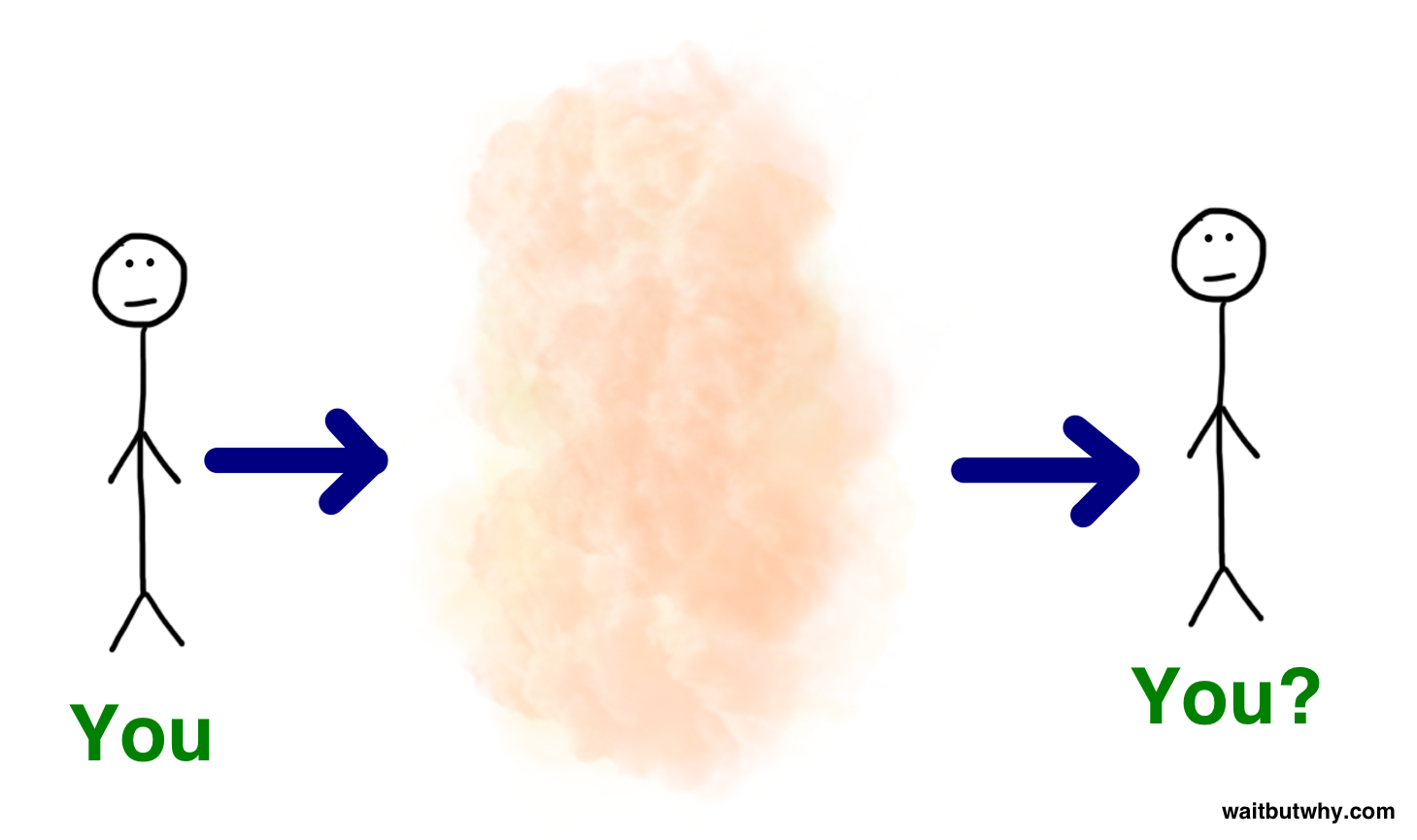
disassemble

Is that still you? Or did you die when you were disassembled and what has been reassembled is a replica of you? It doesn’t really make sense that this reassembled you would be the real you and London you would be a replica, when the only difference between the two cases is that the scattering room preserves your exact atoms and the London chamber assembles you out of different atoms. At their most basic level, atoms are identical—a hydrogen atom from your body is identical in every way to a hydrogen atom in London. Given that, I’d say that if we’re deciding London you is not you, then reassembled you is probably not you either.

The first thing these two tests illustrate is that the key distinction between Boston you and London you isn’t about the presence or absence of your actual, physical cells. The Cell Replacement Test suggests that you can gradually replace much or all of your body with replica material and still be you, and the Body Scattering Test suggests that you can go through a scatter and a reassembly, even with all of your original physical material, and be no more you than the you in London. Not looking great for Body Theory anymore.

The second thing these tests reveal is that the difference between Boston and London you might not be the nature of the particular atoms or cells involved, but about continuity. The Cell Replacement Test might have left you intact because it changed you gradually, one cell at a time. And if the Body Scattering Test were the end of you, maybe it’s because it happened all at the same time, breaking the continuity of you. This could also explain why the teletransporter might be a murder machine—London you has no continuity with your previous life.

So could it be that we’ve been off the whole time pitting the brain, the body, and the personality and memories against each other? Could it be that anytime you relocate your brain, or disassemble your atoms all at once, transfer your brain data onto a new brain, etc., you lose you because maybe, you’re not defined by any of these things on their own, but rather by a long and unbroken string of continuous existence?

Continuity

A few years ago, my late grandfather, in his 90s and suffering from dementia, pointed at a picture on the wall of himself as a six-year-old. “That’s me!” he explained.

He was right. But come on. It seems ridiculous that the six-year-old in the picture and the extremely old man standing next to me could be the same person. Those two people had nothing in common. Physically, they were vastly different—almost every cell in the six-year-old’s body died decades ago. As far as their personalities—we can agree that they wouldn’t have been friends. And they shared almost no common brain data at all. Any 90-year-old man on the street is much more similar to my grandfather than that six-year-old.

But remember—maybe it’s not about similarity, but about continuity. If similarity were enough to define you, Boston you and London you, who are identical, would be the same person. The thing that my grandfather shared with the six-year-old in the picture is something he shared with no one else on Earth—they were connected to each other by a long, unbroken string of continuous existence. As an old man, he may not know anything about that six-year-old boy, but he knows something about himself as an 89-year-old, and that 89-year-old might know a bunch about himself as an 85-year-old. As a 50-year-old, he knew a ton about him as a 43-year-old, and when he was seven, he was a pro on himself as a 6-year-old. It’s a long chain of overlapping memories, personality traits, and physical characteristics.

It’s like having an old wooden boat. You may have repaired it hundreds of times over the years, replacing wood chip after wood chip, until one day, you realize that not one piece of material from the original boat is still part of it. So is that still your boat? If you named your boat Polly the day you bought it, would you change the name now? It would still be Polly, right?

In this way, what you are is not really a thing as much as a story, or a progression, or one particular theme of person. You’re a bit like a room with a bunch of things in it—some old, some new, some you’re aware of, some you aren’t—but the room is always changing, never exactly the same from week to week.

Likewise, you’re not a set of brain data, you’re a particular database whose contents are constantly changing, growing, and being updated. And you’re not a physical body of atoms, you’re a set of instructions on how to deal with and organize the atoms that bump into you.

People always say the word soul and I never really know what they’re talking about. To me, the word soul has always seemed like a poetic euphemism for a part of the brain that feels very inner to us; or an attempt to give humans more dignity than just being primal biological organisms; or a way to declare that we’re eternal. But maybe when people say the word soul what they’re talking about is whatever it is that connects my 90-year-old grandfather to the boy in the picture. As his cells and memories come and go, as every wood chip in his canoe changes again and again, maybe the single common thread that ties it all together is his soul. After examining a human from every physical and mental angle throughout the post, maybe the answer this whole time has been the much less tangible Soul Theory.

______

It would have been pleasant to end the post there, but I just can’t do it, because I can’t quite believe in souls.

The way I actually feel right now is completely off-balance. Spending a week thinking about clones of yourself, imagining sharing your brain or merging yours with someone else’s, and wondering whether you secretly die every time you sleep and wake up as a replica will do that to you. If you’re looking for a satisfying conclusion, I’ll direct you to the sources below since I don’t even know who I am right now.

The only thing I’ll say is that I told someone about the topic I was posting on for this week, and their question was, “That’s cool, but what’s the point of trying to figure this out?” While researching, I came across this quote by Parfit: “The early Buddhist view is that much or most of the misery of human life resulted from the false view of self.” I think that’s probably very true, and that’s the point of thinking about this topic.

___________

You can buy this post as a PDF for printing and offline reading here.

Related Wait But Why Posts
– Here’s how I’m working on this false view of self thing.
– And things could get even more confusing soon when we have to figure out if Artificial Superintelligence is conscious or not.

Sources
Very few of the ideas or thought experiments in this post are my original thinking. I read and listened to a bunch of personal identity philosophy this week and gathered my favorite parts together for the post. The two sources I drew from the most were philosopher Derek Parfit’s book Reasons and Persons and Yale professor Shelly Kagan’s fascinating philosophy course on death—the lectures are all watchable online for free.

Other Sources:
David Hume: Hume on Identity Over Time and Persons
Derek Parfit: We Are Not Human Beings
Peter Van Inwagen: Materialism and the Psychological-Continuity Account of Personal Identity
Bernard Williams: The Self and the Future
John Locke: An Essay Concerning Human Understanding (Chapter: Of Identity and Diversity)
Douglas Hofstadter: Gödel, Escher, Bach
Patrick Bailey: Concerning Theories of Personal Identity

And a fascinating and related video
For a while now, my favorite YouTube channel has been Kurzgesagt. They make one amazing five-minute animated video a month on the exact kinds of topics I love to write about. I highly recommend subscribing. Anyway, I’ve spoken to them and we liked the idea of tag-teaming a similar topic at the same time, and since this one was on both of our lists, we did that this week. I focused on what the self is, they explored what life itself is. Check it out:

_______

If you like Wait But Why, sign up for our email list and we’ll send you new posts when they come out.

To support Wait But Why, visit our Patreon page.

Read this next

539 comments

Leave a Reply

  1. kazerniel Avatar
    kazerniel
    Hide

    Those thought experiments are so full of logical holes that it's hard to take them seriously 😐

    A lot of the seemingly conflicting results between the theories come from the conviction that there can only be one "real" you. Why? When you "split" people, they start with identical personalities but over time they would diverge just as identical twins diverge during growing up. There's no "real" you.

    I guess I found Iain Banks's Culture series a better exploration of the topic that this post.

  2. James K Avatar
    James K
    Hide

    I got here through an article by the same author on the implications of the future of AI. That article was very well researched on all sides. I agree here with some other commenters that once other theories were passed over and the ‘soul’ theory came into the conversation that the article ended very abruptly without further research due to deeply held beliefs against religion. If you are going to be philosophical you must consider all possibilities. Maybe the reason it is so hard to answer this question is that it IS beyond human understanding.. and even though… the answer is right in front of you. Maybe do some research into the actual historical accuracy of the existence of Jesus Christ. Read even apocryphal sources that confirm biblical accounts. Use logic and reason to try and explain how the Jews and the Romans could not cover up the truth about the miracles he performed before crucifixion and His post-resurrection ministry because there were thousands upon thousands upon thousands of witnesses. How many men better than you and I allowed themselves to go to gruesome, torturous deaths because they knew what they had seen. You can work backwards from there, but somewhere in the midst I think you’ll find your answer of what makes you…. you. Some here are correct in quoting Buddha or Descartes… there is no you, there is no me… We aren’t here for us but for a greater purpose. BTW, you can go visit the tomb of Buddha, or Muhammed or any other religious leaders, prophets or so-called deities.. try and visit the tomb of Jesus Christ, a historically verified man who lived on this earth, and you cannot. It doesn’t exist. Now flame me everyone.. I can take it.

  3. Anita Kirkbride Avatar

    My mind exploded during the teleportation bit and I couldn’t finish reading. It’s going to take me a while to recover from this.

  4. Cully Avatar
    Cully
    Hide

    Now I’m jealous of the version of me who gets to have a hot android girlfriend in the future

  5. Joseph Avatar
    Joseph
    Hide

    Interesting that this post is still getting comments after over 8 years since its publication, probably because it’s very thought-provoking and well written.

  6. 李资 Avatar
    李资
    Hide

    No matter which you is you you think you should be, the only thing we can do is enjoy the current moment.

  7. Msnow Avatar
    Msnow
    Hide

    I think you miss a point that would support the data theory. The reason that London you is no longer Urban you, is because the data content of London you starts to change as soon as London you wakes up. So from that point forward London you & Urban you are no longer the same, data wise. So if data is the defining property of you, then Urban you is still you, but not London you. My guess is that for something as complicated as a personality there are many properties that define it, data being a major one.

    Very difficult to see outside the box, when you are the box!

    Interesting book on conscious I would recommend, is The Origin of Consciousness in the Breakdown of the Bicameral Mind by Julian Jaynes. Probably generates more questions than answers, but isn’t that where the fun is?

    https://en.wikipedia.org/wiki/The_Origin_of_Consciousness_in_the_Breakdown_of_the_Bicameral_Mind

  8. AF Avatar
    AF
    Hide

    Fascinating. As a biology student who at some point learned bout DNA replication, cell division and cell death, I arrived at a similar conclusion. As our cells divide and DNA is replicated all of a sudden different atoms make up our DNA and therefore ourselves. Therefore the process itself (macroscopic: living/sharing memories with former self or microscopic: DNA replication/cell division), which bring continuity into the system makes up the the thing we call “me”.

  9. Manu R Avatar
    Manu R
    Hide

    If someone teleported using the system you mentioned, I don’t think they would “wake up” in London. I think they would cease to be, and the new body would have a new mind, with no memories.

  10. xpat Avatar
    xpat
    Hide

    Does this mean humans or perhaps all biological creatures who feel their sentience in their physical bodies are incapable to develop a hive mind? And if so, AI which starts out from a bodiless existence is vastly superior as an intellect that can learn simultaneously from many multiples of its individual copies out there and incorporate that information instantly on all its copies? Scary…

  11. Matthi Avatar
    Matthi
    Hide

    The way I define the soul is just that what makes you you. The one who feels the torturing and the one who is the only one that you know who is actualy aware of its being, because YOU know nobody’s awareness but the awareness of yourself. I beleave that you can have the same awareness in someone elses body or even in the body of an animal. And that is what in my opinion what makes you you and what defines the soul of someone. But the question is what is needed to make or replicate the soul? Is it something biological or is it a science we don’t understand as humans? If it is something biological, then maybe twins share the same soul since they share ALMOST the same DNA. And if twins doesn’t, maybe clones do. It could be possible that 2 or even more of the same souls exist in parallel beings, something that is hard to imagine but who knows there is someone in this universe who is tortured at this very moment and YOU feel it at this very moment. That in thought, maybe there is only just one soul in the entire universe. Maybe you are in everyones body at the same time, but you just don’t know. Okay this is hard to beleave. I don’t beleave it neather really, but it’s also hard to beleave that there is an infinity of souls just like yours and yours is never going to be reincarnated. And if you don’t beleave in parallel souls, then who has your soul when you give half of your brain to your twin or if you clone yourself? Maybe its just destroyed by cutting the brain in half or maybe it has nothing to do with the biology and you still keep your soul unless you mis half of your brain and your twin has the same memories as you but with another awareness of being (=soul (( to explane ones more )) ) So the question of life: is there something after your life? Is there a way the biology or science that we don’t understand will make you again someday? Is it even possible and if so, how big are the chances?

  12. haku Avatar
    haku
    Hide

    you can’t change your “data” without changing your brain, because data is connections between neurons, or networks of neurons, so the data theory is invalid.

    1. ifisayimbusyimreadingmanga Avatar
      ifisayimbusyimreadingmanga
      Hide

      ok but hear me out. we can agree that neurons are physical, right? but we talk about the stuff that the neurons CONTAIN and more exactly the data. even scientifically we call it data so the data theory is not invalid, because we wouldn’t transport the neurons itselves but the data that they contain

  13. TrueCelt Avatar
    TrueCelt
    Hide

    It’s just about familiarity. I got there before he mentioned the old man recalling his younger self, the connecting thought between all the different swaps and replacements was familiarity. If it feels familiar, it feels like us. So then we have to ask 2 questions. Firstly can we challenge ourselves to overcome our reliance on familiarity to exceed our body/brain/data view of self and in turn be able to lose part of ourselves to become something new? Caterpillars die to become butterflies. I wonder how or if they comprehend that process.

    And the 2nd question is whether familiarity is something that unifies us and is at its core, almost sacred. Because a solitary stranger to all others is an empty existence. By having familiarity in our lives we connect deeply beyond our own selves. Maybe this is the key to understanding our “self”, by our ability to ignore self and focus on connecting to more than self. I certainly feel this is the answer to loneliness, and this article left me with a deep reaching existential loneliness while contemplating all these theoretical concepts. I want to hold onto ME. But to do so without external connections would be meaningless.

  14. Meg Avatar
    Meg
    Hide

    About soul, I’ve seen an interesting video on YouTube. So basically, the guy in the video asked a question to the audience. He wanted us to think about how we fall asleep, and imagine the process of sleeping. You can try it out.
    So I pictured myself lying on my bed, it seemed completely normal at first (I’m pretty sure I’m not the only one who thinks this way), but just think about it, in general, we use the first point of view which is our eyes to see the world, so when I pictured my myself sleeping, I should’ve form an image of the ceiling above my bed instead of looking down at myself. Well it doesn’t really prove anything, but it’s an interesting idea to think about.

    1. reuben Avatar
      reuben
      Hide

      Hey, do uni have the link to this youtube video?

  15. AlicecilA Avatar
    AlicecilA
    Hide

    Just to improve everyone’s knowledge on twins DNA (you’re welcome ^^) : actually identical twins do not share 100% of their DNA, meaning that everyone is actually unique on a DNA based point of view. Interesting article on this topic here : https://www.livescience.com/identical-twins-dont-share-all-dna.html. Bye!

  16. Slava Kostukovich Avatar
    Slava Kostukovich
    Hide

    I dont think teletransporter story contradicts Data theory in any way. If anything, it reaffirms it. The london you WAS boston you for a brief moment when he appeared in london chamber. But the very next moment he started to slowly become other person bc his experience from now on differs from experience of original you. As in BOSTON DATA became different form LONDON DATA the very moment transfer completed. Same thing with split brain story

  17. Adrian Dallegrave Avatar
    Adrian Dallegrave
    Hide

    Let me see if I get this straight. When we fall asleep we are turning off the brain waves that make up our conscience and that’s why we lose conscience while asleep. When we wake up, our brain waves are there again, but they are not the same. They are made of different energy sources than the last night ones and even though they are similar, let’s say, vectorially the same, they are new ones. Does this mean that the brain waves that make me understand who I am died when I slept and a replica of those waves were created? So every time I fall asleep I die and a replica of me is created with the memories of me but it’s not the same me anymore? Yeah, thanks, I’m afraid of sleeping now. Worse site ever.

    1. T Fish Avatar
      T Fish
      Hide

      That’s my view. Every morning a new “you” wakes up and comes into existence, pre-loaded with a set of thoughts and memories and feelings that makes it sure it is tied to the person who has existed in the past. It’s evolutionarily convenient (critical, even) for each existence to sincerely believe in its ties to the ones that came before, and perhaps even more critical that it feels tied to the ones that will come after (for the sake of planning and the like)…but the underlying belief feels like as much of an illusion as free will itself. It’s an incredibly strong illusion in both cases, but an illusion nonetheless.

      This has long been my impression of how sleep works, and I do think it originally stemmed from Tim’s brief mention of this idea in this post. The end result is that there isn’t really a “you” that persists through time in a philosophical sense. This argument seems particularly strong for when you are put under for surgery, or get knocked out, or fall into a coma….

      1. Adrian Dallegrave Avatar
        Adrian Dallegrave
        Hide

        I’m still astonished…

      2. Leather Pig Avatar
        Leather Pig
        Hide

        if this were the case, what is the thing that limits “You” to the previous copy of “You”? Why isn’t it that someday I wake up to be someone else’s copy of themselves? If a new copy is born every time I wake up, why is there so little error in the copy? I wake up a lot and yet the copies happen perfectly every time. That’s highly unlikely. In fact, what’s to prevent the copy from being entirely corrupt to the point that I wake up as someone who is not me?

        The copy idea would require A) the ability to copy all of the memories, all of the thoughts, processes, dreams, emotions, etc. perfectly B) would have to do so without being detectable (no spike in any measurable electrical or chemical systems in the body) C) would have to do so without expending any energy–which seems entirely impossible, and D) would have to happen instantaneously. It would defy all logic and would be something that we cannot perceive of to date. It would be even more unlikely to believe as you do that a new copy of us is created after every nap than it would be to think that we had a soul or some mystical ethereal version of ourselves that exists and is equally Ilikely to avoid measurement.

        I think what’s important to consider is your motivation for this belief. It seems to comfort you in some way. As though you can simply fall asleep and awake a new person that cannot be held responsible for the previous actions of the previous people who shared your likeness. It allows you to isolate each version of yourself and therefore relieves any guilt you may have over your failures or your previous actions or inactions. It adds to your belief that we have no free will and that this is all an illusion–or rather a copy of an illusion. I’m not saying that this is your motivation personally when I say “your”, I am referring to the general case of “you” not the author of this comment.

        But that’s largely because I believe that “you” are much more than the copy of “you” that wrote this comment.

        It sounds to me like you believe that we are software that is loaded into ram. We are the operating system that gets booted each time the computer starts. We maintain our similarities to the previous boot based on storage hardware and the general system that defines us. This would be fine, but there is no denying that when I boot up my windows machine, it’s a different OS than when you boot up your Windows machine. There are differences that make them discretely unique. My windows machine may change state from time to time, but it’s still the same OS. The “you” in this example is my OS and that’s different and persistent when compared to the idea that it’s new every time it boots up. One is a technicality that ends discussion, the other allows us to discuss the characteristics that separate my OS from yours.

        The same is true with your argument. It would appear that you have avoided discussing the difference between you as an OS by refusing to acknowledge the persistent states of your OS characteristics and instead only want to discuss one session as a copy of you. A copy or instance of You is not YOU, it’s an instance or copy. You persist over time, copies do not.

    2. Domantas Grazulevicius Avatar
      Domantas Grazulevicius
      Hide

      When you sleep brainwaves don’t turn off, they switch to other frequencies depending on sleep phases.

  18. susmart3 Avatar
    susmart3
    Hide

    Would highly recommend the 2017 low-budget indie movie The Endless, which touches on many of these themes. There’s also a similar one that I can’t even remember or find the name of, where two inventor friends end up turning against each other, and their other selves.

    1. therpr Avatar
      therpr
      Hide

      Primer? Thanks for the movie recommendation, will check it. Also “Resolution” from 2012 seems to be somehow connected with The Endless, that’s what I’ve read, didn’t see it yet.

  19. Shinichi Avatar
    Shinichi
    Hide

    I like that you took on this matter very seriously and logically. I like your continuity theory very much. However, this theory of yours cannot explain how “you” came into being from “non-existent” in the first place, for there was no “you” with which your continuity could’ve hinged. Therefore, I still buy the soul theory. Precisely, I buy into the Catholic spirit theory.

    Note: A spirit is different from a soul. For a soul is an “animator” animating a body. A spirit is also an animator that can animate a body but can also exist without animating anybody. A soul can cease to exist, whereas a spirit cannot cease to exist once created. A human soul is a spirit. But since a human being would not be fully human when the spirit is separated from the body, after we die our spirits will eventually need to reunite with our body – as it’s the destiny of human being.

    My comment is in response to another similar (or identical) post from you on Quartz. So forgive me if there’s any “disconnect” (^_^) in my reasoning as a result of any deviation between the two articles herein and on quartz.

  20. Corinna Avatar
    Corinna
    Hide

    Regarding the Continuity theory: if a person falls in a coma, and loses its self consciousness for a while, when he awakes, is he the same person?

  21. Arian Sadeghi Avatar
    Arian Sadeghi
    Hide

    Maybe you are illusion of your mind, and everything you feel such as happiness, sadness, or anger don’t really exist. Then can I say it doesn’t matter?

  22. Erick Kieti Avatar
    Erick Kieti
    Hide

    A SOUL FOR ATHEISTS

    Hey Tim,
    i know you said you dont want to hear about souls.
    am atheist too and

    i dislike the word in its traditional use and form.

    but you opened my eyes to a new solution.

    a non-religious, non-superstitious, non-abstract and discernible (even tangible) form of the word,

    SOUL : The MEMORY of continuity that connects me to every version of me that came before me.

    thank you.

  23. Max Avatar
    Max
    Hide

    All of you are missing the point. Wittgenstein would be turning over in his grave.

    The core problem is the word (!!) “me” / “I”. What exactly do we mean by it? Depending on different definitions (e.g. I-as-conscious-observer or I-as-having-a-biography or I-as-body), the question of “Who am I?” becomes trivial and the resolution to the supposed paradoxes become immediate.

  24. Mohamed Taqi Avatar
    Mohamed Taqi
    Hide

    I don’t believe that there are souls or spirits, but what I think about when I entertain the idea of an afterlife, is the mere possibility of my subjective experience reccuring again somewhere in the Universe (or multiverse), as a human or alien .

    But, I believe that whatever makes me “me” (I mean the present subjective experience, this very conscious state), MUST be reproducible in existence, not only as a “twin event”… My argument is simply that its existence implies its possibility, and if existence is eternal then it will probably recur, there is no reason for me to think that Existence will ignore it forever after its death.

    Existence itself must be eternal (in the timeless sense), since nothing comes from absolute nothing. Therefore it follows that what Existence is fundamentally looks like nothing, but it is not “nothing”. It follows then that it will never turn into a “nothing” (in the philosophical sense of nothing).

    From this I conclude that existence must be eternal, with no beginning and no end, And I am possible to occur in existence ( I am not impossible, my current subjective experience proves that I am possible).

    It follows then that it is very implausible to ignore this possibility FOR ETERNITY, FOR INFINITY. I mean, the exact same evolutionary path that led to humans (or other aliens), and that eventually ends up giving me birth. And when I say “Me” , I mean this very subjective unique set of qualia, that describes the world from “My” perspective, and not a mere twin’s perspective.

    If existence is eternal, then it follows that after my death, it’s very improbable and implausible to not happen again, as a human with the very same life to re-live, or a different life, or a totally different species (but with the same level of consciousness).

    And while it may take trillions of trillions of years to happen again, for me it would be like an instantaneous event… I die, and then I am crying again, forgetting everything about this current life. For the same reason that we were not waiting for our birth to this world.

    The good thing about this idea is that we’ll end up living all possible conceivable and physically possible lives, including lives were we reach our highest possible level of knowledge and fullfilment (like in an advanced alien civilization).

    The bad thing about it is that we will live and re-live an infinite amount of suffering and pain… that’s just horrible.

    But, if this idea is true, then all we get is to deal with every life we are in.

  25. Mohamed Taqi Avatar
    Mohamed Taqi
    Hide

    I personally think that PROBABLY (only probably) there is life after death. From an atheistic and materialistic perspective, here is what I mean. (By ‘I’ I mean this present subjective experience, that sets me apart from “Your” subjective experience, and not “I” as a set of unique memories , because in the end, what matters for me is this present “I” , and not whether I have a past continuous identity or not, since it’s already possible to conceive of “I” without a past, for example : if I have an advance case of Alzheimer’s )

    Premise 1 : “I” am sure that “I” exists, because without it, this premise would not make sense.

    Premise 2 : Existence could not have come from an absolute philosophical nothing, Existence must be eternal (on the quantum level).

    Premise 3 : The evolution of humans, and my birth already happened once. And my birth here does not make my birth “impossible”. If something happened once, its happening does not make it suddenly impossible. My happening proves that it is possible for me to open my eye again, since it already happened.

    Premise 4 : Whatever is possible, MUST happen forever again and again in an eternal existence. It would be very implausible (for me at least) that the Univere made me happen once and then ignores me, FOREVER.

    Conclusion : Therefore, when I die, I will probably open my eye on another planet.

    I am not talking about “souls” , I don’t believe there is such a thing. But I am talking about the very possibility of “Me” occuring again.

    And if existence is eternal (which is probably the case), then : After death, I will probably open my eyes again, to live another life, the next life will probably be as a very different species, on a very different planet, quintillions of quintillions of years from now (or maybe time doesn’t even make sense at those scales).

    Unfortunately, I will forget everything about this one.

    This is what I think is probably true, in such a way that if I were to bet on something, I would bet on this one. Because, for something to happen once and then be ignored by the Universe (or the Multiverse) for eternity, does not make any sense at all.

    Entertaining this idea makes me think : If this idea is true, then it follows that I already lived an infinite amount of past lives, that are totally irrelevent to my current subjective experience / life.

    1. iedynak Avatar
      iedynak
      Hide

      I came to the same conclusions as you a couple of years ago. I see, however, one pesimistic scenario, namely the possibilty that there is no Multiverse and our Universe will expand forever and ultimately “die” as a cold and empty space. If this is the case, then there (probably) won’t be enough time to be “born” again.

      1. Mohamed Taqi Avatar
        Mohamed Taqi
        Hide

        Yes, I am trying to find a single way to disprove this idea, here are my current premises and conclusion, as well as my conviction of every premise (

        1. If Existence is eternal and possible configurations of matter and energy are finite then anything possible will recur forever (100% certain)
        2. If nothing came from absolute nothing then Existence is eternal (100%)
        3. Nothing came from absolute nothing (100%)
        4. Possible configurations of matter and energy in space and time are finite (50%)
        5. I am possible (100%)
        Conclusion : Therefore, I will recur forever.

        As you can see, the only one that I meet with some level of agnosticism is 4 … I don’t know whether possible persons are finite or infinite. If they are infinite, then I will be lost between an infinite amount of configurations (and possible consciousnesses), that everytime my possibility recurring again would be near zero.

        That’s the only problem with this idea, other premises are all true, and given the premises are true, the conclusion would also be true (it’s a valid argument).

    2. Matthi Avatar
      Matthi
      Hide

      I fully agree with this one. It’s exactly how i think about it as well. Only one thing about the soul: for me the soul does exist, but it’s the way how you define it. For me the soul is just the “I” that you are talking about. When you recure on an other planet, its the soul that is the same as your previous life. The soul as something religious does not exist for me cause i dont beleave in such thing as heaven. But in my definition of the soul I think its hard to deny its existence. This definition just makes it easier to talk about the “I” that you talk about.

  26. Seth Rofhök Avatar
    Seth Rofhök
    Hide

    You stopped short. The continuity informs “you” that is just the blip in the present that is capable of feeling pain and pleasure. I don’t care if I felt pain in the past, and technically I don’t care about the future me too, I care only about the present me, the only me capable of suffering.

    1. Mohamed Taqi Avatar
      Mohamed Taqi
      Hide

      Yes, but your current “I” must also care about the “I” that you will identify with a day later. I would be scared and anxious if I get to know that I will be in pain tomorrow . This means that we actually care about what will become of us.

      Similarly, I would be horrified if I get to know that after my death, I would live a miserable life full of pain and suffering as an alien in the next one. And I would be very happy to know that my next life would be full of pleasure and luxury, and great achievements .

      The holy grail of happiness (for me at least) would be to die and reborn as an alien from a very advanced civilization, that’s so advanced that they know everything about the Universe… That would be great to know what advanced civilizations know about the nature of reality.

      1. RedGunGirl Avatar
        RedGunGirl
        Hide

        I also empathize with cats. The fact that you used the term “empathize” kind of proves my point. Also no actually your current I doesn’t have to empathize with your future or past I. Psychopaths have difficulty with self empathy and that’s part of why they suck at future planning. I’m definitely not a psychopath but I’m pretty bad at empathizing with my future self as well. And like, whether or not you empathize with yourself doesn’t mean anything lol

        1. Mohamed Taqi Avatar
          Mohamed Taqi
          Hide

          Yes, I agree .. I just meant that it would be horrible for me (now) to know that after my death, I’ll be a totally different person, but I’ll spend most of my time suffering.

          I mean I would care about it, and if I had the option, I would chose not to.

          Even if I know I will live as a “John Doe” (and not a Mohamed) in the next life. I would care as long as the perspective is the same perspective.

          Of course I care about others suffering, but what I mean is this sense of continuity and conscious experience, when my toe hits the table, although others empathize with me, but in the end , it’s me who feels the physical pain, not them.

          And no matter what identity I’ll have after death, that identity is still me feeling the pain, albeit a different alien species… But it’s still like you took this brain and put it in that alien’s head.

  27. AngelCrawls Avatar
    AngelCrawls
    Hide

    I do not subscribe to any of those! We need to stop thinking of ourselves as some spiritual ‘being’ who may continue to exist or stop doing so – what are we but a series of circuits wired together to perform certain habits? Our brain simply continues working or stops working. There is no magical, mystical ‘me’ that will stop existing when I die.

    But please do not mistake this with nihilism, this bundle of neurons are happy to not have any higher purpose or state of existence and simply find some joy in living & loving the other bundles of neurons around them. 🙂

    1. Quelklef Avatar
      Quelklef
      Hide

      I want to agree with you so bad.

      But the fact of it is that somehow, I am not just acting out my habits, but also experiencing said actions. And such a viewpoint fails to account for this fact.

      1. AngelCrawls Avatar
        AngelCrawls
        Hide

        That wasn’t the point of my view, haha. Sorry for the confusion! I didn’t mention it, but said bundle of neurons are capable of experiencing things – why else would I be able to ‘find some joy in living and loving’? Doing things that help other humans produce happy juice, that’s what my brain was evolved, wired and trained to do.

    2. Mohamed Taqi Avatar
      Mohamed Taqi
      Hide

      I don’t believe that there are souls or spirits, but what I think about when I entertain the idea of an afterlife, is the mere possibility of my subjective experience reccuring again somewhere in the Universe (or multiverse), as a human or alien .

      Existence itself must be eternal (in the timeless sense), since nothing comes from absolute nothing. Therefore it follows that what Existence is fundamentally looks like nothing, but it is not “nothing”. It follows then that it will never turn into a “nothing” (in the philosophical sense of nothing).

      From this I conclude that existence must be eternal, with no beginning and no end, And I am possible to occur in existence ( I am not impossible, my current subjective experience proves that I am possible).

      It follows then that it is very implausible to ignore this possibility FOR ETERNITY, FOR INFINITY. I mean, the exact same evolutionary path that led to humans (or other aliens), and that eventually ends up giving me birth. And when I say “Me” , I mean this very subjective unique set of qualia, that describes the world from “My” perspective, and not a mere twin’s perspective.

      If existence is eternal, then it follows that after my death, it’s very improbable and implausible to not happen again, as a human with the very same life to re-live, or a different life, or a totally different species (but with the same level of consciousness).

      And while it may take trillions of trillions of years to happen again, for me it would be like an instantaneous event… I die, and then I am crying again, forgetting everything about this current life. For the same reason that we were not waiting for our birth to this world.

      The good thing about this idea is that we’ll end up living all possible conceivable and physically possible lives, including lives were we reach our highest possible level of knowledge and fullfilment (like in an advanced alien civilization).

      The bad thing about it is that we will live and re-live an infinite amount of suffering and pain… that’s just horrible.

      But, if this idea is true, then all we get is to deal with every life we are in.

  28. Floop Avatar
    Floop
    Hide

    I definitely subscribe to data theory. If the mad scientist wiped both peoples memories, then both people are dead. If you are an amalgamation of your experiences and memories, then having that copied or wiped and not directly transferred is also death. When you copy data, you make a new one. That’s a new you. The old one is dead if the data is deleted or destroyed. You’d perceive to be the same, but it’s like copying and the deleting the original. Imagine having yourself copied. That’s simply gonna be a new person if the old one still exists and is still experiencing living. They will have exact same memories, up to the point of being created, where it then instantly deviates. It’s similar to the cloning. That’s not you, it’s an entirely different person, especially if it doesn’t even have your memories. It’s a genetic twin, a copy of your data would be a data twin up to the point of origination.
    This is also why being beamed up and reassembled also means you are dead, because the data is recreated on the other side, but effectively the person previous was destroyed entirely.

    What you could do is upload your data, not copy and house it somewhere to be projected through different bodies, like controlling an avatar. This is essentially the idea for ultimate virtual reality, but it might also work taking over a physical body that isn’t organic as organic is incredibly fickle. Would be easier to use energy from your brain to connect and control say a android body that doesn’t have the same limitation or issues with connection and damage.

    I think the biggest hurdle is if it’s possible to slowly transfer chemical data into an advanced technological data. We do know the body and brain know how to transfer things over if something is missing, at least to a degree. People have lost part of their brain and often it’s able to compensate, but we also don’t know how fragile something like memories maybe. Clearly motor function and skills can be adapted to other parts of the brain if literal mass is missing, but it probably has limitations. Also separating the brain and keeping it functioning and alive by itself seems to be extremely difficult, though not impossible. If you have the stomach for it, or your curiosity overrides you discomfort, there is an experiment in which a dogs head is kept alive and the dog seems pretty unaware of what is going on. Which is probably further proof that we are our brain, or even deeper, we are the data that gets stored overtime and all of that is housed in the brain.

    This also stands even more when you understand that you aren’t the exact same person you were even a year ago. You do change gradually into a new you, but the old you adapts, rather than “dies” so to speak. You effectively evolve.

    Speaking of all this, I actually think since consciousness and sense of self as biological data is so important, it would make more sense to store copies of certain memories in other parts of the body or some bits and pieces as back up, so that if that same bit is lost in the brain or you get brain damage, it could be transferred back. And though it is a copy of say some memories or some experiences, it’s not a total copy of the person outright. I imagine it more like Amnesia but instead of the data being locked away, a copy takes it’s place. Almost as if your whole body becomes a brain. I wonder now if the brain actually does keep back ups of things it learns. It must if people who lose say the entire left side, and yet can recover memories and typical functions of the lost side. Clearly some things are lost, but it does seem like the brain might already make backups in case of damage.

    Overall,if everything is lost, the person is dead. And this to me is why Alzheimer’s is so terrifying and depressing. The person is basically having who they were deleted slowly overtime. They revert backwards in memory to earlier stages before who they are now.

    1. Terence Chua Avatar
      Terence Chua
      Hide

      “What you could do is upload your data, not copy and house it somewhere to be projected through different bodies”

      You do realize when you upload your data, you are essentially making a copy right? Your whole theory is then self-contradictory. If you upload your data to multiple locations, which would be you? None of them.

      1. Bohdan Avatar
        Bohdan
        Hide

        Hard to understand this

      2. Joe Blow Avatar
        Joe Blow
        Hide

        Or all of them. At least at that initial moment. Then many yous would grow and experience and become different people. But, at that first moment of replication, they are all you.

  29. Joe Blow Avatar
    Joe Blow
    Hide

    Props. Great article. My grandfather had the same axe for 50 yrs. He replaced the head twice, and the handle 4 times. He had the same axe for 50 years.
    A stream, when you watch it, sparkles and bubbles and changes, but it’s the same stream, even though hundreds of different water molecules are constantly changing place.
    It’s the pattern that matters.

    1. Erick Kieti Avatar
      Erick Kieti
      Hide

      the pattern, the continuity.

      1. Joe Blow Avatar
        Joe Blow
        Hide

        Yes, continuity is the word I should have used. I wrote that 8 months ago, so I don’t remember my level of sobriety 😉

  30. Eric Biggs Avatar
    Eric Biggs
    Hide

    The continuity thing hits the nail on the head. London you is you in the sense that he shares all your memories. That’s not so easy to dismiss. He thinks he’s just as much you as you think you’re you. And he’s no less you than the you a few years into the future is you, indeed he may be more you than future you. I think there’s a connotation in “replica” that is unwarranted – which is that a replica is some sort of imposter, it’s not. Both you have equal claim to you. Let’s say 10 years ago you were a leftist and now you’re a hardcore conservative. If you got unstuck in time like Billy Pilgrim and could travel to the you of 10 years ago would you still be a conservative or would you be a leftist again? You’d be a leftist again. We’re stuck in time in the same way that we’re stuck in our meat.

    1. Terence Chua Avatar
      Terence Chua
      Hide

      What if you have permanent amnesia? There goes your memories and continuity out the window. But you’re still you right? You might be a different person, maybe even develop a different personality, but you’re still you.

      1. Seth Rofhök Avatar
        Seth Rofhök
        Hide

        You’re not still you in the inner self way. Other people might consider you you and even you might, but you have zero connection to who came before as you only exist in the present. There is a new “you” every second.

  31. Jesse Osbaldo Avatar
    Jesse Osbaldo
    Hide

    Ok guys, I’m going to be the odd man out here in this conversation, and probably be considered the most ignorant although I would highly disagree with that. I originally searched this topic because of watching Altered Carbon. With the soul in mind, I knew that was the best conclusion and only read to see if you would arrive at what is to me is the obvious answer.

    But of course, “souls aren’t’ real apparently” to some, You can’t disprove a soul, It is unknown, unseen. It is only with a general bias that we are flesh and not both flesh and spirit. The soul is not “the connection in the heart between his 6 year old etc self. Have we really forgotten what a soul is, Can people really not even arrive at the correct meaning of this anymore? Or is it being deliberately ignored by the left brained individuals. Left brain can be spiritual if they understand it is a logical conclusion. The soul is more than mentioned here, Not just “eternal” It is the true YOU, If you were able to add data to a new body, That body would be in a delusion, You can replicate your memories a thousand times over in a thousand bodies, But each is still that person because your original body still holds your memories and self and soul while another body is out there, It can’t be you,

    If you swap bodies and kill your original, You are dead, If the soul is you, it doesn’t go with you, It remains in your body because the body is merely a vehicle and the flesh is just a way to give a the flesh a version of what the soul is doing. The soul remains. Yes you will die if any of these happen to you. The only way to truly experience a body swap and remain with your soul would be to swap data, then download that data from the swap experience an place it back in your original body, Then your Mind Body and Soul will believe and remember what it was like to be in another body. This allows the experience without the Delusion. Soul theory is the best suitable but LEAST “plausible” but what is “plausible” , what is “logical” Something we invented, Logical to one is illogical to others,

    Does the scientific method determine what is logical simply because we can “see” it. This changes all the time. What is real? Imagine that what senses we have now Are not equipped to see, feel, touch, understand, or test, Something else that is out there. A whole world joined with our own. It is there but our senses are not equipped to do anything with it, and it’s laws govern that no instrument that is on our plane can examine it. It doesn’t make it not real, it makes it impossible for us to KNOW it is real.

    What if there was a smell No being on earth can smell, It is there but our sense can’t sense it… It .. is still , there, Now imagine we can see an effect this plane has on ours like ripples, but these ripples cannot be tested only felt and occasionally we get flashes of it’s existence when it crosses with ours, Its variables do not allow testing and on top of that, our brain isn’t created for it to understand that plane. We are so arrogant. We didn’t even know about quantum mechanics until now. That alone is an insane thing. particles that react to OUR observation even if you use a camera and not our eyes…. How does a PARTICLE react to us, It does not have thoughts, YET WE still think this does not fall under proof of more than just our reality and a spiritual one is still an irrational answer and can only be guessed at and more fairytale for those who are “weak” minded and scared of death… Really?

    We have proof all around us of more than just the flesh being the end all be all. But we are not equipped to open are flesh to it because the flesh and spirit are separated. It is why the soul is active AFTER the flesh dies, The flesh blocks those signals to fit this reality, But the spirit can catch glimpses because it is part of it, But we are not in grounded by our limited senses because we are in the car, We have not stepped out onto the freeway because The doors are locked and the windows are tinted. Once we die the doors unlock and we can step out onto the highway and see what we could only feel while driving but now we can see, smell, feel and be involved in what was outside of the car the whole time.

    1. Joe Blow Avatar
      Joe Blow
      Hide

      If your copy murdered somebody, then reintegrated with the original you, are you responsible for the murder?

      1. JP Avatar
        JP
        Hide

        I don’t think your copy could murder someone unless the original you was already going to do it, so you should be responsible since it’s your brain that decided to murder someone.

    2. Floop Avatar
      Floop
      Hide

      It conflicts with literally everything we understand about how the universe works. What we see is that things are predetermined, but not fate because there is no grand scheme, just cause and effect. In which case free-will is impossible and what we are is a construct of what was useful to us from an evolutionary advantage coupled with random mutations that are either being taken out through natural selection, or were relatively harmless to the reproduction of the species.

      Also the double slit experiment has been proven false that it is us ourselves that cause it to act differently. We failed to consider that light, the thing we need to observe anything because of how our eyes work could have an effect on how the particles acted because the light particles were bouncing off of it causing the pattern to seemingly change due to our observation. Even the most intelligent and most educated persons on any given subject can fail to account for one variable or another. What this really means is that we should always consider that we might be missing something if new information goes against everything else we understand. So far everything we’ve learned about quantum theory doesn’t directly contradict anything we understand previously, it’s just that things get odd on that particular scale and function differently, but not out of the overall rule-set we see in macro and micro observation.
      It’s like the thought experiment of Schrodinger’s cat. The intent of that was not to suppose that our observation makes it real, it was to show that our observation doesn’t determine reality. We may not know if the cat is alive or dead, but the cat is alive or dead whether we know or not. We merely learn the information, but the information was always there. Much like the whole, if a tree falls in the forest, and no one is around to hear it, does it make a sound? The answer is yes, because sound is created by waves, and those waves happen with the velocity the tree is falling at coupled with hitting the ground. It’s not observation of reality that makes reality and to think that it is is extremely self-important. Reality exists whether we are observing it or not.

      Yet people took that though experiment as the opposite and actually postulate if the tree makes a sound. Not the first time that’s happened with lots of developed things in the scientific community. People take IQ to mean intelligence as a simple constant, when it measures a specific type of intelligence, and on top of that, the designer of the IQ scale only wanted it to be used to help people who were lower, so that they could function better and understand things that they otherwise wouldn’t get as quickly as those higher on the scale. It was NEVER meant to be used to show off or declare that anyone was really really smart and therefore worth more by having a higher IQ. People like to twist things to fit their narrative a lot. The movie “What the bleep do we know” is rife with ridiculous things that are either directly disproven, such as water has memory, and also encourage the idea of magic and purport the power of mere thought to change reality.
      This was released to the public when it was discovered as part of a flaw in the experiment and it’s findings, but the public doesn’t care, and so you get stuff like water has memory and quantum theory to say that we have power over the mirco-verse to further extend the self-important special narrative humans tend to think of themselves.

      A sense of self, allows for a a more complex lifeform to procreate like mad and also procreate with the best genes possible. Empathy afforded our species to work together on a scale no other creature knows how to do, but it also has allowed us to see how barbaric the race of procreation and “best forms of life” are when it’s no ones choice to end up as they do. So our ultimate step will be to take our own evolution into our hands, which would also interestingly be a natural product of evolution in any species that is allowed to continue to evolve and doesn’t wipe itself out.That’s probably why we have consciousness in the first place or any sense of self, because it became understood so to speak that not only is the overhead picture important, but that overhead picture is construed of tiny individuals and their issues. But since evolution is not a living conscious thing itself, there are billions of errors and mistakes that were not advantageous or even detrimental to the “goal” of procreation. We’re so consciousness and self-centric as a species that even talking about evolution and it’s “goal” supposes by language itself that it must be a thinking thing that makes decisions, when it’s really just a term to an observed phenomena that we know has had a hand in making us what we are and where we are now. Because we have a hard time thinking of things that are not conscious, yet still having some kind of effect that appears to be a directive or a goal. We have no terms for this, yet we can kinda understand on a theoretical level. Humans are human centric and every person is further more self-centric.

      The same reason that some animals don’t have the developed sense of social capabilities and also our level of empathy is the same reason we do have those things. They were useful to the pressures in our environment to develop and clearly much of what we are is not anywhere near as unique as we think. Plenty of creatures have a sense of self, but had no need to develop to our level of self-awareness as to question why it’s there at all.

      I think the question “why are we here, what is our purpose” is probably a fallacy that’s only unanswered because we don’t understand how a lot of things work. An animal likely doesn’t ask this because they had no need to develop to our level.

      So a magical thing, called a soul, spirit or anything else directly conflicts with every other rule that the universe follows. Even quantum theory has no room for such an idea that would effectively be chaos, it’s the same with free-will. It’s the idea that something exists spontaneously. Even what we understand about the big bang suggests that that’s not possible. Everything we see in macro and micro has origination, usually developed overtime through some form of evolution.

      That said, people are more than welcome to hope there is an afterlife, to hope we have a soul. There is a theory that says we might actually just be a simulation ourselves and it explains why we find no life outside of our earth, which mathematically on every scale seems extremely unlike given the size and scope of what we know to be out there.But believing it? I think the idea of trusting that we have a soul cheapens life for a lot of people. Why be here if after you are dead you no longer need to worry about death? Or worse yet, what if we have two lives and the spirit life alone with out a body to host it is wrought with ever peril and all of them perish anyway? If the soul was a in anyway physical, chemical construct that could retain memory and experience through some kinda energy force, that that force is probably very delicate and might just implode the second it exists the body, meaning death would still be a persistent issue anyway.

      We have no evidence that it exists and we also have evidence that it’s unlikely, if not impossible. There is no current information we have to even postulate a form in which a soul is possible. And it’s the same with God. Especially since he doesn’t even have theoretical grounds for how such a being would exist. Is he made of energy? is energy consciousness? Is the universe somehow conscious? Is he an alien, does he breath air, or somehow survive in the vacuum of space? If he existed beyond space he would be a being beyond material and likely in no way would communicate or care or even fathom that we exist. This is the problem with souls, ghosts, gods etc. There is no concrete grounds for existing, even in wild speculation it starts to defeat itself.

      I think people of all kinds of cultures come up with any solution they can to prevent death, because well, that’s our ultimate directive. It’s the only enemy we can’t conquer. Be it spirits, gods, reincarnation, eternal sleep. Anything we can to not say, it just ends. I’m as scared of it as any person, but I’m not content to delude myself about it. I’d rather learn how to extend my life than feel a false unknown sense of assurance that I would continue after it. Especially so when life is so unfair because there is not purpose to it, and therefore no karma and no balancing act to our small corner of the universe and even smaller corner of sense of self and understanding that others have the same thing we do.

      The proof is on the person trying to say the thing is true. Not the people saying it is false, especially if all evidence thus far points to the contrary of the former. Which it absolutely does.

      1. AngelCrawls Avatar
        AngelCrawls
        Hide

        I look forward to the day I drink from Russel’s teapot. ????

  32. GreggB57 Avatar
    GreggB57
    Hide

    Some of the teletransporter discussion was covered in Star Trek and was a major factor in why Dr. McCoy hated to use it. It sounded to me that even in the 24th Century, there were people concerned enough about this topic to still be discussing it. I think this was in one of the first novels written after the series ended. It was by James Blish and titled “Spock Must Die.” As an early teenager, it was one of my first exposures to philosophy.
    As far a I know, this debate was never settled.

  33. Cheryl Avatar
    Cheryl
    Hide

    I think the most important thing to consider is the gut reaction I had to the Boston+London existence at the same time. “ME” is a property of uniqueness, I’m me, and I’m the only one that’s me, and once there’s 2 who could be me, one of them has to not be me, because I’m the only me. So likely, we’ll both thinks we’re me, and we’ll both think the other is wrong and someone else. It’s the only scenario I had an immediate, non-intellectual, reaction to.

    The continuity theory really appeals on an intellectual level, I think it’s what I believe. I’m the sum of all my experiences, and “the total is greater than the sum of its parts”. But then, the stories of complete amnesia and people totally changing in personality during it. Is that a break in continuity? Am I still me if I can’t remember being me, and if everyone else doesn’t recognize me as me? And what if after a few years, I started to remember me, and became more like me so that others recognized me? How does that play with any of these?

    Ok, and now I’m joining you in the land of ‘who/what am I?’. Thanks for not bringing ‘why?’ into it as well, that might have melted my brain.

    1. Eze Avatar
      Eze
      Hide

      I think the continuity isn’t broken if you get amnesia, you still in your body, with your brain, and maybe your personality changed but it would probably still a little like before, AND you´re still having the same continuous experience.

  34. Chandra Noctis Avatar
    Chandra Noctis
    Hide

    My theory of “self” is that we are the currently running process in our physical brain or body. Even when we are sleeping or unconscious there is still some level of activity. If like in the teleportation example we start a new process on identical hardware – it is still not us. If we replace the hardware piecemeal we are still “us” as the running process never completely stops. If we could somehow gradually transfer our process to new hardware completely without any pause then we are still us – even if that means different cells or even by some unknown tech a machine.
    If the process is duplicated the second one is no longer the same instance so not “us”. I’m on the fence as if “we” could be completely paused (so no activity) and resumed in the same he and still be the same self but I’m leaning towards no.

    1. Floop Avatar
      Floop
      Hide

      That’s an interesting idea. If the whole brain could be paused with something like cryogenic freezing that doesn’t cause any of the cells to die, but instead hit a stasis, is that death? I think this depends on if when you are sleeping, are parts of your brain actually dormant? There is blood going to them so the cells don’t die, but is the electrical activity or chemical activity actually suspended entirely in some parts of the brain? If so, I do actually think a stasis is not a death. Much like turning a computer off doesn’t suddenly cause degradation of any of the information it holds, merely the power to access it.

      The reason brain death is death currently is that when there is no activity, there is usually immediate degradation, because it’s not a chip, it’s organic and wholly dependent on constant supply of oxygen via blood. It also uses a TON of calories to actually function and work, so it’s an energy hog vs other organs. If you prevent that degradation, then maybe it is exactly like the parts that may shut down in sleep. But if there is always some low level activity, even just the most minute, I think the person is still alive. Much like those frogs that freeze over and hibernate. There is just enough there to keep the lowest level of activity to stay out of degradation. As far as we know though, the human body has no real construct to be able to do this, so what you might be able to do is put someone in a long term sleep state while supplying nutrients enough to prevent serious damage or loss of quality to the body including the brain. I wonder what the minimal amount would be in that state, and would the amount be so much that things like muscle and bone density would slowly degrade anyway from lack of use?

      1. Seth Rofhök Avatar
        Seth Rofhök
        Hide

        You die every moment actually as your past self cannot feel what your current self feels or visa versa. The continuity is an illusion

  35. Stark, o Acumulador Compulsivo Avatar
    Stark, o Acumulador Compulsivo
    Hide

    Simplesmente estou encantado com seu blog.
    Sua forma de escrever e de elucidar ideias (e fazer a gente viajar nelas) é simplesmente única.
    Parabéns e MUITO OBRIGADO por fazer nossos cérebros explodirem.
    Um grande abraço de um leitor brasileiro.
    Stark.

  36. saw fish Avatar
    saw fish
    Hide

    Could it be rendered to a point of what the individual perceives and the perception of self that forms the image of “me”…or “not me”?

  37. Blaire Hopkins Avatar
    Blaire Hopkins
    Hide

    Funny. How is it it’s easy to understand “[technology creates things we can’t even imagine right now]” – like travel at the speed of light or faster, BUT it’s hard to imagine a solution outside of the parameters of the rules By which we think the world operates? Quantum physics is evidence that we can make these leaps and bounds in technology (and have), and that perhaps the world isn’t only operating with classical physics? WHAT IF, all of these theories have a basis in reality, all at the same time, instead of just one? Or, perhaps there is another more cohesive theory that takes into account all of the glitches in each theory? Hmmm

  38. sg Avatar
    sg
    Hide

    We are convinced the world is made of objects when it is in fact a soup of atoms. This is why it is not possible to determine exactly where what we see as an object begins and ends.

    All these mental experiments assume a crucial element when duplicating a person, or shuffling organs between people. The assumption is always that, after the process, the notion of self (consciousness?) is the same for all involved. However, it is not clear whether indeed both of the subjects in any of these scenarios will perceive themselves as the same original person, or whether neither will or maybe only one.
    It is interesting to note that identical twins, even conjoined born twins, do perceive themselves as distinct people. Whether it is only a consequence of diverging experiences would be hard to asses.

  39. sg Avatar
    sg
    Hide

    We are convinced the world is made of objects when it is in fact a soup of atoms with varying densities. This is why it is not possible to determine exactly where what we see as an object begins and ends.

    All these mental experiments assume a crucial element when duplicating a person, or shuffling organs between people. The assumption is always that, after the process, the notion of self (consciousness?) is the same for all involved. However, it is not clear whether indeed both of the subjects in any of these scenarios will perceive themselves as the same original person, or whether neither will or maybe only one.
    It is interesting to notice that identical twins, even conjoined born twins, do perceive themselves as distinct people. Whether it is only a consequence of diverging experiences would be hard to asses.

  40. sg Avatar
    sg
    Hide

    We are convinced the world is made of objects when it is in fact a soup of atoms with varying densities. This is why it is not possible to determine exactly where what we see as an object begins and ends.

    All these mental experiments assume a crucial element when duplicating a person, or shuffling organs between people. The assumption is always that, after the process, the the notion of self (consciousness?) is the same for all involved. However, it is not clear whether indeed both of the subjects in any of these scenarios will perceive themselves the same as the original person, or whether neither will or maybe only one.
    The closest we can come to answer this is noticing that identical twins do perceive themselves as distinct people. Whether it is only a consequence of diverging experiences would be hard to asses.

  41. a Avatar
    a
    Hide

    this is a test

  42. Bob Keefe Avatar
    Hide

    I do not want to have a conversation with either of me.

  43. Eric Avatar
    Eric
    Hide

    There is no meaningful distinction between Brain Theory and Data Theory. Information isn’t stored on the brain like it is on a hard drive, it’s structural information, unique to the physical properties of your particular brain. You will never be able to “upload your mind” to a computer. In order to move the data you would have to replicate the structure, down to the last atom. Heisenberg’s uncertainty principle renders this impossible… which also makes the concept of teleportation nothing more than a thought experiment.

    1. Astro Ocean Avatar
      Astro Ocean
      Hide

      Maybe, yet those same words were historically often muttered, only to be the inspiration to achieve what was not believed to have been possible before.

    2. Floop Avatar
      Floop
      Hide

      That’s if memories and experiences can only ever be formed in the exact way they are in the brain. IE for a memory to exist, you would need the synapse structure and composition to exist at all. Or is the shape and structure merely a conducive host to the information stored? Say a wooden chest vs a steel one, the idea being that a structure is needed to store things, but there are various ways to do that and various materials in which it could be stored.

      That is something I don’t think we know and I wonder if the question has been postulated or could even be experimented on? Short of seeing if a brain could adapt to a microchip to store information and that would be assuming the chip is actually advanced enough to break down and re translate the raw data into a readable source similar to how synapses and neurons work in the first place.

      Basically, could you create technological reconstructions of synapses and neurons advanced enough to store massive amounts of data like how memories work? Or is it that the structure itself as it is exactly supports memory to exist at all?

      I’m personally inclined to think that there is overall no full deviation from what exists. Us making computers and such is just another version of data, but it’s not a complete deviation from systems that already exist in one form or another. In fact nothing that exists is fundamentally totally different from what we can see. Everything is a new iteration or evolution from something else. Our brains actually can’t think very well of things to which we don’t have some grasp of information to in some form. It’s also interesting that we use data in a reverse of where it developed since after making them we use that as the analogy, but data existed way before the form we think about today.

    3. Seth Rofhök Avatar
      Seth Rofhök
      Hide

      Perhaps all you need to do is convince whatever you upload that it’s still you and there will be that sense of continuity. ANYWAY you only exists at this point in time and dies every moment so. Everything else is in some sense externally considered to be you. Whether by a future or past you or someone else entirely

    4. Seth Rofhök Avatar
      Seth Rofhök
      Hide

      You is the structure right at that instant from one perspective.

  44. charles Avatar
    charles
    Hide

    It seems to me that Tim may have (amazingly entertainingly and with a huge intellectual impost, thanks so much, Tim!) committed one MASSIVE epistemological mistake.

    I nominate that possible mistake as not perceiving ‘self’ as a concept.

    The truth of any concept is explicable by four epistemologica criteria:
    1. It must be initially credible.
    2. It must be internally coherent;
    3. it must be consistent with context and
    4. it must thereby be reflecticly credible..

    When I assert that I am ‘me’, I am asking myself and others whether I and they can believe initially (i. e. in the first place – ‘prima facie’) that I am me; whether the assertion that ‘I am me’ makes internal sense (i. e. do ‘I’ and ‘me’ share identical physical, mental, emotional, social and spiritual characteristics); whether ‘I’ and ‘me’ share the same geographic, historic and cultural characteristics (for example) and whether that ‘total package’ makes so much ‘[un]common sense” that there is no possibility of reasonable doubt.

    That way, I can and do KNOW that I am me.

    1. Astro Ocean Avatar
      Astro Ocean
      Hide

      Yes, every “self” would just as well ask the same thing, and probably all recieve the same irresolute subjective answer.

      1. charles Avatar
        charles
        Hide

        Just noting: I purport that mine is an objective answer.

        1. Astro Ocean Avatar
          Astro Ocean
          Hide

          Yes, that’s where error is easily introduced, in believing that there exists simply “an objective” answer in conditions such as above teleporter scenario.

  45. Astro Ocean Avatar
    Astro Ocean
    Hide

    I have yet to read all of the comments, so I may have very well not gotten to anyone else’s comments touching on my following points.

    The “you” is just an abstract biased fabrication. Notice that the whole question revolves around the “you” that “we” all associate with, that is the one reading this.

    This entire short article in addition to everything I have read so far, almost completely fails to address the very obvious, a simple resolution; that only one version of “us” is reading and thinking about what is on this page, from our OWN perspectives alone.

    Under these same conditions the other “you” will feel, think, come to the same conclusions, and posses the same presence of continuity. Likewise the other copy, the one in London would appear and if were to learn of the Boston one could very well wonder, “who is that, because the one ‘here’ is clearly ‘me’.

    He could also ponder who this other individual really is, rejecting the idea of this foreign external body as having continuity with what the London individual clearly knowns to be ‘self’, as without any significant breaks, he always feels and remembers that he himself has had.

    We have to think a little outside of our own typical cognitive process of a very ‘self’ centered world, like when attempting to view opinions from other people perspectives. It is advantageous to know that not only “our” way of thinking, or the process of doing so, or that even the very instances of doing so are unique to the “condition” we associate with what we term “self”.

    **The answer is subject to the “answerer”.

  46. Kay King  Avatar
    Kay King
    Hide

    What if I (the one writing this comment) am not one at all, but two? One, the human being, mortal, existing in a 3-dimensional, physical set of stuff and processes (and yes, we could endlessly discuss what all goes into that). Two, a being that does not exist in physical stuff and processes—a sort of nowhere, nobody, no time dimensional being (which is not fully knowaboutable by human beings, or easily talkaboutable using human language). And the human being is alive when breathing and connected to the non-physical being, and when disconnected is dead.

    1. Bazkie Bumpercar Avatar

      Yes, this seems likely to me too. I think this is called mind-body dualism, wikipedia has a large page on it, guess I’ll be going to bed late tonight 😛 https://en.wikipedia.org/wiki/Mind%E2%80%93body_dualism

    2. Jick Avatar
      Hide

      Didn’t the Beatles write a song about that guy?

  47. Jess H. Brewer Avatar

    The idea of “self” may be like the ideas of “consciousness” and “free will”: we can’t form a universally satisfactory definition of any of these core notions because they are all fictions. As Harari says, H. sap. became sapient when we acquired the ability to believe in such made-up fictions. Until then, we were simply meat machines, reacting automatically to stimuli as programmed by evolution and experience. We are still meat machines, but now our programming includes this imagination: we are hardware programmed to imagine things that don’t exist in hardware, and act as if they were real.

    1. Judith Graham Avatar
      Judith Graham
      Hide

      How does that make us “not machines” – we are still machines, still programmed, just a level more complex.

      1. Jick Avatar
        Hide

        Yep. I never suggested we were “not machines” — in fact, I stated several times that we are, indeed, “meat machines”.

  48. Michael Ilewicz Avatar
    Michael Ilewicz
    Hide

    data theory wins, you just need to view it more completely. The I is the data at this exact moment. one split second later you are somebody else, because your data has changed, even if it is only one neuron that fired in that time, or even on electron changed position. sure, you are very similar to your previous you. in the teleporter idea, the two physical manifestations quickly diverge from each other, because time goes on and now neither the london you nor the boston you is still the original you. We are in the moment, but our brain is capable of compressing this data of a you into memories. This data is a snapshot of the relevant parts of you and you can restore a part of a previous you by remembering it. hence the grandfather thinks that the 6 year old is him, because he found the relevant data in his brain, and was able to reconstruct large parts of his previous version.

    If the grandfather can not remember himself as a 6 year old, he would not say “this is me”. If now told by somebody that this is him, he would either not believe it, or his brain would construct a snapshot of data, which could resemble the I of the 6 year old or would be completely wrong, but it would still give him the illusion, that this was him.
    consider the torture experiment again. the scientist now says “i will either torture you but than wipe all your memories of it and restore your body that means replacing you with the exact same version you are now, or i will torture bill clinton, but not restore his memories. whom would you choose now?

    1. Seth Rofhök Avatar
      Seth Rofhök
      Hide

      The you uploaded is no more you than the you a moment before is you to the you a moment before ????. When you’re talking about a past and future you you’re just talking about yous that believe there is continuity but they aren’t you. You are not your future or past self. You die every moment. There you go. If the uploaded you believes there’s continuity it will think it is you tho in the same way your you in a moment will think the you now is. It just thinks that there’s continuity

  49. Tom Dolphin Avatar
    Tom Dolphin
    Hide

    I’m an anaesthetist, and I had a patient once who was quite an anxious young man who had done a LOT of reading about anaesthesia prior to his surgery date, but also a lot of reading about philosophy and the sort of things covered by this post. His main concern about anaesthesia was an existential one – he felt fairly sure that the break in continuity of his consciousness would mean that whoever woke up at the end of the operation, it would not be *him* as he currently existed… he declined the surgery for that reason.

    1. Kurnik Avatar
      Kurnik
      Hide

      Couldn’t you convince him that he is under anaesthesia every night? Or does anaesthesia have more profound effect on brain’s work?

    2. Jick Avatar
      Hide

      Reminds me of a Music student I had in my Physics for Arts class decades ago: he was one of the smartest, and from time to time I’d “catch” him almost getting it and then veering away from a full understanding. When I asked about this, he confirmed that he was afraid to ever actually “think like a physicist” because it might alter his mind in a way that would affect his music. I asked him what he was doing in University, the whole point of which is to change you into a different person!

    3. Seth Rofhök Avatar
      Seth Rofhök
      Hide

      Death isn’t even foreign to us. We experience it constantly. Or we don’t because it’s a lack of experience. There’s no reason to actually be afraid of it. We just like the idea of future selves existing

  50. Michael Nelson Avatar
    Michael Nelson
    Hide

    This “question” provides the basis of Buddhist thought: anatta, the doctrine of non-self (or not-self or no-self). “You” do not exist (but you don’t NOT exist). This was the Buddha’s great enlightenment. There is no self; the self is an illusion. Extending outward from the false belief in self (or rather the attachment to a “self”) is all suffering. Anatta is the place where a lot of people part ways with Buddhism, because it’s difficult to comprehend (as you can see from my confusing and unhelpful comment right here).

    There are countless pieces of beautiful writing on this subject. To readers of this blog curious to engage with this in the framework of contemporary psychology, I’d recommend Mark Epstein’s “Thoughts Without A Thinker.” I wanted to comment here only to note the link between this post and the Buddha’s enlightenment/teachings, and to say I found it really interesting to see these questions discussed in this way. Thank you!

    1. Seth Rofhök Avatar
      Seth Rofhök
      Hide

      Yeah this is a concept I want to understand. How can one suffer then? Can’t one technically be tortured and not suffer then?

    2. Coleman Zeigen Avatar
      Coleman Zeigen
      Hide

      Another Buddhist concept is the 5 Skandas. The historical Buddha described what we perceive as a “self” as 5 Heaps of experience that arise many times each moment to give us an experience of a self. The 5 Skandas or Heaps which arise in less that a second in this order:
      1. Form: we experience the duality of our body as separate from external experiences.
      2. Feeling: some kind of bodily felt sense is connected this experience of duality.
      3. Perception: Whatever feeling arises creates desire, aversion, or indifference.
      4. Concept: We label that experience in relation to our senses and perceive it as connected to “me”.
      5. Consciousness: Mental stories arise in relation to that concept that make us believe that the past and future exist in relationship to a self.
      All of this said, the 5 Skandas experienced as an intellectual exercise does not present the whole picture. The Buddha was only able to experience this through intensive meditation practice over time.

  51. Max Hodges Avatar
    Hide

    He seems to conflate “atoms” with higher order structures, relationships and processes like neural connections, memories, and brain activity. You can replace parts of s clock and while it’s not the “same” clock it could still tell time. Likewise just because a person’s atoms are replenished over years doesn’t mean their physical appearance and neuronal wirings is completely different. Or perhaps he just using these bad ideas to construct a straw man which he can the attack, but he seems to get things wrong anyway.

    1. Kate Lincourt Avatar
      Kate Lincourt
      Hide

      Max, everyone’s physical appearance and neural wiring is changing. This is just saying that we age.

  52. Max Hodges Avatar
    Hide

    >>It seems ridiculous that the six-year-old in the picture and the extremely old man standing next to me could be the same person. Those two people had nothing in common.

    Sure they do. They share a certain background, parents, relatives, and upbringing, and some shared memories (albeit memories of memories). Much of our development (brainpower, temperament, things we call personality traits) are determined to a significant degree by our genetics. Nothing in common? We just found many things they have in common.

    >they were connected to each other by a long, unbroken string of continuous existence . . . a long chain of overlapping memories, personality traits, and physical characteristics.

    OK, so why, dear author, did you state the opposite a moment ago? In some cases, a person’s Ideals can be established early in life, usually informed by attachment to a role model, like a mother or father, but even a fictional character or someone from history can do. These ideals serve as long-term aspects of our personality because they define our values and goals–the kinds of things we think we ought to do, and ought not to do.

    > It’s like having an old wooden boat. You may have repaired it hundreds of times over the years, replacing wood chip after wood chip, until one day, you realize that not one piece of material from the original boat is still part of it. So is that still your boat? If you named your boat Polly the day you bought it, would you change the name now? It would still be Polly, right?

    Well, a boat doesn’t have personality traits and memories and genetic dispositions which transcend its physical makeup, so you’re lost in muddled thinking again. Polly is Polly in name only; that’s much different than a person at different stages of their life.

    >In this way, what you are is not really a thing as much as a story, or a progression, or one particular theme of person. You’re a bit like a room with a bunch of things in it—some old, some new, some you’re aware of, some you aren’t—but the room is always changing, never exactly the same from week to week.

    Sure! I’m not the same person I was this morning–as I’ve gathered new facts, created new goals, and re-weighted by opinions and priories about many things. It’s like how AlphaZero isn’t the same chess player it was after playing itself at another game. It’s made subtle adjustments to its neural network. Interestingly, where #N = the number of games it’s played itself: there’s a greater difference between AlphaZero#1 and AlphaZero#1K than between AlphaZero#50K and AlphaZero#51K. Over time, perhaps we too converge an understanding of ourselves and the world which is less radically refined in later iterations than in earlier ones.

    >Likewise, you’re not a set of brain data, you’re a particular database whose contents are constantly changing, growing, and being updated.

    The idea that people are a database hurts understanding more than it helps. Our memories are far from perfect like a database. And remembering involves arousing resources in the mind which were previously active–quite different from how a database works. And we don’t simply store and retrieve “data”, we also process information and think about ourselves and our memories.

    >And you’re not a physical body of atoms, you’re a set of instructions on how to deal with and organize the atoms that bump into you.

    Here, again, I think he’s over-simplifying things. What instructions is he talking about? DNA? What about culture learning? We are learning machines too after all. I’m not sure what his statements could possibly mean. When I watch a ballet performance there is a “set of instructions” which organizes the actual atoms (such as photons) which stimulate my retina?

    Our self is a construct to be sure, but we have many models of ourselves, not just one. The same person can be a son, a father, a brother, an engineer, a sport’s fan, an “ass” man, and a Republican. We can be a patient teacher, but also an angry customer. These different roles we play are also different ways we think about our own selves.

    >People always say the word soul and I never really know what they’re talking about.

    People don’t always say the word soul. This guy should say what he means and mean what he says.

    1. Kris Wu Avatar
      Kris Wu
      Hide

      You have way too much time on your hands.

      1. Max Hodges Avatar
        Hide

        http://bit.ly/2kwvQsF

    2. Kate Lincourt Avatar
      Kate Lincourt
      Hide

      Have you ever tried to imagine the people around you as children? Sometimes it’s easy to do; but sometimes it’s really hard. How is it that the most downtrodden unhappy person you see today was once a cute five year old with a gleam in their eye? I think the point of the grandpa story is to try to trigger this feeling. Logically, old people were once young people, but are they still the same “person”? It sounds like you would say, “Well who else would they be? It’s just like how I have different sides to my personality…” But I don’t think that who we are is this simple. As an example, you say you are a son – but this means drastically different things when you are a 6 year old, a 36 year old, and a 56 year old. Are you the same son/person at any of these ages? To my way of thinking just based on being a son who you are at these different ages kind of means that you are no longer the same person. You are a new person and have a novel part to play in each moment.

      1. Max Hodges Avatar
        Hide

        Yup! But are you completely new? Do you have nothing in common with your past selves? Are you no longer your mother’s daughter? Do you no longer have any recollection of your first kiss? Do you love some of the same people over time? You’re a new person–in every way? do you now hate the food, movies and music you loved, and love everything you used to hate? Are you now an expert on mathematics? have you forgotten everything you knew about cats?

        1. Kate Lincourt Avatar
          Kate Lincourt
          Hide

          I’m not arguing that my past has no impact on who I am.
          (And no – you did not just win the argument!) 😉

          To clarify, the question is whether or not identity is static; and, if so, is it based on your body, mind, thoughts, or some other mystery variable.

          According to your argument biological connections, memories, and long held feelings and aptitudes make it obvious that we are the same people our whole lives. Where I am arguing that my six year old identity/self is more like an ancestor that felt certain things, learned certain things, and passed some of them down to the current “me.”

          I am still my mother’s daughter

  53. Dave Oatley Avatar
    Dave Oatley
    Hide

    A fun weirdness I’d add is that even the continuous me doesn’t feel like the same guy. 15, 35, and 49 year old me are so different. I’d much sooner consider Boston AND London me to be “me” before I admitted any me-ness regarding the Dave from 30 years ago. I’m still comfortable with the Data Theory, but it means there’s a new me fairly regularly. If you replicated me, we’d both be me until we started living our separate lives and becoming the next versions of ourselves. Eventually neither of us would be the “me” we were.

  54. Adam Hyla Avatar
    Adam Hyla
    Hide

    This is a great thought experiment and really has helped me peel back my ego even further than Ryan Holiday’s books helped me to do. Dennis Taylor provokes a lot of these questions in his “Bobiverse” book trilogy where a mans memories or consciousness is downloaded and turned into an AI-Esque replicant. But when it really becomes apparent that we may not be what we think we are is when the replicant makes more replicants. To me it all just reinforces that we all share this conscious space and need to respect each other accordingly.

  55. Natália Oliveira E Souza Avatar
    Natália Oliveira E Souza
    Hide

    Love this discussion. In my experience of lliving I had the chance to know, actuate and see my soul separeted from my mind, brain and fisical body. The pure soul is something indescrible through words that the brain can put together. It was possible thanks to the queen of forest, Ayahuasca, and other significant espiritual estudies. It changed my life and gave me peace of mind and soul.

    1. Floop Avatar
      Floop
      Hide

      It honestly sounds like you are high. Most NDE’s or experiences like it are mostly just an oxygen deprived brain hallucinating or some other mind altering state like that produced by drugs. The tunnel of light for instance is basically the eyes being unable to process the data correctly.

  56. Ewindar Avatar
    Ewindar
    Hide

    If uniqueness is defined as “not more than one version of a person can exist at the same time”.
    Should uniqueness be accepted as a fundamental rule?

    If you travels through space you find only one instance of yourself (obviously because there is no way to create a duplicate of a human yet), but if you travel though time you find many people who are you.
    In the teletransporter experiment maybe you and your duplicate are both right believing to be you, and both wrong believing you can’t reside in more than one body (The situation with The Split Brain Experiment is not much different). if one person can be in many places across time (even at the same space), it’s only fair to say “people can also be in many places across space (even at the same time)” too.
    But what does the new born baby version of you shares with the aged one, and all the others in between?! in my opinion they all have received your brain data, Not necessarily all of it, only a big enough chunk to let you and the people who know you recognize you, and all that contributes to this recognition is memory and personality (that’s why the girl with half a brain is still the same person).

    1. Floop Avatar
      Floop
      Hide

      You and any iterations of you are always unique because no creature or even version of you can exist in the same time and space exactly. This is what makes everything truly unique, not just the physical atoms that make up one individual to another as they can’t be exactly the same either.

      1. Ewindar Avatar
        Ewindar
        Hide

        A and B don’t have to be truly identical, for us to recognize them as same.
        when it comes to humans we tend to ignore some differences (e.g. A and B don’t have to exist at the same time)

  57. Ewindar Avatar
    Ewindar
    Hide

    Is there any hope to be revived after death in the shadow of Continuation Theory?
    Sleep or coma may not break the chain of continuous existence, but what about death?!
    What if health care improves in the future and people can be revived after death, then what happens after a person is revived?
    Someone has survived death or an aged person is born? I thing the former makes more sense. accepting the Continuation Theory comes with high prices to pay.

    1. Seth Rofhök Avatar
      Seth Rofhök
      Hide

      So long as the revived self thinks there is continuity that is all that matters really

      1. Zeke Krahlin Avatar
        Zeke Krahlin
        Hide

        Not really. Could be a form of brainwashing or wishful thinking or self delusion.

    2. Seth Rofhök Avatar
      Seth Rofhök
      Hide

      How do you know the you a minute ago was actually you? How do you know that future and past you’s even exist?

  58. arbenboba Avatar
    arbenboba
    Hide

    Some fairly obvious misconceptions here. First, there is an implied equality between the “London you” and the “you” that comes out of the Scattering Chamber – this is false because of their relationship to the ORIGINAL person in each case. In the Teletransporter scenario, the original you literally dies while the London clone continues living. The original person is destroyed in this case – it has no further experiences. In the Scattering Chamber scenario, the “original person” WILL have further experiences, because its continuity is only interrupted momentarily, in the same way our continuity is interrupted when we go under general anesthesia.

    So, it is true that there is no *physical* difference between the “London you” and the “you” on the other side of the Scattering Chamber. The difference is what happens to the ORIGINAL person in each scenario. In one case it dies, and in the other it lives.

    Second, there is no such thing as “copying the data” from one brain the another. “The data” is just literally the physical cells and their motions. In order to “copy the data”, you would have to literally turn one brain into the other in the strongest physical sense.

  59. Tom Barron Avatar
    Tom Barron
    Hide

    I think you’ve made a good case for the idea that what I think of as my self is in fact a kind of optical illusion of consciousness.

    1. Seth Rofhök Avatar
      Seth Rofhök
      Hide

      Yeah but there’s also layers to that. You can think of consciousness as software to a hardware and call that an illusion. And then there is the question what is experience? And if you have ideas about the latter I would like to know

  60. Fraser Stewart Avatar
    Fraser Stewart
    Hide

    What you descibed isn’t teleportation, it’s using technology to clone yourself. True teleportation doesn’t require technology. In fact, on a sub atomic level particles can appear and reappear in a different place. This is what’s known as quantum tunneling. Although it’s stupendously unlikely as you’re made up of so many atoms. It’s not mathematically impossible for you to spontaneously disappear and reappear somewhere else.

    1. Jick Avatar
      Hide

      Fraser, I think you need to learn more about quantum mechanics. Quantum tunneling is not as you describe it in classical terms. The expectation value of the position of the particle (the closest thing to a classical “position”) actually moves continuously from one side of the barrier to the other; it takes time, and the expectation value cannot move faster than the speed of light.

  61. Chet Chamberlain Avatar
    Chet Chamberlain
    Hide

    While reading your article, I thought up two similar theories to the “continuity” theory.

    The first is “stream of consciousness”. Essentially, a continuous stream of consciousness defines who you are. Wherever that stream goes, there are you. You may have long- or short-term memory loss, or both, but you’ll go to great lengths to keep your stream of consciousness from being interrupted. When it is interrupted permanently, even if restarted somewhere else (e.g. brain swap or teletransporter), it feels as though the previous location is no longer you. This is the only issue I have with the scattered cells thought experiment. If my stream of consciousness continued (albeit paused momentarily) and if my cells were not destroyed, than I have no problem trusting a 100.00000% proven scatter chamber in the same way that I trust my bed or the anesthesiologist. My problem with the teletransporter is that I fear Boston Tim does not continue, that his consciousness abruptly ends. He experiences death and whatever (doesn’t?) lay beyond that final threshold.

    The second theory I’ll call “story theory”, which is that you have an origin and a destiny. (I don’t mean pre-determined; I mean a fate or a final chapter that will one day be written.) You share your story with nobody and it defines you. Books and movies and our own autobiographical thoughts are entirely centered around stories. Even someone in a coma is continuing their story, albeit a boring one. If through a matrix-like simulation, 100 identical clones were subjected to identical stimuli for their whole lives, we might expect these clones to have the same behaviors, the same thoughts, the same memories, etc. They would for all intents and purposes be the same. Unless differing stimuli were introduced, there would be no way to decisively say that they were not all controlled by one hive-like consciousness. These clones do not differ from each other in origin, in story, or in fate. They would make identical choices so long as the stories continued in perfect parallel. Whereas Boston Tim and London Tim shared data, they did not share an origin, a story, or a fate. (I.e. each came into existence and died on a different continent.) These clones could all have their memories wiped in exactly the same way. They could have their bodies replaced in exactly the same way. They could even have their streams of consciousness heavily disrupted. Through all of this, they would be by all measures the exact same person as each other, even if they are not the exact same person as who they started with. They would only cease to be identical when their stories would be allowed to differ, such as releasing them all into the world.

  62. Chad Avatar
    Chad
    Hide

    There have been a great many movies and tv shows that revolve around this theme as well. Currently on Netflix is a show called Altered Carbon where your “stack” stores “you” and can be transferred to any “sleve” (aka body) anywhere upon request. this clearly leans into the data theory of “you.” A book called the Champion of Mars also leans into this, on an epic scale. But there are movies that have crazy escapes that would have the body theory working. the movie “the island” basically has the boston and london Tims alive at the same time for profit. resulting in copies that end up fighting for the right to be “you” and live the good life. point for body theory. and then how would you mix in the matrix? when Neo goes into the matrix is it really him there? or is he lying on the ship and having a crazy dream, dare i say, out of body experience? another point for body theory. and really data theory. i suppose you could plug your brain back into a different body if pulling the giant needle out of your head didn’t’ kill “you” first. seems that there really sin’t a good answer to this.

  63. Jared Avatar
    Jared
    Hide

    The teleportation example doesn’t seem to disprove the Data Theory. At the exact moment of the molecular snapshot you and your double would be the same person, but nano seconds after that you are having a different experience and are no longer the same person. The guy in Boston being told he has to die and the guy in London are clearly different people according to the data theory.

  64. pali Avatar
    pali
    Hide

    I totally don’t get what is the problem with the Data Theory? If the machine was broken and my Boston me sees my London me is safely walking in London (and have no clue at all) and the law (logically) says there shall be no two instances of single human (the departuring one must be destroyed), my Boston me would be perfectly okay following the law and accepting the self-destruction. London me could even never find out that there was any malfunction (or London me can be notified via email and get nice present 🙂 ).

    So the rest of the article was pointless for me, because I don’t feel this problematic.

    Tim, I’m really curious how do you feel about this topic today.

  65. Christopher Narveson Avatar
    Christopher Narveson
    Hide

    …or consider the idea that the mind and the body or in inexorably linked…..that our mind is linked to our biological physical body and vise versa. And that one cannot exist without the other (insert Morpheus quote here). That plus the idea the the “self” is a result of quantum level effects in the brain that are impossible to reproduce without somehow altering them, the whole idea of transplanting for “Self” is totally preposterous.

  66. Varangian Guard Avatar
    Varangian Guard
    Hide

    This is only possible assuming Bill Clinton has a brain. I know he has a libido, but anything else may possibly be open for interpretation.

  67. GuccizBud Avatar
    GuccizBud
    Hide

    Tim,

    When “Bill Clinton” walks into the (conference room? when the others say “Hey look guys, it’s Bill Clinton” and “Far out”), he looks all wobbly, like he can’t keep his balance.

    At first I thought this might be because he had had a few too many drinks prior to entering the (conference room?), perhaps to ease his trepidation over the others’ reactions to his newly coiffed hair . . . but upon further reflection I don’t think so, as I believe you would’ve made that fact more evident, perhaps by way of a “hic” or two and some of those “drunk bubbles” that seem to permeate the air around drunk cartoon people.

    As such, I believe the actual reason to more likely be his legs, which seem to represent only about 15% or so of his height, 20% at the most, whereas a normal person’s legs represent nearly half his height, or maybe a little less. This deformity really makes his legs more akin to flippers, so it’s like he’s walking around, stone sober, trying to maintain his balance on a short little set of flippers, constantly in a state of high anxiety at the the prospect of falling on his face and mussing up his new ‘do (hence the perpetual look of barely concealed horror on his face).

    What do you think? If you agree, please amend.

    Mom
    Editor-in-chief

    P.S. Love you honey.

    1. Jim Avatar
      Jim
      Hide

      What in the absolute stupid fuck are you talking about woman?

  68. Karin Young Avatar
    Karin Young
    Hide

    Tim–Have you ever considered where the laws of physics came from?

  69. K Evi N Miranda SC Avatar
    K Evi N Miranda SC
    Hide

    If I had the chamber that can scan, destroy and print a new person, I would collect all the people’s data of a normal day and save it as a restoring point in the human race history, just in case something in the evolution goes wrong.

  70. Adrian Satja Kurdija Avatar
    Adrian Satja Kurdija
    Hide

    You missed the obvious alternative which says that “you” is an incoherent concept and just a matter of definition. Once we accept the Buddhist-like claim that “there is no you”, the problem dissolves. There is no fact of the matter what “you” is. “You” is not a real phenomenon which can be defined without already choosing a theory. In reality there is only bodies, brains, data, continuity… and we can arbitrarily name any of that as “you”.

    1. Kelly Avatar
      Kelly
      Hide

      Well said! Tim – Could you update the article with a section with your thoughts on this idea?

    2. arbenboba Avatar
      arbenboba
      Hide

      No, it is not arbitrary at all and you have completely missed the point. The “you” we are interested in here is the felt sense of personal continuity over time. The problem is very clear and specific: are there instances where your personal continuity ends? If the answer is “yes”, then this constitutes death, which is a source of horror and suffering for humans. There absolutely IS a “you”, and when you die it is gone. This matters a great deal for the reasons Tim outlined, and invoking “Buddhism” does nothing to solve the very clear and specific problems.

      1. Adrian Satja Kurdija Avatar
        Adrian Satja Kurdija
        Hide

        I agree that we feel personal continuity over time. But that’s all that is, a feeling. Strictly speaking, there is only a “feeling of personal continuity”, and not some independent “personal continuity” which could be tested apart from whether we feel it is there. You have just defined “you” as that feeling, which is legitimate, and answers all the questions precisely after you accept that (somewhat arbitrary) definition. For example, if I suffer from brain damage and wake up without any memories, under your definition it means I have died.

        1. arbenboba Avatar
          arbenboba
          Hide

          The feeling is what matters in these discussions. That’s all I’m saying. When we ask questions like “in this scenario, would you still exist?” we are asking the question: “would you continue to have experiences?” That is what these discussions are about, so it is just useless obfuscation to talk about the illusion of the self and the fact that we don’t understand the nature of our minds, etc. That’s all true, but it’s not what matters in the discussion.

  71. George Tabacar Avatar
    George Tabacar
    Hide

    Actually no, the teletransporter theory is wrong as you describe it. When you “teleport” you are actually decomposed to atomic level on one end, and recomposed on the other so it is impossible to be in two places at the same time. The only option would be to have half your body on one side, and half on the other. Teleportation means that your atoms are sent to another place, not cloned there.

    1. Randy Miller Avatar
      Randy Miller
      Hide

      But why? One atom is the same as another, after all. Over there has atoms just like over here does. It should be possible, if such teleportation is possible, to reassemble you out of the atoms that came from a bear or something else of similar mass.

  72. Arun_hudku Avatar
    Arun_hudku
    Hide

    Body Theory and the Brain Theory made it clear that we are not our physical body or the physical brain. Data Theory proves that we are our data. The problem is we give too much importance for the data we hold as it defines our individuality. As in your grandfather example when he was 90 years old, the data he held when he was 6 years was completely lost and did not make any sense. Most of the data we held some 15 years back are not held now and do not make sense in the present.

    In the same way if we develop the mental maturity and discard all the data we currently hold and are disinterested in accumulating any new data thereby willing to lose our individuality then that is the goal according to “Advaita”, the ancient Indian Vedic philosophy. It is akin to some machine stripping me of all my data leaving just my physical body and brain. Then I do not become a zombie, instead I become selfless, radiate love and compassion all around and still carry out my profession as my little service to humanity. With that state of mind instead of looking at my 5 year old photograph and saying it is me I could point to any photograph and say it is me. In other words I would see myself in everybody having lost my puny ego and individuality completely. I am currently explaining this concept elaborately in my book “Pearls of Vedic Wisdom To Succeed” which is expected to become available at Amazon towards the end of August 2018.

  73. J Bello Avatar
    J Bello
    Hide

    “You” is the biochemical whirlpool that extends in spacetime from birth to dissolution and more globally the infinite sea of energy in which that whirpool is irrevocably embedded.
    https://plus.google.com/113206833774432390918/posts/RQyWJf8TAJD

  74. Katherine Avatar
    Katherine
    Hide

    Disclaimer: I do not yet have a clear stance on most of these matters and have not done any in depth research or fact-checking but it is always nice to be probed to consider new aspects as a way to examine current schemas and beliefs.

    Now I may be out of my depth here but considering how much we don’t know about consciousness, can the Soul theory not be considered wherein “soul” is the part that connects the two? Or if “soul” has too much baggage/connotations associated with it, let’s just call it the “blob” theory: the undiscovered aspect that connects each consciousness with the physical host that the blob inhabits and drives.

    And just to throw this out there: what about Dissociative Identity Disorder (what people imagine when they think multiple personalities)? It’s been known that certain identities may even have different allergies or other physical differences (https://www.ncbi.nlm.nih.gov/pubmed/8888853).

    If you want your mind blown open a bit more, I highly suggest reading this article recently published in June 2018: https://blogs.scientificamerican.com/observations/could-multiple-personality-disorder-explain-life-the-universe-and-everything/

    Excerpt 1 from that article: “doctors performed functional brain scans on both DID patients and actors simulating DID. The scans of the actual patients displayed clear differences when compared to those of the actors, showing that dissociation has an identifiable neural activity fingerprint.”

    Excerpt 2 from that article: “Even subatomic particles possess some very simple form of consciousness. Our own human consciousness is then (allegedly) constituted by a combination of the subjective inner lives of the countless physical particles that make up our nervous system.”

    Excerpt 3 from that article: “And here is where dissociation comes in. We know empirically from DID that consciousness can give rise to many operationally distinct centers of concurrent experience, each with its own personality and sense of identity. Therefore, if something analogous to DID happens at a universal level, the one universal consciousness could, as a result, give rise to many alters with private inner lives like yours and ours. As such, we may all be alters—dissociated personalities—of universal consciousness.”

  75. Bogdan Radu Avatar
    Hide

    I’m not sure the twin experiment works in the way it’s described. Indeed the brain adapts but you’re losing physical brain cells and their “contents” and functionality. While functionality can be dealt with (or at least attempted to) the “contents” are gone. The brain has specific centers.

    1. Chibuike Osita Avatar
      Chibuike Osita
      Hide

      too bad no replies to this, but I think this is true, different information and experiences are stored in different parts of the brain.

  76. Mike Doubintchik Avatar
    Mike Doubintchik
    Hide

    This sci-fi book analyzes the emotional implications of the teletransporter scenario interestingly: https://www.amazon.com/Punch-Escrow-Tal-M-Klein/dp/1942645589

    1. Harald Avatar
      Harald
      Hide

      I think another great example of a sci-fi book analyzing exactly this topic is the commonwealth saga by Peter F. Hamilton: https://www.amazon.com/Pandoras-Star-Commonwealth-Peter-Hamilton/dp/0345479211/ref=sr_1_1?s=books&ie=UTF8&qid=1530826980&sr=1-1&keywords=peter+f+hamilton+pandora&dpID=51Q%252BRrgUoKL&preST=_SY344_BO1,204,203,200_QL70_&dpSrc=srch

  77. pekapa Avatar
    pekapa
    Hide

    Hey Tim,
    Great post!

    About the brain transplant segment, wouldn’t the brothers be who they are by what those around them believe? I mean, if the twin (Bob) convince the rest that his actually you as well (after all, he has all your memories and the continuity of the history, he just changed bodies at some point), wouldn’t there actually be two yous? (Obviously, each one believing they are the right one!)
    It’s just the same about the teleporter, we have copied the data and the history for each is complete and can be considered continuous (if we don’t consider those 5 minutes continuous enough, how would we treat moments when we pass out, or are asleep, or in a comma?).

    Back to the brains, have you thought about actually keeping half of Bob’s brain and adding half of yours to it? Who would survive at the end? I guess that if everyone thinks it’s Bob, it doesn’t really matters how his personality develops with two halves of personalities.

  78. Paulo Becker Avatar
    Hide

    I obviously have no evidence to back what I’m saying, but I suspect what defines our “self” has its roots in quantum mechanics which we don’t fully understand yet. It has been suggested (although not proved) by several scientists that quantum phenomena happens in our brains and could be key to explaining consciousness. If that’s the case, then Heinseberg’s uncertainty principle suggests that a perfect deconstruction followed by the reassembly of our body is likely impossible, because we cannot do it with the precision required to maintain absolutely the same quantum states everywhere inside us.

  79. Angryguitarist Avatar
    Angryguitarist
    Hide

    HI Tim,

    I believe that what makes you you is soul indeed and each & every soul is unique. Maybe we are unable to physically detect or visualize or define soul as it is made up of ” dark matter” or ” dark energy”?

  80. Nick Avatar
    Nick
    Hide

    “We seem to be honing in on something”
    Homing in*

    1. Lester Avatar
      Lester
      Hide

      ?
      https://www.google.com/search?q=honing+in&rlz=1CDGOYI_enUS674US674&oq=honing+in&aqs=chrome.0.0l3.2657j0j4&hl=en-US&sourceid=chrome-mobile&ie=UTF-8

      1. Nick Avatar
        Nick
        Hide

        It would appear that you didn’t read the page you sent me, the below quote is from your source.
        While it’s true that it’s starting to be common to use hone it – it’s inaccurate:

        “Most usage commentators consider hone in to be a mistake for home in. The use may have arisen from home in by the weakening of the m sound to or it may have developed simply because of the influence of hone, with perhaps an underlying sense that “honing” figuratively involves a narrowing or sharpening of focus. Whatever the explanation of its origins, it has established itself in American English and has begun to make a few inroads into British English as well. Even so, your use of it especially in writing is likely to be called a mistake.”

  81. billcollings Avatar
    billcollings
    Hide

    An incredible follow up after your Neuralink article which I pondered upon for awhile without making up my mind what and how I felt about it. Now again an excellent well written detailed article which will remember and contemplate upon often in the future. At my present age, living life in what I’ve nicknamed “the tunnel of death” with 4 more years to go before I get through it, I am thinking about such “the meaning of life” , “who am I?” and death thoughts for the first time since my 20s. Thank you for helping to widen my imagination and contemplation.

  82. Hadari Avatar
    Hadari
    Hide

    If on the regular basis in the teleporter you get a blink of nothing and then wake back up, why is it that suddenly when you aren’t disintegrated you don’t have any connection to your “clone.” You should be experiencing both bodies. If you aren’t, chances are you already died the first time you ever used the teleporter, and Boston you would be a clone too. So if you don’t share consciousness with the clone, that just makes the teleporter would merely just murder machine.

  83. Pragmatic Avatar
    Pragmatic
    Hide

    Look up the self image. In reality, your brain creates the notion of a “self” in the first place. So therefore, logically, since your brain creates your “self”, “you” are your brain. In your argument about the teletransporter, what you would end up with is two of “you” but both would feel like the other was an impostor. From a completely objective standpoint, there is no difference between the two, but your brain just gives you the sense that you are “you”. The self image was something created by our brain so that we can understand the world around us. So can we stop worrying about what makes us us and just accept that we exist?

    1. Inkerflargn Avatar
      Inkerflargn
      Hide

      I think the Cell Replacement thing was the reason given for why the brain theory doesn’t work, but the teletransporter scenerio agreed with the brain theory.

      I think the author would agree with you that in the teletransporter scenario both people would think they were ‘you’ and both would think the other was an impostor. But that if you had started out in the first place as the person in Boston, then, from your subjective experience standpoint, you would not travel to London. The person who was created in London will still be ‘you’ from their own subjective standpoint, but since you can’t subjectivally be both people at the same time or experience the same things without your brains being connected the original and the copy will be different people from each other.

    2. Astro Ocean Avatar
      Astro Ocean
      Hide

      I had this all written out before I read your post. I just picked out a random location further down the page and learned afterword what you had written. I’m delighted that like me, you know this to be a simple issue, not what it often looked at as.

      The “you” is just an abstract biased fabrication. Notice that the whole question revolves around the “you” that “we” all associate with, that is the one reading this.

      This entire short article in addition to everything I have read so far, except your post above, fails to address the very obvious, a simple resolution; that only one version of “us” is reading and thinking about what is on this page, from our OWN perspectives alone.

      Under these same conditions the other “you” will feel, think, come to the same conclusions, and posses the same presence of continuity. Likewise the other copy, the one in London would appear and if were to learn of the Boston one could very well wonder, “who is that, because the one ‘here’ is clearly ‘me’.

      He could also ponder who this other individual really is, rejecting the idea of this foreign external body as having continuity with what the London individual clearly knowns to be ‘self’, as without any significant breaks, he always feels and remembers that he himself has had.

      We have to think a little outside of our own typical cognitive process of a very ‘self’ centered world, like when attempting to view opinions from other people perspectives. It is advantageous to know that not only “our” way of thinking, or the process of doing so, or that even the very instances of doing so are unique to the “condition” we associate with what we term “self”.

      **The answer is subject to the “answerer”.

  84. SLD Avatar
    SLD
    Hide

    I just can’t go for any of these except for the brain theory.

    While all great in theory we’re completely ignoring logical fact:

    – bodies die/or parts get removed, but plenty of people can survive with a percentage of their body destroyed, I think if you have a torso with a working heart, cauterized wounds and a head with a working brain then you’re still you – although I have no idea how long you’ll live for
    – people can’t upload their thoughts to a USB – even if computers can think and pass all the Turing tests they’re not human because we cannot replicate human processes as we don’t understand them, that’s still just a computer fooling humans because we are not data
    – you can’t wipe brains
    – you can’t transport people. And if it’s a Westworld build-a-bear idea then the London version would be a new being with fake memories. It may well be an entity with rights but it isn’t you. Boston you might not be you either – that process has either copied you or killed you
    – you can’t give half of your brain to someone – if you could their brain would cover it in their memories/soul/thoughts – just because we can lose half of our physical brain matter goo doesn’t mean we lose half of our brain – the brain is he firing synapses through the available physical matter
    – you can’t body scatter and put yourself back together, humans aren’t lego
    – you can’t replace all of your cells, yes you can replace some and I agree that I don’t know what % it is but it isn’t 100% there is a threshold and I’d rather we didn’t do experiments to find out how much thanks

    – the one that I most waver on is continuity, although 6 year old and 90 year old have completely different cells it isn’t like you become 90 overnight, it takes 84 years! I can maybe see that process being sped up in some way that’s the opposite to going into space but at every juncture you have mostly the same set of cells (and always you have your brain working – see half brain notes)

    – so that leaves the brain. Yes we also haven’t worked out how to do a brain transplant yet, but we didn’t think we could transplant a heart until less than a hundred years ago so it’s a matter of time.

    I am my brain – my brain contains my soul and my brain makes me feel my body. If Star Trek becomes real nobody is beaming me up.

  85. deloprator20000 Avatar
    deloprator20000
    Hide

    The one thing that cannot be circumvented in all this “brain switching” is the entropy incurred in performing the operations. Though you may be convinced you are Billy Clinton, it is always possible to realize that time has passed and energy spent above and beyond normal functioning, in essence it is possible to determine that the entropy of the universe has changed in unusual ways, indicating that you are not you, rather you are me. (I’m joking in that last line)

  86. Black US XY Avatar
    Black US XY
    Hide

    Forgot to post the blong link:
    https://blackusxy.wordpress.com/2015/08/22/a-way-to-transfer-consciousness-to-an-artificial-carrier/

  87. Black US XY Avatar
    Black US XY
    Hide

    I wrote a post on my blog about a related ideia, you guys should definitely check it up. it talks about a way to transfer consciousness to an artificial carrier, and before i even knew the word, i came to the same conclusion of this article. Continuity is the key.

    Check it out guys and give your opinions!

  88. JohnAdams_1796 Avatar
    JohnAdams_1796
    Hide

    How about the Daniel Kolak model — if I understand it correctly — in which we take turns using the one and only existing consciousness, sort of like a relay race team with billions of members? Consciousness is the baton, of which there is only one. Time is tangled up and wrapped around in a way that we share our existence with other instances of beings. We mistakenly believe everyone else has their own consciousness, but it is just an illusion. Lots of interesting moral implications follow. You will have a turn being Gandhi. And Hitler. Killing me means killing you.

  89. S H Avatar
    S H
    Hide

    If you want clear knowledge that really clarifies and helps one to understand and to find the genuine selfhood, then look up a book called Alkuajatus – The Original Thought.

  90. Cris Avatar
    Cris
    Hide

    What about frezing yourself? that would litterally kill you… Just going to sleep makes me afraid, I am kind of a a diferent person from the one that went to the bed past night, I have new memories, diferent mood, less pain. Maybe dreams are there just to keep the continuty.

  91. gary lopez-watts Avatar

    when we all realize that we are constant reassemblies of ourselves, as matter collapses due to its own gravity upon formation at every instant, we will realize the fact of our true unity as all life and consequent eternity. we’re just a bunch of subatomic particles floating in the vastness of space, packed so closely together, due to gravity, that we are made to believe that we are individuals, but we are really a whole.

  92. Giovanni Dienstmann Avatar

    Brilliant post!
    From the point of view of the discoveries of eastern contemplatives, of Vedanta and Yoga tradition, you are NOT your body (or its brain) and you are NOT your mind (or its memories and patterns), but the underlying Awareness or consciousness. This has been my experience through meditation as well.

  93. Tom Avatar
    Tom
    Hide

    Great post as always Tim, but you used the Ship of Theseus thought experiment in multiple examples (one literally containing a boat) and never credited Plutarch. Obviously I doubt he’d mind considering he’s been dead for two thousand years, but at the very least people might like to know for further reading.

  94. Luis Avatar
    Luis
    Hide

    Well, one way to consider this problem of the self is from the perspective of the ghost in the machine. Many of the thought experiments described here seem to have a dualist ontological commitment that disappears when consider the thought experiments as excellent examples of what Ryle called Category Mistakes. Ryle’s example of the category mistake is of a foreigner whom you are tasked with showing around the university. You show him all of the important administrative facilities, recreational areas, stadiums, and lecture halls. But at the end of the tour he seems a little baffled. He tells you that it was nice of you to show him around all of the buildings, but that he still wanted to see the university. You explain to him that the university is not another building among the other buildings you helped him tour, but the university is All of those buildings in conjunction, not another building in itself. So the thought experiments seem to commit this same category mistake: they are still asking us to tour all that the body has only to try and locate the self as if it were another body part.

  95. Winch Avatar
    Winch
    Hide

    Your Boston-London example makes me think of the 4-sided triangle: https://en.wikipedia.org/wiki/Four_Sided_Triangle

  96. Seth Avatar
    Seth
    Hide

    I really should be putting out job applications instead of reading this drivel. Subscribed!

  97. ANON Avatar
    ANON
    Hide

    Your reactions to thought experiments have convinced me that you are literally insane.

  98. Sugarmuffins Avatar
    Sugarmuffins
    Hide

    Congratulations, you broke my mind.

  99. Jakub Łątkiewicz Avatar
    Jakub Łątkiewicz
    Hide

    Beautiful and mind-stretching.

  100. Joce Avatar
    Joce
    Hide

    Two theories in this “story” seem to carry “more” meanings.

    1- the dream one, where we sorta die while we sleep. Jean-Pierre Garnier-Malet, a French scientist has written a book called “change your future with the temporal openings”. To sum it up “very roughly”; he believes when we dream we are actually traveling in time to our future and learning things in the process…

    2- the “atom gas” theory is a cool one; what makes us “defined / contoured” is the magnetic field (I am no specialist) connecting our fundamental elements. So maybe this is the secret; how far can our atoms go from each other’s and still be considered “whole” or continuous? And more importantly how far can they go from each other and never loose their initial “attraction”, thus being able to reform in the very same exact way ….

    Interesting stuff, thanks!

  101. Алексей Петров Avatar
    Алексей Петров
    Hide

    Actually, you had only one step you didn’t take. You should understand to this point that you sir, yourself is an Information Process. As any and each part of information universe you could be copied or backuped and restored. There is absolutely NO sense in question “Which one is real” – the only difference between you and your clone, which we can show if and only if the copying process was in real-time, is that you was CONSISTENT and your clone/copy/double was INCONSISTENT.

    Basically, it violates most of humans ethics and morals. Of course it does, because human ethics was never evolved in a world of information, only in a world of consistent persons forming small tribes.

    Good news is you should not be afraid of death. Process could never know that it is stopped, because it does not exists when stopped.

    UPD: Seems I somehow miss the last paragraph of text. )

  102. Ednamcraver Avatar
    Ednamcraver
    Hide

    Go to Our Community w i u w y- – Online money

  103. Mokyx Avatar
    Mokyx
    Hide

    Hey there. First post on wbw so far, my english is not that good please excuse me :b.

    Like some of your previous posts, it’s a topic I have been thinking about for a big (maybe too big hehe) part of my life (Tamming the mammoth and AI posts). We have very much in common Tim, since each time you talk about a topic that I had think about, you draw same conclusions as me. It is very… disturbing. And strange, maybe you are a copy of me.

    End of the joke : this time I have maybe a part of the answer for you.
    I don’t have to start from scratch since you already understood the main things. God you explain it really well I never could do it with my friends. Anyway, the data theory is, in my opinion, the best of the 3 theories you exposed.
    So you thought : the problem with the teletransporter (thanks Gantz btw) is that you die every time and a copy of you is created.

    The thing is, the data theory is not embarrassed by this experiment. Neither by the split brain experiment.

    It is because the data theory you exposed is too narrowed. You seem to define the “data” like all the informations the brain contains.

    But the “data” that makes “you” is more than this. It is indeed your memories, your toughts but there is also (this list is absolutely not complete and has no source except me)

    – Your DNA (and all the code that defines how your cells will react in the future)

    – The state of all the atoms in your body (even atoms have an age)

    – And the most important : all the physical links between your brain and your body.

    Explanation of the last one :

    what make you feel that you are here, right now ? That you are sit in your chair and you see this comment on the blog ? Your eyes, of course. Then ? Okay your ears, your nose and all the little nerves that forms your body.

    Basically, your 5 senses. What defines the fact that you feel here right now is that you see, hear, smell, taste and feel your environment in a coherent way.

    Coherence is important because if suddenly you start to feel water on all your skin when you are at your desk, you know there is a problem. The brain tells you there is a problem (and virtual reality engineers struggle fixing this).

    There is a bit more than this : lets incorporate the feeling of gravity, weather, temperature, stress, exhaustion, emotionnal state and all of this shit in a 6th sense.

    Now we have a picture of our feeling of “being here” thanks to these 6 senses.

    The data theory as I define it not only talk about the “data” as we understand it (memory, intelligence, thoughts, consciousness). It adds a lot of more parameters, including the 6 senses.

    Lets take the scientist experiment again. The first situation stays the same, but the last sentence of the scientist in the second change.
    Now the MS does not say he will take all the data in your brain and store it in Clinton’s.
    Now he says that he will take (take not copy, it’s important) all the data (as I mean it) in your brain and INCORPORATE it in clinton’s body. With this process, your data as you meant it (consciousness, thoughts, memories) will be connected with the 6 senses of Clinton’s, forming my version of “data”, and resulting in a “no, torture me if you process that way”.

    Maybe now you are thinking “he is bullshitting, my sense of pain or how my eyes perceive the light and sees the world are differents from Clinton because I do not have the same body as him”.

    And you are right. The data theory is the most accurate of the 3 theories but it needs the body theory to works. The good theory is formed by mixing these two theories : “me” is defined only by data, but some data is perceived thanks to my body.
    So if the scientist wants to achieve what he says, he will have to modify Clinton’s body (his skin and nerves, his eyes, eardrums… because we all have small differences in theses organs) in order to allows us to feel with our 6 senses that we are indeed in Clinton’s body. To make the data he transfered available and COHERENT.

    Well, maybe it is not well explicated, maybe I will need to gives 2 more examples (a step by step being transfer and the explanation of the “why if I make a clone with all the data you talked about I don’t feel it ? You are bullshitting” or the “Ok then I cut data and it works, and if I copy, malking a close, and then kill myself it doest works ?”) but maybe this will be enough.

    Anyway thanks you for your website man it’s really amazing, I feel like you are the me with the motivation to write and share all these things in my head (ye it sounds strange and if you think of me as an attention seeker lying in order to show off, I can understand :b). Maybe because you discovered procrastination while I did not. I could never thank you enough for these 3 posts about procrastination man, you saved my life.
    Would greatly appreciate having a conversation with you someday.
    And if you, Tim or wbw reader read all of this comment, thank you too, it’s a great honor.

  104. Sebastian Francois Avatar
    Sebastian Francois
    Hide

    Check out James Patrick Kelly’s “Think Like a Dinosaur” for a more detailed look into the teleporter quandary… Or watch the Outer Limits episode like I did, heh

  105. PaulineCMoses Avatar
    PaulineCMoses
    Hide

    Some New Features with waitbutwhy….. Go To Next Page

  106. AndrewAGarcia Avatar
    AndrewAGarcia
    Hide

    Next few days start your new life…waitbutwhy… < Find Here

  107. Reuben Hopper Avatar
    Reuben Hopper
    Hide

    If continuity is what makes you you, then what about when you are created in the womb? When you were created, you were forming new memories, and were aware of you. Why is it that your mother was able to create you, but a machine wasn’t?

    1. JohnAdams_1796 Avatar
      JohnAdams_1796
      Hide

      Excellent question, that latter one.

      1. Reuben Hopper Avatar
        Reuben Hopper
        Hide

        The latter one of what? There’s only one thing…

    2. Adrian Avatar
      Adrian
      Hide

      Because continuity starts upon fertilization.

    3. Frank Rizzi Avatar
      Frank Rizzi
      Hide

      They both were to able to create a “you”. There’s just two “you”s now. Like Adrian said, “continuity starts upon fertilization” – and the other “you”‘s continuity started when the machine created that “you”. The self is measured with 4 dimensions, not 3. Even the thought of it has a beginning and an end.

  108. JohnAdams_1796 Avatar
    JohnAdams_1796
    Hide

    These books might shed some light:

    By R.J. Lees: “Through the Mists”, “The Life Elysian”, “The Gate of Heaven”

    All three are available free in PDF form.

    The Padgett Messages also do a lot of explaining. They’re also available free in PDF form.

    In any case, in 100 years or so, most of us will know what the deal is.

  109. MaryCSmith Avatar
    MaryCSmith
    Hide

    22222Ultra Income source by waitbutwhy < Find Here

  110. tirevaro Avatar
    tirevaro
    Hide

    Your first choice waitbutwhy Find Here

  111. alec Avatar
    alec
    Hide

    Tim what are your thoughts on someone’s consciousness if they die and then are resuscitated? Essentially this consciousness is broken, are they themselves upon awakening or are they essentially a copy?

    1. Reuben Hopper Avatar
      Reuben Hopper
      Hide

      It’s continuity that makes you you. Continuity of your cells. During resurrection, your cells are never replaced. So continuation is not broken.

  112. Troarat45 Avatar
    Troarat45
    Hide

    < ✜✱✪✪✲✜.+waitbutwhy+ ********* ….. < Now Go R­e­­a­d M­o­r­e

    11

  113. CarolJLockett Avatar
    CarolJLockett
    Hide

    All time hit the waitbutwhy Find Here

  114. kit Avatar
    kit
    Hide

    the sharing a brain thing is just my daily reality, being part of a multiple system (though most of you would probably know it better as “multiple personalities”), heh. shared memories and cooperation but differing priorities and tastes.

  115. Guest Avatar
    Guest
    Hide

    Christian Theologian, Randal Rasuer, did a bit of a hatchet job on your video, ‘What is Life’. Maybe someone here will respond:

    http://randalrauser.com/2015/06/reductionism-propaganda-on-the-wily-ways-of-the-open-minded-dogmatist/

  116. c.k. lester Avatar
    c.k. lester
    Hide

    Your clone is not you. End of story.

    1. Reuben Hopper Avatar
      Reuben Hopper
      Hide

      You pretty much just ignored all thinking with that post.

      1. c.k. lester Avatar
        c.k. lester
        Hide

        There’s a lot of thought behind that brief and definite assertion. Just because you only see the summary doesn’t mean there wasn’t some thinking done about it. And, since you obviously cannot counter my statement, you’ve added nothing to the discussion.

        1. Reuben Hopper Avatar
          Reuben Hopper
          Hide

          Okay, so then I will add to the discussion by asking, what was your thought behind it?

          1. c.k. lester Avatar
            c.k. lester
            Hide

            My kids and I had a great discussion about this a few weeks ago. We were wondering what we could do to extend our lives indefinitely. Would it be possible to upload “ourselves” from our current body into another? At first, this sounds legitimate, but, upon further reflection, it just simply isn’t logical or scientific.

            If I upload myself- that is, the entire contents (software) of my brain (not including the brain itself (hardware))- basically, all the memories- I am simply making a copy (clone) of myself. I would still exist in my body/brain, and the copy would reside in the data repository, ready to be transferred to a new body/brain. So, how, if at all, would it be possible to actually MOVE my “being” into another body? You would have to move my physical brain. Otherwise, you’re just making a copy.

            All the what-if scenarios in the article above that involve a duplicated you are simply talking about clones. No, they are not “you.” They are a copy (clone) of you. That clone has its own perception of reality now. Of course, up to the point of cloning, you both have the exact same data set (memories, etc.). But once your clone becomes conscious, it begins to have a different experience than you, and will soon diverge enough in experience that it is a new form of you- but it is never “you,” and you are never it.

            This is a fun thought experiment, and it delves into the very nature of existence and thought and mind. But, at this point, it seems to be impossible to “transfer our data” in order to perpetuate our existence. We are our brain. Once that brain is gone, so are we.

            1. Papel Aluminio Avatar
              Papel Aluminio
              Hide

              That’s why arguing in internet sucks. You sumarize all your thinking in a complete and simple sentence. Then people complain about it, that you don’t have arguments. Then you write down your whole thinking, showing your point. Then people that were complaining just get away and you lost your time writing a wall of text.

              =.=

            2. skola28 Avatar
              skola28
              Hide

              I think all of these arguments are fundamentally wrong as they presume that ‘you’ can span two separate conscious streams. IE: they assume that ‘you’ are still ‘you’ if you go to sleep and wake back up.

              I’ve come to the conclusion, through thinking about this argument at length, that you essentially die whenever a stream of consciousness is interrupted. When you awaken in an identical body, it is no different than if you awoke from the body you’ve always been in. The reason we think we live through each unconcious segment is that we are left with the memories and initial conditions that make this seem real. The same reason the clone wakes up and thinks he is real.

              In other words, each of them is exactly as real as the previous one. They all only live through ONE and exactly one consciousness cycle. As soon as the brain spawns significant synaptic activity, a ‘you’ is born and booted into being. It is VERY much like a computer rebooting. Doesn’t matter what hard drive is present, or what RAM; once the OS is booted, you are now you… until you aren’t.

        2. ForceReconJohn Avatar
          ForceReconJohn
          Hide

          Spouting assertions and declaring the discussion to be over does nothing for the discussion either. On the whole this comes off as very arrogant.

          Share some of your reasoning at least, else your words carry no weight.

  117. Lefuld Avatar
    Lefuld
    Hide

    < ✜✱✪✪✲✜ +waitbutwhy +*********….. < Now Go R­e­­a­d M­o­r­e

    30

  118. PatriciaMEssary Avatar
    PatriciaMEssary
    Hide

    Reset your job with waitbutwhy Find Here

  119. NeilCBarfield Avatar
    NeilCBarfield
    Hide

    Reset your job with waitbutwhy Find Here

  120. Chiel Wieringa Avatar
    Chiel Wieringa
    Hide

    So how can we put the near death experiences and the out of body experiences in the mix? In my humble opinion the body is just a vessel you need to navigate through the material dimension, more specially to experience emotions. Like you need a boat to navigate the seas. Or a “character” to play a video game. The boat is not you, the character in the video game is not you. The boat can be copied, the character can be copied, but that does not copy the user. The boat and the character are just “extensions” of the user enabling the user to experience certain things. But if you copy the boat and leave the captain out of it, it wont sail. If you copy the character, but you don’t copy the user the character won’t do anything.

    Personally I do not believe the brain is a data-storage device. I think “the ether” (for a lack of a better word to describe a realm that supersedes the material) is where the data is stored. The brain (or maybe it’s DNA or something else I don’t know) is just the “codec” (coder decoder or you could call it a modem as well) for you personal signal, your personal experiences. The body is the interface, it’s not you. If you interpret the brain like that, your “data” is your soul. So it could well be that when you create an exact copy of your physical self you will go terribly insane since you are experiencing the material world at two places at the same time. (this might be easier for women since they tent to be able to multitask better, think about birth here 🙂 )

    Some have proposed that the universe is just one single consciousness trying to experience itself. The body is (one of) the device(s) through which the illusion of division is created. In the end the universe is nothing more then energy expressed in a certain way. The vibration-frequency of the energy makes it material, light, sound, etc. but it’s the same energy.

    1. LightlessReaper Avatar
      LightlessReaper
      Hide

      Here I recommend you and anyone else reading this the short story called “The Egg” by Andy Weir, and if you have time to spare, you could maybe read “The Game”, a free e-book, part of a series by Terry Schott, both will make you think of “me” on a whole different level and mmaybe clear up some of the miseries of “me”

      1. Chiel Wieringa Avatar
        Chiel Wieringa
        Hide

        http://www.galactanet.com/oneoff/theegg_mod.html

        Red it, loved it. Thanks. Does raise a lot of new questions though, but that’s what answers are supposed to do I guess 🙂

        Found “The Game” as well, thanks for the tips!

  121. Konstantinos Avatar

    An excellent post. A more formal treatment of the “identity debate” can be found at http://plato.stanford.edu/entries/identity/ and about the relationship between an object and the stuff that is made of at http://plato.stanford.edu/entries/material-constitution/. In any case those interested will like this little game at http://www.philosophersnet.com/games/identity.php.

  122. Sawly1971 Avatar
    Sawly1971
    Hide

    < col Hiiiiiii Friends..''.——–''▬▬▬▬★★ that's a full enjoy with+ waitbutwhy+ ********* < Find More='' ……..''

  123. Craig Avatar
    Craig
    Hide

    The cells in the cerebral cortex are never replaced, therefore maybe what makes you, you lies in there? Memories are all a matter of perspective and opinion so you probably aren’t even the you you think you are!

  124. Peter Moleman Avatar
    Peter Moleman
    Hide

    Great post Tim,
    Did you read Metzinger ‘The Ego Tunnel’, Hofstadter ‘I am a strange loop’ and ‘Open MIND Anthology’ (www.open-mind.net’). Some more recent theories there. Among them that consciousness and the self are constructs of the brain in order to function socially. So theorizing about the self by only acounting the one person is senseless then. Also memories can’t be wiped from a brain, because there is no software separate from the hardware (and the other way around). Also theories that the brain can’t live without the body eg embodied cognition).

  125. blackskimmmer . Avatar
    blackskimmmer .
    Hide

    fun to think about but until we TRY these for real, we won’t know whether this is al handwaving or not!! i suggest trying the split the brain thing first. that seem doable. personally i’m not convinced if you put my brain in another body i’d feel like me. you’ll have to try it.

  126. Johnception 1 Avatar
    Johnception 1
    Hide

    Correct me if I misunderstood, but your argument seems to lie on many things you believe to be self evident, when you could look deeper.

    I noticed this particularly in your teleportation thought experiment, you kept referring to the person getting killed as “you”‘ while questioning weather the londoner was also him. Human Ideals such as the treasuring of originality seem to play a big role in who you decide to be the “you”.

    Who is to say a copy of me has to be “me” just because they are a copy, couldn’t they simply be another person or entity that seems to be superficially similar to me. I say superficially as there are bound to be many other levels of comparison, such as the isotopes of my atoms, or the placement of the electrons in my lungs, where differences might not matter to the subject at hand, consciousness and sense of self.

    With this in mind I see “ME” as the particular viewpoint I have in this universe, If someone cut my fingernails, I would not care. As I grow I change, but I still carry memories of my past viewpoints. If someone made a clone of me, the clone would not be me, he would be himself, though he would carry the same memories of my past selves; his new viewpoint which, I could never experience, would quicly diverge from mine. And if someone dissasembled my atoms and put me back together, I would die, but only in the same way I die as I grow, as my point of view would be carried on in the reassembled entity.

    And If someone cloned me and made both my clone and me experience the exact same things or fill our heads with the exact same data, I will let quantum mechanics create the differences. Even when dealing with a scenario where such differences do not exist, I would say that the fact that I can not switch between him and me without breaking what I have already defined as “ME” seems to create a distinct difference”

    And If I were in bill clinton’s body I would avoid getting tortured. Choosing to avoid torture before the body switch seems rational as from the beings point of view, Its going to get tortured. In both cases you’re asking different people: A being very similar to me in bill clinton’s body in the first example, and me who is about to die in the second.

  127. catarino Avatar
    catarino
    Hide

    Have you read “the ego trick” by Julian Baggini?

  128. Jorge Agustin Meriles Avatar
    Jorge Agustin Meriles
    Hide

    Hi Tim, very interesting article I’ve enjoyed it big time. I was thinking in the Data Theory and the Teletransporter experiment that you present, and I see that the two “yous” are not the same in the Data Theory terms, because the London one spent a fraction of time (nanosecond, microsecond, second, whatever) in London and the Boston one, spent this fraction of time in Boston, so the data in both “yous” are different now.
    While the London you is going to the meeting, is creating new memories and changing his data. The Boston you have created the memories for the unexpected and confusing episode.
    So, if there is a branch in the “you” data, this data will automatically change an the very instant that its created, because when it materializes starts interacting and creating new memories.
    So, maybe the people that wants to kill you, must agree that now there are 2 yous, sharing a big percentage of “himselfs”, but with his own memories.
    Thanks for your mind blowing articles!

  129. Stuart Anderson Avatar
    Stuart Anderson
    Hide

    A good mind trip.
    What you didn’t address is what the London you thinks.
    I think you’d have 2 individuals. Common history, diverging future. Both would considering themselves as “Me”, and both would be equally correct.

    1. b Wilks Avatar
      b Wilks
      Hide

      This. I think contrary to the article’s claim, the transporter experiment supports data theory. Immediately upon waking, London Bob and Boston Bob cease to be the same person because the collection of data in their brains has diverged. They are now literally London Bob and Boston Bob and each have equally valid claims to say “I’m me.”

      But thinking about this brings me to an interesting sticky widget for data theory: What about Alzheimer’s or permanent memory loss? Does the loss of data mean you are no longer the same person as when your memories were intact?

      So it might make more sense to say: You are the total flux over time of the unique dataset which was created at your birth. In the transporter theory this would mean Bob is Bob, not Boston Bob, and London Bob is a separate person.

      Or it could mean that the self is a continually transitory state that exists only in the present and continuity is an illusion like movement in a motion picture.

      Or it could mean, like a poster above stated, that none of these theories are correct because the question itself is invalid.

      In that case at least we know the answer is, of course, 42.

  130. Ieva Zuvelyte Avatar
    Ieva Zuvelyte
    Hide

    This is REALLY something I’ve been thinking about since I was a kid… Maybe not so throughly with so many details but deep within ‘ur’ intuition ‘knows’ what’s right… And I’m always saying to people that I’d never step into teleporter xD

    But then… Maybe there is a god and maybe he is just ASI and all of us are just some projection and and… And there are so many things that when I start thinking I don’t even feel like writing or thinking anything at all. It just seems so unimportant… The only thing we can be sure of we cannot be sure of anything 🙂

    The End.

  131. Dave Trowbridge Avatar

    Nice article, but I think it assumes such a thing as “self” in the first place, which is problematical (as other commenters have noted), and therefore begs the question.

    Phenomenologically, of course, there is certainly a self, except in weird types of mental disease, and various schools of psychoanalysis more or less tacitly assume the existence of a soul (in the non-metaphysical sense) that is its ground; dream workers will tell you that the work of the dream is building the soul–James Hillman calls dreaming a kind of bricolage. However, for reasons I won’t go into here, but which are pretty obvious if you think about them, self is a relational concept. As shown by the phenomena of “wolf-children” and prisoners in solitary confinement, one can develop and maintain a self only through interaction with other human beings.That radically changes most of the experiments, and renders them no longer problematical.

    In any case, I think the thought experiments above are all disguised versions of phenomenological continuity: the conscious experience of identity. They show convincingly that even if you take away the ground of the self, including the soul (again, not assumed to be a non-material thing), the self persists as an experienced phenomenon.

    I’m pretty sure, myself, that the Buddhists and some schools of Christian mysticism are right to insist that there is no “self,” and that insisting that there is one is the root of all suffering.

  132. Srikanth Avatar
    Srikanth
    Hide

    Hi Tim, amazing article. also check this 13mins video which explains about karma and memory. https://www.youtube.com/watch?v=zO8QzMWZbN4

  133. Mike Pellatt Avatar
    Mike Pellatt
    Hide

    I (think) I’m inclined to agree with bmritz here – as I read the article, I was coming to the conclusion (and I’m not the first) that “self” is a purely artificial construct of the brain.
    Probably came about along with self-awareness. Nice circular argument there 🙂 Proving it’s the wrong question.

  134. rev667 Avatar
    rev667
    Hide

    To me this post is intimately tied in with the ‘multiverse’ theory. Once London you has popped into existence, there are 2 versions of you, both individuals, both persistent. The taxman might have a headache tho, and whoever pays your wage.

  135. bmritz Avatar
    bmritz
    Hide

    Concepts in philosophy are only useful if they can be used to describe or predict physical phenomena. By that test, the self is an empty concept. No predictions can be made contingent on the fact that you are “you.” In all of the thought experiments presented, what actually physically happens down on the atomic level is *exactly* the same no matter if you subscribe to the body theory, the brain theory, the data theory, or the soul theory. There is much mystery and debate around this topic because there is no right answer; and there is no right answer because it is not a right question.

  136. alessio Avatar
    alessio
    Hide

    Interesting, the data/brain/body theories place the ‘self’ somewhere in ‘space’, whereas the continuity theory places it in ‘space-time’. This sounds more general to me.

  137. zhuhj Avatar
    zhuhj
    Hide

    First of all ,I would say that I love your artical so much .Some of my roommate said that philosophy (It is about philosophy,right?) is weird and hard to understand,but after reading it ,I thought I should translate it to Chinese so that much of my friends can know more about that philosophy is understandability.
    Can I ? 🙂

  138. Yiorko Chaz Avatar
    Yiorko Chaz
    Hide

    The problem with the teletransporter thought experiement is that we still do not have the slightest clue on what exactly is consiousness and where it arises from. Therefore, we are not even sure if the I could be transmitted from Boston to London as part of an atomic assembly pattern.

    Here’s some good further mindfuck on the questions above:

    http://themindi.blogspot.gr/2007/02/chapter-26-conversation-with-einsteins.html

    Francly I am surrpised nobody has mentioned “the Mind’s I” (http://www.amazon.com/Minds-Fantasies-Reflections-Self-Soul/dp/0465030912). In my opinion, even though it is an old book, its kind of a milestone on this kind of conversation about the nature of self.

  139. swiers Avatar
    swiers
    Hide

    The ‘teletransporter thought experiment’ seems to be begging the question. I have no trouble accepting that BOTH the person in London AND the person in Boston are ‘me’. They both experience identical continuity previous to replication (and along divergent paths afterwords). Such replication of self seems quite beneficial, as it is the only viable path I see to becoming immortal; anything else is just to risky. I’d have a very hard time accepting the destruction of either self. You might say, oh, torture, you’d automatically will it on the other… but parents will undergo torture to save their children the same, so why does it seem unlikely to do so to save your other self?

  140. Vic Avatar
    Vic
    Hide

    I’ve read quite a lot of your articles, and this is the one that hit me the most. I’m just speechless, amazing work.

    The only thing I could add is how a sequel to this article would go: How true is the reality we perceive? The Matrix could be a good starting point. In either case, really, outstanding article, I’ve been thinking about this for the past few months, and this has opened up many new venues of thought.

  141. Ameet Avatar
    Ameet
    Hide

    It might be about the experience of control. When your grandfather said “that was me!” he was also saying, “he” experienced control over that body in the photo.

    The Soul Theory is a good fit, but not in the way that the soul has been defined so far in most religions. If it exists in another dimension, well, it escapes all this drama, but that needs to be proven. If the soul dies with the body, then it must be a manifestation of our brain (ie there is no eternal soul).

    Regarding the split brain theory, there may be a particular network of neurons that are genetically programmed to be the “I” neurons. If those neurons move into the new body, the “I” would feel like it’s moved into a new body, if they stay in the old body, but the rest is removed, then the “I” is still with the old body, with parts removed. The new body would not be immediately functioning with a sense of “I” in this case, and that could be tested in a real experiment.

    If the brain in the body without the “I” network could repair itself somehow, and create a new “I”, well, that would be a new person, capable of experience control of that new brain/body, and able to fear death. This would suit the Brain Theory the most, and answer the problem of replacing some but not all brain matter.

    So in short, “You” may be a small network of neurons genetically programmed to exist and created in the same way other bodily organs were created, only as a subset of the brain.

    The only instant teleportation I would ever go through, would be the portal style warp teleporters.

  142. Tom Avatar
    Tom
    Hide

    The cool test of the Continuity Theory, I think, is: what happens when you enter dreamless sleep? Your consciousness goes away temporarily. Is the person that wakes up still you? If so, what makes that different than the Atom Cloud? Sounds a bit crazy but I think with the exposition of this post it’s hard to dismiss off-hand.

  143. […] https://wait-but-why-production.mystagingwebsite.com/2014/12/what-makes-you-you.html […]

  144. […] https://wait-but-why-production.mystagingwebsite.com/2014/12/what-makes-you-you.html […]

  145. Ben Avatar
    Ben
    Hide

    I suppose “me” is just a concept the brain comes up with as a helper. It doesn’t actual exist. The thing is, without this helper all “incoming data” that our brain receives wouldn’t make any sense.

    Another experiment:

    Imagine you hook up your brain to the sense organs of somebody else, part by part.

    Say you are sitting in front of each other and can see each other.

    So say first you are just paralysed. You can see everything, hear anything and so on but just can’t move anymore.

    Next step is to be able to move somebody else’s body. But you still see, hear and feel through your body.

    So you can see that the other body moving as you want it too, may be weird but shouldn’t affect you too much.

    You go on and replace now sense by sense, touch, hearing, seeing, smelling until you essentially swapped bodies completely.

    At what point would you acknowledge that your old body is not YOU anymore?

    Another thing that might be worth to think about: What happens if you could hook up two brains?

    In our current situation the distinction between “me” and “we” is pretty clear but what if we “merge” two brains? Share all the memories, experience and one body? Could it maintain both personalities? Would one personality suppress the other one? Would that be an entirely new person?

    1. Max Avatar
      Max
      Hide

      I was thinking along that line too. Maybe “I” is just an illusion or a concept. It is useful, but it’s not real. And it’s not just our concept of self – boundaries are almost always blurry and messy –

      – At what point of “hardness” do you say something is hard and not soft?
      – At what point does a clear sky change to a little cloudy?
      – At what point does a bite of apple that you ate became part of your body?

      These are concepts that are useful but that doesn’t make them real.

  146. […] link’s right here, but I’m gonna jump straight to one of the last few points it brought up, specifically the […]

  147. Vlad Avatar
    Vlad
    Hide

    the problem with considering identity is that there is the assumption that identity persists through time. This is not true, scientifically. We are not the same people we were 1 second ago, or 1 hour ago, or 10 years before. One can only ever “be”, that his have a unitary identity, in the present. This identity is formed, as I see it, of two main components. First is the memory, the sum of all the stored connections in the brain that include memories of past experience, knowledge, thoughts, ideology. The second part is the reception of new information, through the senses or through thinking. This is a continuous process that is also continuously linked to the “hard drive” we carry around, the memory. The hard drive is continuously being updated, acquiring new information from the receivers and losing other stored information. Thus, identity can only be a snapshot of these two system as they were at a certain moment in time. We have an infinity of identity slices. However, our perception does not account for this, we see ourselves as a continous stream of identity. This fabricated continuity is important for our sense of ego and indeed I believe for the drive to reproduce, to perpetuate “ourselves”, our identity. It may very well be an evolutionary trait of the brain.

    Regarding the problem of clones. It is supposed that the entire brain data of a person is either duplicated into another body, or uploaded to a computer. The question is whether the duplicated or artificial person IS the original, or a duplicate, and whether the original person continues to be the only one that IS him/herself. If the original dies, does its identity die, or continue in the duplicate? This problem of course operates on the continuous-identity assumption. If we disregard this, we can see that right before the moment of duplication,there is an identity snapshot (IS) unique to the original. Through duplication, this IS is doubled. What is doubled? The hard-drive of memory, and the state of the receiving process at that moment of time. They are identical. However, in the very next moment, they are no longer identical. The original, say version I.1 now receives its own experiences that communicate with the hard-drive, and the duplicate I.2 receives again, its own, separate, experiences. Thus, they are undoubtedly not the same. From the moment of the IS that is duplicated, two separate continuous-identity streams are created. The question of whether I.1 is the same as the I.1 before duplication because of the process of cloning/uploading is nonsensical. It wouldn’t be the same either way. And neither is I.2 the same, it just had the same starting kit at its inception, but is now independently receiving experiences and so cannot possibly be the same.

    On the question of if I.1 and I.2 were then fed the same experiences, would they be the same, I think that if they were hooked up to a VR machine that fed the same stream of information, starting from the instant of duplication, then yes, they would be the same. In the real world, however, life experiences are never identical even when sharing the same life from birth, as we have seen with twins, triplets and so on.

    1. Vlad Avatar
      Vlad
      Hide

      I guess one may call this continuous-identity fallacy of our perception the soul.

  148. IllNeverBeYourPizzaBurnin Avatar
    IllNeverBeYourPizzaBurnin
    Hide

    Having thought on this many times from childhood till now; I submit Three Possibilities on what makes “you”.. “You”
    -First, what we’re really talking about is your consciousness, the decision maker of the body you inhabit. Consciousness, like our bodies, changes and evolves (sure the stubborn people out there resist this, but the capability is at least there) so I propose the first possibility that Consciousness is not really One Entity. It is arguable that every person is a contained Collective-Consciousness. Something that [to keep this relatively short] is dependent on or determined by all the factors, data-brain-body as well as emotions and for that matter chemical/protein reactions, to ultimately make the “You” that you are in this moment. something that can never pinpointed to one physical location within yourself.
    -Second, due to our limited understanding of the brain, it is feasible [although i don’t subscribe to this belief myself] that there is one Cell or Neuron that contains your Consciousness, the one cell that dictates what the other cells do and receives info from all of them
    -Third, is the soul theory. Before this moves to a religious tangent, from a scientific standpoint I mean a particle or element tied to your physical being. It would be arrogant to assume we know conclusively what types of energy and matter exist. So i’m referring to possible constructs of undetectable matter/energy/waves that work in conjunction with the brain-data-body to ultimately make up “you” and retain “you” even when some of the brain-data-body is removed or fails. To elaborate a bit, let’s take the discovery of the Higgs Field into account. A universe-wide Field of particles that are unseen and without mass of their own, yet they give matter it’s mass and therefore create gravity as well. “Souls” may operate on this or a similar field/dimension/whatever-you-want-to-call-it that could just as easily inhabit non-living matter as well us, yet the plane they actually exist on cannot be be seen or determined in 3 dimensions as we know it. This lends itself to studies done with thought experiments such as the directed thought on water experiment, showing various crystal formations of water when subjected to a range of emotion-based thoughts. The thoughts were either transmitted like light: on an in-determinant wave/particle basis from the source brains to the water OR they were transmitted via my hypothetical plane-of-existence which is overlapped on our visible and interactive one. I could go on on this topic but it would be as long as the post I’m commenting on.
    /comment

  149. Perplexed Earth Inhabitant Avatar
    Perplexed Earth Inhabitant
    Hide

    Very interesting, and something that I’ve spent countless hours puzzling over. Here’s my take on a possible alternative to the Soul Theory: There is no “me” (sorry, Descartes).
    Perhaps the root of this enormous apparent paradox is that we are assuming that “me” describes some kind of fundamental, non-replicable conscious existence. Maybe there is no actual continuity. Instead, we are different at any one moment than we were at the moment before, but we simply assume that we are the same entity because we can remember everything that happened in the time beforehand.
    Say we developed a very advanced computer system that was constantly accumulating new data and that monitored its environment. And say we copied all data from that computer system over to another computer system. Perhaps those computers wouldn’t be as “conscious” as a human would be, but if we consider their ability to monitor their environment and to evaluate their own hard drives as a form of consciousness, we could say that they are both sort of conscious, in a sense, and that they are identical. Now if we assume that human “consciousness” is merely akin to a very advanced computer program that’s really good at self-monitoring–if we assume that humans are just higher on a spectrum of consciousness than computers–than why would it be impossible for there to be more than one “me” at a given time? If we allow for the possibility that consciousness is something that can be explained in terms of very advanced and constant chemical interactions in our brains, and if we assume that our “consciousness” is really just an illusion of high-order self-monitoring and memories, we don’t have to worry about the problem of there being just one “me”, because there can be many.
    If this explanation is effective, what would the implications be? If I die, I die for good. Even if all of my data is uploaded to a computer after I die, “I” myself do not experience life or consciousness via that computer. I’m gone. That computer might be just as conscious and have the exact same memories as me, but I’m gone. Similarly, if 500 clones were made that matched my own body and brain atom for atom, each of those clones would think and remember identically to “me”, but “I” would only be aware of this once existence.
    I don’t know. Maybe this makes no sense at all.

  150. Makaze Avatar
    Makaze
    Hide

    I believe the information about twins being identical is misleading:

    “Monozygotic twins are genetically nearly identical and they are always the same sex unless there has been a mutation during development. The children of monozygotic twins test genetically as half-siblings (or full siblings, if a pair of monozygotic twins reproduces with another pair or with the same person), rather than first cousins. Identical twins do not have the same fingerprints, due to the fact that even in a small space inside the womb, people have contact with different parts of this environment, which gives small variations in the same digital, making them unique.” – Wikipedia (http://en.wikipedia.org/wiki/Twin#Genetic_and_epigenetic_similarity)

    “Recent research presented at the 2012 American Society of Human Genetics meeting, however, suggests that identical twins may not be as genetically similar as hitherto suggested. Identical, or monozygotic, twins come from the same fertilized egg. So, at some point during cell division (before 14 days post-conception), identical twin embryos share virtually all of their DNA. During early fetal development, however, identical twins undergo more than 300 genetic mutations, or copy errors, on average. As human cells divide trillions of times during their lifespan, a few hundred genetic mutations could lead to millions or trillions of genetic differences in the DNA of identical twins over the years. Chemical factors can furthermore activate or suppress gene expression, which means that the same subset of genetic material can lead to the formation of different proteins.” – Psychology Today (https://www.psychologytoday.com/blog/the-superhuman-mind/201211/identical-twins-are-not-genetically-identical)

    1. James Avatar
      James
      Hide

      I was thinking that too, even Identical twins can have completely different personalities. That’s interesting though, so technically, the children of identical twins aren’t cousins, but half-siblings(genetically)

  151. BBM Avatar
    BBM
    Hide

    For me, someone’s personality comes from/is defined how the brain’s neuron connections are grown/created over time, by education, intelligence and mostly experiences.

    Another thing I’ve been asking other recently is (although there’s no explanable answer for it, I think, maybe more rhetorical or philosophical);
    Ever wondered why/how “you”, your personality, your ‘being’, your ‘self awareness’… is present in your body/brain, in this very day and age?
    Say, why didn’t ‘you’ live, exist say 100 years ago? Or 100 years in the future?
    Why are you here now?

    🙂

  152. phan Avatar
    phan
    Hide

    I enjoyed reading the post, and am surprised by its revelatory thoughts. But I don’t quite agree that the continuity and the soul are the same thing. Soul, at least to me, means maybe the personality. But the continuity, underscores maybe more on the active

  153. Aaron Avatar
    Aaron
    Hide

    I was surprised not to see any mention of brain activity in this post. Our brains’ states go beyond physical data – the current state of the electric impulses flowing through our neurons is also vital to who we are. One of my favorite analogies comes from Gödel, Escher, Bach, where the brain is likened to an ant colony, its consciousness emerging from the interaction of thousands (millions?) of ants. After the colony is thrown into chaos by a thunderstorm that disrupts the ants’ states, the colony’s identity has changed from JSF to Aunt Hillary, composed of the same aunts but with no top-level similarities. (see http://themindi.blogspot.com/2007/02/chapter-11-prelude-ant-fugue.html, search for “former owner”)

    Ultimately, we all choose how to define “I”, usually implicitly, and (I suspect) usually in a way that won’t yield consistent results to the various tests you described. The teletransporter highlights a key fact: if everyone continues treating the transported you as “you”, then you’re also likely to believe that you’re still “you”. Identity is, at least in part, a social construct that we shouldn’t expect to yield consistent results when subjected to thought experiments like those above.

  154. drnemmo Avatar
    drnemmo
    Hide

    The point is that there is no “me”. The idea of “me” is the result of evolution; species who didn’t think of themselves as individuals worth of living were simply devoured by other more aware species. But in the end, what I call “me” is just a temporary structure that feels like an isolated part of the Universe. That lasts until you die.

  155. […] https://wait-but-why-production.mystagingwebsite.com/2014/12/what-makes-you-you.html […]

  156. […] https://wait-but-why-production.mystagingwebsite.com/2014/12/what-makes-you-you.html […]

  157. Asun Avatar
    Asun
    Hide

    From the little I understand…

    The answer to your question might be found in what the Buddha taught a couple of thousand years ago.

    Firstly, Buddhism distinguishes between conventional and ultimate reality.

    So conventionally we can say something like “John exists.” But when we look at John, what are we really seeing? The human being we call ‘John’ is a collection of parts – skin, muscle, blood, organs, cells, etc. Even when we try to break down his consciousness, we see that consciousness is also a collection of sense parts (sight, sound, taste, touch, smell, cognition).

    So, we can say that John both exists (conventional reality) and doesn’t exist (ultimate reality).

    And then we can also see that John really has no independent self, by that which I mean that John doesn’t exist as an independent element apart from the rest of the universe. So we cannot really claim that John has an independent self.

    Even when we try to look at John’s consciousness, we see that even consciousness has no independent self – there is no thought that can be separate from the awareness of the thought itself, consciousness only arises from touching something else.

    (Imagine that you were a bodiless existence in a space of pure white light. You’d only know the existence of the light when an object arises, casting a shadow – making you aware of both that the light and the object exists. Not the best metaphor, but I hope you know what I mean.)

    So this stand actually helps to explain the various experiments and tests you’re writing about. There is a conventional self to be confused about, but there is also no independent self to be found, and no self at the end, really, which explains why you can do things like replicate another ‘you’ and still be ‘you’ and stuff like that.

    It’s kinda the illusion that you’re trapped in clothes you must wear the whole of your life, and eventually you start to believe that these clothes are ‘you’. One day, you see someone else wearing the exact same clothes, you freak out. Or you realise that you can take these clothes off, and you freak out. And then you being to peel away layers and layers and realise that you can release a lot of these layers and find no ‘you’ there.

    I’m a very junior Buddhist and I don’t think I understand anata or no-self to explain it very well. I may have very well gotten some things wrong, but if you’re interested I hope you find out more.

    What has drawn me to Buddhism is that it can be very pragmatic. At first, things like ‘self and no-self’ sounds like gobbledygook, but with meditation practice and the guidance of a good teacher you can actually experience these things for yourself, and then you realise that it’s probably the most precise way the old monks could come up with, using imprecise language to describe an indescribable thing.

    Some people call Buddhism ‘direct understanding’ and that’s what I like about it. You can verify for yourself whether or not what it says rings true. The problem is that while the surface level stuff can be intellectually grasped, the rest of it takes some work and won’t come naturally. For example, meditation isn’t some kind of mystical magic, but at the beginning is a way for you to train your focus so that it can become strong enough to sustain the work needed to be done (sort of like lifting weights to take part in a sport).

    Even retreats aren’t anything mystical, but a chance for your mind to drop distractions and interruptions to give you the space for some clarity.

    Anyway, I’ve rambled on. Hope this is at least interesting.

    1. drnemmo Avatar
      drnemmo
      Hide

      We are the instruments the Universe developed so it could look at itself.

    2. istvan Avatar
      istvan
      Hide

      Buddhist philosophy does seem to contain a lot of insight into this. I don’t see anything mystical in this either, it seems that people can come to these ideas simply by thinking and contemplating a lot. I wonder how much of it is by chance though and maybe we’re projecting back some things by the power of hindsight that weren’t originally thought like that.

      Anyways, the clothes analogy is interesting and it has been shown scientifically that the brain can even include “foreign” object into its body map, corresponding to tools for example. It’s like an object becoming part of yourself in the way that your limbs are (or your nails, which aren’t living tissue).

      As a junior Buddhist, do you think Buddhism can ever claim something that is wrong? Do you believe it’s ever possible to say about some Buddhist teaching that “no no, this part is wrong for this and this reason”?

      1. Asun Avatar
        Asun
        Hide

        Hi istvan,

        It could be. The Buddha himself said not to take what he says on face value but to investigate it for yourself:

        “Do not believe in something because it is reported. Do not believe in something because it has been practiced by generations or becomes a tradition or part of a culture. Do not believe in something because a scripture says it is so. Do not believe in something believing a god has inspired it. Do not believe in something a teacher tells you to. Do not believe in something because the authorities say it is so. Do not believe in hearsay, rumor, speculative opinion, public opinion, or mere acceptance to logic and inference alone. Help yourself, accept as completely true only that which is praised by the wise and which you test for yourself and know to be good for yourself and others.” (Anguttara Nikaya 3.65)

        In the modern context, the Dalai Lama has expressed this view:

        “If scientific analysis were conclusively to demonstrate certain claims in Buddhism to be false, then we must accept the findings of science and abandon those claims.”

        I’m not sure if this would be categorised as ‘wrong’ but it shows that the historical Buddha could change his mind. He asserted that both men and women could achieve enlightenment, but for some reason he didn’t want to ordain women at the beginning. After five years from the first ordination of Buddhist monks, and after repeated requests from women, he relented and ordinated women into the Sangha.

        I know that the original teaching of the Buddha has been expanded on after his death in some traditions (the second, third and fourth turnings of the wheel) – I’m not sure if that means the original teachings were ‘wrong’ but it churns up the possibility that they might have been incomplete. Different traditions may have different thoughts on this and again I don’t really know enough to say.

        1. James Avatar
          James
          Hide

          Thanks for sharing, while I’ve never considered practicing Buddhism, I’ve always agreed with and found its teachings interesting. Thank you for sharing that quote, I love it.

  158. […] 下面翻译转载一篇文章,试图来回答“我”是什么这个问题。原文来自:https://wait-but-why-production.mystagingwebsite.com/2014/12/what-makes-you-you.html […]

  159. tsakiris16 Avatar
    tsakiris16
    Hide

    Imagine my surprise when i was playing this game and this woman who is apparently super smart says THIS!!! : https://www.youtube.com/watch?v=gGL2RergN0U . Perfectly explains it, though i don’t know if there is anything false

    1. istvan Avatar
      istvan
      Hide

      What if I take my computer apart, clean it then reassemble it? Do I have a new computer now? Does this question mean anything? Does anything depend on the answer? It’s the same with the mind.

      And it doesn’t even need loss of consciousness. You are something different second-by-second. You are a different you, with different memories and a little bit different personality since you’ve read this comment.

      But what’s more, consciousness *needs* change. You can only stay the same if you freeze yourself but then you don’t have consciousness any more! Staying the same, preserving identity to 100% is incompatible with being conscious.

  160. […] If the brain belonged to Jim right before he passed away, the computer would now wake up as Jim (?), which would be a robust human-level AGI, and we could now work on turning Jim into an […]

  161. […] If the brain belonged to Jim right before he passed away, the computer would now wake up as Jim (?), which would be a robust human-level AGI, and we could now work on turning Jim into an […]

  162. […] If the brain belonged to Jim right before he passed away, the computer would now wake up as Jim (?), which would be a robust human-level AGI, and we could now work on turning Jim into an […]

  163. […] If the brain belonged to Jim right before he passed away, the computer would now wake up as Jim (?), which would be a robust human-level AGI, and we could now work on turning Jim into an […]

  164. […] If the brain belonged to Jim right before he passed away, the computer would now wake up as Jim (?), which would be a robust human-level AGI, and we could now work on turning Jim into an […]

  165. […] If the brain belonged to Jim right before he passed away, the computer would now wake up as Jim (?), which would be a robust human-level AGI, and we could now work on turning Jim into an […]

  166. […] If the brain belonged to Jim right before he passed away, the computer would now wake up as Jim (?), which would be a robust human-level AGI, and we could now work on turning Jim into an […]

  167. Xinye Li Avatar
    Xinye Li
    Hide

    Tim, great read, well done.
    Question, what makes the continuity possible? Anything physical or spiritual or both or neither? Possibly that’s the ultimate answer to the title question?
    If I were to pick an answer it would have to be something physical. Perhaps partly because of my unwillingness to believe in a higher being, and also because I think the complexity of the human brain does have that much to offer.

    1. guest Avatar
      guest
      Hide

      why would there be a higher being involved in the “spiritual” situation? i am not religious, but i think that many aspects of spirituality can translate into science, as long as they’re fully understood. the concept of the non-physical body is still being heavily researched, so the scientific community isn’t 100% certain it’s only a myth. i believe there’s some debate over the role of electromagnetic resonance which accompanies the body and changes with mental and physical states, along with the anomalous property of making memories despite brain shutoff during clinical death.

  168. HahTse Avatar
    HahTse
    Hide

    Two things:
    1.) The data and the brain theory are really the same thing, because all the data of the brain is encoded in the physical structures of the brain. If you “wipe the brain” those structures go away and when you “imprint the new data on the brain” structures identical to the ones in the original brain will form. It will, except for the DNA of the cells, be the same brain.
    (Addendum: this also leads the split-brain thingy ad absurdum – the left-half you wouldn’t have all the skills and memories of you, same as the right-half you. The would be not be you.)

    2.) Suppose you could reintegrate the data from several different instances of you. The Boston-you and the London you would get marched back into the chamber, destroyed, and recombined into a single being with the distinct memories of being in two places at once. What then?

    1. Joshuazh Avatar
      Joshuazh
      Hide

      What then?

      Then a new being, containing both Boston-you and London-you’s memories, has formed.

  169. […] If the brain belonged to Jim right before he passed away, the computer would now wake up as Jim (?), which would be a robust human-level AGI, and we could now work on turning Jim into an […]

  170. […] To watch the video, go to waitbutwhy.test.   […]

  171. RichardLHoman Avatar
    RichardLHoman
    Hide

    This started out strongly, but it lost me when it suggested in the second half of the torture experiment that I would suggest the other body, the one which will then contain my thoughts and consciousness, be the one that gets tortured. No. That’s a ridiculous thing to do. My drive is to protect me, and I am my memories and experiences. If I add torture to those memories and experiences, then I’ve been tortured. Just because I know it’s going to happen in another body doesn’t mean I would want to go through it. Literally everything said here against data theory (thank you for the name, I’ve had that as my main understanding of “me” for a VERY long time, but I’ve never heard anyone else refer to it, let alone give it a name) was 100% against what I would do and think.

    As for the ‘original’ being killed, yes, that’s still death, and it’s murder. Consider the last movie you watched, or even this article you’re reading. Did you watch the movie or the read the article? No. You watched/read a /copy/ of it. If I put a text file from my computer onto my thumb drive, it’s not the original. It’s a copy. But it’s still the text file. If I copied it, that doesn’t mean the original is the text file and the new one is a copy and nothing more. They’re simply /both/ the text file.

    From the perspective of my body that’s going to be killed, the other me is just that, /another/ me. It’s not /me/, but it’s not exactly someone /else/, either. The problem here is that you’re asking a question on a faulty basis. You’re asking what makes you you. Only, first, you have to ask what makes you think /you/ are even a self contained entity entitled to some special word to describe your separateness. You’re not. You’re a collection of atoms arranged in such a way that you have a brain which happens to react to stimuli in such a way that it maintains itself. It seems dry and meaningless when put that way, but that doesn’t make it wrong or bad. Just because I’m nothing more than a collection of atoms and the happiness I experience is only the logical result of how those atoms are arranged at the moment of happiness doesn’t mean I can’t appreciate said happiness.

    If I’m teleported, there are then two collections of atoms which will react exactly he same because they have exactly the same memories. If you decide that in itself makes you /you/, then by all means, feel free to think that. You’re not wrong. But that doesn’t mean it’s right for everyone else.

    Also, if you cloned yourself, why on Earth would you decide to murder yourself?! That’s… absurdly extreme. All you say is “it would be dangerous.” Why? Because others will find out? So what? Finally, it would be a /clone/, not ‘you’. It’s only you until it experiences something different and the two have different memories. Then, there are two distinct sets of very similar atoms. They’re both you, but they’re also neither you. Right now, I am a slightly different person than I was a moment ago. I am me because that is the way my brain perceives itself and the world. If I made another me, that me would perceive itself to be me. And so would I.

    1. James Avatar
      James
      Hide

      I like the conclusion that a clone wouldn’t be you anymore after a certain point, after which you both will be very similar but still different people. Since experiences and memories change who you are, after some time, you won’t be the same person anymore even if you started out with the exact same memories and personality. Through reading this article and all the comments, I keep going back and thinking about the Arnold Schwartseneger(???) movie where he finds out hes actually a clone and there’s another him living what he thought was his life

      1. Karolina Avatar
        Karolina
        Hide

        I believe that movie was called “Island” and the actor you mentioned was Ewan McGregor 🙂

        1. James Avatar
          James
          Hide

          I was thinking/talking about a movie called “The 6th Day” but I’ll have to check that one out too.

  172. Fletcher Avatar
    Fletcher
    Hide

    In my fairly basic studies of physics and quantum principles, I was under the impression that because of the Heisenberg Uncertainty principle, it would actually be impossible to extract the “data” from someones brain because the laws of physics state that (on a very very very very small scale) we cannot know the exact position and velocity of an atom at any one time – thus preventing us from knowing exactly how a brain in constructed.

    This means that the arguments against the data theory are technically invalid because they describe situations which physically cannot happen – you can’t build a teleporter in the way described and if you did, it would only be an estimation of the data (with an error on the order of Planck’s constant), thus the person created on the other side of the teleporter would not be you at all and if the cell destroyer failed you would not have two copies of the same person, you would have you and an “estimation” of you on the other side.

    1. RichardLHoman Avatar
      RichardLHoman
      Hide

      Almost correct. We can’t know the exact position and velocity of a /particle/. However, that’s not even relevant. Our brains are pretty fragile, but not so fragile that having an electron on the other side of the atom will change how our brain functions. Our brains function on the overall collection and interaction between atoms which wouldn’t change just because we can’t get the exact same alignment down to the planck level.

  173. […] What Makes You You?: […]

  174. SuckMyButt Avatar
    SuckMyButt
    Hide

    I’m not a native English speaker and of course I am not a neurologist 🙂

    Having experiences with computer programming, I am not really convinced how the Data Theory was analyzed. I think it is valid to argue that any Data or Software you store, perhaps in any media, these collection of data(data and instructions) remain static throughout its storage lifespan. It does not do anything for short.

    A software that contain a program to do a particular job that is stored in a DVD or USB drive is like a super positioned quantum state where you can only speculate the outcome. You can speculate that the program will do addition or subtraction but only until you put in in a particular set of hardware and circuit the software produces or manifest its meaning, just like a quantum state that will only show its meaning or outcome until you measure or observe it.

    To correlate it with the Data Theory you presented, maybe it is ambiguous to claim that if you put the collected data of a person’s memory and then transfer it to another brain will assure you that all those data will be processed exactly the same as the original brain would process them. Since a different brain is obviously a different set of fleshy, fluid-y, bloody interconnection of “physical” brain stuff, it is not hard to say that these set of data and instructions will eventually flow into some different path.

    Given the above scenario, entropy defines that any small change will gradually decline into greater disorder. As to Bill Clinton’s brain that was uploaded with the data from the other guys brain, it is more likely that Bill Clinton, as he wakes up, will start to process those new data very differently and could cause him to have a mental breakdown or overload or in a computer a “blue screen of death” because some instruction tried to access some part of the brain that was still being used by some other instruction – consequence of putting incompatible data to a different set of hardware or circuit.

    Based on what I have discussed, perhaps “entropy” is the cause why every clone in your Teletransporter Experiment all have the feeling that they are the “one”, and why the Continuity Theory is so essential to who we truly are.

    As long as there is “entropy” there is dynamism and eventually uniqueness, even if you create a perfect clone even in the most basic atomic level. I also believe entropy is the cause why humans are wired to wonder and explore.

  175. […] https://wait-but-why-production.mystagingwebsite.com/2014/12/what-makes-you-you.html […]

  176. Payless Shoes Avatar
    Payless Shoes
    Hide

    I like to think of myself as Jesus, front row-center at a Lynard Skynard concert double fisting Coors banquets wearing a tuxedo t-shirt which tells people that I’m formal, but I’m here to party.

  177. […] 下面翻译转载一篇文章,试图来回答“我”是什么这个问题。原文来自:https://wait-but-why-production.mystagingwebsite.com/2014/12/what-makes-you-you.html […]

  178. […] 下面翻译转载一篇文章,试图来回答“我”是什么这个问题。原文来自:https://wait-but-why-production.mystagingwebsite.com/2014/12/what-makes-you-you.html […]

  179. […] 下面翻译转载一篇文章,试图来回答“我”是什么这个问题。原文来自:https://wait-but-why-production.mystagingwebsite.com/2014/12/what-makes-you-you.html […]

  180. Mike Dobbles Avatar
    Mike Dobbles
    Hide

    Great post. The obvious (but unsatisfying) answer is that the sense of “me”-ness is an illusion. i think you could have gone further and challenged the continuity test as follows: image in you slowly but by bit transfer your brain data to a backed up server deleting your old brain slowly one cell at a time over decades. the backed up brain server keeps multiple running copies of each cell and outputs a final result to the rest of the cells only if all copies agree which they always do because they’re all perfect copies. At this point the illusion of self is intact. To break the illusion you stop confirming the outputs of each cell are the same and you feed into the backed up copies of the optic nerve different input. As soon as the backed up you starts processing different inputs its difficult to pick which one is the real you.

  181. Nicole7wong Avatar
    Nicole7wong
    Hide

    Well life certainly does not seem like just a particular atomic arrangement for if that is true, we would be able to create life in a lab dish by now. I would really question whether duplicating another you in another space will actually be alive. It might just be a dead dummy that looks and feel exactly like you. If my assumption holds, a whole bunch of what-makes-you-you hypothesis above is invalid.

    Also I question whether, considering heisenberg uncertainty principle, that anyone will figure how to replicate something down to the atomic levels. No one like to talk about impossibilities in waitbutwhy because that’s not fun. But perhaps, our maker, god or randomly generated universe has considered this issue and prevented it.

    As much unsatisfying it must be, you are your soul, the spark that makes a bunch of molecules and atoms alive. I would speculate that our soul is not in our dimensions, much like an AI that exist only in a computer with its source intrinsically tie in with my 120/240V ac outlet

    1. Joshuazh Avatar
      Joshuazh
      Hide

      Life is hard to create because we don’t have the ability to arrange atoms and molecules to what we desire right now. Life is just a series of interactions between atoms that arrange and react in a way that we deem to be “life”. A duplicated you would be alive in the sense that we define life, and be able to be conscious and act in the way that we define as “conscious”.

      Heisenberg uncertainty principle was already responded to above by @RichardLHoman:

      “Almost correct. We can’t know the exact position and velocity of a /particle/. However, that’s not even relevant. Our brains are pretty fragile, but not so fragile that having an electron on the other side of the atom will change how our brain functions. Our brains function on the overall collection and interaction between atoms which wouldn’t change just because we can’t get the exact same alignment down to the planck level.”

      And as for the soul, why would you pick the most complicated answer? Why does a soul have to exist? It seems that the simplest and most reasonable example is that you, as a consciousness, is atoms that behave in a certain way defined by yourself.

      1. Nicole7wong Avatar
        Nicole7wong
        Hide

        Well if life is just a series of interaction between molecules and atoms like what you claim, I see no evidence . Putting all the correct ingredients of life in a pot have chemical reactions but no life. And if your second response to Heisenberg is take , it should not matter how exact we pin down the proportions . Life isn’t that fragile right? And let’s stretch this some more, in this vast universe , how difficult is it to replicate this unique arrangement of molecules and atoms plus says a 0.1% tolerance of error which you claim isn’t important. Still very difficult but surely we have seen plenty of life in the universe by now. Life is just singularly extremely rare. i am still betting replicating you using a atomic tweezer is just a dead clone.

        A soul doesn’t need to be complicated . Perhaps u think it is complex bec it invokes religion . I didn’t, I invoke dimensions . A self sustaining intelligent program that exisit only in a computer cannot create another self sustaining program unless the program recognize that he need A/C power, which don’t exisit in his world. The power exists outside the computer housing the AI.

        1. Joshuazh Avatar
          Joshuazh
          Hide

          What do you mean you see no evidence? If you change someone’s brain chemistry or the structure of their brain, their personality and memories will change. It’s very well defined in science by now that memories and how you act depend on your brain, and that changes in the chemistry or structure of the brain can have a big impact on how you behave.

          Life is actually pretty fragile. Your example of a 0.1% tolerance is off by tremendous magnitudes. Heisenberg was talking about a single electron or two being off, because they were talking about things at a planck level, which is theoretically the smallest piece of matter we can get. An atom can have, let’s say, 12 electrons and 12 protons, which would be a carbon atom. A mole of carbon atom has 6.023×10^23 atoms, and a mole of carbon weighs 12 grams. Assuming that a human is 70kg and you’re off by an ENTIRE MOLE of carbon, which has 7.2276×10^24 electrons, you’d still be off by 0.017%, which is an order of magnitude away from your example of a 0.1% tolerance. A 0.1% tolerance can be extremely fatal to a human. Imagine 0.1% of the mass in your body changing into gas.

          And what do you mean by “dead clone”? What makes that clone you assembled difference from a living person? They have your memories and your personality and act just like a human, so why would you assume they’re somehow different?

  182. […] from Boston to London, you’re killed by the cell destroyer, and a replica of you is created.1 To the people who know you, you survive teletransportation just fine, the same way your wife seems […]

  183. […] It's still a mystery. But the topic has been long discussed in philosophy, and Tim Urban has a great post on the subject. I highly recommend […]

  184. FeepingCreature Avatar
    FeepingCreature
    Hide

    “could anyone really believe that he should be fine with
    being obliterated just because his data is safe and alive over in
    London?”

    So, just saying – yeah. I totally could.

    It seems to me that there’s two _completely different_ senses of self – “consciousness self” and “mind self”, let’s say – that we both care about. Any sort of duplication experiment preserves the mind self just fine, and the only reason we care about “continuity” or “consciousness” is because it’s easier – the mind is a complicated system, so when your mind thinks about itself, it thinks it’s its consciousness. But if you think about consciousness, you notice that all the parts of it that are “temporal”, that change, ie. memories, thoughts, intentions, even feelings, are part of the biological state of your brain. We care about our consciousness because we think it’s “us” – but I think it’s possible that we’re simply … wrong about that.

    The notion that consciousness is something continuous that passes through time is not physically supported anyways. It’s like Many-Worlds – if you would expect (due to decoherence) to measure a single outcome anyways, why additionally claim that the other outcomes disappear? If you would expect to believe to be “you” regardless of whether you “were”, why additionally believe that your other selves are wrong?

    PS: the best way I have found of thinking about it is to treat it like Git as opposed to SVN – there isn’t a “main repository” that you make copies of; rather, all there is is states linked by historical causation, of which you simply happen to have one checked out.

    1. Forbes 66 Avatar
      Forbes 66
      Hide

      Geek 🙂

      Actually, I love the Git analogy. Well done!

  185. Ratatoske Avatar
    Ratatoske
    Hide

    Oh, so that’s where all of the comments saying “hey Tim, I ignored most of your logic and already had all the answers before reading this article!” got to…

    I was beginning to have hope after reading the Facebook comments.

    Seriously though, I think a problem is that people confuse “identity” with “consciousness”, and “consciousness” (the state) with “consciousness” (the soul or the mind). It’s possible for two beings to have the same identity, or for identity to just be an illusion, but the same can’t be said of consciousness. I am I, a single being – I know I exist, I know I was unconscious at one point and that I also existed before that, and I know I can’t be two people. Those are just facts. Stating the opposite and saying nonsensical things like “you are just an illusion” or “Data Theory is right because we have two consciousnesses from the same one” isn’t going to change them.

    As for the existence of a soul… imagine a child asking where babies come from, and being told that “the daddy puts it inside the mummy” (that’s what we have in Britain, not sure what happens in America). They’ll believe it for a while, but dismiss it when they have too many problems with that answer, and end up asking everyone they know and inventing their own silly explanations. A sceptic is in a similar situation – they’re told about our consciousness being an immortal soul, but since Christianity believes in a physical resurrection (which clearly won’t happen) and an eternal God, they can’t believe in a soul and come up with the idea that it is simply made inside the brain.

    But eventually, a child will learn more facts about babies, and realize that their parents were telling the truth all along. That’s what we need – we need to preserve the idea of an immortal soul, while throwing off the nonsensical beliefs that come with it. We have to find our “spiritual vaginas”, for want of a better term. That’s how I think of it, anyway.

  186. […] new “tuesday post” from waitbutwhy looks at the different theories surrounding the question: “What makes me, me?” Here some […]

  187. […] none of that really defines who “you” are as explained by Tim Urban in his great post “What Makes You You?”.  I have come to the conclusion (at least until there is more sufficient evidence otherwise) that […]

  188. […] Today’s story was sent in on Twitter and I can’t find the guy who sent it. Sorry: https://wait-but-why-production.mystagingwebsite.com/2014/12/what-makes-you-you.html […]

  189. kizi3 Avatar
    Hide

    I enjoyed this articl. Thanks

  190. Robert Baruch Avatar

    As many commenters have commented before, we think what makes you you is your consciousness. There are two problems with that. First, it goes away when you sleep or go under the knife (but it apparently comes back). Two, although we’re pretty sure it’s generated by the brain, we don’t know how. Sure, we can throw around words like quantum coherence and tubulin, but in the end we just don’t know. We know we have it, but we don’t know how to determine if anything else does. We experience consciousness directly, kind of like we experience time and three dimensions of space directly.

    So maybe consciousness is some kind of dimension! It’s just there, inherent in the nature of the universe. Our brains somehow evolved to hook into and manipulate stuff in that dimension. This has a bunch of implications, not least of which is that most, if not all, of our evolutionary predecessors and siblings also have consciousness, to some respect. Also, it implies that we wouldn’t be able to deduce consciousness from four- (or twelve- if you’re into that sort of thing) dimensional physics, you need to add the consciousness dimension and its (as yet unknown) physics. We know that the consciousness dimension does interact with stuff in the others, but not how. And finally, it means that the mind-body problem is resolved in favor of Cartesian Dualism, and specifically, property dualism, that is, both mind and body are fundamental but irreducible in terms of each other.

    Anyway, that’s my crackpot theory.

  191. wobster109 Avatar
    wobster109
    Hide

    Tim, have you been on Less Wrong? Sounds like it would be right up your alley. The prevailing theory there seems to be that when you are cloned you have a 50% chance of waking up in Boston and a 50% chance of waking up in London (although both copies would “feel” like the original afterwards). More specifically, a 50% chance of being pushed into a universe where you wake up in each city. If your Boston body is destroyed then “you” are pushed into the universe where “you” wake up in London.

    Among the Less Wrong community, I seem to be in the minority who would never set foot in a teleporter, although they assure me that with a background in modern physics I’d be convinced.

    1. FeepingCreature Avatar
      FeepingCreature
      Hide

      Okay, the “50%” thing doesn’t imply that there’s an objective outcome, it’s just a matter of effective preference maximization.

      And yeah, the physics thing mostly comes down to “You may imagine that your brain ‘knows’ that it’s the true self, but due to the fact that physics is unavoidably local, it really has no way to know that.”

  192. Eddie Avatar
    Eddie
    Hide

    Really suprised that whoever wrote this either forgot or refrained from
    mentioning consciousness even once. From what I remember quantum physics
    has attempted to explain it, which makes sense to given the relations
    made between the brain and physics (and how little we know about it).
    Consciousness is unique to each brain, and in this case would pertain to
    the brain theory, it is what I would describe as ‘being me’. Given the
    fact that it can come and go (varying states of consciousness). Being
    the only thing that has remained constant from memory, only ‘coloured’
    by changes in my perception and primary sensory systems.

    Consciousness is simply awareness, unconsciousness is broken by
    mechanisms that control the body’s transition between the two states (ie
    waking someone by slamming a door is due to a brainstem reflex not that
    you were still fully conscious and your ‘subconscious’ or something
    heard the noise and decided to wake you up).

    Therefore what if
    your adult brain was starved of its senses (everything), you’d still be
    able to think, and what if you were born without senses (and had no
    memories)? You wouldn’t have a language to think in, and you wouldn’t be
    able to interact with the environment around you. How would that affect
    your consciousness (awareness)? Maybe you’d be aware of time, not
    knowing what it is, just that your thoughts are in flux rather than one
    constant inanimate state.

  193. Toby Driscoll Avatar
    Toby Driscoll
    Hide

    As a mathematician, my perspective that the need to discretize “you”-ness into a boolean decision creates what we call an ill-posed problem: there is always some case somewhere at which an infinitesimal perturbation creates a 100% change in the result. If we adopt more of a wave-function point of view and allow values between 0 and 1, that problem vanishes.

    Also on point is the Orson Scott Card short story, “Funny Farm.” http://leyanlo.tripod.com/SrAnthology/OSC-FatFarm.pdf

  194. Leo X Avatar
    Leo X
    Hide

    Here I am, late as usual.

    Fascinating theme. But I think the article left out two key aspects of ‘what makes you you’: life and consciousness.

    Every living organism known by humans is connected to a living predecessor. Life is both ubiquitous and impossible to re-create without a living connector.

    Consciousness is the brain’s capacity to think about itself, both in empirical terms (my brain is divided in hemispheres that have distinct functions) and philosophical/metaphysical (where is my mind? what’s the meaning of my life? Who am I?). It seems to be innate and exclusive to the human brain, and is the quality responsible for increasing both pain (why is this happening to me? this is so unfair) and pleasure (wow, this feels amazing! I can’t believe I’m living this moment!).

    It is sadly ironic that we left consciousness out. It is the very quality that makes us ponder the key question in this article.

    When you take these into account, most thought experiments mentioned here, although logical, turn out to be invalid. For example:

    – The Data Theory and the Torture Test don’t really end up describing the same situation: the first simply ignores your consciousness and the second doesn’t.

    – The Teletransporter theory isn’t possible because of biogenesis. Any transporter as described would only be able to recreate in London a lifeless replica of the person just killed in Boston. The same happens to the Body Scattering Test: a vaporized person can be reassembled and live no more than a person cut to pieces can.

    A third aspect left behind, not crucial, perhaps, to the discussion, but also important, is the fact that the body has a memory, just like the mind. Here is another thought experiment to bring that to the fore; I call it the Pianist Experiment:

    Imagine someone who wants to learn piano in the year 2184. Instead of going through the pains of the learning process, he pays fifty bucks to be hooked up to a machine that will upload all the piano data to his brain in mere three minutes. All of a sudden, he is swarmed with all this info: chords, progressions, key names, staff notation, etc. He goes to the nearest instrument, eager to play. All in vain: his fingers don’t obey him, they scramble through the keys. He calls to action the ring finger, and two fingers hit the same note; he tries to hit the C key, and hits B as well…frustrated, he realizes he’s missing the body synapses required to play, formed by training, during traditional education. I my view this invalidates the Body Theory, as physical changes also affects who you are in the long run.

    Finally: one of the oldest, perhaps the oldest, definitions of soul, is found in the Bible, and is dramatically different of what most religious people think the Bible means: according to it, a living soul is just the combination of body and life (Gen.2:7). Both humans and animals have souls (Lev.24:17,18) and may die (Ezek.18:4). But I’m becoming dangerously dogmatic… ☺

    To me, what makes me me (hehe) is a certain level of consciousness that’s mine alone (since the viewpoint that forms it is always unique), but that changes every day. (Please don’t dispute this. I’m terribly aware I’m over simplifying my own existence. But I needed to try and get somewhere with all this!)

    On a lighter note: a great sci-fi that gives food for thought is Duncan Jones’ ‘Moon’. Check it out!

  195. […] to calling the entire thing off. I had done a great deal of research I was definitely afraid. Would I still be “me” if something went wrong?  What if I forgot the number 5, my wife’s birthday, or 10-15 IQ […]

  196. Stephen Marotta Avatar
    Stephen Marotta
    Hide

    Third question: I’m going to reconstruct your thoughts in his brain, and his in yours.

    I would have answered: Torture the body lying where I am now.

    I would then be in the other body, and I would be thinking: “I made a good choice!”

  197. asdf Avatar
    asdf
    Hide

    https://www.youtube.com/watch?v=GzCvlFRISIM

  198. Chas Avatar
    Chas
    Hide

    Why stop at the reconstitution of our selves back into our physical self. Is the cloud of cells destroyed by the machine that is 100% us still not us? Consciousness plays a role and if not then we are still us after death because we become that cloud of cells.

  199. Guthrie H Avatar
    Guthrie H
    Hide

    Here is a tangent, in relation to the Body Scattering Test…

    Caterpillars go through life thinking it’s pretty great. Chew some leaves, squirm around, do what caterpillars do.

    Then they suddenly have this weird, downright bizarre urge. They must create a cocoon. They begin to secrete and build their cocoon around them, probably never knowing WHY they do so.

    When they’re done, their body goes through an amazing change, and I’m not just talking about turning into a moth or butterfly.

    During the process between caterpillar and whatever, their entire body liquefies. If you were to cut a cocoon open at the right time, you would find no structure within, just this goo. (You’d also be committing caterpillar-cide, you monster [or butterfly-icide, depending on which side you want to be pedantic about]).

    Now here’s the odd thing. Scientists would train a caterpillar (don’t ask me how, but that kind of job sounds exciting and tedious in equal measure), then wait until the butterfly emerged from the cocoon. They’d conduct the same sort of test, and found the butterfly would respond exactly as trained as the caterpillar. They retained their memories and were able to perform the same tests with the same results.
    I’m not in the mood to decide how this applies with our current discussion, but I thought I’d just throw this out there as a neat bit of information.

    1. Osas 'voice of reason' Avatar
      Osas ‘voice of reason’
      Hide

      change is an illusion

  200. Justin McCallon Avatar
    Justin McCallon
    Hide

    As always, this is another fantastic post, and your thinking on this subject (and rationale) almost perfectly mirrors mine — I went through the same dilemmas with the legacy theories of self, most liked the Continuity theory, and then basically dismissed it. I have read several of the sources you mentioned and had a similar existential crises (really only from an intellectual standpoint) and am of the opinion that “there is no ‘I’, which appears to be identical to your “false self” reference at the end. You may find interesting “Waking Up: A Guide to Spirituality without Religion” by Sam Harris, who basically cuts through the religious parts of Buddhism and focuses on the false-self issues.

    The part that is

  201. Chris Geissler Avatar
    Chris Geissler
    Hide

    Speaking as an American convert to Tibetan-derived Buddhism, a lot of this sounds very familiar. The most central idea in Buddhism, as I understand it, is that we’re all hopelessly confused. We think that we’re “solid” and “real,” and we think that other beings and objects are “solid” and “real,” but when we look at ourselves and other things (such as by using meditations or analysis that often resemble your thought experiments) we find that we’re not like that at all. This can be scary, and can lead to nihilism–another unhealthy extreme view that is the opposite of the extreme view that we and stuff are real. So the “Middle Way” of Buddhism is to understand that we do exist, after a fashion, but not like that.

    This is important because we’re always trying to be happy, but nothing we can do will ever succeed. We keep thinking that if only we get X, or become Y, we’ll be happy… but of course it never lasts. Even something like a fulfilling, lifelong marriage isn’t a source of happiness all the time, and indeed it’s constantly changing as the people participating in it are constantly changing. That change or flux is our nature. This is a simplification, and I wouldn’t dare claim that I “get it” at all.

    Buddhist practice, then, is about weakening our incorrect sense of self and trying to grow out of it. One such practice is generosity. You know how when you give something freely, particularly something nice or very fitting to the recipient of your gift, you feel open and light and GOOD? That’s the self weakening a little bit. It’s a teeny-tiny glimpse into what a different, less confused, way of being might be like.

    Non-Buddhist, and even non-religious, practices do this sometimes too. Think about the natural appeal of singing, moving, and having feelings in groups–religious chants and songs, group dances, chants at sporting events, concerts. In all of these, the individual, tightly-held (false) self subsides a little bit.

    If you’re interested in learning more about Buddhist philosophy, I’d recommend _What Makes You Not a Buddhist_ by Dzongsar Jamyang Khyentse. It’s a very slim book and very accessible, written for a Western audience by a prominent, universally respected Tibetan/Bhutanese teacher. A more down-to-earth book about how this works in a person’s life is _Razor-Wire Dharma_ by Calvin Malone, a set of autobiographical stories by a man who became Buddhist in prison and how it helped him through. There are lots of others–it’s pretty much impossible to go wrong with the Dalai Lama, Thich Nhat Hanh, Pema Chödrön, D.T. Suzuki, and Bhikkhu Bodhi, who are prominent teachers from a variety of Buddhist lineages with really excellent books.

    Here’s a video by Khandro Rinpoche outlining the big picture:

    https://www.youtube.com/watch?v=t6mRdBsYNeY

    1. Justin M Avatar
      Justin M
      Hide

      Can you explain more about this: “So the ‘Middle Way’ of Buddhism is to understand that we do exist, after a fashion, but not like [Nihilism].”

      What is the Buddhist reasoning for why Nihilism is “wrong”?

      1. Asun Avatar
        Asun
        Hide

        From the little I understand…

        Buddhism classifies reality into two kinds: conventional and ultimate reality. So for example, we say that there is a car. But in reality, what we’re looking at is really a assembly of parts, which are assembly of parts, which are assembly of materials, which are assembly of atoms – so where is the car exactly?

        You could say that the car exists (conventional reality) and it doesn’t exist (ultimate reality).

        So you could also say the same for the ‘self’. We say that there is a ‘you’, but when we look at you, there really is nothing about an assembly of parts. When you break consciousness down, you see that it is also nothing but an assembly of parts – of sense parts (sight, sound, touch, taste, smell and mental). You also see that you cannot find an independent self that exists outside of reactions to the world.

        The self both exists (conventional reality) and doesn’t exist (ultimate reality).

        When you look at it this way, you realise that you don’t deny your self (Nihilism – if I understand it correctly) neither do you affirm the exist of an independent self. Rather, you do what you need to do to flourish in this world.

        Remember that the Buddha himself went through six years of ‘Nihilism’ by denying his self and self-mortifying his body. He realised that all that achieved was to make him weak in mind and body. One way to explain it is how a stringed instrument is tuned – tighten the strings too much and they break, loosen the strings too much and they can’t play.

        The Buddha realised that the answer laid in balance, rather than extremes. So for example, the legend goes that he went from a single grain of rice a day to a single meal a day – not super-gorging out after his self-denial phase, but pursuing balance.

  202. Jon Avatar
    Jon
    Hide

    Personally I do believe in souls and consciousness, to me it is probably the same thing. I think our real self is elsewhere, higher in the ranks than the human body, connected by a wire of information. When I hurt my hand, I say “I hurt my hand” I don’t say “I hurt me”. My hand is not me, without it, I’m still me. This body is not me, it’s just my body.

    If I happened to be cloned, my real self would be the same, except with two bodies, two strings of information connecting my higher self to my biological living flesh body. I’m just a puppet to my higher self.

    Maybe that would explain people remembering past lives. The human body being only a yoyo being thrown on and off the earth by the same self.
    Or person that higher self is the same for everyone, maybe “we are all one” has meanin behind it. Difference facades, diferent puppets to experience different events in time and location.

    This topic is way too big for some people.
    For others, they are their bodies, when they die, they are nothing.

    1. Jon Avatar
      Jon
      Hide

      Or perhaps * not person. Typing on the phone is no the easiest thing. I typoed.

  203. Nach Avatar
    Nach
    Hide

    Your conscienceness makes you, you. Check it: https://www.youtube.com/watch?v=7bPVNnxrgT4

  204. […] Um texto sobre o “quem sou eu” […]

  205. longiy Avatar
    longiy
    Hide

    Why wouldn’t you want to die when your teleported self is in London? By stating that your real you is in Boston, you’re basicaly degrading your teleported self as something less than you even though it’s you (I also don’t believe in soul theory so at least for me it’s me) since premise says that your physical body and all your data is in London. In my opinion by going out of teleporting cube and realizing you have not disintegrated, you have now created different persons because now you have different sets of experinces (experineces of not being disintegrating) and memories (memories of not being killed). The sooner your “corrupted” self dies the better for your other self in London. I would gladly die for my other self since the same (and he at least got to the meeting).

    1. Batman Avatar
      Batman
      Hide

      If you would want your “Boston You” to die, your London “You” would have zero memory or knowledge of what happened. You would not suddenly awaken in your London body once you die as your “Boston You”. The second you are teleported to London and “You” remain in Boston, for a SPLIT second you may be identical, but everything after that, you will grow and learn separately and different. Like a tree branching off.

      1. longiy Avatar
        longiy
        Hide

        Yeah but your original intest was to be in London, and your existence that did not disintegrated is basicaly a nuisance to the teleported one (and to many other thigs an people). Therefore I think it is right that unteleported me should be disposed off.

  206. Kannik Avatar
    Hide

    I really
    enjoyed reading this. And I concur: it
    is our narrative that makes “us”. And
    the narrative is something we make up, often unintentionally, and that is why people
    who’ve gone through similar or the same experiences can end up with vastly
    different experiences and with different ways of being and acting in the world
    (different “personalities”). We as
    humans have great capacity for all sorts of things and ways of being, and it is
    our narrative that makes our identities, including the bits that empower us and
    the bits that disempower us or over which we suffer. It’s
    why I love ontology (the study of being, the study of “self”) as it gets us
    closer to that, closer to that Soul Theory, with Buddhism, the work of
    Heideger, forum workshops, and more, as great vehicles for delving into it and
    the freedom, connectedness, and peace of mind that can come from it.

  207. Emily Avatar
    Emily
    Hide

    Tim, I recommend you attend a 10-day Vipassana course, if you never have before, for an experiential exploration of the topic! It would likely also make for a great post. And if you’re willing to spend 4 months exploring the ‘outer’ world, it behooves you to spend some dedicated time exploring the ‘inner’ world 😛
    Especially since you do a lot of thought experiments for your posts, but how many actionable experiments do you do?

    They courses are free to attend, free to donate after taking one, centres scattered throughout North America (and globally). Buddha’s scientific method of self-inquiry taught in modern facilities : )

    http://www.dhamma.org/

  208. […] What Makes You You?, by Tim Urban […]

  209. Ezo Avatar
    Ezo
    Hide

    Teleportation experiment did nothing to Data theory. Why do you think that there can’t be 50 beings that share common past?

    Brain and body theory obviously have flaws, only ones that remains are data and soul theories. And, bby Occam Razor, we should dismiss soul theory until someone will give some evidence for it. I’ve described whhy data theory is right here: http://www.reddit.com/r/transhumanism/comments/2pose4/interesting_article_on_waitbutwhy_dealing_with/cmytp6c

    Copy of this:

    Nice. Interesting coicidence that I’ve argued over this 2 days ago.

    Here’s link to discussion: http://www.reddit.com/r/transhumanism/comments/2pevin/a_way_to_test_for_continuity_of_consciousness/cmx1eri?context=10000

    In short, I think that I’m a process, which can be described by data.
    I’m alive until something happens that this process will never be
    running again.

    So, if someone will freeze my brain, and then unfreeze it, then I will be alive.

    If someone freeze my brain, perform bran scan, at right level of
    abstraction(this is thoughts experiment, so let’s say quantum mechanics
    level or even lower(but we don’t know what’s under QM(Strings?))),
    destroy organic brain and then emualte my brain for gathered data,
    again, at right level of abstration, then I’m alive.

    Doesn’t this create my exact clone and kills me? No. If soul don’t
    exist, and I am processed by matter in the region of my head, then
    surely no. And there is no evidence of soul, and we don’t need soul to
    explain human mind complexity(brain explains it sufficiently), so by
    Occam Razor soul don’t exist, and if someone claim that soul exist must
    give some convincing evidence.

    If he don’t accept that Occam Razor is valid heuristic, then he’s idiot(or troll) and arguing with him is waste of time.

    About your Case A and B: you think that because of common sense.
    Unfortunately, common sense fails when things get weird. A & B is
    exactly the same -> unless brain is running when it’s being
    dissasembled. In this case, I think it would be pretty painful 😀
    Physical continuity of mind doesn’t matter, logical does.

    First, atoms don’t have identifies. Simply, atoms are idnetical. You
    can’t mark them to differentiate them. So if you build replica of you
    brain in atomic level, with exact parameters, then you get two exact
    brains, which if are actually processing mind(aren’t frozen, for
    example), then will start to diverge immediately. You will get two
    persons with single history. you can’t point at any of them and say
    “It’s original”.

    So, we have data gathered from brain, and brain itself, and brain is
    frozen, and data just sits on storage device, untouched, not simulated.
    Now where is you? I would say that you don’t really exists now. You’re
    process, and this process currently isn’t running anywhere. But we
    assume that at some point in the future someone will unfreeze your
    brain, start emulating your brain from the gathered data, or both. So,
    by my definition of death, you’re not dead. You’re just suspended.

    We have two captured states of your mind – physical brain and this
    data. Now this is just like any other data – mp3, pdf, exec ->
    whatever. Someone formats storage device with your data? Nothing
    happened. Someone creates 1000 copies of this device? Nothing happened,
    it’s the same data. Someone destroys your brain completely? Again ->
    nothing happened, you didn’t die. We have the same data. We can even
    reconstruct this physical brain if we have data at atomic
    level(normally, I think, we will have rather data on network level, and
    some parameters of neurons and synapses. It makes more sense for
    consciousness to be generated at network level, not nodes. I can’t
    imagine how could this be other way. C. Elegans have consciousness? I
    doubt. We have more sophisticated neural network, not neurons itself(not
    100% true, but mostly))

    So, we have two copies of the same data. if we run both, then we will
    have two beings, two consciousnesses with single origin. None of them
    will be “real” you. Question “where you really are?” is simply nonsense.

    That’s why mind uploading will work – even instantious. We don’t
    need physical continuity of process – we need logical continuity. If you
    stop processor on one computer, copy RAM state through some DMA device,
    set RAM state to be exactly the same on second machine, and run CPU on
    it(firstly setting CPU registers(which are on-cpu memory cells) to be
    exactly the same as in original machine), we will have situation as if
    “mind” of the first computer transfered to second computer. In which
    sense old computing system(OS, programs etc.) died and new clone arose?
    It’s nonsense.

    I am process, which is software-like, which state can be described in
    data and moved to other processing machine that brain. It’s simple, if
    you spend some time analyzing this.

    Really, you shouldn’t have dissmissed data theory on such weak basis.

    1. Ratatoske Avatar
      Ratatoske
      Hide

      “If someone freezes my brain, performs a brain scan, destroys my organic brain and then emulates it from the data, then I’m alive.” What happens if they don’t destroy your organic brain? Which one is “you”?

      1. Ezo Avatar
        Ezo
        Hide

        At the moment before start of emulation and unfeeezing brain(after scan) – both copies are the same, thus both are me. After first moments of simulating upload and running organical brain again, both copies will start diverging. Both have the same origin, but will progressively evolve to be two different persons due to different stimuli.

        When doing mind uploading you’re not doing “transfer”. Becuase transfer of information is impossible, really.You’re doing copy. If you have two copies of the same data, then you can safely delete one of them. Nothing will be lost. And no one copy is more ‘real’ than another. So what you’re really doing is making 2 copies of data that are necessary for your existance, and then you destroy one of them. You still have everything that you need to exist.

        If you don’t believe in something like a soul(which we have no evidence or reason to think exists, everything is explained solely by brain), then it’s obvious.

        Argument there that makes a ‘blow’ to this theory was exactly like yours, that? If so, then it’s purely emotional, not rational. It’s strange that there can be two persons, that in the past was really one. This feeling is hardwired in our brains, so it’s understandable that most people will feel like this. I was too one of them. But after hours of thinking, this theory don’t have any problems/paradoxes. Others have.

    2. Makaze Avatar
      Makaze
      Hide

      I believe the information about twins being identical is misleading:

      “Monozygotic twins are genetically nearly identical and they are always the same sex unless there has been a mutation during development. The children of monozygotic twins test genetically as half-siblings (or full siblings, if a pair of monozygotic twins reproduces with another pair or with the same person), rather than first cousins. Identical twins do not have the same fingerprints, due to the fact that even in a small space inside the womb, people have contact with different parts of this environment, which gives small variations in the same digital, making them unique.” – Wikipedia (http://en.wikipedia.org/wiki/Twin#Genetic_and_epigenetic_similarity)

      “Recent research presented at the 2012 American Society of Human Genetics meeting, however, suggests that identical twins may not be as genetically similar as hitherto suggested. Identical, or monozygotic, twins come from the same fertilized egg. So, at some point during cell division (before 14 days post-conception), identical twin embryos share virtually all of their DNA. During early fetal development, however, identical twins undergo more than 300 genetic mutations, or copy errors, on average. As human cells divide trillions of times during their lifespan, a few hundred genetic mutations could lead to millions or trillions of genetic differences in the DNA of identical twins over the years. Chemical factors can furthermore activate or suppress gene expression, which means that the same subset of genetic material can lead to the formation of different proteins.” – Psychology Today (https://www.psychologytoday.com/blog/the-superhuman-mind/201211/identical-twins-are-not-genetically-identical)

  210. ws Avatar
    ws
    Hide

    re: life and robotics

    +1 Kurzgesagt

    In his comparison of life and consciousness studies, David Papineau has chosen (unoriginally) to characterize life as “a physical system of a certain general kind”, with “physical organization which fosters survival and reproduction”. I suppose that view draws attention away from the individual molecular units, and out into the living gestalt, where life can be more usefully characterized.

    Maybe Papineau’s definition lowers the prior standard of life-characterization. Even so, his standard flagpole remains higher than the surrounding inanimate rock. Whether it remains higher than the surrounding silicon — well, I’m unsure. What’s the news in robotic self-repair and self-reproduction?

    “Biology textbooks sometimes begin with a few perfunctory paragraphs about the distinguishing characteristics of their subject matter. But the nature of life is no longer a topic of serious theoretical controversy. Everybody now agrees that the difference between living and non-living systems is simply having a certain kind of physical organization (roughly, we would now say, the kind of physical organization which fosters survival and reproduction.)

    The explanation for this nineteenth-century debate, and its subsequent disappearance, was that it was premised on the notion that living systems were animated by the presence of a special substance, a vital spirit, or elan vital, which was postulated to account for those features of living systems, such as generation and development, which were thought to be beyond physical explanation. And of course, if you do believe in such a vital spirit, then you will want to know about its nature, and why it arises in certain circumstances and not others.

    However, nobody nowadays believes in vital spirits any more, not least because it is now generally accepted that the characteristic features of living systems can in principle all be accounted for in physical terms. In consequence, it no longer makes sense to puzzle about why living systems are alive. To be alive is just to be a physical system of a certain general kind.”

    -David Papineau, Philosophical Naturalism (Oxford: Blackwell Publishers, 1993) 121-23

    All the best,
    ws

    https://www.youtube.com/watch?v=QOCaacO8wus#t=325

    1. ws Avatar
      ws
      Hide

      A Schrödinger quote, expanding on the Kurzgesagt video’s intro to his view of life, to encompass also self-identity and death:

      “…each of us has the indisputable impression that the sum total of his own experience and memory forms a unit, quite distinct from that of any other person. He refers to it as ‘I’. What is this ‘I’?

      If you analyse it closely you will, I think, find that it is just a little bit more than a collection of single data (experiences and memories), namely the canvas upon which they are collected. And you will, on close introspection, find that what you really mean by ‘I’ is that ground-stuff upon which they are collected. You may come to a distant country, lose sight of all your friends, may all but forget them; you acquire new friends, you share life with them as intensely as you ever did with your old ones. Less and less important will become the fact that, while living your new life, you still recollect the old one. ‘The youth that was I’, you may come to speak of him in the third person, indeed the protagonist of the novel you are reading is probably nearer to your heart, certainly more intensely alive and better known to you. Yet there has been no intermediate break, no death. And even if a skilled hypnotist succeeded in blotting out entirely all your earlier reminiscences, you would not find that he had killed you. In no case is there a loss of personal existence to deplore.

      Nor will there ever be.”

      -Erwin Schrödinger, “What Is Life?: with ‘Mind and Matter’ and ‘Autobiographical Sketches’, 89-90

      All the best,
      ws

  211. ws Avatar
    ws
    Hide

    re: correlation of consciousness and awareness

    …”consciousness and awareness the same?”
    -Nut Miñano Cárdenas

    Awareness would seem to be necessary and sufficient for consciousness, as with Chalmers:

    David J. Chalmers, “The Conscious Mind” (Oxford University Press, 1996) Chapter 6. Page 243:

    “It is very plausible that some kind of awareness is necessary for consciousness. Certainly all the instances of consciousness that I know about are accompanied by awareness. There seems to be little reason to believe in any instances of consciousness without the accompanying functional processes. If there are any, we have no evidence for them, not even indirect evidence, and we could not in principle. It therefore is reasonable to suppose on the grounds of parsimony that wherever there is consciousness, there is awareness.”
    -D. Chalmers

    Chalmers speaks of “some kind of awareness,” and that raises the question of just which kind suffices. I’ve found John G. Taylor’s “passive awareness” a plausible candidate, but my references are dated:

    http://mbdefault.org/8_identity/3.asp#fn39

    All the best,
    ws

  212. Matt Avatar
    Matt
    Hide

    Many philosopher are quoted in this article but I would like to bring another to the party and for doing so is necessary to think about the teleportation experiment:

    can the London you feel he’s a clone of Boston you even if the last hasen’t been shattered?
    No, is the priciple ove the teleport is made: London you feels, belives and has no reason to think he’s not Boston you if the teleporter is made correctly.

    So how could you know you aren’t the almost exat clone of you a Planck time (5×10^-44 seconds) ago?
    Every instant your body is inevitably changed: your memory record something (or forget something if you are old), your mind make some ne thoughts, your blood flows, your cells create and use energy, your atoms bouce one with another, your electrons orbit, gluons, quarks, photons do their thing and do it very quickly. So you are less you a microsecond afther than a perfect copy of you (achieved for example by quantum teleportation wich copy even the sates of every particles).

    Perhaps there is never continuity, perhaps every very short time we are simply replaced by an almost identical clone who think is us (or start the throught an then is replaced again), in this case the teleportation actually creates a satisfying copy of you and biologically is enough to consider him you, phisically you are different every Planck time and legally bah, they’ll have an hard job to figure who own the Boston house if the Boston you hasn’t benn destroyed. And we could never figoure out if this happends.

    The philosopher is Heraclitus who belived in the panta rhey: everything flows, if you are placed in a river the wather you feel flowing near you appear the same but is different wather every second so a human every second is irrevocably changed.

    This of course if there isn’t a soul, in this case teleport of living things is impossible but I don’t think we really have a soul.

    1. Ratatoske Avatar
      Ratatoske
      Hide

      “A human every second is irrevocably changed” – no. My consciousness is the same from second to second. I know that, and you should know it too (if you really are conscious, that is).

      1. Matt Avatar
        Matt
        Hide

        Is almost the same, during long periods of time i change my convictions, my ideas and as i said for conciousness as the copy of you can’t now he is a copy so you couldn’t now if you are an almost identical copy of yourself a second ago.

  213. danron Avatar
    danron
    Hide

    I think you made some crucial mistakes on the data theory: To stay with your teleporter experiment, you forgot about continuity. Since the “replica” arrived perfectly safe in London, time passes on for your un-destroyed self in Boston. And here’s the point: Every second you see things, talk to people and so on. These new information is new data, that continuous forms your identity every second. So in this experiment you have two new entities, developed from the same source. So in fact your argument against data theory is no argument.

    I guess people always want to be unique, individual and so on, because we’re likely to overestimate our own existence. Face it people: Every molecule in your body (including the brain) is replaceable. In fact, every 7 years our body changes completely hit molecules. Would you consider this also as dying? I guess not. So you got two options: Accept that identity is only a transient phenomenon of nature, that is formed by your lifelong experience, or create god, a soul or anything similar if you can’t stand the void of mankinds existence.

    1. Ratatoske Avatar
      Ratatoske
      Hide

      In terms of identity, your argument is valid, but in terms of consciousness it doesn’t make any sense. How come I am the same consciousness from second to second if my consciousness is constantly being reformed? Your argument that every molecule in your body is replaceable so identity is meaningless doesn’t just make no sense, it makes negative sense – since the total replacement of molecules is not death, it proves that consciousness is not dependent on the body, so physicalism is false.

  214. Mya P. Avatar
    Mya P.
    Hide

    http://youtu.be/LPhgDfT4Zpc

    1. Mya P. Avatar
      Mya P.
      Hide

      https://www.mum.edu//srv/htdocs/wp-content/uploads/2014/07/hagelin.pdf

  215. Rich Baker Avatar
    Rich Baker
    Hide

    Just discovered your blog. I really like it. I equate the sense of self with sports teams. The Dallas Cowboys have a different stadium, different uniforms, different players, coaches and a different owner since I was a kid. Yet everyone I know who cheered for them in the 1980s still cheers for them now. Yet nothing’s the same other than the name ‘Dallas Cowboys.’ And for some sports teams even that’s not true (Anaheim Angels instead of California Angels or Washington Bullets to the Washington Wizards for example). And some people I know from Houston stuck with their team when then moved to Tennessee even though they soon became the Titans. I think it’s a wonder of human consciousness that we can even identify as individuals. And maybe one day we’ll discover something that will shed more light on this, but now I relate it to the Big Bang or abiogenesis. They’re fascinating to discuss, but at least for the moment, we have no satisfactory concrete answers. Thanks for posting this!

  216. Ian Wardell Avatar
    Hide

    This is really excellent. I particularly thought you expressed the teletransporter thought experiment rather well.

    I think that under any hypothesis which takes as a starting point that
    brains somehow produce consciousness and the sense of self, people are
    going to tie themselves in knots trying to reconcile their instinctive
    view of themselves with such thought experiments. This is because
    almost all of us are instinctively dualists.

    The only way we can square our instinctive
    feelings about ourselves is if we assume that our essence is a soul. I
    personally don’t have any difficulty in believing in such a soul.
    After all it rescues our commonsense conception of ourselves and it is
    consistent with a great deal of evidence eg NDEs, deathbed visions,
    certain types of apparitions, apparent memories of previous lives
    spontaneously recollected by children, mediumship.

    Incidentally I myself talk about the teletransporter thought experiment
    in a blog entry. I attempt to show that under any sort of materialism
    there cannot be a persisting self.

    http://ian-wardell.blogspot.co.uk/2012/06/is-after-death-possible-if-we-are.html

    1. ws Avatar
      ws
      Hide

      ””the prospect of reincarnation does not seem to be ruled out so long as
      we understand it need not be a ‘soul’ that survives in order to conclude
      that reincarnation might be meaningfully be said to have occurred.”
      -Ian Wardell

      I understand what you’re saying. And as a separate line of reasoning, we could consider subjective continuity under natural conditions that preclude survival. The coma scenario of Old/New Paul is one way to frame this concept. Excerpting a bit:

      http://mbdefault.org/9_passage/default.asp

      “As James drew them, Peter and Paul ‘forgot themselves’ as they slumbered. When they awoke, they remembered themselves…

      But what could we say of Paul were he to suffer a stroke as he slept, losing some memories…? Would the injured Paul wake to the same fullness of self as the uninjured Peter? Probably he would not. Remembrance in Paul would be weakened, and therefore he would not know himself so fully as Peter would…

      But going further: what if Paul’s stroke should prove even more severe? What if it were to entirely destroy the tissues of long-term memory during a coma blackout, and leave him unable to recall his past upon waking? In this extreme case his power of remembrance would be helpless to ‘reconnect’ his past: he would wake as an amnesiac. Upon waking he would have to discover himself anew, as a new man. And if Peter were to relate some stories from Paul’s past which seemed to the new man unpleasant or embarrassing, this new man might even be inclined to separate himself from Paul by changing his appearance and behavior, or by taking a new name. I’ll refer to this transformed man as ‘New Paul,’ in contrast with ‘Old Paul,’ who would be no more…”

      I think we can plausibly grant Old Paul subjective continuity to New, despite the loss of subjectivity in coma over an indefinite period, and permanent retrograde amnesia from the start of that period. The conditions of James’ unfelt time-gap are still explicitly satisfied. Therefore it seems Old Paul becomes New Paul, regardless. Here subjective continuity is granted across a radical change, with much that constitutes the person failing to survive the change.

      Or that’s my view, and a common one, if only lightly reasoned in excerpt. As for yourself, do you concur in granting this subjective continuity without survival?

      If so, were a “reincarnation” structured in the same terms — subjective continuity without survival — would you think it plausible, or at least conceivable?

      All the best,
      ws

    2. ws Avatar
      ws
      Hide

      re: impersonal survival

      I should qualify yesterday’s comment on “subjective continuity without survival”. Survival is not only personal; it has an impersonal aspect as well. E.g.:

      Old Paul pens some insight, committing his unique, personal thought to an impersonal medium. It will survive the injury that effaces the insight from Old Paul’s mind.

      Later New Paul reads and applies the text. The impersonal record then becomes personal, and his own.

      Thus Old Paul’s thought may not only survive what Old Paul does not survive, but also continue, within New Paul’s personal identity. The impersonal medium has enabled survival of a personal thought across an event that bars personal survival.

      (One notable “impersonal medium” is Adler and Van Doren’s ‘Great Treasury of Western Thought’, with many insightful texts organized by time and topic. When we use such insights, are they not then ours, and us?)

      All the best,
      ws

  217. Mathieu B Avatar
    Mathieu B
    Hide

    Hi Tim,
    I can’t help but think that London and Boston you are just who you were before the ‘continuity split’, plus their new experiences. My present self would become the base for both of them, but from the moment of the split they are themselves and can only diverge. They would individuate ever so slowly, if only because from that point on they can never experience the same thing exactly the same way again (for one they can’t be at the same point in space and time…).

    Maybe that’s the flaw in this thought experiment, they’re not you, they’re based on you. The you’s in that last sentence are you now. Your future self is not you, it’s based on you. It only becomes you (or you become it?) when it’s in the present.

    So, I think what makes you you is how your brain perceives the world around you through your senses and reacts to it at each instant through the lens of your past experiences (I include the physical configuration of neuronal connections in that, because we know they actually matter in making you you).
    And so you’re you only now. And always changing. See the other comment below on amnesia (are you the same you if you forget your past from one second to the next?). I can feel perfectly myself even if everybody around me tells me otherwise, and even if I have objectively changed from outside, continuity does not seem to matter here, not to me. See patients coming out of comas speaking a new language for example. Are they not them anymore?

    And schizophrenia? The same brain housing two or more sets of reactions to external stimuli and typical interactions with reality. We could assume that the sensory communication is the same up to the brain, same body same nerves after all. But what then? Who’s who? Both you? Two you’s? Ouch.

    And there’s brain injuries and their effects. Oh my!

    I’ll just throw it here:
    My self is the instantaneous expression of a set of constantly updating instructions (data) running on a biological machine (brain), dealing with a permanent influx of internal and external information (qualia).
    Screw with the instructions set, the machine, or the qualia and I become a new me!

    Just one silly illustration, from Mitch Hedberg:
    “Here’s a picture of me when I was younger”
    “EVERY picture of you is when you were younger!”

    To me, I’m always me, that conscience that recognizes itself consistently through time.

    Enough rambling, thanks again for the thought-provoking post.

    1. ws Avatar
      ws
      Hide

      “Here’s a picture of me when I was younger”
      “EVERY picture of you is when you were younger!”

      +1

    2. ws Avatar
      ws
      Hide

      “(are you the same you if you forget your past from one second to the
      next?). I can feel perfectly myself even if everybody around me tells me
      otherwise, and even if I have objectively changed from outside,
      continuity does not seem to matter here, not to me. See patients coming
      out of comas speaking a new language for example. Are they not them
      anymore?”
      – Mathieu B

      If curious, last year a thought experiment on amnesiac coma patient “Old Paul” sparked over 370 spirited posts in forum thread, “Dar al-Hikma”:

      http://mbdefault.org/forum/showthread.php?tid=8703

      All the best,
      ws

  218. ws Avatar
    ws
    Hide

    “As I understand the Buddhist view, the body and brain are a receptacle for a protrusion of universal consciousness.”
    – Gareth Hinds

    Can you help us with some targeted quotes, to explore the term you’ve broached there?

    fwiw some Buddhist psychological terms have working parallels in essay reasoning, and in the reasoning of other like-minded “continuance” writers:

    http://www.mbdefault.org/20_proof/#fnB7

    “Buddhism also presents congruent aspects, though not to the degree I see in Hinduism. Saraswati and ahamkara reappear, adapted to Buddhism’s own rich and sometimes suggestive vocabulary. Some Buddhist terms:

    Buddhist thought emphasizes the impermanence (anicca) of all things, including the self. Universal impermanence leads the Buddhist to a formal negation of self (anatta): expressed also as non-ego, egolessness, or impersonality. That impersonal consciousness which does persist across lives is denoted in Buddhism as vinnana-sota: a “stream of consciousness.” We’ve seen that phrase before: I quoted William James’ coinage in Chapter 9. The translation of vinnana-sota is natural and meaningful: Buddhist stream-imagery maps quite accurately onto William James’ own stream-imagery, which served me well in the argument for existential passage.

    Anicca, anatta and vinnana-sota are not far from western concepts presaging existential passage. An eventual convergence with some Buddhist ideas is therefore not out of the question.”

    All the best,
    ws

  219. Dock Miles Avatar
    Dock Miles
    Hide

    The big “soul” believers are always going to have screaming fits with the arguments of “no-self” Buddhists (and yes, it is belief versus arguments). But there’s no resolution. Buddha said “don’t worship me as a God,” and yet that’s the most popular form of Buddhism in the world today.

  220. Anna Avatar
    Hide

    It gets even more confusing when you realize that the atoms that make up “your” body were 1) created in the center of a star billions of years ago and 2) will be incorporated into other organisms after you die. For some reason, this kind of stuff comforts me, I guess it allows me to take myself less seriously.

  221. Efraim Avatar
    Efraim
    Hide

    So, both London and Boston you’s are you, the only difference being that for the London you Boston you is not him, and vice-versa. It makes you wounder living in this Earth will be like when cloning begins.

  222. oregondave Avatar
    oregondave
    Hide

    Cloning is not just a thought experiment: leading physicists/cosmologists are saying that we are constantly being cloned into parallel universes that are exact copies of “this one,” and just as “real,” in each instant of time in which an either/or occurance happens (Max Tegmark of MIT, “Our Mathematical Universe”; Sean Carroll of Caltech, “From Infinity to Here”; Brian Greene, “The Hidden Reality”; also see YouTubes). This cloning of universes (and selves) is called “decoherence.” The science is based on a complete acceptance of ALL the predictions and implications of the Schroedinger Equation, unencumbered by the unnecessary theory of quantum wave function collapse put forth by Bohr and Heisenburg.

    Each clone of us is just as real as the one we call “me,” and each clone is necessarily unaware of the others’ existence, which for me brings up the crucial questions: What is the essence of “me” that carries the consciousness of “me” through in this particular universe? What is self-consciousness? And why located in this particular universe?

  223. Sooty Mangabey Avatar
    Sooty Mangabey
    Hide

    Oh boy, this brings me back to the Philosophy of Mind class I took in college. My mind-brain is now being revisited by images of Swamp Man and his lack of evolutionary history…

  224. Shaun Avatar
    Shaun
    Hide

    Maybe you should look into the research in Morphic Fields. They might give you a somewhat scientific view that allows you to get around the implications of Soul Theory.

  225. CyrixInstead Avatar

    The post reminds me of this scene from Only Fools and Horses https://www.youtube.com/watch?v=BUl6PooveJE

  226. Dan Avatar
    Dan
    Hide

    Hi there. I think you went over the “teleporter” experiment too easy. Regardless of whether or not the “destruction chamber” in Boston worked or not, the guy in London is “you” 100% percent. He contains all the information that makes you: memories, biology, social norms, thoughts etc. And he is behaving just as you would do it in every situation (including the meeting in the morning). From his point of view, he is you no doubt about it as he has got everything you have including the sense of self. It is just there are two of you now in the world with all the complications arising from this. The information of you from the “data theory” contains also the sense of self and the so called continuity covered at the end of the article. So I would say that the “data theory” nails it. I say “so called” continuity because one cannot really know if the memories they have really depict what happened in the past. Every time you lose consciousness, you lose the continuity and are subject to memory manipulations. Whether or not these manipulations happen is not the subject here.

    1. Dan Avatar
      Dan
      Hide

      One other thought: “you” is also the social (spouse, children, kin) and material (house, city) environment one lives in. So yes, the guy in London is you 100%, provided he does not know of your existence. He is the true you in the legal sense. He would continue to live your life happily ever after as you. He is not a robot, he is truly you, unaltered by the malfunction experience. The poor guy left stranded in Boston has a problem, provided he is not killed. He has to start over somewhere else and become a different man in a different environment, wondering about the meaning of life and the definition of “you” 🙂

    2. Ratatoske Avatar
      Ratatoske
      Hide

      Well, I’m not destroyed when I fall asleep or pass out. I’m sure of that.

  227. ws Avatar
    ws
    Hide

    “…when we discover what binds our continuous experience, we will answer the REAL question we all are making behind the curtains: Where will our First-Person experience “Land” after we die.”
    -Rodrigo Martins

    For clinical psychologist William James, continuity of subjective experience was a consequence of both the function and limitation of consciousness itself. Continuity at limits was explicit in his original formulation of the “stream of thought”, specifically, at the limits of interruptions:

    “…the broken edges of the sentient life may meet and merge over the gap, much as the feelings of space of the opposite margins of the ‘blind spot’ meet and merge over that objective interruption to the sensitiveness of the eye… To expect the consciousness to feel the interruptions of its objective continuity as gaps, would be like expecting the eye to feel a gap of silence because it does not hear, or the ear to feel a gap of darkness because it does not see. So much for the gaps that are unfelt.”
    -W. James, ‘Principles of Psychology

    This conception of subjective continuity has currency with psychologists today.

    I’d say James’ continuity is more certain if subjectivity is seen to correspond with instantiations of explicable, natural function. Recursive neurocomputation seems to go some distance toward explanation. At the transitional limits of subjective interruption, recursive principles are seen to transition also, to and from the individuation of realized recursive instances. There would be continuity of subjectivity at transitions because incomplete recursions must be, for a time, incapable in themselves of individuation and discontinuity.

    The question of subjective continuity then becomes a question of isolating the conditions that produce the actual transitions. Answers would have bearing on your stated question of course.

    My own essay attempts this and related questions, applying some reference material to the problems in Ch. 9 ff: mbdefault.org/9_passage

    All the best,
    ws

  228. Ryan Avatar
    Ryan
    Hide

    To quote Mr. Spock: “when you eliminate the impossible, whatever remains, however improbable, must be the truth”

    P.S. It occurs to me that the entire Star Trek universe is pretty much dependant on the Data Theory being true!

    1. DeeDee Massey Avatar
      DeeDee Massey
      Hide

      I’m not an expert trekkie, but *supposedly* the Star Trek transporter deconstructs the body’s matter into an energy pattern (dematerialization) then beams it to the destination where it’s reconstructed (rematerialization). The original matter is not destroyed, only it’s energy is transferred. Like a true transporter, it actually moves something from point A to point B.

      The teletransporter in this article’s scenario doesn’t move anything, it only relays assembly instructions, like a facsimile. It produces a copy. A copy is similar, but not the original. Just like I could send you all the data you’d need to reproduce my car, computer chip and all. You’d be able to build a similar car, and its computer memory would even have my stored info about my driving patterns and know how to adjust the seat for me. But it’s not my car. MY car, with it’s VIN, is still sitting in the garage.

      Since energy cannot be created nor destroyed, when the original is obliterated, wherever and in whatever state that matter/energy winds up, that’s where the original exists. That’s where You are, along with your consciousness (whatever consciousness is and whatever happens to it when we die). If someone came up and said, “Hey, we’re going to kill you now, but don’t worry, although we’ll make another being just like you to take your place,” I doubt many of us would go for it, unless we knew that our uninterrupted consciousness lived on in the new body. We probably would be OK with the idea of a body transplant (in fact while you’re at it, on my way to London, can you make me taller?) But in this scenario, the original consciousness is destroyed/transformed into the ether, and the new body has its own separate consciousness. It is a different being altogether.

      Data about a thing is not the thing.

      1. Ignacio Calvo Avatar

        The thought experiments talks about verbatim copy. Think about copying a file of your computer. Is the copy “similar but not equal to the original?”. Nonsense. Except for being in different places, both files are essentially indistinguishable. Try to imagine that a procedure to assemble atoms in EXACTLY the same way as those of your body does exist (the same way as a digital copy), and go again through the thought experiment.

        Also think again that the atoms of your body are FULLY replaced regularly. So your “matter/energy” is constantly flowing in and out yourself. It’s not a constant. You cannot bind your consciousness to your current matter/energy.

        I would certainly go for killing myself, since I would have experienced that travel many times in the past, I would remember going many times from Boston to London and back and I would know that it really works.

        1. DeeDee Massey Avatar
          DeeDee Massey
          Hide

          Although very similar, a copy of a file on your computer is not the same as the original. As an entity, it possesses different properties, and is therefore distinguishable from the original. This distinction would matter to you if you had to prove you were the creator of the file, rather than someone else who’d made a copy of it and claimed the intellectual property in it as their own creation and/or in violation of your copyright. We might both own copies of the same book, for instance, but if yours was signed by the author and maintained in pristine shape, you might not appreciate it if I switched them, taking yours and leaving my crappy, weathered copy in its place. A copy is never the same as the original, no more than a twin is the same person as the other.

          You claim that consciousness is not bound to matter/energy. What do you assert happens to it when the body dies?

          1. Ignacio Calvo Avatar

            The property that matters for a digital file is the sequence of 0s and 1s that conforms it. It doesn’t matter where this sequence is written. You woudn’t be able to win your case for intellectual property, no matter how hard you try, by using the file itself. You must resort to other external objects (for example the support of that file, but that’s not the file itself) that link that file with a given date. The one who is able to do so with the earlier date will win. But the file and the copy are not distinguishable because what matters about the file is the content.

            The crappy copy, as long as it is faithful to the original (same sequence of 0s and 1s), can be used to obtain brand new copies. The same as with the original. I will obviously appreciate changes in the support, which is another thing, but the letters are the same, so the book bears the same information.

            And the conciousnesses of twins are essentially different, because the neuronal connections are different. Were it the same, then both would have the same consciousness, they would be essentially the same person.

            I think that the consciousness disappears when the body dies. The same way as the consciousness is not there before your birth.

            1. DeeDee Massey Avatar
              DeeDee Massey
              Hide

              The file and the copy are distinguishable BECAUSE they have different properties and are therefore separate instances.

              In digital contexts, a “file” is a container of data. If you copy a file, which is to create A DIFFERENT container to hold the same data (which possesses different properties, such as create date/location, etc.), you have produced something similar but distinct. Although the files contain the same data, they are separate files.

              If two people with the same DNA sequence (regardless of consciousness) are born, one in LA at 10:59 am and one in NY at 12:02 pm the next day, they have different “external objects/support” (properties) and therefore unique. Same content + different containers = different entities.

              Again, a copy is never the original. That is why originals are usually so highly valued over copies.

            2. Ignacio Calvo Avatar

              Cmon, guy, the circumstances cannot work as a way for identifying a file. Otherwise, when you MOVE the file, it would be suddenly a different thing. That makes no sense. Are you a different guy each time you move or simply let the time pass by?

              No, you have to rely in other thing to define the identity of a thing. In the case of files, it is just the content. A file copied is an identical copy. You can even tamper the metadata in the file system to leave no trace that one instance is newer than the other. If the property “is original” were intrinsic of the file, you would always have a way of finding out which one is the original.

              Of course a file and its copy are separate entities, but they are identical. Not the same thing to be “the same” than to be “identical”.

              DNA is something that poorly defines conscience, not a good example. We are talking of a (ficticious as of now) way of doing a “digital copy” of a human being, including neuronal connections, including atoms. Not “the same” guy, but “identical” in the sense of indistinguishable from the original.

            3. DeeDee Massey Avatar
              DeeDee Massey
              Hide

              The digital file example is tricky because when you MOVE a file, the data actually stays in the exact same place on the storage disk as when it was created, but you’re changing the pointers to it. It still occupies a difference space and at a different time than a subsequent copy would. Even if you managed to time the creation of “identical” files, they still would be 2 distinct things. That is, unless you can figure out how to occupy the same space-time. C’mon man, let’s figure this out. I wanna teleport and time-travel back to the future already! 🙂

            4. Ignacio Calvo Avatar

              You still confuse “same” with “identical”. No one is saying that the cloned person is the same as the original one, only that they are identical. Saying that two things are identical depends on what do you use as identity function. In the case of the thought experiment, the identity function is “same consciousness”. That means: same inputs, same reactions. So the copy will react the same way as if you used the Star Trek device. I know that the copy will do the same thing as if I were brought there by Scotty. Then, why distinguish one method from the other? The only difference with the latter method is precisely the “original”, so just get rid of it, don’t you think?

            5. DeeDee Massey Avatar
              DeeDee Massey
              Hide

              Your words still seem to confuse the state of two things “being identical” (as much as they can be, because no two things can be exactly the same thing because of the space-time properties regardless of the consciousness function) as sharing an identity. Besides, according to your belief that the consciousness is destroyed along with the physical, when you get rid of the original, that consciousness is destroyed.

            6. Ignacio Calvo Avatar

              Maybe you have a point, I will think about it for another 4 months and come back (just kidding, but I really have to think :))

            7. DeeDee Massey Avatar
              DeeDee Massey
              Hide

              We do agree that about the consciousness disappearing when the body dies.

              I’m inclined to think it is tied to the body, dependent upon and directly affected by our physiological processes. That is why I’m pondering your statement that you can’t bind the consciousness to the current body because we replace our atoms fully. Maybe our consciousness is likewise in a state of constant change because it regenerates with the birth and death of new atoms. ??? That’s what I’ll be thinking about.
              :-S

  229. Sean Avatar
    Sean
    Hide

    Check out Hofstadter’s “Mind’s I” for some great additions to this line of thinking (sadly, for some, no conclusions 😉

  230. Apollonia Avatar
    Hide

    Great article! It’s very nice of you for trying to tackle such a philosophical issue.
    However… I’m not sure… I think there are some holes in some of the above arguments.
    Most importantly… continuity? Really? What about amnesia? What if someone completely forgets a significant part of his or her life? Is he/her stops being who he/she is? Wouldn’t still say “Hey, I know I am me” even if he/she doesn’t remember who used to be?
    (e.g. “I don’t remember my name, but it’s ‘me’.” Would anyone say, “I don’t remember my name, who is this guy?” Nope. It’s still me, even if I don’t remember anything about myself or my life).
    Personally, I would rather choose the word “consciousness”. I think it’s consciousness what makes me, me.
    When I’m asleep, I can’t say “it’s me”. (What others say, doesn’t count, I believe you proved that. Only what I say or think of me, actually counts). Only when I’m conscious I can talk or think about “myself”. I guess the very fact that we are able to think (or talk) about the “me” is what makes the difference. The fact that we care to define “me” as opposed to anything else, is what makes us “us”. Consciousness.

    1. Lucymaybe Avatar
      Lucymaybe
      Hide

      You’ve made points I was coming here to make 🙂 It seems like ‘consciousness’ is why the teletransporter thought experiment induces panic at the end. London ‘me’ is me in every way except my consciousness – and this is the same with the split brain experiment.

      And maybe consciousness can be continuous even if it’s dormant or muffled for periods — for example during sleep, after catastrophic brain injury and during infancy and early childhood.

      But… what the hell IS ‘consciousness’ and how does it manifest? Haha – back at the beginning!

  231. das monde Avatar
    das monde
    Hide

    A recognized answer is not present. See “The Untethered Soul” by Michael Singer, for example.

  232. Erwin Avatar
    Erwin
    Hide

    As I was thinking over this post, the contuination argument makes even more sense. From the I i’ve been as a child, to the I that I am now, up the I that I will be when i’m dead and maybe even after – it’s me all the time, even my dead body remains ‘me’ for the ones that would see mee in the open coffin. Maybe not the happiest thought, but imagine yourself being a Islamic State hostage, ending up in the worst (but over there somewhat common way imaginable): beheaded. Your head is being disposed, but somehow your family manages to receive the rest of you, as they decide to give you a worthy funeral. The coffin would be closed as the image would be too hard to see (a thing I can recommend as the way I’ve saw my teenage best-friend in his coffin after a severe car-accident, which pretty much ruined half of his head, and i’d rather not had that as the latest ‘picture’ of him – though it was still him) but your familymembers will know it is you in there. Even when they visit your grave after years, and you’re probably decomposed, exactly that spot, six feet deep: it is you lying there, at least for them. When one of your familymembers would decide to dig up the coffin and open it and see your decomposed body, it could very well still think of it as you. There’s not much of data (except the memories others have of you), no brain at all and not much of a body… Still people would conceive the whole thing that is left as you.

    Now, I am arguing with myself if ‘you’ is just a second or third person version of ‘me’, as when someone else sees me, the you they perceive is per definition different than the I that I actually fully am. But that I is also formed by all those people for who I am ‘you’, the experiences I have with them and so forth, and there comes that contuination argument again.

    I guess what we really are is much more than just ourselves, something that might even be too hard to put in words yet, let alone just one word – as I do agree that ‘soul’ doesn’t really work for me, as it has that connotation of living on etc.

  233. Lara Kristine Turner Avatar
    Lara Kristine Turner
    Hide

    I had brain surgery almost two years ago. Surgery removed parts of my RTL, amygdala and hippocampus. Afterward, I’ve found that my memories do not feel like mine; rather, they feel like the memories of another and my memory of them is really a recollection of a recounting told to me by the real possessor of that experience. I’ve found that much of “me” is the emotion, the vividness of experience. I am the old “me” and the new “me”, one and the same, but the split occurs because I’ve lost the emotion created when experiencing life.

  234. Mike Avatar
    Mike
    Hide

    Brilliant post Tim!

    Major question for you though. What’s your view on how this could, eventually, link into humans becoming immortal? 😛

    Imagine a scenario where we were conscious of both the real world and a digital virtual world via some implant in our brains. If the meat parts of your brain were gradually replaced with robot parts until nothing remained, and you gradually became less aware of the organic world and more aware of this virtual world, would you still be you?

    (This, by the way, is pretty much how i envisage humans one day actually going to space…. i love this topic lol)

  235. Clara Avatar
    Clara
    Hide

    A long and thoughtful webcomic from Existential Comics on the same subject: http://existentialcomics.com/comic/1

    I’m sure that this has been mentioned, but it seems that the problem with the data theory is that our brain structure does affect or maybe even define the way we think (or maybe more accurately, how we’re able to form thoughts). If I got Bill Clinton’s brain, and it turned out that he has more neurons but they fire more slowly and he has more blood flow to some parts than others and a larger prefrontal cortex, etc. the data I had from my old brain would be processed differently than before. Of course, this could be the case with brain damage, but when damage is severe enough, we often *don’t* think of the person as being the same as before, for example with someone whose brain is functional enough to keep their body functions going but otherwise seems incapable of forming thoughts or speech.

  236. Jeff Lewis Avatar
    Jeff Lewis
    Hide

    Regarding the torture thought experiment, that seems to fit exactly with the brain theory with no conundrums. You ask a brain, which brain would you rather be tortured, and in both scenarios you offered, the brain chose that the other brain get tortured instead of it. The rest of the details don’t change that simple choice. If you’d ever offered up a scenario where a brain chose to have itself tortured, then there would be a conundrum (an interesting twist would be parent and child).

    The brain point of view makes sense of the other scenarios as well. More than that, it’s not simply the brain, but the matter that goes into making the brain, the matter that somehow gives us our sensation of consciousness. For example, in the body scattering test, the reason why that wouldn’t be you, is that there’s very little chance that the matter in your brain went back into your brain in the same way. Some of them could now be in your fingernails and hair, and just a few weeks away from no longer even being a part of you. It’s now a different bunch of atoms in the brain that are experiencing consciousness.

    That’s also why, for example, going to sleep and waking up is still you. There may have been a short period of dormancy, but it’s still the same atoms experiencing consciousness.

    Now, the cell replacement test for the brain would be an interesting question, but fortunately for our traditional sense of self, brain neurons are never replaced. The old factoid about our body replacing cells every seven years is simplified and possibly not very accurate. Different cell types are replaced at different rates. However, I haven’t seen much (not that I’m an expert, by any means) on how often glial cells are replaced. If they play a large part in consciousness and get replaced regularly, then our sense of continuity is just an illusion. Self would be more like an organization or a business, with a constant flux of different employees.

    The data theory just seems to be a more modern sounding version of dualism – that there’s something outside the physical aspects of ourselves that makes us who we are, and that this other portion can be transferred to a new body. An atom for atom clone may look and behave just like the original, but the seat of consciousness won’t have been transferred. The clone is a brand new person, but saddled with all the experiences of the original, with no say in the matter.

    1. ws Avatar
      ws
      Hide

      “That’s also why, for example, going to sleep and waking up is still you. There may have been a short period of dormancy…”

      Actually there isn’t such a period. Somatosensory awareness continues in sleep, via active linkage of postcentral gyrus and thalamus. Hence perception of pain in sleep.

      All the best,
      ws

  237. Matt Avatar
    Matt
    Hide

    “In this way, what you are is not really a thing as much as a story, or a progression, or one particular theme of person.”

    I won’t pretend to be able to hang with all of the permutations of the logic experiments that some other commenters have raised, but I love this suggestion of what a person is. That a person is a story. It made me think about how we have some editorial control over our own story, but that it’s impacted by so many other things: biology, family, community, education. It also made me think about how a story is nothing without an audience – which raises our connections with others. Which in turn made me think about how we’re all of us impacting the stories of others as we go about our lives. It’s an interesting way to think about morality – the idea that we have an obligation to responsibly wield our power to contribute to the stories of others.

  238. Bill Warren Avatar
    Bill Warren
    Hide

    OK I’m going to try this without freaking anyone (myself included) out…SO based on the information in this post and according to the Data Theory…IF I upload my brain to the “Matrix”, my body dies, yet to my database all is well and right with the world and I currently reside in my new fancy digital body, and I wake up in the same spot I was before I was “uploaded” (continuous). As long as the simulation remains powered and my data is not lost…am I alive?

    What if I live there for say 10 years and my data is able to be updated/changed/maintained w/ those new memories. Now I “download” that data into my now ready new fancy physical body, again without loosing continuity, I am still now me? Or would I be considered artificial intelligence since I am based on a real person’s data but that data has been digitally manipulated into something that is…not me but a pseudo digital version of a 10 year older me?

    I think my brain is leaking…

  239. […] Αν έχετε χρόνο, αξίζει στη συνέχεια να διαβάσετε την εξαιρετική ανάλυ&… με πολλές θεωρίες για το τι καθορίζει εμάς και την […]

  240. […] έχετε χρόνο, αξίζει στη συνέχεια να διαβάσετε την εξαιρετική ανάλυση του Tim Urban από την ιστοσελίδα Waitbutwhat με πολλές θεωρίες για το τι καθορίζει εμάς και την […]

  241. Josh Avatar
    Josh
    Hide

    Your point about grandpa was interesting and made me think about your numbers post about obnoxiously large numbers and how that makes you feel about eternity. Six year old grandpa could never have imagined life as 85 year old grandpa. But they share a common heritage of thought that, however now unrelated in an almost century of distance, still are glad the other exists. In your numbers post, you state that living for millenniums would be ostentatiously mind numbing, the issue is that you were thinking that you would still be exactly who you are now during that entire time period. It would be like 6 year old grandpa thinking he would be the exact same person as 85 year old grandpa, and 85 year old grandpa would be sitting over there in the corner quietly chuckling to himself about the naivete of his 6 year old continuity. With this in mind, the idea of eternity seems a plausible and interesting concept.

  242. Katherine Avatar
    Katherine
    Hide

    I really enjoyed this article, but I am kind of on the opposite spectrum. I have a way easier time believing in souls that I believing in teleportation.

  243. Kelly Avatar
    Kelly
    Hide

    Deep thoughts.

  244. Marcelo Yoiti Avatar
    Marcelo Yoiti
    Hide

    Hum… I guess the data theory is actually right. And the key for that is exactly the continuity concept.
    Let’s say your full data is completely copied to another body, are you both you? At the exact moment of the copy: yes. A millisecond later: no. As soon as each copy experience the world a tiny bit different they become completely and distinctively different. As soon as the data is a tiny bit different, they are not the same anymore. Therefore a millisecond after copy, both will be different persons (although with still a lot in common).
    Continuity here is the key. The two copies of you are not continuous (with each other) after the copying.

    Which comes to another thought experiment. Let’s say after the copy both bodies are synced and both bodies/minds are experiencing the world from both bodies at the same time. That is, there is continuity between the two bodies at all times. Who are you?
    My guess: both. You just feel that you have two bodies while everybody else has just one. (Kind of cool, if you think about it…)

    1. ws Avatar
      ws
      Hide

      “Let’s say your full data is completely copied to another body…”

      Let’s not. The assertion of the nomological impossibility spoils the thought experiment. Sound inferences can’t follow, irrespective of skill and care. Your post illustrates. Countless others illustrate.

      The pros know why this is. Have known, long time.

      Yet the teleporter philosophers still crank out papers, talks, books, posts, often under the paternal gaze of senior instructors who should know better, and maybe do. Meanwhile the common, natural conditions surrounding subjective limits — which match the simpler teleporter scenarios in many respects — are passed over by these philosophers with at most some timid, cursory analysis. Most keep silence on the natural conditions, in sharp contrast to their volubility on teleporters and the like.

      You point out this failing to senior instructors, and they deflect the criticism: illogically, haphazardly, almost to a man. As do their capable students.

      Why?

  245. Michał Michał Avatar
    Michał Michał
    Hide

    I’ll give you something else. You are not “You”. There is no “You”. There is an imprint of your environment, which influences the probability of making every decision that you can make. It fits this continuity part, but at bigger, world scale. Or universe. And thats were we hit quantum mechanics and determinism.

  246. […] here is a fantastically interesting view from the author at Wait but Why . Be advised, the content can mess with your […]

  247. Alvin Soon Avatar
    Alvin Soon
    Hide

    Tim,

    You’re coming close to what the Buddha covered 2,500 years ago. I remember several other commenters advising you to check it out on one of your previous posts as well.

    I can’t pretend to understand it fully, so I won’t stir up any misunderstanding by trying to elucidate it. I’ll highly recommend you read ‘What the Buddha Taught’ by Walpola Rahula as a place to start your search for self (or non-self).

  248. Joshua Warhurst Avatar
    Joshua Warhurst
    Hide

    I’ve always been weary of teleportation for exactly this reason, but then, I probably won’t have to actually deal with it in my lifetime.

    But then midway through the post I re-examined it again and thought about sleep. And in a way, maybe it is dying. Maybe I’m just a copy of me who died yesterday and woke up today. Certainly, while I remember yesterday, it’s not as clear as it was yesterday. Weird. And suddenly, this realization that perhaps I died yesterday and was born again today makes teleportation seem fine, oddly enough.

    Because even if sleep is death, we need to sleep. It’s terrible not to sleep. It’s inevitable. And yeah, we shut off for a few hours every day, with the knowledge that there’s a 99% chance that “we” will wake up and continue what we were doing.

    I dunno. It is a weird question. Understanding that we’re not really anything is comforting. :p

  249. Caz Avatar
    Caz
    Hide

    Buddhist ascetics/possibly Gotama himself were working on this issue 2.5k years ago. They conceptualized it as ‘no-self’ (anatman) and the five skandhas, the five fundamental pieces of a persons idea of self.

  250. Volksgasmaske Avatar
    Volksgasmaske
    Hide

    The fundamental base ís our individual memory (meta data) stored in the space we call brain.
    The algorithm that processes this meta data is called heart.
    A bio-electrical interface connects both, brain and heart, and forms the individual spirit.

  251. Luca Avatar
    Luca
    Hide

    How could you transmit your memories through teletransportation? They are not a concrete thing. How could you be sure that you appear at the “Arrival chamber” and not simply be an envelope of flesh and bones?

    1. dan Avatar
      dan
      Hide

      If you look down deep enough, memories are stored as connections between neurons. We don’t completely understand how this works, but the point is that on some small enough level, memories actually are physical structures. Since the hypothetical teleporter copies your body atom-for-atom, it would be able to transmit the memories in your neurons along with the rest of you.

  252. Yiorko Chaz Avatar
    Yiorko Chaz
    Hide

    Brilliant -Thanks
    Suggested further reading: “The mind’s I”, by D Hofstader and D.Dennett
    Particualrly relevant chapters:
    http://themindi.blogspot.gr/2007/02/chapter-13-where-am-i.html

    http://themindi.blogspot.gr/2007/02/chapter-14-where-was-i.html

  253. edissick Avatar
    edissick
    Hide

    Your major point against data theory derive from the teletransportation experiment but if you think about it, the LondonYou cant be you, or as of now the BostonYou, because the BostonYou had some data in it – the conversation with the manager, the fear of being killed, – that London you doesnt have.
    That, according to me, is the missing link beetween Data Theory and Continuity Theory that made the two of them overlap nicely. So it’s true, you’re a stream of consciousness, but that stream of consciousness it’s just a line of datas and if all of the datas and their allignment are preserved, then even with replacement, the result doesnt change: the you you is preserved.

  254. DrSuess Avatar
    DrSuess
    Hide

    I’m surprised to see that James Patrick Kelly wasn’t on your list of sources. His 1995 short story, “Think Like a Dinosaur” is a great fictionalization of the teleporter accident scenario. If you haven’t read it, you should!

    This post took me back to Metaphysics class back in university. It’s interesting that as technology advances some of these issues are moving less from the “yeah, nice thought experiment” realm to “holy crap, are my kids or grand kids actually gonna have to deal with this stuff for real.” Replacement parts and organs, brain implants, links to technology aren’t the impossibilities they once seemed to be. Weird times ahead.

    I teach gr 9 science, and always try to throw in a day to do the Ship of Theseus thought experiment, and let them loose to argue it out. For the vast majority, it is the first time they put any independent thought into the nature of being problem, and it’s cool to watch the gears turn. Tim’s post may just end up getting used in my classroom; the cartoons bring it down to an appropriate level for philosophy novices.

    nice work!

  255. Rushabh Avatar
    Rushabh
    Hide

    Swami Dayanada has a great talk on the subject too. Anything that can be objectified i.e. the mind, body, memories, cannot be me because I am the subject / awareness / consciousness. See a version of the talk here https://www.youtube.com/watch?v=LUsrcqVuJRw

  256. Nerissa Avatar
    Nerissa
    Hide

    Neil daGrasse Tyson sort of addresses this very question in a discussion about multiple universes. Great post, as usual, Tim.

    1. M.B. Avatar
      M.B.
      Hide

      Do you have a link for that maybe? Would be greatly appreciated. I think NdGT is awesome 🙂

      1. Nerissa Avatar
        Nerissa
        Hide

        He discusses this very briefly during the half-way mark. Enjoy!
        https://www.youtube.com/watch?v=l7tV7v71k-I

  257. Pam Avatar
    Pam
    Hide

    As a mathematician, I can say: we’re not the value at a point. Maybe, we’re the function.

  258. Nelly Asher Avatar
    Nelly Asher
    Hide

    One of my favorite movies, “The Prestige”, deals exactly with that teleportation issue, sans the cell destroyer (so the torture test is also thrown in the mix). It’s actually one of the major plot twists, but I hope I’m not spoiling a movie for you in case you haven’t seen it – the most twisted and disturbing thing there was what length can a person go to not even because of revenge, but because of vanity. Actually, given that the character was such an egoist, what was making him him was his all-transcending ego.
    The movie also makes an interesting use of recurring themes and features David Bowie as a scientist (if you haven’t seen it, this must bring up an interesting mental image, especially after this article 🙂

    1. ws Avatar
      ws
      Hide

      +1 Bowie-Tesla.

      https://www.youtube.com/watch?v=P_8oed3EVUw

  259. DeeDee Massey Avatar
    DeeDee Massey
    Hide

    In the brain-body swap scenarios, I’m tempted to see it as having terminated Tim Urban and Bill Clinton and produced Till Clinban and Bim Urton.

  260. ws Avatar
    ws
    Hide

    re: teleporters and their worthlessness:

    Of course, the root problem with teleporter philosophy is that teleporters are nomologically impossible. There’s no true function, and nothing to describe. This has a bad effect on thought experiments. As a rule, the more complete the descriptions in thought experiment, the more likely the derived inferences are to be correct. Conversely, a magical element like a teleporter cannot be described, lacking true function to describe, and this spoils the thought experiment right away.

    As there’s no true function, the writer of a teleporter thought experiment can choose any story, without restriction. Perhaps that’s part of the charm, to some writers. By magical fiat the teleporter:

    – creates a copy remotely while simultaneously destroying the original, or
    – creates a copy in place while relocating the original with disruption, or
    – creates a copy in place while relocating the original without disruption, or
    – relocates the original instantaneously without disruption or copy, or
    – relocates the original instantaneously with disruption and without copy, or
    – destroys the original and creates a copy remotely, and then creates a copy of the remote copy in the original location, or
    – duplicates the original remotely through quantum-mechanical entanglement of particles encoding the full brain state, or
    – whatever.

    There are endless permutations because the magical result is the product of no true function. And as long as magic is the starting point of reasoning, there is no significant progress in the reasoning. If you disagree, well, ‘Reasons and Persons’ dates from 1986: compare that replicator philosophy to Tim’s teletransporters, and see how little the teleporters have advanced understanding of the self, in the past 28 years.

    For pro versions of this criticism, see e.g. Wilkes, ‘Real People: Personal Identity without Thought Experiments’, and Rescher, ‘What If?: Thought Experimentation in Philosophy’.

    Net net: we can discard teleporter thought experiments with no loss of knowledge or understanding.

    And what then? What happens if we limit thought experiments to nomological possibility? Limiting ourselves to natural scenarios that can be as detailed as necessary in order to correspond with truly possible conditions.

    Is philosophy of the self then shackled unfairly?

    Or does this discipline lead to progress?

    I and my referenced writers think progress is possible, and we’ve examined natural scenarios for this reason. I think we’ve made some progress. We’ve settled on some tentative answers to old questions, and we’ve opened fresh questions that need to be asked. The links in today’s previous post dive into all that, esp. from Ch. 9: http://mbdefault.org/9_passage/

    All the best,
    ws

    1. Toni Avatar
      Toni
      Hide

      “The root problem with teleporter philosophy is that teleporters are nomologically impossible. There’s no true function, and nothing to describe.”

      Wait what? Teleporters have no true function? What is this? I’d say that teleportation has some very tangible function. I’d say that the basic idea is to transfer information with or without material redundancy.

      We could even describe teleportation as an evolutionary series. This might begin from the step that you see a house made from legos and you re-build it at some other place. You could send the instructions via mail to your buddy in a space station and he could do it there. I could scan a 3d-printed object, send the drawings to other side of the world and they could print a copy of it there.

      Now, let’s say that I scan you, beam that information to stars and some alien race 10 000 light years from us catches the transmission, puts it into their 3d printer and out pops something that I’d say is you.

      Teleportation ≠ magic
      Teleportation ≈ copying

      1. DeeDee Massey Avatar
        DeeDee Massey
        Hide

        The given scenario is also like book publication. The original is destroyed after the first copy is made. Then some words are changed and chapters added and it’s copied/destroyed again….. A different thing is reproduced with each subsequent use of the machine, which doesn’t MOVE anything. It only relays reproduction instructions, like a fax machine.

      2. ws Avatar
        ws
        Hide

        “I’d say that the basic idea is…”

        …the same wish they magic-wanded on Star Trek, yes. But a wish is not functional – or not truly possible under natural laws – and no amount of wand-waving will change that. Which is why philosophical arguments premised on teleportation can’t progress. Wilkes, Rescher, all that.

        1. Toni Avatar
          Toni
          Hide

          So, you’re basically saying that 3D-printing is impossible. Why am I not fascinated by your skill of argumentation.

          1. ws Avatar
            ws
            Hide

            Fallacy of definition, a common mistake.

            Anyone doubting the pro criticism of teleporter thought experiments can give Wilkes and Rescher a reading. It’s sober reading, and useful.

            All the best,
            ws

            1. Toni Avatar
              Toni
              Hide

              I could not find the text you’re referring online and you’ve deliberately failed to provide any details of the authors’ thoughts so I’ll take your argumentation as a fallacious appeal to authority.

              You’ve also reasoned that because teleportation is nomologically impossible the result of the thought experiment is dismissable. This is known as bad reason fallacy (if P then Q, P is fallacious argument, therefore Q is false).

              And even the nomological impossibility of a teleportation is a fallacy of a kind. Here you’re just throwing names at things without any regard to opposing arguments and definitions.

              Common fallacies, to pick a few.

              p.s.
              And saying things like “The pros know why this is. Have known, long time.” is just a waste of everybody’s bandwidth.

            2. ws Avatar
              ws
              Hide

              “…you’ve deliberately failed to provide any details of the authors’ thoughts so
              I’ll take your argumentation as a fallacious appeal to authority.”

              I gave some reasoning myself, to illustrate. The pro references were just fyi.

              “I could not find the text you’re referring online…”

              Not one text, but two: Wilkes, ‘Real People: Personal Identity without Thought Experiments’, and Rescher, ‘What If?: Thought Experimentation in Philosophy’.

              Free two-day shipping with Amazon Prime.

              “You’ve also reasoned that because teleportation is nomologically
              impossible the result of the thought experiment is dismissable. This is
              known as bad reason fallacy.”

              I said there’s “no significant progress in the reasoning,” and that is objectively the case. An uncontroversial observation is no fallacy; neither is the uncontroversial explanation of the observation. If you still disagree, why not give Rescher a read, and then share your impressions, after.

              “What If? begins by examining the nature of thought experiments.
              It presents an overview of how thought experiments have figured in
              natural science and in historical studies, before moving on to examine
              how they function as an instrument of philosophical inquiry. After
              examining thought experiments from the pre-Socratics to the present day,
              Rescher turns from history to analysis, and examines the modes of
              reasoning involved in the use of speculative hypotheses in philosophical
              problem solving. He shows the limitations of speculative ontology,
              showing that thought experimentation can lead readily to paradox in a
              way that increasingly diminishes its usefulness. The book concludes by
              arguing and illustrating how and when it becomes pointless to push
              speculation, or thought experimentation beyond the limits of
              intelligibility and cogent sense.

              Among the principal features of Rescher’s book is its elaborate analysis
              of the appropriate conditions for philosophical thought experimentation. Its cardinal
              thesis is that there indeed are limits to the appropriateness of this important
              methodological resource and that transgressing these limits destroys the
              prospect of drawing any valid lessons for the philosophical enterprise.”

              All the best,
              ws

  261. Santosh Zachariah Avatar
    Santosh Zachariah
    Hide

    Tim, I don’t know if you have time to read all the comments; I certainly have not. Anyway, here goes.

    Thanks for the thought provoking post.

    I think you made two wrong turns in your analysis.

    The first was when you called Locke’s “Memory theory” a static-in-time “Data Theory.” You could have grabbed the continuity idea right there pretty much at the start of your essay. I have not read Locke, but to quote the citation you provided “Locke holds that personal identity is a matter of psychological continuity. ”

    The second was that the choice in the torture test (I guess, because I have never been tortured) is not based on who suffers the torture, but who *remembers* the torture. I think I would not have any problem with non-fatal torture, if I had absolutely no memory of it after the fact.

    It would be interesting to develop the continuity theory without having to call it a soul.

  262. No One Avatar
    No One
    Hide

    False sense of self is correct. There is no “self”.

    http://noonethinksthat.wordpress.com/2014/12/13/bubbles-of-consciousness-percolating-in-the-broth-of-the-universe/

  263. […] been working on this post for some time (at least in my mind), and today I read this post on waitbutwhy (great site btw) that reminded me of some thoughts. It also brought a few disparate thoughts […]

  264. Helena Avatar
    Helena
    Hide

    I think what makes me me is also this sense of consciousness, this voice in my head, perceiving the world through my senses.

    In the Mad Scientist experiment, in the first scenario, one would choose for his own body with Bill Clinton’s brain in it to be tortured, because his own brain is in Bill Clinton’s body and therefore he thinks that he will perceive pain in Bill Clinton’s body. /He/ as in the sense of consciousness within himself.

    And for example in teletransporter thought experiment. Although my London Self exists some distance away, I am perceiving the world through my Boston Self. My Inner Voice is in my Boston Self. My sense of consciousness. Why do I think that I am not the London Self? Because my sense of consciousness is not in that body. If let’s say, I know that after my Boston Self enters a Departure Chamber and has the cells destroyed, I would be able to see the world through my London Self, I would willingly go into the Chamber. But if I know that after the process, my sense of consciousness wouldn’t switch into the London Self — there would be another “voice” inside there that is not /mine/, I wouldn’t want to go into the chamber because I think that if I did, I would, in a sense, die.

    So, I think that essentially, what makes me me is that sense of consciousness. /My/ sense of consciousness. But I think that what makes me me is much more complex than that, and is made up of much more (e.g. Tim’s Continuity Theory).

    1. Katie Avatar
      Katie
      Hide

      That was my exact thought too.

    2. DeeDee Massey Avatar
      DeeDee Massey
      Hide

      Part of what makes the Boston You and London You distinguishable from each other is their separate consciousness, origins, and histories. They are distinct beings.

      But is consciousness even required for a thing to be a distinct thing? In a comatose state, You are in a diminished state of consciousness, but still You. The stuff that eventually made up the Earth existed since the Big Bang, but at what point did it coalesce into what is recognizable and definable as Earth, and does it need to be conscious to be itself? When You die do you cease being You, or do you remain You in a dead, unconscious state?

  265. Garik Avatar
    Garik
    Hide

    I think that there are two key points that need to be analyzed whenever talking about what the “self” is.

    1. Your body is replaced every 7 years with brand new cells.

    2. What our primitive earth minds considers the “self”, doesn’t actually make it the self. Most of your thought experiments simply defined what we would “consider” the self. In other words just because you tell the mad scientist to torture bill clinton instead of you doesn’t mean bill clinton won’t BE you in 10 minutes. It just means that you would rather have that body tortured then the body you are in right now.

    I agree with what you are saying about the continuity (after all we completely have new brains, personalities, and brains as we grow up). But that doesn’t mean that London you isn’t really you. That person has the exact same pattern as you with a different set of atoms. Just because our primitive earth brains wouldn’t be cool with this particular set of atoms being destroyed isn’t a valid reason for choosing one side or another.

    So if human beings are evolving patterns moving through matter (we are a pattern of cells constantly acquiring new ones and dropping dead cells) then there is no reason why london you isn’t you (of course once he is in london he will start aqcuiring new experiences and therefore start to differ from boston you).

    If a particular pattern that is changing is interrupted and then restarted where it left off (such as an evolving light show, experiences a black out but then the generator kicks in). You would say it was the same light show. Same thing with humans.

  266. marisheba Avatar
    marisheba
    Hide

    These are certainly fascinating thought experiments, no question. But I think they are rooted more in 19th-century philosophy than contemporary understanding of the brain, body, and mind. As others have brought up in the comments, there is abundant, compelling evidence that our brains and our bodies are inextricably linked, and that thinking about what your brain is and does outside of your body, or giving your brain a body transplant, doesn’t make a whole lot of sense in the real world. And the idea of separating the data of your brain from the physicality of your brain and body, is again, a fairly meaningless thought experiment along the lines of multiplying infinity by infinity or something–it’s a fun brain trip, but not really based in the physical world.

    I’m hoping this is a part 1 type post. I’d love to see more thinking through of this topic, from that above perspective, or going even further: because not only can we not separate our brains from our bodies, we can’t even separate our bodies from our bacteria! They affect our moods, our thinking, even our personalities in countless ways that research is only just beginning to uncover. It’s truly fascinating stuff. Though given his vendetta against bugs, I’m not sure Tim would enjoy immersing himself in the wide world of our bacterial colonies 😉

    1. marisheba Avatar
      marisheba
      Hide

      For the sake of argument and thought experiment, however, I do think the answer about what we consider to be our SELF lies in continuous subjectivity. With the split-brain example, each of the two created people would independently feel like a subjective self. Each of them would feel, rightly, that they were the real self, with continuously subjective experience going back to before the brain split. Yet they would be completely separate and independent from eachother, with their present-tense identity and self-hood no more complex than that of identical twins.

      I do think the most compelling questions are the ones that get at questions of continuity, such as the idea that perhaps teletransportation would result in your consciousness’s death, with the replacement of a new consciousness, with your memories. That new consciousness wouldn’t know the difference and would be believe that it had always been you; but you, yourself, wouldn’t be in there experiencing it. You’d lose whatever tapped you into that body and aliveness. I think it’s much more likely, though, that teletransportation, if possible, would result in one of the following 2 possibilities: either you’d come out the other side the same bodily-rooted, continuously subjective you you’ve always been, OR, even more likely, that only your dead body would show up on the other side, without any replacement consciousness.

  267. Muizz Al-Aradi Avatar
    Muizz Al-Aradi
    Hide

    HAH here’s a little thought experiment for all of you. Imagine the mad scientist clones you with all your memories but ALSO connects each brain wirelessly to the others’ senses so each of you see/feel/taste from both bodies.

    Now the mad scientist says I’m going to kill one of you. I think both of you would shrug and say whoever yo, it doesn’t matter because WE’RE BOTH ME.

    So it’s not just the brain or the data and your memories, you are you right this moment, right here and right now, occupying a specific place and time.

    Thank you, good night.

    1. DeeDee Massey Avatar
      DeeDee Massey
      Hide

      Firstly, no matter how similar a clone or replicant is to You, he/she is NOT You.

      Secondly, I’m not sure I understand your scenario, but if You sense the environment through your body AND through the other body, then if the scientist kills the clone, you would just cease to feel through that channel.

      1. Muizz Avatar
        Muizz
        Hide

        Lol and what if the scientist kills your body and not the clones? Wouldn’t you just cease to feel from that channel?

        1. DeeDee Massey Avatar
          DeeDee Massey
          Hide

          Not necessarily. The scenario merely suggests that the only the pathways that relay sight/feel/taste sensations are the ones connected, not the pathways that delivery sustenance to the brain (fuel, oxygen). Assuming it’s your body that sustains the brain, if he kills your body, your brain dies and ceases to receive input from both channels.

  268. Adrien Gravelle Avatar
    Adrien Gravelle
    Hide

    I have a couple of issues with your post, but I enjoyed it overall and the subjects you touched on.

    I don’t agree with the idea that the brain is separable from the body. First, the brain is more than a lump of goo in your head, it is intricately connected to your central nervous system, and that is where the brain interacts with the body. But okay, let’s say that in the brain swapping thought experiment, you also swapped all the nerves. I would still see that as a problem because the nerves have configured themselves to connect to YOUR muscles, skin tissue, etc. and not Bill Clinton’s. If the brains and nerves weren’t adapted during the transfer process, both subjects would most likely die. So, you separate the brain from the body and then adapt it to a new body without altering it in some way.

    Second, I think you were on to an interesting concept when you began talking about continuity, but you got sidetracked by boats and souls. If you combine the concept of continuity and the data theory of self, I think you can explore the concept of self even deeper.

    So what is the data that makes up you? You’ve included insubstantial things such as personality and memories, but I would add the data that makes up your body (including your brain which I’m saying is inseparable and part of your body) back into the equation. And perhaps there is more data that makes up you, but I’m not trying to make a list here. Now how much data that makes up you can be removed or substituted with new data before you stop being you? Assuming all of the data that makes up you is changing through a continuous process, it becomes extremely hard to draw a line anywhere. Any one memory, personality trait, or cell in your body can be lost without you becoming a new person, so at what point does this change?

    Many people in the comments have already mentioned consciousness, which is very interesting to bring up. Perhaps it is the continuity of consciousness that is the important factor along with the data theory of self. Of course I don’t think we understand consciousness very well, and all we can do is posit that it is entirely our subjective perception of reality. So our understanding of who we are would be entirely based on subjective continuity? That does not seem like a solid foundation, but perhaps that is the answer. That there is no ‘objective’ existence of you and you only exist subjectively.

  269. ws Avatar
    ws
    Hide

    “what you are is not really a thing as much as a story, or a progression”

    A subjective continuity, even? Well, at minimum that.

    After William James’ ‘Principles of Psychology’, subjective continuity has been thought to occur across unfelt time-gaps, in which subjectivity is interrupted for a time:

    “To expect the consciousness to feel the interruptions… as gaps, would be like expecting the eye to feel a gap of silence because it does not hear, or the ear to feel a gap of darkness because it does not see.”
    -W. James

    These are impossibilities. Hence, by analogy, subjective continuity across gaps.

    This continuity operates at the limit of subjectivity. This is also the individuating limit of personal identity, as subjectivity is the temporally limiting criterion of personal identity. Thus subjective continuity, unique among all our notions of continuity, appears to step outside of individuation.

    This curious aspect of subjective continuity is not treated in papers on the individual personal identity, just because those papers are focused on the individual, solely. But there’s no reason to restrict our thoughts to the individual. Wherever transitions between subjective and objective states are thought to occur, Nature is Herself stepping outside the individual personal identity. Therefore it’s reasonable to consider these transitions in natural terms, and think about what subjective continuity might be, at identity-denying limits.

    Teleporters not required.

    Several writers have attempted such reasoning. My own, central reasoning is at:

    http://mbdefault.org/9_passage/default.asp

    Other contemporary and historical lines of reasoning are referenced at:

    http://mbdefault.org/10_precedent/default.asp

    All the best,
    ws

  270. AnnaQS Avatar
    AnnaQS
    Hide

    To me the most fundamental philosophical and scientific question in life is the one about CONSCIOUSNESS, which would be your “soul”. A set of data is not enough, the self-awareness is the key here..
    You should most definitely read “the Invincible” by Stanislaw Lem. His imagination about what life might be is most amazing. Also his “Solaris”- the ideas about when “you” are really “you” are all in that book, which is one of the best books of all times.
    Coming back to consciousness, it seems to be the answer to the puzzle of “what is life” and “what makes you you”.The magic of life and the question of soul are all about how and why consciousness appears, how different level of complexity of living organism presents different levels of consciousness.

    1. ws Avatar
      ws
      Hide

      +1 Stanislaw Lem
      +1 Andrei Tarkovsky

      https://www.youtube.com/watch?v=FcglyhUre4w

      https://www.youtube.com/watch?v=_Vvdtaaprzw

  271. misterbingo Avatar
    misterbingo
    Hide

    My favourite quote on this subject is

    “I do not fear death. I had been dead for billions and billions of
    years before I was born, and had not suffered the slightest
    inconvenience from it.”


    Mark Twain

  272. FrisbeeDisqus Avatar
    FrisbeeDisqus
    Hide

    There’s a really great book titled My Big Toe by Thomas Campbell that discusses all of this and will blow your mind open to the possibility of something far greater going on with all of us. Highly recommended reading to anyone slightly interested in this stuff.

  273. istvan Avatar
    istvan
    Hide

    ASAPScience also made a somewhat related video, showing that a DNA-based “Body Theory” won’t work (my interpretation). There are lots of bacteria in your guts, on your skin etc., that influence your immune system and many processes. If they had the same DNA as other parts of your body we wouldn’t have a problem calling them you. But is there really such a difference? You need them in order to function, you are this whole symbiosis.
    Link: https://www.youtube.com/watch?v=jIAltUyFo5o

    1. DeeDee Massey Avatar
      DeeDee Massey
      Hide

      Your microbiome is not You, it is part of your variable environment.

      Before You were born, You were sterile, with no microbes, but You were still You then. Microbes may be necessary for thriving, just like access to good food and water is. Nevertheless, You are still You with or without them, You just exist in various states of physical health as affected by your environment.

      http://learn.genetics.utah.edu/content/microbiome/changing/

  274. MooBlue Avatar
    MooBlue
    Hide

    You are right on with the point of thinking about this, Tim. It is not only about the view of self (in general) but in practical terms, it is the question of self-worth. Funnily, I spent the beginning of this week thinking about just the same thing: How do I define myself and (more importantly) how do I define my own self worth?

    I find that I derive a lot of it from being a stoic in life – playing the cards I was given in the best possible way. It doesn’t matter if I don’t achieve anything, it’s the effort that counts. Now a hypothetical scenario – what would I be if I got into an accident or got meningitis, had to stay in bed for a couple of months and couldn’t do anything. Anything at all. What if all the achievements and trying were taken from me? I like to think that I have worth as a person and would have it, even if I wasn’t productive, didn’t create stuff. Was just being me. But then I think about how everything I am is nature + nurture. I was born this particular way – I can hardly take credit for that. Throughout my life, I was shaped by the environment and experiences. It doesn’t matter that I made those experiences happen – even if it was hard and painful and I worked on it – because all of my will and ability to work is again just a result of who I am: nature + nurture. There is no core person that is me. I am a collection of experiences (this is the pandemonium cognitive model/model of mind of Minsky and Dennett). So what am I actually adding to the table? What is this I – this thing that doesn’t exist because I have no value, no worth. I guess this IS where spirituality would step in with the concept of soul. Well, I’m not there yet. But maybe one day I will.

    1. M.B. Avatar
      M.B.
      Hide

      It’s quite amazing how you worded my (almost) exact thoughts on the matter: “You” is simply the result of the experiences you had, how you dealt with certain things and what decisions you made. “Decisions” in the sense that you barely have any free choice at all, but you choose what you think is best based on past experiences and so on. Nature + Nature indeed.. I will definitely look into the literature you referred to as I had never actually read anything about it.

    2. M.B. Avatar
      M.B.
      Hide

      What books would you recommend? (I see there’s quite a lot of stuff out there from both Minsky and Dennett)

      1. MooBlue Avatar
        MooBlue
        Hide

        Oh, yes, it would be Consciousness Explained (Dennett) and The Society of Mind (Minsky). I got to them through a short story by Greg Egan called “Mister Volition”, which I definitely recommend reading. It’s in the collection “Luminous” ($2.99 for Kindle). And there is a another story in it called “Reasons to be Cheerful”, which I think you may also enjoy – it deals with the biochemical nature of our brains and how their “mechanical” set-up defines our selves. It’s also not a depressing short story and that’s always good . )

  275. trenzterra Avatar
    trenzterra
    Hide

    Excellent post. However, for many years I’ve been pondering about this question, related to this topic but which this topic does not address and I was wondering if you might have any thoughts on that:

    1. If you are beheaded, which part is you: your head or your body?

    2. If say, I were to slice you exactly into half, would your left half or the right half be you?

    1. DeeDee Massey Avatar
      DeeDee Massey
      Hide

      If your head is severed from your body or You are split in half head to toe, neither separate part is You. You consist of all those parts and unless by some technological marvel that keeps your parts
      functioning, You are still You, but in a dead and disassembled state. If you cut your fingernails, You remain You, only now with shorter nails. Your body regenerates some parts and it can live without others. If you donate a kidney to someone, You still exist, but you have changed states to become a unique single-kidney-having whole. The donated kidney is of You but it is not You. The recipient of the organ does not become You, they remain Them only with a foreign kidney. They have not implanted You into their body; they are not now some type of turducken. The recipient might function for some time, but not normally, because their body will probably eventually reject your organ
      because it’s not similar enough to them. The kidney removal does not terminate You any more than cutting off your fingernail does. Your brain is not You, but without being connected to your brain, your body will not function on its own. Separated from Your brain, You are still You, and You are dead. But, brains aren’t replaceable, and even if they were, the new one would be too dissimilar and
      your body would reject it like any other organ, sometimes even if it came from a genetically identical twin. Your body really only “wants” YOUR own replacement parts that you generate yourself, or none even if that means death. How does it “know?”

      Yes, our bodies regenerate themselves every 7 years, but it’s not an all-at-once replacement. In every fraction of every second along a time continuum, you are in a slightly different configuration of body composition, personality development, consciousness, and space-time than the one before.

      The problem is that we are trying to use descriptive, variable, discretionary properties to define what is You. It’s that base, distinct, immutable kernel that I’m trying to grasp as “You.”

  276. Sean Avatar
    Sean
    Hide

    I’m so glad I read your stuff.

    I’m thinking the data theory works in every case? With the teletransporter, either the London or the Boston version of you could just as easily be you as the other. You can easily identify with either, because the Boston version also stepped out of a teletransporter at some point, so regardless of whether we’re talking about the London or Boston you, you know what it’s like to step out of a teleporter unaware of what happened to your old atoms back at the other end. The only difference in this instance being the branch off when the transporter failed. The logical question is, “There’s two, they can’t both be you, so which one is it?” I’m led to believe that If there is a scenario in which you can identify with either, and therefore perceive the other as beyond yourself, then neither of them are you in that scenario. When the teleporter works normally and there’s only one version of you around, why do you identify with that version? Why don’t you identify with the version that’s been destroyed? Every time you’ve used the teleporter before it made no difference whether the previous version lived or died. Who do you identify with if both versions live? Who do you identify with if both versions die? If your definition of you doesn’t apply to both versions, it doesn’t apply to either.

    Then, the only time you are indisputably you is in the present? I think you feel connected to your past because you have the memories you do, and you hope that someone (you) in the future will have those memories too. So, basically data theory.

    Tangentially, I once independently conceived of the teletransporter thought experiment before I knew it was a thing, pretty much exactly like Parfit described. I wanted to tell my friend about it because I thought it was cool and it made me feel like a super badass. When I started describing it to him, he went, “oh, that thought experiment.” I felt embarrassed and deflated.

  277. anonymous Avatar
    anonymous
    Hide

    “I took a deep breath and listened to the old brag of my heart; I am, I am, I am.”
    —Sylvia Plath, The Bell Jar

  278. […] you want to ponder all these crazy questions, head here for a more detailed […]

  279. Esen Avatar
    Esen
    Hide

    I think the answer is continuity as you concluded and then digressed with the boat example.

    Imagine that you build that boat and you find a way to preserve it perfectly, a much better way than the ancient Egyptians preserved their mummies. So after 1000000… years that boat will stay the same. However, no matter what you do you cannot preserve a living organism the same way because it is an organism, a living thing rather than an object so it will either die or at least change 0.0000000000001% even if you find the perfect way to preserve it, because if it does not change that conflicts with the definition of what an organism is. Organisms have to renew and change in time, whereas objects like boats don’t have to if the perfect way to isolate them from the environment can be found. For that reason the boat example does not refute the continuity idea that describes what makes us ‘us’.

    Let’s imagine further and find a way to preserve the organism 100% after 1000000… years.

    When an organism’s (let’s call it Master Chief) continuity is broken Master Chief does not exist anymore even if it is reconstructed from the same or different cells. We agreed on that. The question is: If you find a way to completely suspend Master Chief’s functions to preserve him perfectly, just like the wooden boat, so that after 100000000….years he stays exactly 100% the same and once the hibernation(?) is over he can continue his existence from where he left off 10000000…years ago, can we say that we broke Master Chief’s continuity because we made him stop being an organism to preserve him 100% after 100000000….years? And would he be the same Master Chief as he stopped being an organism for a while?

    I would say once Master Chief stops being an organism and becomes an object so that we can preserve him 100%, his continuity stops and once he is revived he is the same person, but this time he shouldn’t be because he should have changed in time as that’s we all do, that why times gives us legitimacy. It is the same as destroying a person’s cells and reforming him from same or different cells; during that small amount of time in between destroying the cells and reforming them, that person does not exist so he cannot change during that small amount of time, just the way the perfectly preserved Master Chief can’t during that huge amount of time.

    It is the continuity of change that makes us exist. When we stop changing we don’t exist.

  280. sonali srivastav Avatar
    sonali srivastav
    Hide

    An Indian Film deals with the same question, it is called the Ship of Theseus by Anand Gandhi. Wiki link http://en.wikipedia.org/wiki/Ship_of_Theseus_(film)
    It derives from the thought experiment by the same name.

    But I liked the way you use humour in discussing such philosophical matters. Cheers!

  281. DLX Avatar
    DLX
    Hide

    I think this question is very interesting, but pointless.
    The self is CONSCIOUSNESS.
    It doesn’t matter “what i am”, “what does it mean to be me”
    the counscious being that’s been tortured, that’s been presented with the prospect of anihilation, and whatever existence might it be experiencing: That’s the self. It is not important how many replicas are out there, if they live or die. If they are organic or not. Each one is a single counsciousness and it exists, he/she is real.
    Maybe the bottom line is that we really are nothing. But is that really THAT important?
    We exist in an ever changing instant, constantly moving through the dimension of time. I think continuity + counsciousness is my partial answer, but it really doesn’t matter.
    To exist, to look around and contemplate my mind and my context. That’s everything.

    Thanks for sharing this thoughts, i really enjoyed it.

    1. Scott MacNeill Avatar

      But if you die on the operating table and then are resuscitated, is it you from before that wakes up, or did your consciousness end, and someone else wakes up in your place? I would think that matters a lot, because in the first instance, you’re still alive (I mean you, the person I’m talking to right now), but in the other instance, someone is alive who remembers this conversation, but YOU will not remember it, because you have died. Pretty big difference.

      1. DLX Avatar
        DLX
        Hide

        Yes, ofcourse that’s critically important, and actually i’ve had heated discussions years before with people who didn’t understand or didn’t care about the destruction of one’s self during a teleportation. In yout example tough, i think that i would wake up, the same person who died before. It was just a mommentary stop of bodily functions, nothing more. The teleportation example is clearer and terrifying.
        But i really think that on that level, it surpasses us as humans and there is no real solution to the dilemma. I know that i am RIGHT NOW, and that’s the only thing we can be sure of in life.

        1. Scott MacNeill Avatar

          I think it’s possible that you would be the same you after you died, but I’m not totally sure. Although the structure of the brain might be the same after you’re resuscitated, and the structure determines the function, I wonder if the total ceasing of all neuron activity would mean that the “you” from before you died would be gone. It’s that total ceasing that bothers me.

    2. DeeDee Massey Avatar
      DeeDee Massey
      Hide

      The fact that each of the replicas have distinct characteristics indeed makes them unique. I see consciousness to be another variable, discretionary (not required) property of a unique thing. Your consciousness is not You. It is just another characteristic used to describe you, like the color of your hair, which can change over time.

      At what point did each consciousness start? In the original You, did it start at the moment of initial genetic uniqueness, when You were your earlier form of a recognizable, human, living organism – a zygote? If the moment your self-proliferating genetic uniqueness emerged is not the start of You, what is it the start (or end or continuity) of, and what/who is it if it’s not You? At that time, were You on any level conscious of anything? If not, when did your consciousness start – at about 8 weeks into gestation when the reptilian version of the brain began to form, or not until your brain fully formed, or not until about the 26th week when higher brain functions developed and You demonstrated awareness of your environment? Or not until about 5 months after You were born and You demonstrated a working memory or an awareness of yourself as being separate from your surroundings?

      Some would argue that the zygote’s drive to develop is a form of consciousness. It somehow “knows” it needs to deliberately progress. Womb twin survivors tend to suffer a sense of loss of their twin. Often such people live for years with a profound sense of loss that they cannot explain until they find out later in life that they are a survivor. It is thought that early on in the womb they experienced a consciousness of their twin’s existence and the loss caused lasting affects on the survivor.

      Regardless of what it is and when it starts or ends, is consciousness even required for a thing to be a distinct thing? In a pre-consciousness, sleeping, comatose, or dead state, You are in a diminished state of consciousness, but still You. The stuff that eventually made up the Earth existed since the Big Bang, but at what point did it coalesce into what is recognizable and definable as Earth, and does it need to be conscious to be itself? When You die do you cease being You, or do you remain You in a dead unconscious state?

  282. Mike Avatar
    Mike
    Hide

    Firstly, it goes without saying but your posts are excellent food for thought. On this particular post: I like the continuity theory, however what not ‘continous’ about yourself/brain data etc being teleported (say at the speed of light) to London and filling the ‘mind’ of a previously empty but freshly made you replica? I think that’s continuous to a certain extent: like a branch of the old you (assuming your future self, if left in Boston is also a (different) branch of the old you). Surely traveling at the speed of light doesn’t change you from being you in continuity theory. So how would the essence of you being teleported at the speed of light reflect lack of continuity?

    1. Scott MacNeill Avatar

      But it’s not really a transporter. Nothing is transported, just the information that tells the London machine how to assemble a replica of you. There’s no reason “you” would be conscious within a pure piece of data which tells the computer how to put “you” back together, any more than “you” are conscious purely within your DNA.

  283. Kavi Avatar
    Kavi
    Hide

    Hey Tim, you should check out the series ‘Soul Mate’ on ABC (Australia). There’s a sketch about a guy who works in a time travel shop and actually goes back in the past to clean up the mistakes of his ‘past’ self. He ends up staying in that time period and it gives you an idea of what you could do if you hang around your ‘clone’. It’s probably not what you would expect 😉

  284. Tom Miller Avatar
    Tom Miller
    Hide

    The interesting thing about split brain, is that two potential “personalities” simultaneously exist within a single person.

    People who have had their corpus callosum severed, which connects the two hemispheres together, stay as one person, but the left and right hemispheres are disconnected. Interesting experiments show how that has effect.

    A patient is placed in front a screen, with words flashing on either side. Behind the screen you have a set of objects that correspond to the words. When a word is flashed on the right side of the screen, the patient can name the word (as the left hemisphere sees the image and that hemisphere deals with speech). If you flash up the word “Egg” on the *left* side of the screen, and ask the patient what word was displayed, the patient will say “I didn’t see a word” (as the right hemisphere sees the image, and it doesn’t handle speech – it handles things like spacial awareness). So in essence, you’re asking the left hemisphere something it knows nothing about. However, if you then ask them to retrieve an object from behind the screen, they will pick out an egg. If you then ask them why they picked the egg, they will often make something up, something like “I picked the egg because I had eggs for breakfast”.

    I suspect that personality is also split between hemispheres to some degree, so if you split your brain in half, and put one half in a clone, you’d have one version of you (that was perhaps into reading, movies etc), and another version of you (that was into say art and music). Even if currently you love all those things as “one” person, you personality would effectively be “split”. One version of you would probably be happier and more outgoing, the other perhaps angrier and more withdrawn.

  285. vitordornelles Avatar
    vitordornelles
    Hide

    This reminds me of a great documentary I watched some years ago, called “Unknown White Male”, about a young man who lost his memories. He forgets about his mom, who had passed away before the incident, but still remembers how to swim (apparently there are three kinds of memories, or something like that). It raises most of your questions. Anyway, you should check it out. Here’s the trailer https://www.youtube.com/watch?v=pv0B0Z6mZrQ

    1. ws Avatar
      ws
      Hide

      “apparently there are three kinds of memories, or something like that”

      The hierarchy of memory types, highlighting the distance between event and skeletal-musculature memory:

      http://mbdefault.org/17_species/17_5.gif

      Ref. Milner, Brenda, Larry R. Squire, and Eric R. Kandel. “Cognitive Neuroscience and the Study of Memory.” Neuron 20:3 (1998): 445-68

      All the best,
      ws

  286. Steve Avatar
    Steve
    Hide

    I had brain surgery last year. I told my wife that I found it much easier to have my arm or knee or any other part of me operated on, other than your head. When they’re working on your brain, I recall thinking “be careful…that’s me in there!”. So “me” is your brain, but we’re attached to a body which processes our emotions and gives us physical feelings. I like the soul concept, because it encompasses our mind, body, and life experiences to define one’s self. The soul evolves throughout our lifetime, as it did in your grandfather.

  287. jin choung Avatar
    jin choung
    Hide

    data is physical – so in the scenario where you still have your same brain but it is “wiped” and “rewritten” with the identity of another – that’s probably simply not possible.

    our brains are not like magnetic disks with super generalized bits in on and off states – the very STRUCTURE of our neurons and their connections – those structures themselves encompass and define the “data”.

    as for the famous teleportation example, you are you both in boston and london but there is a big ontological distinction – LOCATION. even if every cell and every synaptic state is copied perfectly and in total, it’s still in a distinct location and therefore, it is NOT identical.

    the only thing that would be EXACTLY the same as you… is you. anything else would exhibit some differences that make it a separate entity.

    1. Scott MacNeill Avatar

      Wait, don’t we constantly have “some differences” in our bodies and minds from one moment to the next?

      1. jin choung Avatar
        jin choung
        Hide

        we are constantly changing. that’s not the point of contention – it’s the question of “if person X is EXACTLY THE SAME as person Y, isn’t person Y actually person X”… my point is that they cannot possibly be “exactly the same” as person X because location is an attribute where they differ. if everything WAS exactly the same, they would be co-incident and actually one person.

        1. Scott MacNeill Avatar

          I understood the first time, I was just saying, it seems like “my location” is an attribute, and “the location of the atoms that comprise me” is also an attribute, so how does one override the other.

          1. jin choung Avatar
            jin choung
            Hide

            i don’t understand your use of the word “override”. i think on the next post, you’re going to have to state your question very fully – not as a continuation from a previous post but as a standalone question – so that i can understand what you’re getting at.

            but here’s my interim attempt at a response-

            – there is no overriding. they’re two different questions.
            – so from moment to moment, your body is indeed changing. your cells are in different states, your temperature is different, if you got up from the couch to the fridge, all your cells are even in a different locations.
            – you COULD make the argument that since from one moment to the next, you are different, you are a completely different being.
            – but that would be arguing that there is no such thing as “you”. that at any given moment, you are SOMETHING but at the very next moment, you are SOMETHING ELSE.
            – under this premise, the transportation doesn’t even matter because the question of identity is nullified – it doesn’t make sense to ask whether the teleported clone is still you because even the you that stayed behind is not you.

            ———————————

            i’d say that that’s not a very compelling argument.

            you ARE you from one moment to the next.

            you are simply CHANGING states… but “state change” only makes sense as it pertains to the same entity.

            again, i’m saying that the teleportation rationalization or genetic clone/twin with the exact same thoughts cannot be said to be YOU… or EXACTLY THE SAME AS YOU because there IS a difference – location.

            1. Scott MacNeill Avatar

              There is a difference – location – when I get up from the couch to go to the fridge as well. You’re repeating yourself and lacking clarity as much as I am.

              All I’m really saying is, you can’t just say “The attribute of location is different for London you, so they’re not the same thing” because that condition is also true for everything all the time. You have to either be more specific, i.e. add in another or multiple qualifiers to that statement, or else it’s irrelevant.

              What would work better is to say that the atoms of London you and those of Boston you exist in two different locations simultaneously, rather than consecutively (as is normally the case). In that way, it’s not just that you’re two different people from one moment to the next (which is, as you said, moot), but that you’re two different people simultaneously, and since you can’t be conscious in two people, only one of them is the “you” that was “you” before London you was created.

              Obviously London you is not you, since he was created after you were supposed to have been destroyed, so it’s kind of silly that you spent this much effort arguing with me over semantics. Unless it was as entertaining for you as it was for me.

            2. jin choung Avatar
              jin choung
              Hide

              “What would work better is to say that the atoms of London you and those of Boston you exist in two different locations simultaneously”

              ?

              unless you’re talking about entanglement, you’re describing something that does not and cannot happen in our reality.

              NOTHING can exist in one place and time and ALSO exist in another place and time simultaneously.

              which goes back to what i’m saying – you can’t be “here” AND “there”. so the “you” that’s “there”, BY DEFINITION, is not and cannot be you.

            3. Scott MacNeill Avatar

              But you already said the atoms of London and Boston are identical in every way except location. And I said, the atoms of Boston me at 8 am and Boston me at 8:01 am are identical in every way except location as well. So fuck it, what’s the difference.

            4. Scott MacNeill Avatar

              “”What would work better is to say that the atoms of London you and those of Boston you exist in two different locations simultaneously”

              ?

              unless you’re talking about entanglement, you’re describing something that does not and cannot happen in our reality.”

              Incorrect. I didn’t say YOU exist in two places at once; I said “London you” and “Boston you” which are two separate bodies, exist in two places at once. Just like you and me exist in two different locations right now. Poor reading comprehension.

            5. jin choung Avatar
              jin choung
              Hide

              touchy touchy…

              “I didn’t say YOU exist in two places at once; I said “London you” and “Boston you” which are two separate bodies, exist in two places at once. Just like you and me exist in two different locations right now”

              so you’re agreeing completely with what i am saying. that “london me” is in fact not “boston me”.

              that’s all i have been arguing. that by DEFINITION, that the clone is not “me”. which you strenuously agree with.

            6. Scott MacNeill Avatar

              Of course I agree with the conclusion–my other posts attest to how I felt about the “transporter”– I just don’t agree with the way you came to it. It reminds me of that tedious discussion about deciding whether or not God exists based on whether or not “existence” is an attribute and whether that attribute is included in the quality of “perfection.” It’s language trying to outdo reality.

  288. Daniel Avatar
    Daniel
    Hide

    I saw no real problems with the data theory.

    -torture test:i would choose my old body to be tortured in both cases.I became Bill Clinton in both cases.
    -Teletransporter:you die in Boston,what is in London is a replica.I see no problem here.You created a new data.Its not the same one.
    -Continuity:The data changes over time,but its never completely rewritten or deleted.

    1. Scott MacNeill Avatar

      Ok, what if you’re one of those people who “died” and was resuscitated? Does that mean your data was erased, so you die and it’s a different person that wakes up in your body, with your memories?

      Or is the data preserved in the structure of the neurons, even though nothing is currently firing while you’re dead, and then the same structures re-fire when you come back to life, so that your consciousness (“you”) is preserved?

      1. Daniel Avatar
        Daniel
        Hide

        Well,the only cases of people ressurecting i know is when the brain is still intact.The heart and other orgains stop,that doens’t mean that the brain deteriorated.So the data is still there.

        1. Scott MacNeill Avatar

          Right, but if all activity ceases, is the “you” that died the same as the “you” that wakes up?

  289. TheBx2 Avatar
    TheBx2
    Hide

    The “I in who am I is your consciousness. I can’t explain it all here, but just youtube “the holographic universe” its a little long (90 mins) but very interesting if you like this philosophical stuff. blew my mind. I hope at least one person here watches the video.

  290. MIke K Avatar
    MIke K
    Hide

    Kinda funny that when you got to the end and the Soul Theory seemed rather plausible…that you abruptly stopped and denied it without any discussion. Maybe you’re shaking your religion/non-religion tree a little too hard? Why can’t you believe in a soul? And potentially this discussion puts some kinks in your non-religion armor? Just saying….. since we don’t actaully really know for sure.
    But man is it fun to think and discuss and reason about it all!

    1. Anonymous Avatar
      Anonymous
      Hide

      I agree with your comment Mike. I feel like this is Tim again trying to figure out his own theories of self and how it relates to the world, which religion/non-religion helps people to categorize. I’m definitely not going down the religious debate rabbit hole again, because I have done that before and it wasn’t fun; however, I think it is very interesting that all of the other theories were discussed in depth and then as soon as the soul theory comes up, done… This was fun to read but there are holes in it for sure. I checked out the theory of all of our cells die every 7 years and that is a myth. Your cerebral cortex cells are not replaced,etc. But thankfully this site is only meant for fun, so I will take it all with a grain of salt and be glad that my sense of self is still in tact after all.

  291. Brien McGuire Avatar
    Brien McGuire
    Hide

    Reminds me of this SMBC comic:

    http://www.smbc-comics.com/?id=3546#comic

  292. splinter Avatar
    splinter
    Hide

    Data theory still holds, just because a replica was created doesn’t mean he’s not you, there just happens to be two legitimate yous. Continuity can still apply in a data sense. Regarding the Boston scenario, simply tell both to go to a teleporter and create a single merged person on the London end which has both memories of both Boston and London in the last few minutes. Geez it’s the year 2700, if you have the tech to do perfect duplications you have the tech to merge two very very similar people together; what are we, barbarians?

    1. Scott MacNeill Avatar

      A replica is a replica, it’s not the original. That’s why we have a word for replica.

      1. Sal Avatar
        Sal
        Hide

        The replica is a replica only to you, the original, not to the replica or to all the other people that know you. It’s a matter of point of view.

        1. Scott MacNeill Avatar

          Not true at all. A perfect replica is still a replica. You can’t make a new thing without it being also not the old thing. That’s why it’s called a new thing. Doesn’t matter who knows it.

          Are you one of those weirdos who thinks objective reality is defined by one’s subjective experience of it, and therefore there is no objective reality?

      2. DeeDee Massey Avatar
        DeeDee Massey
        Hide

        Agreed.

        In the Data Theory / teletransporter scenario, the machine is indeed terminating the original and producing separate instances. Actually “teletransporter” is a misnomer. It moves no body, no data, no consciousness, no continuity; it just relays reproduction instructions of whatever’s in the box at that time. The “original” is destroyed after the first use. Subsequent uses produce copies of copies that have different properties than the original. It’s not a mover, it’s a facsimile.

        (I can’t get my numbers to display in subscript, but here goes.)

        You(0) is the original You that originated from instructions encoded in a zygote. The first time You(0) used the machine, You(0) was destroyed and ceased to exist. Then You(1) was created from a more complicated initial set of instructions AND different matter in different space and time AND possessing a separate consciousness AND a different continuity AND history. You(1) ceased to exist once subsequently used the machine. Then You(2) was produced……and so on……

        In the malfunctioning transporter situation, what we wind up with are You(N)
        and You(N+1) at least temporarily sharing a time span. They share other
        similarities, but they remain uniquely distinguishable. They are not the same being.

        1. Scott MacNeill Avatar

          Yes, quite.

  293. Adams Immersive Avatar

    Interesting post!

    But a couple of things seem to me to just be using words to “trick” ourselves around something:

    1. The mad scientist example. If he phrases things the right way—and before the swap—he can trick you into making a bad decision. Then you’ll swap minds, and end up in Bill Clinton’s body, being tortured. Now you’re still You, and you’re complaining about being tricked like some hapless talking animal from Aesop.

    I don’t think that example works against the Data Theory. It TRICKS people into thinking it does.

    2. The 50 clones in 50 cities. Why can’t it be argued that they’re all You? I would argue that. To EACH of them, that is You. Sit at a table with three strangers and look around: each one is a “You” to themselves. If they were all teleporter clones? They’re all still a “You” to themselves. Why can’t there be 50 of me? Only one IS me (the “me” asking the question), but to each of them, it’s the same: only one IS them. They USED to be one person. Now they are many. Uncomfortable to think about, but that doesn’t make it false.

    Related question, then: which of the 50 clones (and 1 left in the machine) is the SAME You that ate breakfast this morning? If the body matters, it’s the one left in the machine. But the past is over. NOW there are many of you, and they all remember the same breakfast (and besides, I don’t see the body mattering for identity). So the fact that one of the identical Yous has the body that goes with the memories is an interesting item of trivia, maybe even useful legally, but doesn’t make the others any less You. Just ask them!

    3. Continuity. But continuity of what? Continuity of the body? Or of the data/thoughts/memories? The continuity factor is interesting but it doesn’t really change the other theories—it’s a nice addition to any of them. London You DOES have continuity of mind/data/memories.

    A couple other things to cloud the matter:

    1. I see no reason to think that bits of “data” alone could ever reproduce You in another brain or body, even in theory. It seems more likely that the brain structure itself—the machine, wired a certain way—is you. So you couldn’t put “the data” in another brain of different structure. You could, though, hypothetically build an identical brain with identical atoms (and energy—not just matter) and that would be You. This point could be just a description of how the data is stored, but to me it makes the term Data Theory misleading.

    (I favor the Data Theory strongly, whatever the name. I’d be fine with people using the term Soul for the same thing. Or Mind Theory. Or how about Brain Atoms and Energy Theory?)

    2. What can we know? As Descartes said, “I think therefore I am.” I am a thing that thinks. That’s about it! The rest cannot be known with that complete level of certainty. But WHAT am I? Emotionally, I’d love a reason to think I’m more than physical processes/atoms/physics in a brain. But beyond “because I want it,” there’s no reason to think so. Those processes may be deterministic, or random (quantum probabilities?) or some combination. But the third possibility—free will—is absent. Free will is something we’d love to believe in, but there’s no evidence for it. It’s the reason I think atheists should give religious people a break sometimes: the atheist, too, most likely believes in something supernatural and outside the domain of science and reason: free will. If free will is TRULY free, with true intent, then it’s not governed by physical laws. That’s supernatural. And without evidence, I can’t buy it even if it’s comforting.

    So I try not to think about that too much! But again, unpleasant doesn’t mean false. Nor does this mean that “I” do not exist, or that “I” am not “responsible” for what these physical brain processes do. It just means that “I” doesn’t mean what I’d prefer to think it does.

    Oh–and how does this Atoms and Energy in a Brain theory work with the split hemispheres experiment? It would reveal that your brother with half your brain would NOT be the same as you. Your two brain halves are not identical. And when someone survives with one hemisphere, it’s really more than 50% of the brain: it’s 50% of the hemispheres, but you brain has other central parts not divided that way. I don’t think you could make two living people out of a single brainstem etc. (But if you could, they would be brain-damaged versions of the original. Different from the original and from each other.)

    1. istvan Avatar
      istvan
      Hide

      Great comment. The next problem that I’ve been thinking about for a while is what exactly do we mean by brain here? It seems obvious that thinking, sensing and other mental things are in “the brain”, but labeling parts of the body as organs is quite arbitrary. The neurons naturally continue down along the spinal cord, they continue naturally towards the eye and retina as well as the inner ear etc. And maybe some of “the brain” is not even relevant here, for example the cerebellum (motion coordination) may not be so crucial for identity.

      Can we pinpoint exactly which part of the brain we need to preserve, in order to preserve the feeling of a self? Or phrased otherwise, what would have to be the brain in the “brain in a vat” thought experiment (or Matrix movie)?

      And if it’s multiple parts over a large extended volume, then how come that all this information gives rise to a single self? Two brains placed next to each other will obviously not unite into a common self (since there are no neural connections), but exactly how much connection do we need for it to feel like a single self? The two hemispheres play nicely together to feel like a single entity but why exactly is it so? What about split brain patients? Do they have two thinking selves in them? (Probably one of them would be unable to process language, but it may still think in terms of memories, images and feelings).

      1. Adams Immersive Avatar

        Agreed, “brain” is a gray area. (Apologies. I had to.)

        Some part of out nervous system–but not all–would theoretically reproduce us (memories and continuous thought and all) if recreated exactly down to the last particle and force (and rigged to enough of a body/support system to survive). So what if someone reproduced not-quite-all of the brain? Would you (the copy) be damaged? I would say yes: if all I am is a kind of machine, than that machine can be damaged. Take some parts away and now I’m a damaged me. Brain damage changes you.

        The split brain patient concept is interesting. How MUCH of a brain do we have to have to be a self, a “You”? Does half a brain without language have an identity? A newborn baby? A fetus at 4 weeks? A monkey? A dog? A parrot? A fish? A lobster? A beetle? A worm? I would say there’s no clean dividing line, even though our human brains crave such distinctions! All those animals, and all those people with different brain conditions, are just machines within machines. Different types of machines that can do different things better worse. You could rank them by their abilities, or not, but even the “best” or “healthiese” or “smartest” of these machines is still just that!

        (And can an animal have a “self” but not be aware of it? The experiments with chimps identifying markings on their own reflections show awareness of self–but if a dog, say, can’t do the same thing, does that mean it has no self? Or only that it’s not thinking ABOUT the self? Again, I’d just fall back on it being a range or spectrum–no clean and clear divisions.)

        1. istvan Avatar
          istvan
          Hide

          I agree in all this and if I only had to consider how other people and animals “work” I’d conclude that yes it’s all just physics and we can have different levels of description and viewed from a certain aspect, the neuronal structure and firing pattern can be described as a self that likes to self-reflect, analyze, plan etc. Good job, we’re done; next problem please.

          But the thing is that when I am concerned personally, I still feel that I am some sort of mental entity. I cannot be simply an abstract level of description. Who describes? In whose mind am I a “concept”? Why can’t it all just be atoms bouncing around, why does it have to feel a certain way? Why is there an inside view at all? I am willing to accept that this is just an illusion when discussing other people, but I myself feel that my experience exists… I know everyone says that but that’s all explicable by the neurology. “My” experience is “different”.

          I’m not sure what sort of answer I’d be expecting, but it drives me crazy 😀

          1. Adams Immersive Avatar

            Me too–the whole thing is troubling! But whatever “you” are, and whatever “thinking” and “experiencing” really are–you DO exist*, and you ARE thinking the question! You ARE having an experience, be it real or simulated (vats). Deterministic, random, supernatural whatever it may be–it IS you, and you are experiencing something. Even if it is just neuroscience and quantum physics, the result is still a real you thinking real thoughts (with or without any actual choice/will).

            * Actually, all I know is that I exist. You may not. You may be programmed input for my brain in a vat. But if you do exist, then you could say the same about me.

            1. istvan Avatar
              istvan
              Hide

              If we could be simulations, then we can be represented by an algorithm (maybe simulating the whole brain or even the whole universe quark by quark), and then in principle we could start this program on our computers right now. It would run extremely slowly, but still from inside the simulation this would not be felt at all. But how does the person inside the simulation “know” that he now “has to exist”? My CPU is simply executing some highly optimized instructions that could be interpreted in many ways. We know that it can be set into correspondence with a simulation of a person, but the actual transistors in my CPU make this totally unobvious to someone who doesn’t have the source code or doesn’t even know the architecture and instruction set of the CPU (for example someone from the 1930s). How does the first person view still come about in such “encrypted” circumstances? Just because it is possible to set up a correspondence, now there is an inner view? In other words, how could *I* be such a simulation?

              And as crazy as it may first sound, I actually read online discussions where they contemplated that we may not even exist in the real world, not even as a running simulation. If we consider ourselves to be algorithms, could it be that our algorithm is not even running right now? If we could be slow and scrambled simulations on a CPU and still have inner views, maybe the mere existence of the source code written somewhere, the mere possibility of running it sometime could give rise to the “inner view” too… I don’t think this is possible and have a hard time digesting it, but it’s an interesting path to explore.

        2. Guest Avatar
          Guest
          Hide

          “Can we pinpoint exactly which part of the brain we need to preserve, in order to preserve the feeling of a self?”

          Thalamocortical structures enabling a second-stage recursive separation, of the attention system.

          Apparently.

          A bit of my essay text with (somewhat dated) references:

          http://mbdefault.org/8_identity/3.asp

          http://mbdefault.org/8_identity/4.asp#fn50

          All the best,
          ws

        3. ws Avatar
          ws
          Hide

          “And can an animal have a “self” but not be aware of it? The experiments
          with chimps identifying markings on their own reflections show awareness
          of self–but if a dog, say, can’t do the same thing, does that mean it
          has no self? Or only that it’s not thinking ABOUT the self?”

          The latter, I’d say.

          Self-awareness is rare among animals, but even with humans it’s not always present. Supposedly infants first recognize themselves in a mirror only at 18-24 months. Yet subjectivity is clearly present in the infant — hence personal identity or a baseline self — prior to that glint of self-awareness.

          Some notes on the evolutionary development of self-awareness, above baseline subjectivity:

          http://mbdefault.org/17_species/4.asp#advanced_subjectivity

          Related: a tabular summary of the chapter’s inferences on personal identity across species:

          http://mbdefault.org/17_species/table_17_5.png

          1. ws Avatar
            ws
            Hide

            “My theory would give zest to recent & Fossil Comparative Anatomy:
            it would lead to study of instincts,
            heredity,
            & mind heredity,

            whole metaphysics…”

            – Charles Darwin, ‘Notebook B’ 1837

            http://www.gutenberg.org/files/2088/2088-h/images/facsimile.jpg

      2. ws Avatar
        ws
        Hide

        “Can we pinpoint exactly which part of the brain we need to preserve, in order to preserve the feeling of a self?”

        Thalamocortical structures enabling a second-stage recursive separation, of the attention system.

        Apparently.

        A bit of my essay text with (somewhat dated) references:

        http://mbdefault.org/8_identity/3.asp

        http://mbdefault.org/8_identity/4.asp#fn50

        All the best,
        ws

    2. Adams Immersive Avatar

      Slight tangent, but it relates to THE most upsetting (to me) aspect of “what makes you you”:

      What ways can ANYTHING be caused? (From a planet forming to me deciding to eat a pretzel.) I can think of only four ways ANY outcome can happen:

      1. Determined. Physical laws (even down to a level we’ll never understand fully) acting in a way that can have ONLY one outcome. So my brain cells (and their atoms and the forces among them) can ONLY lead me at that moment to eat a pretzel. And can ONLY lead me to think “I” am something that freely chose to do so.

      2. Random. My brain cells have a component that can do “anything”–still not intentional, but not even theoretically predictable. I could eat the pretzel or not. (I’m not clear on whether modern physics contains true randomness or not. It contains uncertainty, but is that the same?)

      3. Multiversal. Everything that could happen does happen: I eat the pretzel AND I don’t. Infinite parallel worlds created all the time. Infinite new me’s. This could be seen as a variation of #2, since I only experience one of the possibilities. Other me’s experience the rest!

      4. Willed. There is some “me” OUTSIDE of physical laws, and not purely random. I have intent. I don’t just THINK I choose to eat the pretzel, I really do. This seems supernatural, and as much as I love the idea, I see no evidence for it.

      ONLY with #4 is there a “me” and “you” in the way we like to think. I fear it is probably not the case!

      1. MooBlue Avatar
        MooBlue
        Hide

        I love this comment. Very well argued and eloquent.

      2. marisheba Avatar
        marisheba
        Hide

        Yes, it’s very well argued. Except that I don’t think 4 has to be supernatural; it only implies that we are much more primitive in what we understand scientifically than we think we are. I’ve seen some really compelling ideas proposing that consciousness is actually a fundamental property of the universe, as much as matter and energy are. Perhaps consciousness in some way influences and constrains the massive probability clouds that exist at the quantum level, which would result in something of a mix between your #1 or #2; and your #4; or perhaps it works in some other, unknown way. While I don’t REALLY have any idea what the heck the implications of any of this are, it’s the only view that makes much sense to me these days.

        In terms of evidence, I propose two pieces of anecdotal/circumstantial support (I’ll admit the second is more compelling than the first), though they’re more refutations of you #s 1, 2 and 3 than support for 4, but as you say, what other explanations are there?

        1. Our lived experience and intuition shouts at us through a megaphone that subjectivity, life, consciousness, the “magic” and profundity of aliveness and having a self (I don’t really think it’s magic of course) is real. I think that the the predominant scientific paradigm is too ready to hand-wave that experience away since we’re not even remotely close to understanding it. To be clear: I think it’s fine to say that we only have evidence that supports a) b) and c), and so that’s all we can truly say in terms of current scientific theory; but I’m not cool with saying that, therefore, a), b) and c) MUST be the only things that are real, and so our subjective experience MUST be an illusion.

        2. Why the heck does consciousness exist? If we’re all just machines–deterministic machines or randomness machines–that have no ability to influence the outcomes of what we experience, then why did consciousness evolve, what purpose does it serve? What does it DO? Under your #s 1 – 3, consciousness is a bizarrely superfluous outcome of evolution. Thinking about AI helps me think through this. We can imagine, for example, creating a robot that is completely indistinguishable from a human in terms of its language, analytic and decision-making skills, and even in terms of having programmed emotional responses. I’m sure that this would be technologically possible some day, given a long enough time span. But would that robot have a conscious, subjective experience of these things? I can’t know for sure, but I don’t think so. If #1, #2 or #3 were true, then I think we’d be like that robot, but clearly we are not. In fact, I’d say the fact that we’re not is the most fundamental thing about us! To me, that’s a logical argument for #4, other–and consciousness as a base property of the universe is the best “other” explanation I’ve yet encountered.

        1. Adams Immersive Avatar

          I feel the same emotional need for #4, and I love the idea of consciousness or will being a fundamental part of the universe. I’m actually working on a game that explores that very concept.

          In the game, “will” is a third thing in addition to matter and energy. It exists in a “plane” parallel to ours (using those terms very informally) but inextricably tied–maybe a little ways down the string in an n-dimensional string theory. That world doesn’t have particles and forces as we know them–they can’t exist there—but “will” exists there, and cannot exist here. Our brains, then, are just structures of matter and energy in this “plane,” BUT are tied to a parallel structure made of will in the other plane. That structure is the real You. The game explores what would happen if You, the will-structure, became untethered from your brain and body, leaving you in a world of other will-beings (including dead people), all together creating a shared illusion that makes that world seem physical (but surreal). Because that’s the only way beings used to living in our world can make sense of that world. I enjoy this exercise of looking for a loophole for free will! But I do consider it all to be sci-fi mixed with wishful thinking; in reality, I’m left with what the evidence points to: a bunch of microbes in a puddle evolved to become the complexity I now experience, all based on physical laws.

          Next question: what IS consciousness (or the “feeling” of consciousness we speak of)? I see no reason to believe that feeling is anything more than the operation of our brains. Not a side-effect or superfluous extra; it could just BE your brain doing its thing.

      3. Leather Pig Avatar
        Leather Pig
        Hide

        However, by your own definition it is outside of the scope of our ability to measure. We can’t measure gravity except in the manner in which it affects material objects. Gravity by this measure is every bit as much supernatural as the soul. We have yet to make something come alive from raw materials that didn’t start with something living. Why wouldn’t “life” be as fundamental and reasonable to assume as gravity. It most certainly is as useful a concept though it defies measurement. We can still see that living things affect the world around them, so why not isolate and define that as a power or energy not unlike we do so many other scientific concepts?

    3. Leather Pig Avatar
      Leather Pig
      Hide

      Isn’t it likely that free will is only free within context. If you are tumbling down a hill, you may feel that you have no control over the fact that you are tumbling. But you may notice that others are tumbling with more grace–they are avoiding the rocks and pitfalls that you keep hitting by giving up any sense of free will–after all you are tumbling what kind of free will do you have? The answer to me seems simple. Frames of reference. When faced with what little effect you can have on your existence you have the free will to do whatever is within a range of context. You may only be able to push left or right while tumbling, but that choice makes all the difference from your perspective.

      Anyone looking at you tumbling down the hill might think that you lack agency or control or the ability to choose because you are tumbling…but the careful observer would be able to see patterns in some of the people tumbling that allowed them more freedom, less damage, more control over their limited context of tumbling.

      In your game, you talk about a fundamental aspect of existence operating loosely as a plane in a geometrical context and I think that could be easily described. If you think of life (not free will, but life itself) as something that employs aspects of physical existence, but has something about it that we do not yet have the capacity to measure, all living things could share this trait. Then, the development of the efficacy of those “living things” to use their environmental resources develops over time until humans exist with the ability to ponder such events. The “soul” then becomes a fundamental material much like matter/energy and time. Suddenly, we have a way to describe why we can’t get rocks to come alive in a lab. Rocks may lack the fundamental resource of life that we have yet to understand or reproduce.

      If we were to personify life as an shapeless dimensionless, timeless resource (which our minds have a hard time even imagining), then what we know as life would be the perfect intersection of the planes of physicality (which give us dimension, material existence, energy, etc), time (which gives us linear progression and relative change states) and Life. In essence, though we can’t measure it, we can measure it’s effects on the physical world by identifying it as Life.

      We may not be able to see wind, but we can see how it affects things. Life is similar. We may not be able to measure it but we can measure how it affects the material world.

      Form this foundation, all living things must obey the laws of the planes they exist within. In the physical realm, everything must be unitary, elemental. It may be a complex collection of atoms, but those atoms are singular in nature. For life and physicality to exist together, life must be singular in nature and thus the individual is created. Time has the one rule that it always moves forward (our rudimentary understanding), so when combined with physicality , things move towards randomness through time. We age in one direction. All of the rules of each of these fundamental plains of existence come together to make us.

      But that’s just to provide context of us. How we store information, how retrieve information, how we act and all of things that we develop as the intersection of these plains is well within our domain. That is the free will, as constrained by these fundamental premises as it is, that is the free will of a living thing in a material world at this time.

      Plants, therefore, have free will as well–just within a much smaller context. The limitations of freedom do not preclude the existence of free will. In fact, they define it.

  294. M. Avatar
    M.
    Hide

    The people that run the teletransportation system are killing the wrong guy.

    The cell destroyer fails, you remain in Boston and a copy is created in London. A difference in experience appears between you and the copy, you experience the lack of a black out and that you’re still in Boston, where the copy is enjoying the London rain and plans his future meeting. Yes, it’s a 0,00..01 difference, but it exists. You, with the help of the teletransportation thingy, just created a new human being, 99,99..99% like you.

    Besides the small difference in experiences, you have all your original parts in place. In the continuity line split created above, yours is more..fluid, natural. The copy is a projected experience(1) of yourself created by a machine.

    Possible solution:
    After the teletransportation takes place, the system should check if the departure chamber is empty before opening the arriver chamber. If not, disintegrate the copy and try again.

    1.Before pushing the button, you project the experience of arriving in London. The copy arrives in London with the projection in place, creating a continuity bridge between you and the copy.

  295. Russell Scott Wollman Avatar
    Russell Scott Wollman
    Hide

    One great saint said this: “There are 4 million kinds of lives that a soul can have. After all those, one gets a chance to get a human body…” Add THAT to the mixture, and the concept of soul becomes a bit more real.

    1. istvan Avatar
      istvan
      Hide

      Who calculated this number and how?

      1. Russell Scott Wollman Avatar
        Russell Scott Wollman
        Hide

        Those are the words of Swami Brahmananda Saraswati, Maharishi Mahesh Yogi’s master. How he came up with the 4 million is anyone’s guess; it may be an exaggeration. His point was that to gain a human body is a rare thing. He advised that we make full use of our human nervous system by reaching God. If we do not reach God, he said, then we have “sold a diamond at the price of spinach.”

        1. istvan Avatar
          istvan
          Hide

          The Bible says each person was created by God one by one and all of them come to Earth and live as humans. So according to Christianity it’s not “rare” to become human.

          There is no way to say which one is right. You claim one thing I claim the opposite, then what?

          This is why we developed science, so we can actually find out real stuff and not just make up myths.

          1. Russell Scott Wollman Avatar
            Russell Scott Wollman
            Hide

            Believe what you enjoy believing. It matters not. There is a reality which is independent of all belief. I am not sufficiently knowledgeable to claim much, except what I know from my own direct experience of life, from my intuition, and from the most ancient tradition of knowledge, the Vedic tradition of India. Many other traditions are too young, too new, and have been the focus of wars and fighting.

  296. Jason Smylie Avatar

    The question is so hard to answer because it’s really a meaningless question. There is no you and there is no me, we are just the head and tail of the same cat.

  297. Jeff Lewis Avatar
    Jeff Lewis
    Hide

    I think it’s a problem of trying to rigidly define something that isn’t really as discrete as it may seem. Istvan’s comment below was very good in explaining how ‘self’ is really just a convenient phenomenon for this complex colony of cells working together in our brains.

    You don’t even have to get all science fiction-y with the questions. What happens when something happens to someone’s brain, like a tumor, or a stroke, or a disease like Alzheimer’s? Was post-accident Phineas Gage the same person as pre-accident Phineas Gage?

    Another interesting phenomenon in these discussions is alien hand syndrome. In some people who have had the connection between the two hemispheres of their brain severed, one of their hands seems to move involuntarily, with the conscious ‘self’ not knowing what the alien hand is doing or why it’s doing it. One (I think outdated) theory is that there’s a separate seat of consciousness in each hemisphere, but only one gets to control speaking, so it’s the one that talks to the world. The other hemisphere can only observe and act out by moving the portions of the body that it controls. Even if that’s not exactly the case, and it’s down to poor communication between different parts of the brain, the ‘self’ is still unaware of goings on in the brain.
    As far as changing a person piece by piece, it may not be obvious when the transition occurred, but it still occurred. The analogy is day to night. You can’t pinpoint the exact moment it occurs, but day and night are definitely two different things. (There’s also the old story about George Washington’s hatchet.)

  298. Whyly Avatar
    Whyly
    Hide

    I still don’t see the problem with data theory. Consider the example you posit in which a clone of Bob is created. You argue that it would be ridiculous to claim both these clones are Bob, and I agree completely. Bob2 is on his way to London, oblivious to the fact that there’s a Bob1. Bob1 doesn’t want to be destroyed.

    The fact is, at the instantaneous moment at which there are two Bobs, they become separate Bobs because their data are different. Bob1 has had the experience of knowing that the destroyer didn’t work. Bob2 has no idea – therefore, they are now two different selves. It’s the same reason why two genetically and epigenetically identical people can end up as different, because the moment they experience something different, they become different people.

    In the case of teleportation, normally there is never the creation of a new dataset before the old dataset is erased. In other words, you save your data file, then you erase it, and the new data file is created right at the moment the old one is erased, so there is never a second data file. I think the data theory still holds pretty solid for the identification of “self” without any icky contradictions.

  299. Aruwei Avatar
    Aruwei
    Hide

    The only thing that gets me is, ego is what tells Boston Bob that he is himself and wants to keep going on his own timeline. If Boston Bob had no ego he could look at London Bob and acknowledge that London Bob is just as much himself as Boston Bob is. He knows it was Boston Bob’s will to be in London following *that* timeline and says “Okay, I don’t have any sense of self, I am simply the same as all other matter, destroy me.” London Bob is now following the timeline he set for himself in the past and has the same memory, data, and identical atoms. In this way only London Bob has continuity because these decisions were made in the past.

    Who knows what Boston Bob would do or become after his realization that he’s just as much a clone as London Bob. Which is a bonus for Soul Theory. We are the sum of our experience and our choices. Both Bobs will be predisposed to make make the same choices should they suddenly be in each other’s shoes but their timelines will be different, and over time they will grow to be different by what they experience separately. If one Bob had plastic surgery, or even a sex change, then randomly met again when they were 90, if they didn’t share their memories of the past they might not even know they were ever clones. They likely wouldn’t be able to relate to each other and say “that’s me.”

  300. istvan Avatar
    istvan
    Hide

    These science-fiction thought-experiments are really such edge-cases where our notion of self breaks down. Just like Newtonian mechanics breaks down at large speeds. The concept of the self and “what makes you you” is useful in our everyday lives right now but later on we may develop other conceptualizations if such technologies ever get invented (I doubt they would in this form, but something along these lines could be possible).

    But consider our ancestor a long-long time ago that was still a unicellular animal but started building colonies together with its copies. Then each copy specialized to do some job in the colony and they developed complex ways to figure out what kind of copy is needed where. Looking back, we have a hard time pinpointing exactly when this colony should be considered a single multicellular animal instead of many unicellular ones living together (like ants in a colony).

    What you consider one or multiple is in your head. Reality is not chopped up like that by itself. In other words the concept of “you” is on the map, not on the territory.

    1. MooBlue Avatar
      MooBlue
      Hide

      great comment, well written

  301. Michael Hahn Avatar
    Michael Hahn
    Hide

    My personal explanation of the apparent contradictions? There’s no such think as “selfness”. It’s an illusion created by our brains, and thus the question of who am I is ultimately pointless and will lead to self contradictory results if you take it as a question that does have an answer.

  302. Robert Avatar
    Robert
    Hide

    You could also add a reference to G.H. Mead. He refers to the ‘me’ and the ‘I’ of the self, as well as perspectives of time. A bit less philosophical and more psychological/sociological, but sort-of relevant…

  303. Steve Wilson Avatar
    Steve Wilson
    Hide

    You should add a reference to The ship of Theseus, also known as Theseus’ paradox, which discusses the question of when does the ship become a different ship when replacing a piece of wood at a time. From around the 1st century CE.

  304. jamaicanworm Avatar
    jamaicanworm
    Hide

    Who you are isn’t just who you are NOW, it’s also who you WERE and who you WILL be. To tie it into the continuity theory, you’re you because you care about what happened to yourself a few years ago (a traumatic memory still makes you sad), and you care what will happen to yourself in a few years (if you know something good is coming your way, looking forward to it makes you happy now).

    This is why the Instant Gratification Monkey is so devious – it convinces you that only current you matters, screw the future you – which perverts your notion of self. You wake up the next day thinking, “darn, past me was such a jerk, he put me in this situation.” And hating yourself – whether it’s your past, present, or future self – adds up over time and makes you miserable.

    In practical terms, when I look back on things I did, I try to resist the temptation to think, “man, I was so stupid back then” (and instead frame it as something like “look at how much I’ve learned since then”). Otherwise, your subconscious starts to realize that future you will eventually disparage present you, which makes it hard for present you to take himself seriously.

  305. Supconscious Avatar
    Supconscious
    Hide

    First of, there is an “ego theory” by Sigmund Freud. It’s called id-ego-superego structural model of the psyche. Look it up.

    Secondly, when you say “you’re a bit like a room with a bunch of things in it” that’s called the Culture theory where culture exhibits the way that humans interpret their biology and their environment. You are the culture and values you embody. In other words, it is the “cultivation of the soul” or “cultura animi” as the Roman orator Cicero puts it.

    Personally, I think what make you “you” is the values you hold, be it in continous person, or a clone, or even an AI for that matter. Values can be defined as broad preference concerning appropriate courses of action or outcomes. As such, values reflect a person’s sense of right and wrong or what “ought” to be.

    1. Lynn Avatar
      Lynn
      Hide

      “You are the culture and values you embody.”

      That infers we have these values embedded within us – the room with the bunch of things never changes. When it most definitely does: from the ‘objects’ (animate and inanimate) who ‘venture’ into the room. We are constantly defining and re-defining our ‘biology’ and ‘environment’.

      Personally, what makes me, me is the fact I’m constantly evolving. It’s not the values I hold as these are not stable and consistent.

      1. Supconscious Avatar
        Supconscious
        Hide

        If you don’t have clearly defined values of your own then I would doubt your critical thinking skills and integrity. As social animals, we are not single rooms in the abyss. We are collectively like a residential apartment.

        You have embedded values of survival, one of the most simple of which are the fight-and-flight responses. You are influenced by the culture that you are born into, i.e. your parents’ culture. The fact that your values are evolving doesn’t mean that you’re still not part of any culture.

        Ideology, i.e. your system of idea, ideals, beliefs, principles, ethics, morals, etc. are what makes you. An ideology is a comprehensive normative vision, a way of looking at things, your perspective so to speak. This would hold true even in a brain-in-a-vat situation.

        The first thing you may ask a stranger is therefore not “what are you” but: where are you from?

        1. Lynn Avatar
          Lynn
          Hide

          I don’t believe we are single rooms in the abyss either. I interpreted that from your reply, but I may well have misinterpreted it.

          I have embedded values, yes, but these are open to change. They are not stagnant. If I was born into an unemployed family (an example of a potential culture) it does not mean I’m resigned to a life of unemployment. We have agency, choice, rational thought, and aspirations.

          What is culture? A culture can’t be simply defined. Using my example above, if my family are unemployed they would be a part of the ‘unemployed culture’ (and no doubt be labelled as benefits scroungers, welfare cheats, the ‘underclass’, etc. etc.), but what about each individual and their reasons for unemployment (e.g. my mother may be disabled and my father could be her carer). Simply put, culture is socially constructed and what I see as a culture may not be seen as a culture by others, and vice versa.

  306. Maria Avatar
    Maria
    Hide

    The “I don’t believe in souls” conclusion made my jaw drop. Can you please explain?

    1. Adams Immersive Avatar

      To discuss that, both parties would first have to define clearly what a soul is. (Or separately discuss each other’s two different definitions.) If the word can’t be understood clearly, then the discussion can’t proceed.

      As an example: if you define “soul” as your identity–the “you” that thinks thoughts, then we all believe in it. And this article is then an exploration of whether the soul is part of the body, the brain, or the data/memories. Using the word “soul” that way is the same as the word “mind,” I would say. Whatever it is, I have one!

      Or you could define soul based on supernatural forces: a gift from non-physical being we can never directly see, explained in an ancient book, which the Creator and an Adversary fight each other over. Or maybe something created long ago that is “reborn” from body to body, never sharing the same memories and continuity of thought, but continuous in some supernatural sense, maybe striving for some goal such as Nirvana. With these kinds of definitions of “soul,” the people discussing can simply decide whether they share the same religious beliefs (or ones close enough when it comes to explaining the “soul”). If not, then they don’t believe in the “soul” as the other defines it.

      1. Ian Wardell Avatar
        Hide

        What about the soul simply being the nonphysical persisting self, with the implication that it survives the death of our bodies.

        To say it’s a gift is fatuous. Presumably such a soul will never have come into being, not will it ever pass away. Nor of course does the fact we are a soul entail any sort of “god” exists.

  307. mjspieglan Avatar
    mjspieglan
    Hide

    You’ll want to watch this one as well:
    https://www.youtube.com/watch?v=pdxucpPq6Lc

  308. jp Avatar
    jp
    Hide

    Nice Freaky Friday analogy!

  309. istvan Avatar
    istvan
    Hide

    The self, consciousness, freedom of the will… All fascinating and maddening topics.

    A good start is to realize how extremely confused and wrong it is to expect to see a dual split-screen after that half-brain transplant. Really, you need to see how and why this is totally wrong, only then can you get to the next step.

    The self is not something “extra”, it’s not something that magically peeks into our brain, or listens to our brain firings by “magic radio”. It is that freaking brain itself! It fires its neurons in a pattern that represents thinking of itself as in terms of a person. It will consider itself to be itself, what else could it be? It will never consider a guy 10 meters away to be itself, since those neural firing patterns have access to the optic nerve coming from the eyes of this guy and has its motor cortex connected to this guys limbs, not to the guy’s limbs over there.

    There is no separate “Platonic” Tim Urban floating out there in a parallel “person-space” that gets to see and operate on its physical manifestation(s) in this world. This is a deeply deeply flawed view. (I know you don’t advocate this, but it’s sort of the naive story that we may think by default)

    Everything we know about the brain tells us that the self is just a clumsy trick of the brain, to make us plan coherently and go about doing our stuff in a way where we take care of our body parts and don’t eat that delicious looking meat in our thighs etc. It’s a trickery that makes this multicellular colony work in a sensible way.

    From a neural architectural point of view, it makes sense to bring much of the senses, memories and narrative together from which speech and deliberate movements of body parts can be initiated. The alternative would be to wire up all inputs to all outputs, which is clearly inefficient. So this data all come through a bottleneck and that’s the thing that feels like your conscious self.

    You don’t feel like controlling your digestion or hormone levels, but those are also some intelligent processes going on in your brain. It’s just that it’s not connected to the language-decoding, plan-devising module that is actually reading this right now. It’s not your whole brain that can read-write and plan ahead. Only a certain part. And that certain part is having the privilege to tell the world who the whole person is. That part doesn’t even know about all the other parts. But because it’s his task to control speech output, writing and planning, everyone assumes he’s talking in the name of the whole person.

    The you that you may think you are is probably just a certain aspect of your brain functioning, but that aspect is the most vocal one!

    1. MooBlue Avatar
      MooBlue
      Hide

      There is a great short story by Greg Egan called “Mister Volition” – it’s based on the pandemonium models of mind you mention. To me, personally, it makes the most sense but is also scary – if I were to really think about and internalize the fact that this person – me – is just a collective product of our bodies, we might start thinking whether “me” has any value at all (I write about this in a post just above you – or somewhere there). It’s much more difficult to grasp and understand than accepting that “me” is a thing that exists and is whole and all I do and think about is what I do and think about. Not my body that collectively creates the illusion of “me” so that it can go on living.

      Man…I just creeped myself out right here.

    2. Chiel Wieringa Avatar
      Chiel Wieringa
      Hide

      Maddening topics indeed. How do you explain out of body experiences (when people are in extreme stressful situations and are able to see their complete own body not from their eyes but from a different point of view?) and near death experiences (people claiming to experience consciousness during the time when the person is brain dead?) if you are your brain? If you are your brain, then these experiences could not happen. But they do happen…

      @MooBlue:disqus

      a bit off topic, but I just “have to” respond when I hear or read about there “not being any free will”. Kinda ironic isn’t it 🙂

      If there is no free will, why do we build prisons? Why do we assign blame? Thinking you have no choice is just discarding some options which you do not WANT to choose. If you fall in the water you HAVE to swim, so you have no choice at first glance. But you can definitely choose NOT to swim so there is free will here. It’s just that the option of choosing not to swim is to absurd for most people that they do not even consider it and therefor have the illusion of not having a choice. Like I sometimes say that defining something as chaos is just a lack of pattern recognition, saying there is no free will is just a lack of option recognition. Now some stuff might feel it just “happened” to you, but in the end there is always a choice that have led you to that certain situation. The more experience you gain in life, the more options will open up. So a current situation where you have the feeling there is no choice might be interpreted completly different after for instance 10 years when you have more experience in life.

      The DNA might give you a tendency for a certain choice, but that does not mean the other options are not there and therefor there is no free will. God also does not exclude free will, since if God is almighty it can create the options for choice as well (and all the consequences of that and every other choice)

  310. ML Avatar
    ML
    Hide

    For an interesting fictional take on the data theory (as well as some interesting questions of ethics), check out Dollhouse. It’s on Netflix.

  311. Ljubo Avatar
    Ljubo
    Hide

    It’s funny, there’s a course on EdX I’m enrolled in, Introduction to Philosophy from MIT, and we had a lecture on personal identity just this week and some of the sources were given as introductory reading. Maybe Tim’s enrolled as well 🙂

    When talking about continuity, you’re actually talking about a thought experiment known as The Ship of Theseus. I can’t remember exactly what was the response to the continuity solution. I do remember one more thing Tim skipped – what if, during the gradual replacement of your cells, each cell that’s being replaced, is taken, and a new body, same as yours, with exactly the same cells, is built. Is this you?

    Anyway, great article, as always.

  312. Alexander Avatar
    Alexander
    Hide

    I’ve thought about this question many times, using many of the same arguments and thought experiments as you. My conclusion is simple: we aren’t. We’re little coincidences of nature, particles that in the right order undergo physical and chemical processes which manifest themselves as thought and movement and so on. We don’t have souls, or any kind of cosmic identity, and we’re really not so different from rocks. And perhaps most of all, we take ourselves far too seriously.

    1. Maria Avatar
      Maria
      Hide

      Try people’s accounts of their near-death experiences on Youtube.

  313. d Avatar
    d
    Hide

    Finally! I wonder if readers will be into this topic. I feel a bit let down and I don’t really know why, I haven’t even read the whole post, just the beginning and the end.
    I always like to think of everything in terms of quantum theory. A glass of water with various bits thrown and poured in at arbitrary times, pressures and quantities = you can never have two the same. So with us.

    1. d Avatar
      d
      Hide

      I know why I feel let down, having read the whole post. There is no clear message – the search for identity – why is it important (to the author, or anyone). I feel you got close when you realised that you in Boston wouldn’t have cared what happens with you in London. Awareness + body + experience is what makes us feel like individuals who are invested in their own survival.
      I guess I would have been more interested in a post that examined the subjective perception bias and how incredibly powerful habit and conditioning are in controlling our thoughts and behaviour. When one looks at that very carefully, it’s hard to escape conclusion that we are all automatons and drones and THEN you start to wonder Who the heck am I and do I even exist. 🙂

  314. Arturo Narro Avatar
    Arturo Narro
    Hide

    Amazing!
    Tim, have you ever considered embodied cognition?

    http://en.wikipedia.org/wiki/Embodied_cognition

  315. Aahh Avatar
    Aahh
    Hide

    how did i get here?