



All My Thoughts After 40 Hours in the Vision Pro

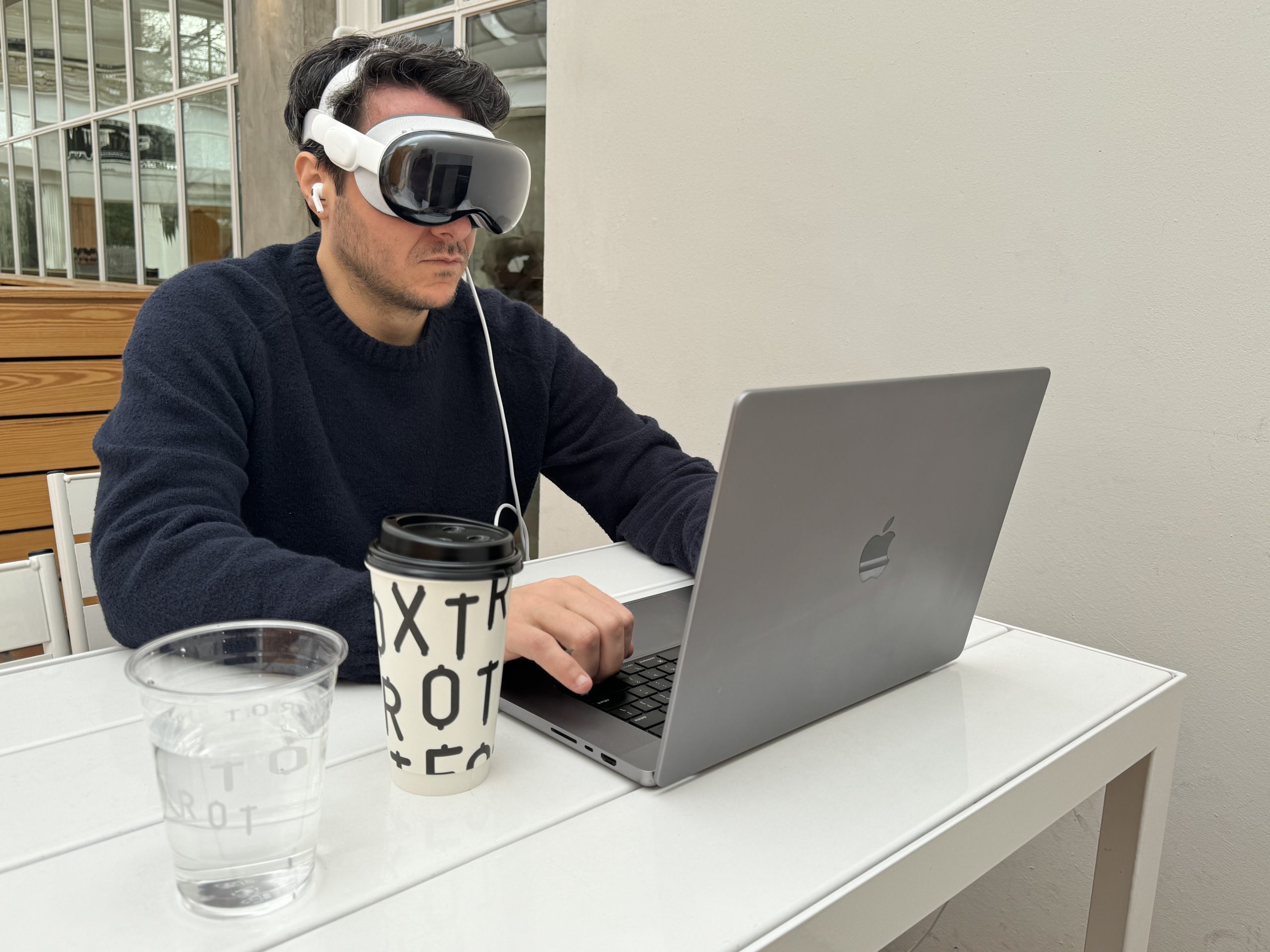
I’m writing this on a 30-foot screen on top of a 10,000-foot mountain in Hawaii, at a table in an Austin coffee shop where I’m pretty sure other people are taking photos of me to send to their friends so they can all call me a piece of shit. In the last week, life has gotten weird.

My journey to the Haleakalā shield volcano Austin coffee shop began more than 30 years ago, in 1990, when my parents brought me to something called a “virtual reality exhibit” at the Seaport World Trade Center in Boston. I stood on a little circular pedestal, and the guy handed me a plastic gun and put a big headset on me. Suddenly I was in some cartoon world, in a military uniform, holding a real gun. The person on the pedestal next to me was there, also a cartoon, also holding a gun. After some janky waving and shooting, they kicked me out for the next person in line.

I had recently read The Phantom Tollbooth, where a kid in the real world crosses a magic threshold and enters a cartoon world. This felt like that. I wanted more.

Then VR disappeared for 25 years. Throughout the ‘90s and 2000s, “virtual reality” was a forgotten dream—a cool concept that never made it. But in the mid-2010s, VR made an unexpected comeback. 20-year-old Palmer Luckey’s duct-taped headset prototype had impressed enough investors for Oculus to become a real company. In 2014, Facebook bought Oculus. Google and Sony got involved. It was all finally happening.

In 2016, I decided to write about the VR revolution. I went around Silicon Valley, interviewing people at Google and Facebook to get the full scoop on VR. I even sat down with Mark Zuckerberg.

I demoed everything. It was mind-blowing. VR was about to take over the world. And I was gonna be the one to tell everyone.

Then two things happened:

  1. VR didn’t take over the world.
  2. I didn’t write a VR post because I fell into a six-year book hole instead.

From the bottom of my book hole, I kept following the story. At Facebook’s 2016 developer conference, Zuckerberg had demoed a new bleeding-edge kind of “standalone, inside out” headset. Up until then, there were two ways to do VR: The first was with a cheap headset, maybe using your phone as a screen, that could do primitive head-movement tracking but had no way to see the environment around you. The second was with external sensors on the walls and a headset that attached to a high-powered PC with a cord. “Standalone” meant the new headset would have the computer inside, with no need for a cable. “Inside out” meant the headset could see the room around you, so you didn’t need external sensors. In 2016, this was just a prototype. Three years later, Facebook launched Oculus Quest.

In 2020, standing around during Covid with my dick in my hand like everyone else, I got myself a Quest 2. It was amazing. I loved it. It was my daily post-writing reward activity. I made 3D art. I swam with whales. I went on cartoon vacations. I exercised by slashing music. I beat Trover.

Then, for some reason, I stopped. I can’t really explain why. I really loved being in the Quest 2. I recently dusted it off to give friends a demo and they were floored, reminding me how great it is. It just didn’t hook me. Maybe it was the solo aspect. I don’t have friends who do VR so there’s no one else to play with. Maybe it’s the friction. It’s minor, but charging the headset, putting it on, and creating a boundaryWhen you use the Quest 2 in a new setting, you have to manually show the headset the boundaries of the open space you’re going to be using. This isn’t needed in the more recent Quest 3, which automatically maps out the space. is still a lot more friction than picking up my phone. Maybe my delight relied more on novelty than I realized.

It’s not just me. VR blows everyone away when they try it, but it seems to have a hard time hooking people for the long run. After a major wave of hype in the mid-2010s, VR receded into the land of subcultures.

And the question is: Is there some fatal flaw to the concept of VR that will always prevent it from achieving mass adoption? Or are we some tipping point away from VR exploding into the stratosphere like the computer and smartphone?

Enter Apple

Everyone remembers where they were when they learned that JFK was shot, a man had landed on the moon, or airplanes had flown into the Twin Towers. I remember where I was when I saw Steve Jobs unveil the first iPhone.

I didn’t always like Apple. My family’s first computer was an Apple 2GS. But then, like many early Apple computer users, I became a PC person. I used an IBM ThinkPad in college and thought Apple people were annoying.

Then Steve Jobs came back to Apple and started Making Apple Great Again. My post-college music composing path forced me to get a 2004 PowerBook G4. After getting used to the interface (why the fuck is there no start button?), I realized that Macs were amazing, and I’ve been an annoying Apple person ever since. But it wasn’t until 2007 that I became a fanboy.

In the presentation, when Jobs did the world’s first “swipe to unlock,” the audience made an audible gasp. A minute later, he brought up a list of artists in the phone’s “iPod” app and asked, “Well, how do I scroll through my list of artists? I just take my finger and scroll.” Another audible gasp. It’s weird that something so normal today was jaw-dropping 17 years ago.

The feeling I had watching that presentation had happened before. I felt it when I was five years old and tried Nintendo for the first time at a friend’s house (I can make something on the TV move by clicking this button??). I felt it in the early ‘90s when my friend showed me how to send an email (You can type something on your computer, hit a button, and it shows up on mine??). I felt it the first time I test-drove a Tesla (Why is this car accelerating so futuristically?).

I’ve learned to see a lot of meaning in these holy shit moments. In most cases, they’ve been followed by an entirely new industry sweeping the world—like the smartphone, video game, internet, and electric car revolutions.

In June 2023, Apple announced the VR—sorry, spatial computingheadset that had been long rumored: the Vision Pro.

I watched the presentation, but it wasn’t quite like my experience in 2007. First, I had gotten excited about VR multiple times in the past and ended up disappointed. Second, unlike demoing an iPhone, watching a VR demo on a 2D screen just doesn’t show you what it’s actually like. Oh, also, it was $3,500. I happily shelled out $600 for the first iPhone. But $3,500? For a V1 product that will get way better (and cheaper) in the next few years? When I already have a Meta Quest? Nah. I might be a fanboy but I’m not a chump. It was the obvious grown-up decision to wait it out. Then I ordered one in the first minute after preorders started.

This Monday morning, I went to the Apple Store to put the Vision Pro on my chump face for the first time. The staff member guided me through a demo. And there it was: the holy shit moment.

But it was a holy shit moment with an asterisk. I had experienced full holy shit moments both in 1990 and in 2016 with VR, and these were the notable exceptions to the “holy shit moments are a surefire omen of an industry about to blow up” rule. Was this time different or would history repeat itself?

What I did know was that it was finally time to write a VR post. I wanted to post this week while everyone was hyped up about the Vision Pro. But I didn’t want to write about it before I had used it a lot, so I could experience not only the honeymoon phase but also what it was like to get thoroughly sick of it.

The plan was clear. I went home, told my wife that I would be deeply ignoring her and our baby for the week, and spent twelve hours a day in the headset for four straight days. I’m writing this on Thursday afternoon, having already logged over forty hours. Here are my thoughts.

Vision Pro, V1

There are three elements of any VR system: hardware, operating system, and applications. Let’s talk about each.

Hardware
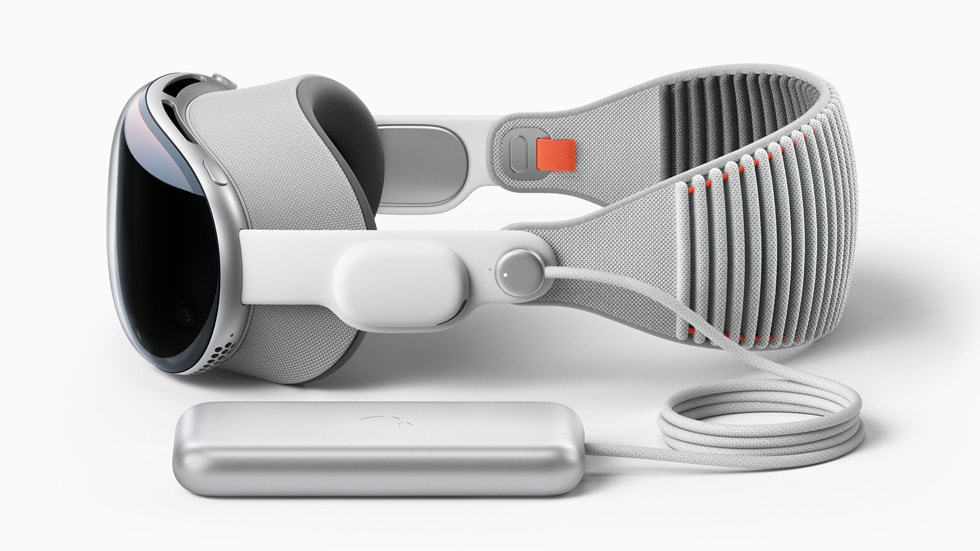
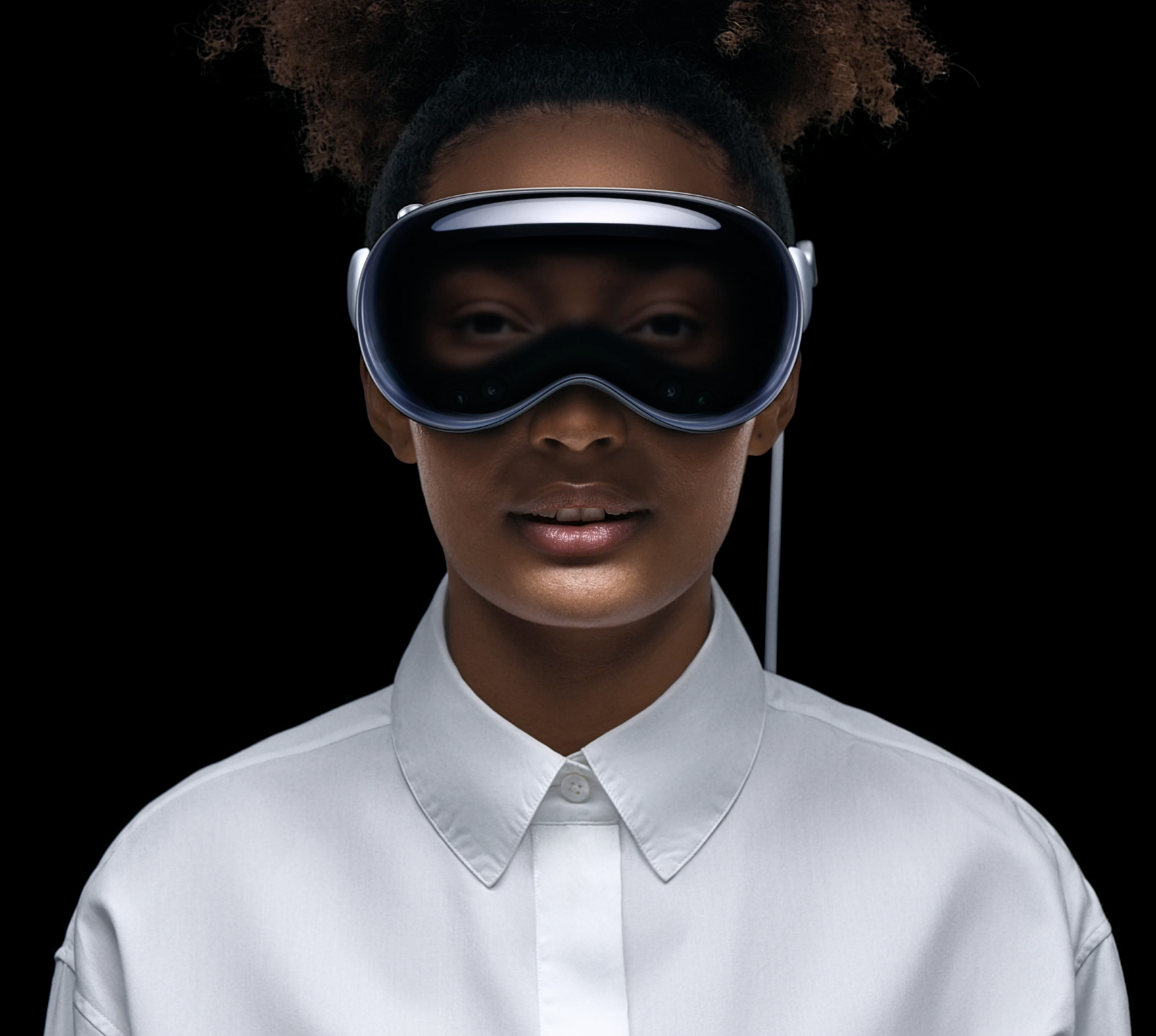
Apple Vision Pro (AVP)Image source: Apple is heavy—a decent amount heavier (650 grams) than Meta’s Quest 3 (515 grams). It comes with a fancy band that goes on easily and you tighten with a little knob. It’s awesome. For 12 minutes. Then it started killing my face. With 3,500 regrets, I switched to the other band it comes with, which includes a loop that goes over the top of your head, and thank god for that because it was way better—so good that I am shocked to say that even at the end of a full day wearing it, I didn’t feel a euphoric “ahhh” relief taking it off. At least right now, it seems only a little more uncomfortable than wearing over-ear headphones for long periods of time. This might not apply to everyone, but I have not felt nauseous once while wearing it.

That doesn’t mean there’s nothing that sucks about wearing it. The “field of view” isn’t great, meaning there are thick black walls where your peripheral vision is supposed to be, which is a bummer. I can’t imagine it’s great for your eyes. And there’s no way around the fact that you feel like an asshole when other people are in the room.

There’s an external battery pack that connects to the headset with a cord and typically lives in my pocket. The battery lasts about three hours, but you can plug in the battery to make it last forever, like a computer if the battery only lasted for three hours. (You’re often using it in conjunction with your computer, which makes it a non-issue because you can plug the battery into the computer.)

When you put the headset on, it does the AVP version of Face ID: scanning your irises. This is seamless and very futuristic. Then, you see exactly what you saw before putting the headset on. Lots of reviewers have marveled over AVP’s “pass-through” capabilities, and the second I put it on, I understood why. While it’s not perfect, it’s almost like you’re wearing a transparent snorkeling mask. The headset is in fact opaque—cameras on the outside transmit the world onto screens on the inside. But the screens are so good and the latency so low that it really seems transparent. Then there’s the much less successful attempt to make it look transparent from the outside as well, using cameras on the inside to broadcast your eyes onto the front of the headset. The goal is that if you’re talking to someone while wearing the headset, it feels to both people like you’re wearing a transparent snorkeling mask. But at least in V1, the eyes don’t show up nearly as well as advertised.

The internal screens save energy by doing something clever called “foveated rendering”—i.e. only putting the exact place you’re looking in perfect focus while making the rest of the view lower-res. This is what your actual eyes do, which is why your peripheral vision is blurry. If you watch this viewcast I made, you’ll see that most of it is blurry (the sharp part was where I happened to be looking while taking it)—but as the person in the headset, I only ever saw perfect sharpness.

The way Vision Pro does audio is also cool. There have always been two sound options for me while on my phone or computer: play from the speaker and everyone can hear it or put on headphones and no one can hear it. AVP speakers are somewhere in between. The speakers (which sound great) are small and right above your ears, and while people right next to you can hear what you’re hearing, people in the next room cannot. So in a coffee shop or on an airplane, you still need headphones, but I do a lot of my work in an office in our house with the door open, and it’s been nice to work both without headphones and without bothering anyone in the other room.

Operating System

This was the biggest holy shit of my holy shit moment. Apple is the king of simple intuitive interfaces. Part of what drew those gasps in 2007 was how natural the iPhone’s interface was. You scrolled down by pushing the page up, just like you would in real life. You zoomed by pinching with two fingers. It seemed like magic. AVP’s interface is gaspworthy for the same reason. The main gesture is what I’ve been calling the “eye pinch.”

When you press the button at the top of the headset, your apps come up, floating in the room in front of you, looking as real as any other object in the room. They’re fixed in space. You can walk right up to them, and the detail is amazing.Image source: Apple
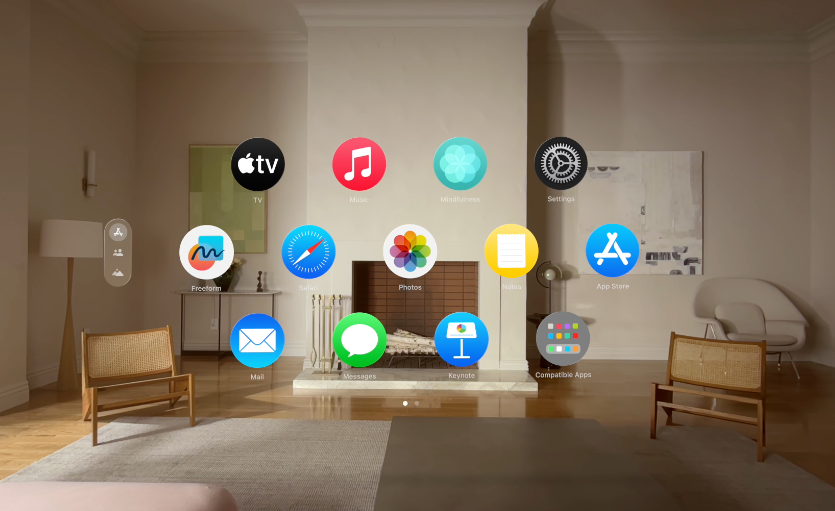
Vision Pro’s eye tracking is outrageously good. It knows precisely where you’re looking. So all you do to select an app is look at it and tap your thumb and index finger together. Your hand doesn’t need to move up to do this, just somewhere the headset can see it. Watching the ads, it seemed like this might be annoying to do, but it’s every bit as easy and intuitive as opening an app on a smartphone.

No matter what you’re doing, the eye pinch is the equivalent of touching a finger to a smartphone screen. To scroll, look anywhere in the window, pinch, and move your hand up. To move a window, look at the little bar below the window, pinch, and move it where you want to. To resize the window, look at the window’s corner, pinch, and resize.

As John Gruber put it in his review:

The fundamental interaction model in VisionOS feels like it will be copied by all future VR/AR headsets, in the same way that all desktop computers work like the Mac, and all phones and tablets now work like the iPhone. And when that happens, some will argue that of course they all work that way, because how else could they work? But personal computers didn’t have point-and-click GUIs before the Mac, and phones didn’t have “it’s all just a big touchscreen” interfaces before the iPhone. No other headset today has a “just look at a target, and tap your finger and thumb” interface today. I suspect in a few years they all will.

Then there’s the fact that everything you see in front of you is available desktop to work with. On my computer, I’m used to my applications being stacked, and I toggle between them. Or maybe I put a few vertical windows side by side. In AVP, I can put one eight-foot window in front of me, two more on either side of it, and a couple more above them in the sky. Then, if I get up to go to the other room, the windows all stay exactly where they are, waiting for me to come back. If I want to switch work spots, I just hold the headset button and the whole configuration jumps to the new location. This is all way cooler than I’m making it sound, so I made a video to show you how it works:

One thing you’ll notice in the video is that I routinely spin the digital crown on the headset to slide between being entirely in reality, partially in reality, and entirely in a virtual landscape. This is ridiculously fun to do. And it’s a general reminder that AR and VR“Virtual Reality” has traditionally referred to totally immersive headset experiences. “Augmented Reality” is when you see the real world around you with virtual elements added in. being separate categories is a thing of the past. In the Vision Pro, the Quest 3, and any future headset, you can be 100% in the real world (when there’s nothing on the screen and it seems like you’re wearing a snorkeling mask), you can be mostly in the real world except there’s a virtual game board on your kitchen table or a little virtual butterfly fluttering around. You can be halfway between reality and virtual when, say, portals open up in the walls around you during a game. Or you can go full virtual.

Apps

There are many categories of spatial computing apps—productivity, entertainment, social, gaming, creative, fitness—and for most of them today, you’ll need a Meta Quest or some other non-Apple headset. There are a small handful of astounding apps for AVP, but they’re more a sampling of what’s possible than an actual app store.

The most “you can absolutely not do this anywhere but a VR headset” thing I did was their little taster menu of immersive entertainment. Entertainment on a headset runs on a spectrum of immersion. The least immersive is watching a normal movie on a massive screen in a virtual space like the moon or a giant theater. Those movies you missed that everyone says are best seen on the big screen—you can see those on a big screen now.

Next are movies that are framed in a normal rectangle, but they’re 3D looking—like when we used to wear those stupid paper glasses but much, much better. Sometimes, these surprise you when something comes out of the screen to fly through the air or stand on the floor between you and the screen. The AVR comes with one of these—“Encounter Dinosaurs”—and it’s delightful.

Finally, there’s full immersion, where the scene entirely surrounds you and you actually feel like you’re there. These are better described as “experiences” than “entertainment.” I saw rhinos up close in person last year. Then, this week, I did one of the Vision Pro experiences that’s an up-close hang with rhinos. These two experiences were very similar. Another experience lets you sit in on an Alicia Keys rehearsal where she sings some songs standing two feet away from you. You can watch her for a while, then look over at what the drummer or keyboardist is doing for a while—just like you would if you were actually there.

Photos and videos are also cool. When you take a panoramic photo, you sweep your phone around in a C-shaped arc—but on a flat phone screen, the result is a flat photo. In AVP, panos are C-shaped, like the photo you actually took. The C wraps around you, which I quickly learned brings the memory back way better than the flat version. You can also turn the headset into a camera and record photos and videos, both of which are immersive. When you later view them in the headset, they’re 3D, putting you right back into the actual scene.

Then there’s the infamous Vision Pro avatars. You get one of these by flipping the headset around and letting it take pictures of you from different angles. Then when you FaceTime someone, your avatar mimics whatever facial expressions you’re making. Here’s mine:

The first person I tested it out on was my wife, who immediately gasped in horror, saying I had “little uncanny valley snake eyes rolling around in my skull,” whatever the fuck that means.

The uncanny valley she’s upset about is this:Image source
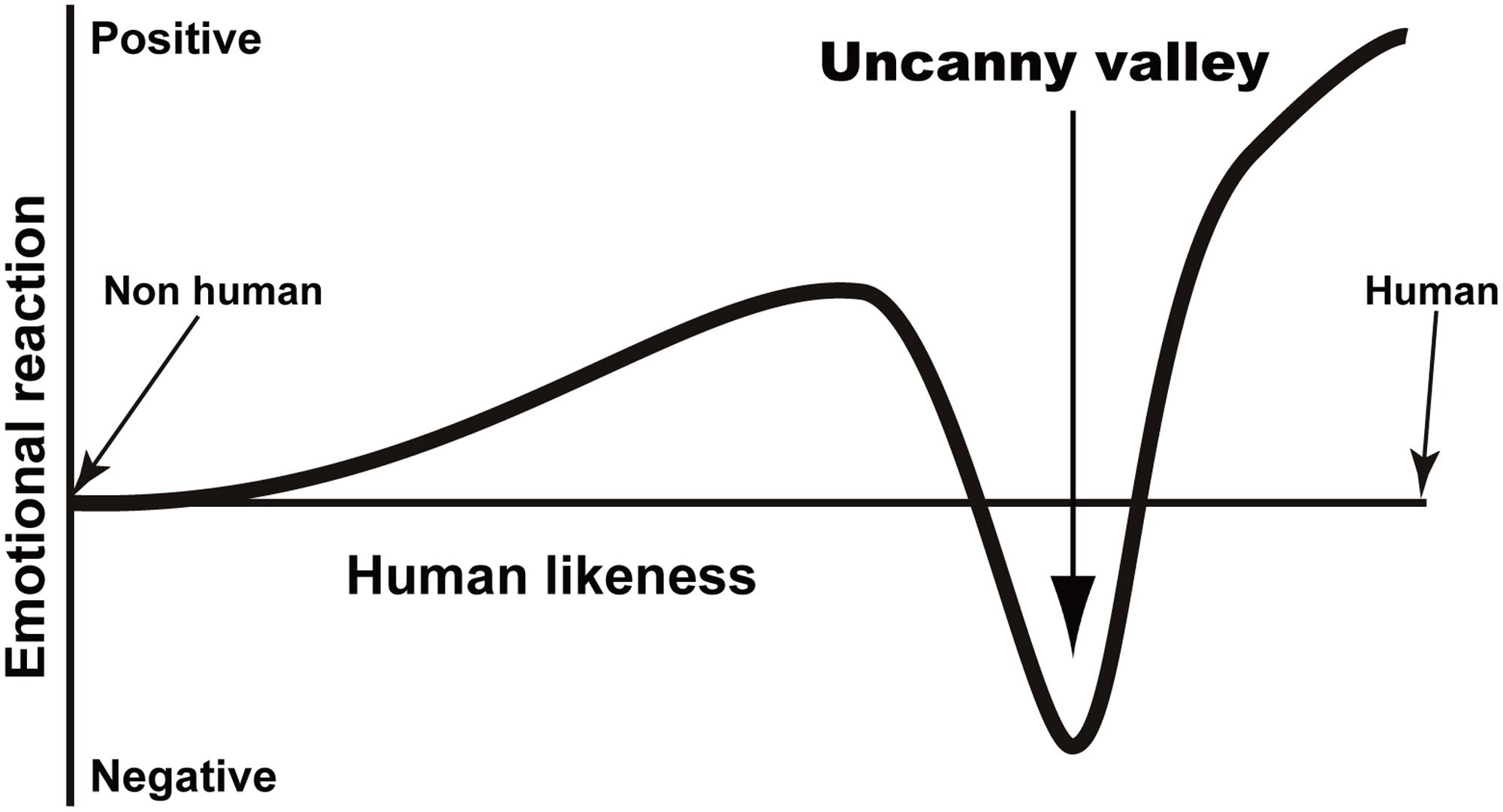
The idea is that we like faces that are somewhat humanlike, and we like faces that are totally humanlike, but we hate faces that are almost-but-not-totally humanlike. Faces that fall just short of being human give us the collective willies.

Avatars used to suck. Then they got better. Now they’ve gotten so good they’ve plunged into the uncanny valley. This was always gonna happen at some point on the road to perfect avatars and that time is now.

To test it out for myself, I FaceTimed my friend Jules Terpak, who also has a Vision Pro. First I put her across from me at this table while we sat around with each other’s uncanny valley faces for a few minutes.

One very cool thing is that when I moved her window to a different seat at the table, her voice shifted locations to that spot. We concluded that this activity was not actually an upgrade over FaceTime, but that if there were more than two people, it could feel like everyone was sitting around a table together, which would be better than talking to a group FaceTime or Zoom.

Then we shifted locations to Mount Hood.
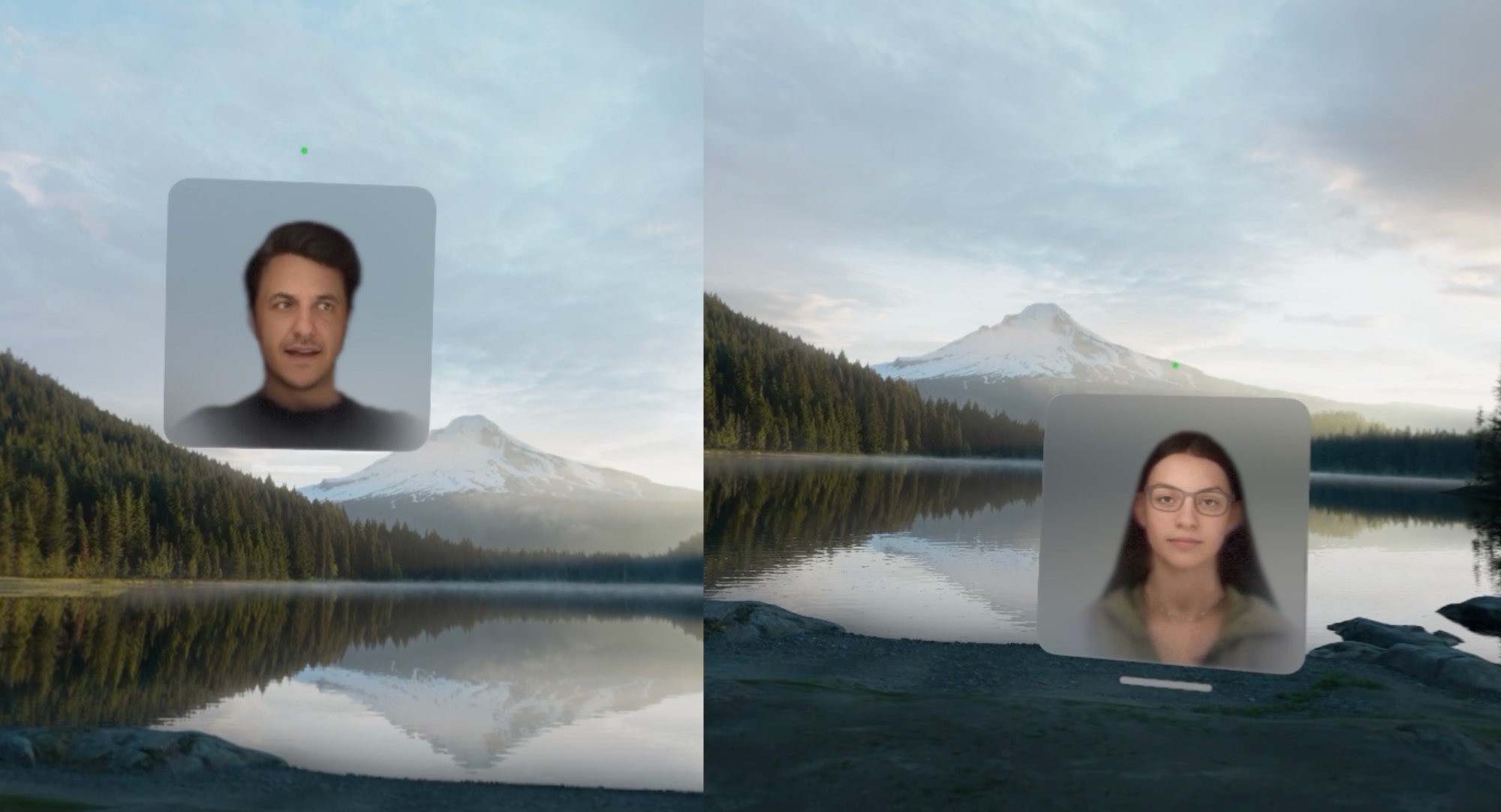
This felt more like we were actually hanging out somewhere, which is an effect you can’t get on FaceTime.

When we started going into apps together, it felt even more like we were actually doing an activity together, in a way you normally can’t do without being in person.
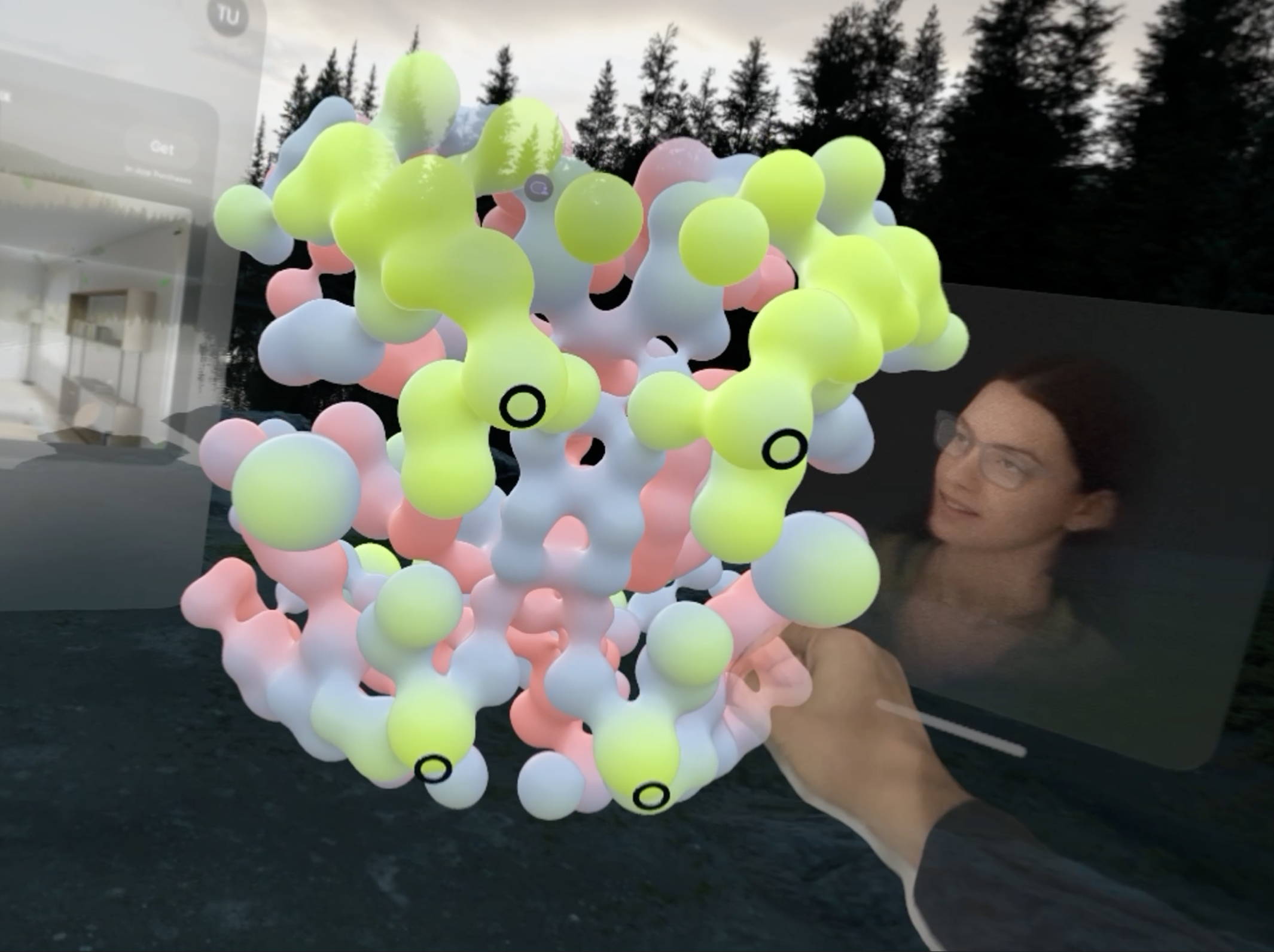
It’s very crude right now, but it’s a primitive version of something we’ll probably all be doing constantly in the 2030s. It’s the next step in a centuries-long human mission to conquer long-distance. First there were letters, then phone calls, then mobile phonesWe’re so used to mobile phones that we forget how insanely cool they are. I can pick up my rectangle and instantly contact you wherever you are on the planet. and video calls. The next step is VR hangouts.

By far the thing I spent the most time doing in the Vision Pro was exactly what I normally do, but the AVP version. When you’re sitting down in front of your computer while wearing the headset, you can open your computer screen as a giant virtual window (which you still control with your normal keyboard and trackpad). Whatever screen you’re used to working on is now much, much bigger. It’s also much more mobile. I don’t usually work on the couch because I prefer my big monitor over my laptop screen. This week, I spent a lot of time working on my couch on a 100-inch monitor. I don’t normally work lying flat in bed because the laptop screen isn’t directly above me. This week I did, putting the screen up on the ceiling. I did some work outside on the porch and some more under a tree. Sometimes I saw the room around me, only with a big screen floating in it. Other times, I went fully immersive, writing on a mountain top, a sand dune, or the moon. And as I mentioned at the beginning of the post, I’m currently using the AVP in a coffee shop, which is officially embarrassing.

For some odd reason, you can’t open multiple desktops (yet), but you can open some of the things on your desktop as their own apps in separate windows. There’s an AVP iMessage app, so I closed iMessage on my desktop and opened it in an adjacent window. I often remotely cowork with Alicia (WBW’s Manager of Lots of Things), putting her in a little window in the corner of my screen. Now, she’s in her own window. If I’m willing to bite the bullet and switch from Chrome to Safari, I can pull my research and web browsing off the desktop too. The end result is that a single small, immobile computer screen has been replaced with a giant mosaic of screens, for the small price of having a snorkeling mask on my face all day. It kind of feels like you stepped into your computer screen, into the beautiful wallpaper landscape, amongst the windows. Very surreal. I wrote this entire post in the headset and have found myself enjoying writing more—and being more focused—than normal.

My overall feelings

The best way I can describe how I feel about the Vision Pro is a strange combination of utterly thunderstruck and mildly underwhelmed.

The magical interface, the giant screens, the immersive experiences—they’re just unfathomably cool and awe-inspiring. It feels like a sneak peek at the 2030s.

But after a couple of days, I found myself thinking, “Is that…it?” I had done the small handful of immersive experiences, played some of the small selection of games, looked at a bunch of my panoramic photos, and tried avatar FaceTime—and at the moment, there’s just not that much else to do in the Vision Pro.

The first iPhone left me feeling the same combination of blown away and bored. The phone and I had a torrid honeymoon, but after the novelty of the interface wore off, all it had to offer was the same 16 practical apps.

There was no app store yet, it dropped calls constantly, and the cellular internet (which you couldn’t use while on a call) was painfully slow. The iPhone wasn’t a world-changing device yet. It was the seed from which a world-changing device would grow.

If you zoom out on a story of technology, you usually see a big exponential curve.
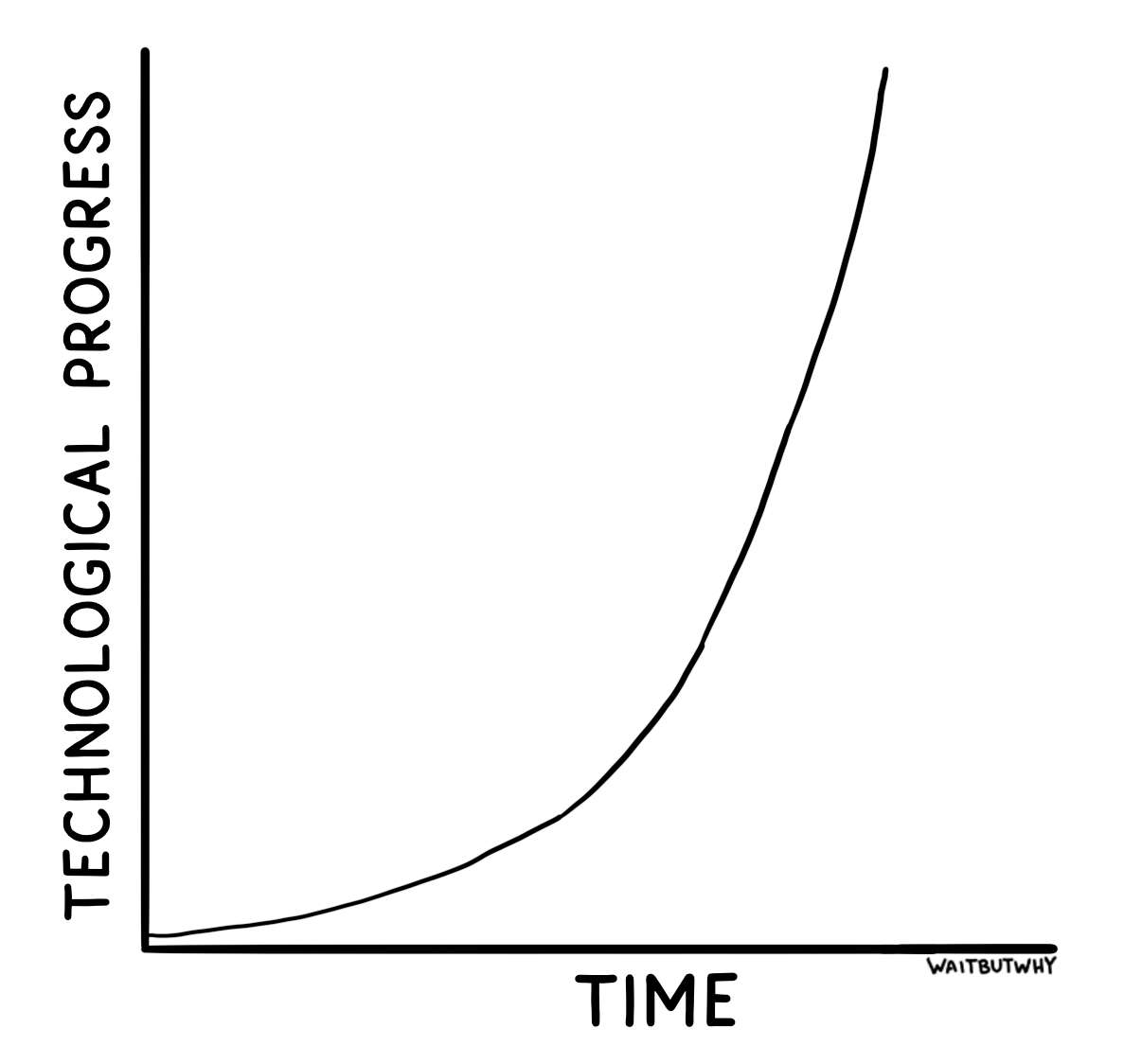
But if you look at the curve up close, you see that it’s wavy, made of S-curves.
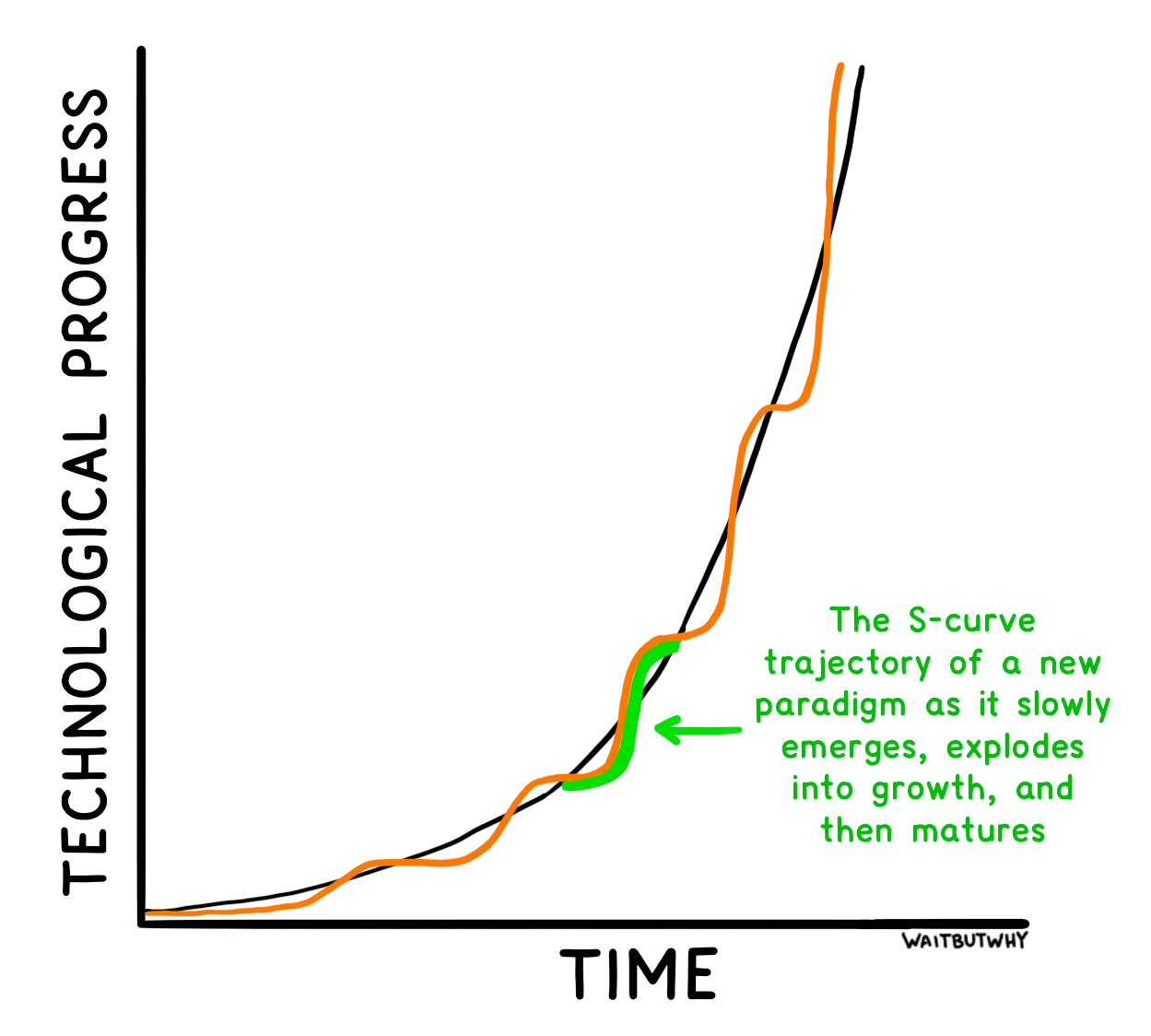
The first iPhone was such a big deal because it launched a new S. Investors had a new place to pour their money. Developers had a new place to pour their efforts. Creators had a new place to pour their talents. As millions of human hours worked on the collective human project, the next five years were a whirlwind of innovation and excitement. Apple’s keynotes became a must-watch for anyone interested in tech, as each jump between the iPhone 1 > 3G > 3GS > 4 > 4S > 5 was a major leap in hardware and software. It was the steep part of the S.

Then, the keynotes got boring. The changes were incremental. Apple stopped innovating and started refining. This coincided with Tim Cook taking over, but it isn’t his fault. The steep part of the S-curve doesn’t go on forever, and companies often reap the biggest rewards in the boring, top part of the S once the industry matures.

Maybe the reason VR has been slow to take off isn’t because there’s something fundamentally wrong with VR. Maybe it’s because, for the last decade, we’ve been working our way through the very early part of the VR S-curve—the slow part where foundational technology is researched and built. My Vision Pro is highly imperfect—overpriced, heavy, slightly glitchy, very limited, creepy-avatared—because that’s exactly what products are like at the bottom of the S. Consumer products aren’t ready for mass adoption during this stage. But it’s the breakthroughs made during these years that set the stage for the explosive exponential phase of the curve.

The lesson from past VR hype cycles is to temper expectations. The VR S-Curve explosion may be many years away or never come at all. But the lesson from past Apple launches is don’t bet against Apple, and Apple’s bet is that the Vision Pro could be a seed like the first iPhone—a platform for innovation that kicks a new S-curve into high gear.If this is what happens, unboxed first-generation Vision Pros will be auctioned for a ton of money in 2060. Just saying…

Vision Pro, V2 – V10

For someone to regularly use a piece of technology, the benefits have to outweigh the costs. Right now, the Vision Pro benefits are probably less than the costs.

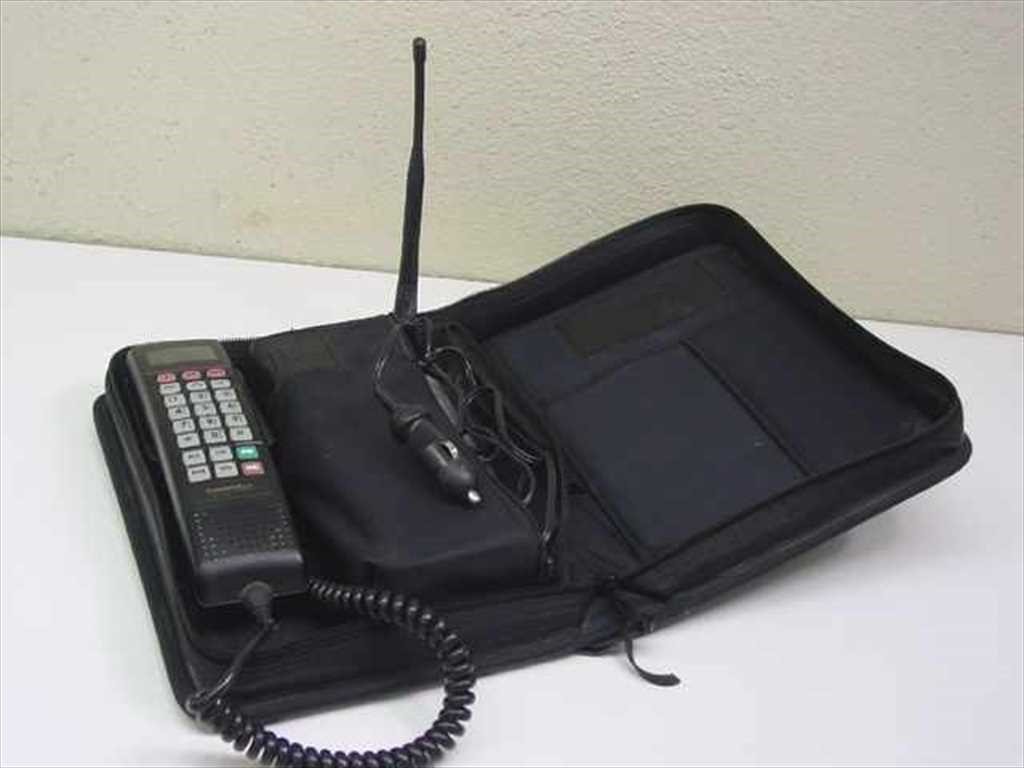
I’ve already paid for mine, which removes one of the costs, and it’s still a question to what extent I’ll choose it over my computer in the long run. In that regard, the AVP might currently be more like those first cell phones you had to carry around with a briefcase than the first iPhone. Would you get a cell phone if the only way they came was attached a briefcase? Maybe, but it’s a close call.

For VR to achieve mass adoption, the good needs to be better and the bad needs to be less bad. It’s easy to imagine a pathway to both.

The operating system will get better each year. The two-finger pinch is currently the only gesture. More will be added. Eventually, there may be dozens of ways to make gestures with our fingers, each one a different command, like today’s keyboard shortcuts. When you spend ten minutes setting up an elaborate configuration of windows, you’ll be able to save (and share) it.

Avatars will go from uncanny valley to indistinguishable from your normal face. When you go into immersive environments, you can currently see only your hands. In the future, you’ll be able to identify other objects to remain visible (like a coffee mug). The environments around you will expand from the six current options to hundreds, including delightful fantasy worlds, and they’ll be interactive, allowing you to change things like the weather.

The hardware will get continually smaller and more comfortable. The resolution and frame rate will become as advanced as the latency. The battery will get way better. So will the look from the outside: to people in the room, the headset will come to look totally transparent. (My personal fantasy: The computer itself becomes detachable, allowing the headset to be a light, sleek, cool-looking visor. The computer and battery snap together into something the size of a smartphone. You’ll be able to snap it to the back of your visor if you don’t want the cord, but most people will prefer the weight to be somewhere other than their heads. The computer/battery rectangle will also have a screen and function as a smartphone for times when you want to do something with the visor off. The visor will fold neatly onto the rectangle to make the whole thing a single compact object.)

Finally, the amount of content, applications, and experiences will multiply by 1,000-fold, just like the apps in the app store did from 2008 to today. There will be a wide array of immersive games and entertainment. People will watch sports from one of many vantage points on the field, sideline, stands, or overhead—next to their friends, who will be able to look at each other and talk as well as if they were actually together in person. Pop stars will play in front of 50,000 people in person and 5 million people virtually. Fitness will become fun, interactive, and social. The best teachers and coaches will reach millions of people. Amazing AI teachers could reach billions. Distance will melt away, allowing people to spend high-quality time with their loved ones, no matter where they are. People who couldn’t dream of traveling the world today will get to enjoy vivid experiences anywhere on the globe. Of course, my silly 2024 imagination can’t scratch the surface any more than people in the briefcase phone days could have predicted Uber, TikTok, or Tinder.

Over time, the price will come down, with some companies making headsets dirt cheap the way they have for smartphones today. As the value proposition gets better and better, more people will have them, enhancing the social component and eradicating any stigma. Mass adoption seems like a very real future possibility.

I know what many of you are thinking: A world where everyone is in VR headsets (or visors, or glasses, or contact lenses) sounds dystopian and awful. And granted, this is coming from a guy who thought that world of glazed over people in moving chairs in Wall-E looked like a great place to live—but I’m excited.

K can I take this thing off my face now?

_______

What to read next:

A post about a technology even more intense than VR

A post about a different technology that’s also even more intense than VR

A post about a third technology that’s even more intense than VR

_______

If you like Wait But Why, sign up for our email list and we’ll send you new posts when they come out.

To support Wait But Why, visit our Patreon page.

Read this next

100 comments

Leave a Reply

  1. Srinivas Peddi Avatar
    Srinivas Peddi
    Hide

    i am big fanboy as well but costs at this point of time keeping me away and we know in next couple years the costs will significantly go down with much more value for the money including and not limiting to apps, more immersive experience, able to connect with your kith and kin to have joint experience ….sooner or later definitely getting this but right now it looks an heavy thing to put on your face for long time ….only if it can be lighter and smaller

  2. juhi.saxena Avatar
    juhi.saxena
    Hide

    Test Reply

    1. juhi.saxena Avatar
      juhi.saxena
      Hide

      Test Reply 2 to reply

    2. juhi.saxena Avatar
      juhi.saxena
      Hide

      Test Reply to reply

      1. juhi.saxena Avatar
        juhi.saxena
        Hide

        Test Reply 1 to reply 2

        1. juhi.saxena Avatar
          juhi.saxena
          Hide

          Test Reply 1 to Reply 3

  3. juhi.saxena Avatar
    juhi.saxena
    Hide

    https://www.godaddy.com/en-in/homepages/india/b?isc=inflash258

    1. juhi.saxena Avatar
      juhi.saxena
      Hide

      https://www.businessworld.in/

  4. juhi.saxena Avatar
    juhi.saxena
    Hide

    https://www.businessworld.in/

  5. NudgeTesting Avatar
    NudgeTesting
    Hide

    I’m testing comments. I am a hippopotamus.

  6. Murad Arif Avatar
    Murad Arif
    Hide

    It is amazing that you write this review step by step explaining everything about this time until AVP was announced by Apple. AVP as you mentioned is an imperfect, overpriced, uncomfortable to wear in casual day time. Hovewer I never thought before that in can be better gradually by time like old iphone journey. I loved the idea of improvement of features and reducment in price.
    Even though I have not had the opportunity to try mine myself I am sure it is a great first experience for VR lovers and tech love people. Thanks for the blog!
    https://media1.giphy.com/media/ZU9QbQtuI4Xcc/giphy-downsized-small.mp4

    1. juhi.saxena Avatar
      juhi.saxena
      Hide

      Test Reply New

  7. wscaddie56 Avatar
    wscaddie56
    Hide

    First, thanks for all the cool, insightful content over the years. You think about things in an interesting way.
    Second, haven't been here in a long while since Tim became a fan boy of a racist, sexist, fail upwards simp. Elon would be your crazy uncle if he started out middle class.
    Last, now I come back and he's an apple fan boy trying sell me a VR headset.

    Have a great life

    Rick

    1. juhi.saxena Avatar
      juhi.saxena
      Hide

      Test Reply New 2

      1. juhi.saxena Avatar
        juhi.saxena
        Hide

        Test Nested Reply 2

  8. Bennie Gottlieb Avatar

    The person is in isolation treatment at a hospital

    1. juhi.saxena Avatar
      juhi.saxena
      Hide

      Test Nested Reply 3

  9. Schnitzle Avatar
    Schnitzle
    Hide

    I'd love to see more of these quick format posts as they get the point across and are more easily digestible before my brain gets distracted onto something else (which still happened for about 5 months as I got hyped to read this post, got a few paragraphs into it, probably got some work message, and left it pinned in my google tabs for 5 months while occasionally opening it and seeing lots of words and being like "ok lot's of words and brain needs to be fully on, I will come back to this later").

    Anywho, have you used the headset since? I'd love to hear any feedback on longterm or continued use. I was using the first Oculus rift for about a week with virtual screens but it was really clunky and I had to keep taking the headset off to do things like accept windows security popup which was frustrating along with any latency or freezing causing instant nausea.

  10. bleh Avatar
    bleh
    Hide

    did you really book an airbnb for 4 days alone just to use the vision pro?

  11. dsqushin Avatar
    dsqushin
    Hide

    vr – a solution to problems we don't have – what's that called when a new product is forced onto people or when people try to wish a market into existence?

    neurallink on the other hand…💀

  12. Vrijesh_vvk_editor_700k Avatar
    Vrijesh_vvk_editor_700k
    Hide
  13. Elizabeth Langston Avatar
    Elizabeth Langston
    Hide

    My argument is that the VR experience here really isn’t true VR – it’s 360 degree videos. You cannot walk around in or explore in these 360 environments. I like that Apple is refusing to call it a VR device for this reason. I really think it is the first of “spatial computing devices” and I hope we see the “S” curve take off.

  14. ahmet gello Avatar
    ahmet gello
    Hide

    Artifical Intelligence,
    Neuralink,
    and the Metaverse.

    Whatever I look at feels like it’s gonna take over the world

  15. Jan Andrew Bloxham Avatar
    Jan Andrew Bloxham
    Hide

    There will be no amazing VR land in the 2030s, for reasons entirely unrelated to VR.

    Patiently waiting for you to seriously look into the meta-crisis and civilizational collapse. I think you’re ripe for it.

  16. Jam Solo Avatar
    Jam Solo
    Hide

    Tim (I have to call you on first name basis, I can’t imagine you liking to be called “mister” or “sir”), do you think this will make us more happy or more productive? Don’t get me wrong; I loved reading about it and as a tech-person I’m curious to try it for myself. However…as I’m now procrastinating on the internet instead of practicing my guitar, I’m thinking about all this “hollow” time that I have wasted on the internet. Playing with ancient technology like my guitar brings a true joy into my life, but there is also a fair amount of joy in writing this comment. One thing is certain though…we are spending too much of our planets resources on hollow pleasures and we don’t appreciate the simple things.

  17. Sohaib Avatar
    Sohaib
    Hide

    Tim, any issues with motion sickness? I was watching your YouTube here when you put the AVP on and felt sick – wanted to know if you felt something like that…

  18. RadioactiveRaccoon Avatar
    RadioactiveRaccoon
    Hide

    You forget a major propeller of sales:

    Porn.

  19. Cassidy S Avatar
    Hide

    How do you convince people to use it over experiences in the real world (asking for a friend)

  20. Trevor Lohrbeer Avatar

    A lot of the “innovations” mentioned in this article already exist in the Quest 2 to a large degree.

    Pinch to click/grab has been a feature on the Quest 2 for a while (though not with eye tracking, AFAIK). I’ve been watching movies on big screens and entering immersive 360d environments for the past couple years on the Quest 2. And with apps like Immersive, you can do work in the Quest with large monitors.

    Overall, it sounds like the Apple Vision Pro is an incremental improvement over Meta Quest—better resolution, improved eye tracking, slightly improved UX—not some amazing new device.

  21. lewiswalsh Avatar
    lewiswalsh
    Hide

    I’ll be interested to see if the novelty wears off after six months as with the Quest 2.

  22. Davestrodomus Avatar
    Davestrodomus
    Hide

    Hey Tim, great piece as usual. I read it when you first offered it as a Patreon perk…and I have been meaning to come post here since. My comment is not directly connected, but since you have also been writing about brain development…I think it might be at least tangental. You might have to cut me some latitude, but I think it will be worth it.

    Since 1980 I have been doing periodic sessions in isolation tanks. Yes, even before Joe Rogan made them popular. I saw the movie Altered States with William Hurt…and I knew I needed that in my life. I have written plenty about my sessions over the years, but for this post, I want to focus on one particular session when a lot of things opened up for me.

    As I got “better” at training my brain to get to the “proper” state by trying different mental routines in the tank, I eventually got to a point where I might claim to have periodically “cracked the code”. That is to say that sometimes you just lay there, in the dark, in the water, naked…and feel like a goof. But some other times, some pretty cool stuff can happen when you get your mind to a point of “awareness”, but also clear of intrusive thoughts. I can’t always do it…but this day in particular…I did.

    Here is what I wrote about that float that day:

    “This was my best float to date. It was sublime. I didn’t prepare for it in any special way, but the one thing I did do differently was to up my time to 90 minutes. This significantly decreased the pressure I put on myself to efficiently use my time. I’ll talk about that more in the TIPS section. You can get into the zone more easily, with a backdrop of knowing that you have more time. It doesn’t feel like every minute is crucial, so you actually use your time better. Wonder if that is a life lesson unto itself?

    This float got really interesting with a really rapid fire series of images coming at me like a hurricane. Images of all kinds of things, each lasting about a hundreth of a second each. Even thought the images came fast, each one was clear, and that amount of time seemed adequate to absorb the image and it’s meaning. This continued for some time, with colors changing throughout the experience.

    Then, I had something happen to me that I’ve never fully had before: I had an out-of-body experience. It’s not like I was floating above myself, but instead, my thoughts were an entity unto themselves. My thoughts left my body. I was “me”, but just detached. They were very well formed thoughts and energy, but they were no longer connected to what I kept feeling was a “chunk of meat” that was my body. For the first time ever, I felt like my body was an anchor. Until that moment, I thought of my body as the vehicle to move my mind and self around this planet. At that moment, I recognized it as an achor. Having to feed it. Having to clean it. Having it limited to just a thin skin of atmosphere around this one planet. Having to obey the laws of gravity, and space and time…WHAT A WASTE! This new version of me was pure thought energy. Clear and crisp and able to go anywhere, anytime, without any concern for past considerations of time and space. It (I) was free! A freedom like I didn’t know was possible.

    The thought crossed my mind, “What if I’m dead in the tank?” What if this is me leaving the earthly plain? I considered it, and quickly realized that if that were true, it was totally OK with me. This seemed like the destination. This seemed like how our energy had always been designed to be situated. The “meat chunk” seemed like something prehistoric and barbaric. Like a penalty someone who didn’t like you would place on your thoughts and desires. A thought jail of sorts. I didn’t want to go back…but the session ended…and back I indeed went. But this time, my perspective on life itself had changed. I no longer had fear for death, in fact, I’m kind of looking forward to it.”

    – My point: what if the best, most amazing VR is already in us…and we just have to learn how to unlock it?

  23. Louis A. Cook Avatar
    Louis A. Cook
    Hide

    Hey thanks for blowing your dough and learning all this on my behalf. I’ve always been a 3gs man thanks to generous writers like you. But… does it have apple maps or something like that? Using this to better boss me around with gps seems like it could be good enough to be a primary selling point eventually.

  24. Scarlett Dooley Avatar

    Thank you I have just been searching for information approximately this topic for a while and yours is the best I have found out so far However what in regards to the bottom line Are you certain concerning the supply

  25. Aigars Mahinovs Avatar

    One possibly interesting way this could branch off would be “portal spatial computing”. Imagine the same eye and gesture tracking in a regular computer monitor as a way of participating in AR/VR experiences for cheap. Or “on a side”. You are doing something else, you don’t want to be “fully” in the experience, but you still want to watch and occasionally interact with it on the side. So you just start up your VR experience on a nearby TV/monitor. It tracks your position and your glance to provide parallax 3D effects and allow using all the same gestures as inside the headset. Now imagine this in the windshield of a car. Able to project individual pictures to each eye of each person in the car.

  26. FourQ Avatar
    FourQ
    Hide

    When a VR headset comes out that is usable across operating systems at half the price and a substantial reduction in weight, with the capability of fully immersive gameplay for premier titles, not just apps (imagine Horizon:Zero Dawn in VR!), then I might be interested. For now, this looks like a neat novelty for early adopters.

  27. cowhi Avatar
    cowhi
    Hide

    Loved the article. It would have been cool to know how the Vision Pro compares to the Quest 3. The Quest 3 is way ahead in terms of games, huge video screens are possible as well, and from this and other reviews I haven’t found an argument that would justify a $3000 markup. I was hoping the vision pro was more of a standalone computer than a 3D phone to run regular programs on it just as I do on my Mac. That’s mainly keeping me from getting one of the V1 models despite having higher quality materials and better resolution.

  28. Ryan Barsotti Avatar
    Ryan Barsotti
    Hide

    Great stuff! So glad to see a WBW post! Question: do you have an estimated timeline for when your first book will be available in print (paperback/hardcover)? I’m one of those folks who really prefers to hold the physical thing I’m reading.

  29. hyperhyper Avatar
    Hide

    Odd that you don’t mention HTC/Valve’s contributions to the space and or other competitors that pushed the needle forward.

    That aside, this tech, like PCs and phones before it will only take off once games come to it. It was a real miss by Apple to not wait a bit longer and get a few killer apps. That said, it’s a dev kit edition for Apple fans so as long as people understand that, no harm.

    Happy to see some competition enter this space to bring VR to the masses.

  30. Srinivas Peddi Avatar
    Srinivas Peddi
    Hide

    i am big fanboy as well but costs at this point of time keeping me away and we know in next couple years the costs will significantly go down with much more value for the money including and not limiting to apps, more immersive experience, able to connect with your kith and kin to have joint experience ….sooner or later definitely getting this but right now it looks an heavy thing to put on your face for long time ….only if it can be lighter and smaller

  31. crg1960 Avatar
    crg1960
    Hide

    As someone with six 1920×1080 monitors attached to my Windows machine and NOT ENOUGH DESKTOP SPACE (virtual or real), I could love this.

  32. Steve Upstill Avatar
    Steve Upstill
    Hide

    Let’s also not forget how lame the first Macintosh was–this from someone who plunked down 2500 1984 dollars for a 128Kb computer with a black-and-white screen the size of a large postcard. It’s amazing that anyone makes the irrational investment in new technology that it takes before it’s even viable, never mind mature or world-changing.

  33. Volt Avatar
    Volt
    Hide

    I tried AVP last week and you eloquently described my experience- I have had a similar history with VR, playing Dactyl Nightmare in the early 90’s and owning (and eventually tucking away)several headsets over the years. I have the Meta 3, and probably won’t buy the AVP, but will likely get a future, more polished offering.
    Thanks for writing this article and making the video, I’ll be sharing them both this week. Be well.

  34. Sandeep Khomne Avatar
    Sandeep Khomne
    Hide

    Love your articles and love this one. I haven’t yet tried Vision Pro and this definitely helps get up to speed. So thanks!

    My take –

    For productive work, laptops / PC and smartphones are great in current form and I don’t see Vision Pro replacing it in current form. I mean big monitors are great but honestly how many people really *need* it? I for one am still living without it with no regrets.

    I saw the movie in Sphere in Las Vegas last year in Oct when it launched. It was mind-blowing. There is nothing comparable experience to it yet. Except Vision Pro can provide that experience and probably even surpass it. Same with watching games, shows, 3D movies, communication etc.

    I think Vision Pro will become huge but restricted to only these use cases and never cross over to productive stuff. People will only use it at home, sometimes in office, and during long travel. Mostly restricted to few hours a day. You will never find people carrying it with them like smartphones and laptops. The market will be still huge.

  35. DiegoSynth Avatar
    DiegoSynth
    Hide

    There are a few issues with VR. The first one, is the price. It’s too much for a peripheral.

    The second is a conceptual one: it’s not for everyone, but somehow it’s expected to be.
    It was the same with joysticks, scanners, sound cards, etc.

    The third issue is: Technology needs to develop further, so the gap between a “VR game” and a “normal game” disappears. We don’t classify games as “gamepad game” or “keyboard” game. The same needs to happen here. VR headsets need to evolve to the point that developers build a game and add simple instructions for it to support VR (same that they do with gamepad, steering wheel, etc), not build a dedicated VR game, because that’s very focused, and it means loses in sales (that’s what happened to Assassin’s Creed VR game).
    Also the headsets need to become easier to setup and use, with jetter tracking, lighter, etc. But that is normal; it will happen; it’s happenning.

    The most important here is the concept. And that it needs to standardize. Just like gamepads.

    1. David Avatar
      David
      Hide

      Yes we do distinguish between consol and PC games, quiet heavily in fact.

  36. scott walker Avatar
    scott walker
    Hide

    always always ALWAYS enjoy your style- On my way to the Apple store tomorrow to get my order in- THANKS

  37. Bartek Avatar
    Bartek
    Hide

    Hmmm… is there anyone else concerned about it or I am the only caveman here?

    Is something we were looking for since we got out of the caves? Seems logical we were looking for some comfort – of course – but it really doesnt make us better.

    I am not sure if this VR experience just doesn’t look good enough for me yet or because it is so self-deceptioning that it draws me away. Or maybe both?

    Feels like we are on this level yet that we know we are covering our eyes and we do it willingly and consciously. It is not hard to imagine a moment that we go to perfect again because “outside world” is too rough/cold/harsh/etc.; then we do it automatically to the extent we no longer even remember we have a VR on.

    I admit – I am afraid of the content of this post – I dont want to say I am sure why.

    Also feels a little like we, as your readers, are advertised here (in a very cool way I admit but still).

    Maybe it is too much only for me (or minority of humankind)? Maybe I am too old (35yo) for it?

    1. Antonius Avatar
      Antonius
      Hide

      The screenshots are a vision of hell for me. I’ll pass. Screens are immersive enough.

    2. Makuto Avatar
      Makuto
      Hide

      Another caveman here. I have the feeling that while mi heart is brightened up after hiking mountains, embracing friends, seeing landscapes etc in “real reality”, I would get somehow depressed after doing that things in AR or VR.

    3. Jack Crimson Avatar
      Jack Crimson
      Hide

      Yeah, i’m totally creeped out by this… I already hate how smartphones and social networks have reshaped the world… This thing seems really seems functional enough to be the next change that the tech world wants…
      But we are the same age so maybe it’s just senility talking 😆

    4. Matej Mulej Avatar
      Matej Mulej
      Hide

      I’m a 34yo caveman too, if that means I will always prefer an actual hike with friends, and the chilly windy weather, and the sense of accomplishment when reaching the view point. But I can’t help but feel you’re looking at this tech from the wrong, perhaps a cynical, or at least a negative perspective.

      While I would never trade my real experiences for these second rate immersive experiences, I will happily replace my day to day work environment for a seemingly open space in nature, and just hearing voices with talking with reactive avatars, and being hunched and neck-bent over my phone with laying in my comfortable bed watching a big screen with the aurora filled night sky of Iceland behind it, while not being as cold as I was when there.

      The point is to enhance mundane experiences. If you replace your vacation for VR, that’s on you.

    5. jun Avatar
      jun
      Hide

      there will certainly be subsections of the population who will just live in these things, and there will be subsections of the population (hopefully larger) that actually utilize it harmoniously to enhance their “real” life (rather than replace it). And most people will fall somewhere in between. It’s the same deal with internet/social media right now, and I think the human race is just starting to realize the importance of balancing the real word and the internet world in recent years. I predict that it will be a similar story for VR.

  38. Raj Shah Avatar
    Raj Shah
    Hide

    Nice post, but would have loved to see a health angle as well. Are there any long term health consequences to this, and how well researched are they?

  39. Kamran KI Avatar
    Hide

    As cool as the AVP is, I wouldn’t want Apple to be the only player in this landscape because: (1) It is a closed ecosystem and Apple will keep it like this, so it’s a bummer, (2) Apple products work for people in US but for rest of the world, some feautures don’t work, so it’s a bummer again (3) We want a much cheaper and an open standards system (don’t mind if it’s buggy) for the whole world to embrace tech like this as Apple will likely never compete in this lower cost marketspace.

    But most regular people will never put on a headset (yet) on their heads just to work or watch TV. It still looks goofy as hell.

  40. Marco Ferazzani Avatar
    Marco Ferazzani
    Hide

    Ooooooh welcome back! Missed you so much 🥲
    Now i’m curious: what’s lots of things?

  41. Paul Davison Avatar
    Paul Davison
    Hide

    A very well done and a very well Balanced piece. Far better than the typical doom-crying Clickbait pieces that are typically run on VR. I got my Oculus GO in 2018, I got my Oculus Quest (1) in 2019. This past January 2023 I got my Meta Quest 2. I will be getting my Quest 3 later this spring. Since I got my Quest 2 with a BoboVr headband I have used my Quest 2 every single day for over a year now. For some of us – this is the future. Others will need for the prices to really come down and/or the apps to really become essential. If you take a deep look into the history of the Telephone, Radio, Television, etc., you will see that most “essential” technologies do take some time to really get established. Virtual Reality is no different, Early Days my friend – early days.

  42. groberts1980 Avatar
    groberts1980
    Hide

    I really, really like the idea of the iPhone actually being the computer for the headset, and the headset is just a “screen” for what the iPhone is computing. A cable would run from the iPhone to the headset at first, and wireless would come later. I’m an early adopter in terms of technology but I’m going to give this a couple of years and see where Apple takes it. In the long run I 100% see myself owning and using one.

    1. Kalinda Avatar
      Kalinda
      Hide

      Interesting idea! You need low-latency processing to update the graphics in response to eye movement. Current wireless speeds are probably workable, but not optimal. I’m using a wireless mouse and bluetooth keyboard right now and it’s fine. But last I checked, serious gamers still prefer wired keyboards for that sweet sweet reaction time.

      1. groberts1980 Avatar
        groberts1980
        Hide

        Yeah I’m not sure wireless is ready for that yet, maybe one day. Wired would be okay for now considering the AVP is already wired to a battery. Simply make a phone the battery and computer for the headset.

  43. Alison B Lowndes Avatar
    Alison B Lowndes
    Hide

    There’s zero point in “Avatars ..indistinguishable from your normal face”. Either you use a webcam or use an obvious avatar. I prefer the latter now, actually no visual. Remember when people would just call each other? I don’t do that anymore. Message or email is enough. PS great review – v. cool but I don’t own any Apple hw so it’d be $3,500 + all the monitors + iPhone (if/when it comes to UK)……so nahhhh.

  44. Tesla2Go Avatar
    Tesla2Go
    Hide

    Best review I ever read about the Vision Pro. Thanks a lot!!! I love all your articles anyway (and even have the ape and the monster from you behind my workspace 😂👍🏼), but this is really awesome. I would jump on the AVP immediately (like I did with the first iPhone, so I can reeeally relate to your article in so many ways) but I have to wait and be patient because it won’t come to Germany till the end of the year, I guess. The best point for me is exactly what you highlighted: it is a workstation where I can do my work everywhere! I don’t have to invest anymore in an extra room in our house, in a big screen, in an office at a nice place – it’s all covered with the AVP with less costs. 😃🥳💪 So THIS is truly the best for me. So again, thanks a lot for your review! ✌️😊

  45. Steve Avatar
    Steve
    Hide

    Visit the Wait But Why wiki! I created this site dedicated solely to Tim Urban’s amazing work. Help us grow this site! It also has an idea lab for us to discuss this book while we’re waiting for the next official one.

  46. Steve Avatar
    Steve
    Hide

    Great review! I’m so happy Wait But Why’s back. I’m glad that your VR post is finally out.

    Your description of the headset was cool, but not mindblowing until you got to the part about experiencing movies, TV shows, videos, and photos in an all around experience.

    I’ve always wished of something like the Pensieve from Harry Potter, where you could go into memories fully immersively. That way you can spot anything you missed. Looks like the Vision Pro can finally do that. Definitely the highlight for me.

    I’m also a little surprised you guys are actually responding go comments, but it’s always a delight to see more of what you guys write, no matter the form.

    Finally, I would like to request you to do another Idea Lab and/or an AMA. I really loved those and I have so much to say.

  47. ciotog Avatar
    ciotog
    Hide

    I would imagine that the uncanny valley effect would be worse if the avatar you’re interacting with is for someone you know.

  48. Daniel Schaefer Avatar
    Daniel Schaefer
    Hide

    Hands-down the best Vision Pro review so far. You asked the exact same questions I had.

  49. Luis C Avatar
    Luis C
    Hide

    What we need is VRSL (VR Sign Language) that would work across all devices, much like what swiping does today.

  50. Bobby Scaramelli Avatar
    Bobby Scaramelli
    Hide

    I wonder whether a simpler approach would be to use transparent displays (like we saw at CES in January and probably earlier) instead of cameras? I can’t help thinking there are elements to the AVP which would work well standalone – for instance a pair of lightweight glasses (with transparent display) where you could just create your own virtual computer monitors. Physical TV/monitor manufacturers must already be looking at AVP and thinking – oh-oh.

  51. Tom Rivett Avatar
    Tom Rivett
    Hide

    Reading this on an old chrome book with no touch screen that I mostly control with a wireless mouse makes me think I might be a ways off adopting. Nice overview though (as always).

  52. cj sheriff Avatar
    cj sheriff
    Hide

    I appreciate the perspective as it beats buying all the toys and figuring it out myself. However, I want to contend with some of the points. VR does have me ‘hooked’ after a fashion. I use VR for my escape from the Austin Heat without inhaling the germs of other people exercise (Beat Saber is my favourite cardio program today). I have both the Valve Index and the Quest 2 (because it is mobile when I go travel). I had the Elite, but sold it to a friend when I moved to the Index.

    I use VR to extend my social circle, and post Covid it helped me stay in touch with friends and just socialize. I am not an in person social person like I was in my 20s and 30s. Almost all of my friends are geographically distributed, so VR helps us socialize. I also play with my nieces and nephews in VR. I feel saying the socialization is a negative is misconstrued. Then again, I don’t go work in coffee shops or hang out in public as I find it normally disappointing.

    There are absolutely other people to do it with, we just have limited ways to meet NEW people to do it with. I have ideas on how to solve that, but have been procrastinating getting what code I have written out there to help this.

  53. Bruce Avatar
    Bruce
    Hide

    I just keep thinking this is a baby step to ACTUAL spatial computing where the device projects the signal into, or is inside, your brain.
    This is the “well you can take it off” part that everyone will laugh at in 30 years like when we put telephone receivers onto modems.

    1. Jeff Alberda Avatar
      Jeff Alberda
      Hide

      Pretty big leap. This uses all of the same technology that phones, vr etc use. Just does it to a price tag that allows them to maximize everything and put the Apple flair on it. I wish it was and yes I can see where you’re going but its going to take revolutionary technology, like Elons brain implants to make that happen.

      1. Frank Avatar
        Frank
        Hide

        I think the halfway point to that will be ar/vr contact lenses.

        1. Grok Avatar
          Grok
          Hide

          Wearable technology is currently also on the low end of the S, like Tim writes. Except they’re about 2-4 generations behind AR/VR. The closest available thing to mainstream adopted wearable AR/VR technology is the Rayban-Meta Stories, which is mostly based on a glasses frame and not the lenses; the lenses, we still have problems with, because corrective optics lenses for lower-vision folk is interfering with all the foundational technology they’re trying to work on. Currently the most promising one (the Luckey stage, maybe?) is Monocle, which is the thickness and size of, like, 10 quarters. Getting AR/VR into a contact lens is going to be a pain, but I suspect will have to be some kind of enhancement of that personal fantasy Tim talked about.

          I don’t doubt Apple is working on it. It seems well into their “intuitive” wheelhouse, but yes, very early days yet.

  54. Angie Penrose Avatar
    Angie Penrose
    Hide

    Minor point, but when you talked about the computer/battery pack snapping onto the back of the visor, my first thought is that it’d cause a rash of unsnap/dash incidents for users who were out in public. At least with a phone, when you’re using it, your attention is on it. It’s in your hand, or at least at the end of a selfie stick in your hand, and you’re looking at it, your attention is on it. If it’s snapped onto a visor on the back of your head, literally 180 degrees away from your attention and completely out of your range of vision, that’s just begging for a thief to take it away from you.

    I’m sure this is a solveable problem, but whoever develops the visor-snappable computer pack is going to have to think about it, or there’ll be a lot of really unhappy customers for a while.

    1. Frank Avatar
      Frank
      Hide

      I think they would make it a wearable like some kind of a vest under your clothes.

  55. oblio333 Avatar
    oblio333
    Hide

    I am also an apple fanboy and own many versions of all categories of their devices.

    But I am not yet convinced on this one. All other winning devices did not require the consumer to leave their world to use it. when you put this on, you are not in the coffeeshop anymore, not really. this is not true for the phone, laptop, airpods, watch, ipod, etc.

    And block buster categories did something WAAAAY better than without it. What about this device?
    There are certain things, like a zoom call where it is way better. or a movie.

    if this device gets cheap enough that it can be used for those niche things then i see it for those things. but as a device to have out in the world… i dont see it.

    1. David Call Avatar
      David Call
      Hide

      I’ve used it twice, and the thing it does WAYYYYYY better than without it is experiencing things. Right now that’s mostly video-centric. This is the first time you can really “go somewhere” you haven’t been, or used to be. I’ve never given half a crap about the panoramic photos I’ve taken on my iPhone over the years, even in Iceland, but I can now load them up and feel (minus weather and movement) like I’m really standing there again. It is exhilarating.

  56. David Durant Avatar
    David Durant
    Hide

    Great post. First and foremost it reminded me to actually buy the book so thanks for the reminder.

    I’ve been waiting many years for an AR system that can leave windows (eventually 3D artefacts I’m sure) in a fixed place as you leave and re-enter a room. That’s a major game changer.

    It occurs to me that the future of TV is going to be really interesting. Firstly, will you have the opportunity to “step into” a show as a 3D environment (how that will work with a moving camera will be a thing). Secondly, and even more interestingly, how will directors choose to show what is happening in a room where each of the characters might be seeing any number of screens and objects that the other characters can’t? We’re used to TV having a NPoV – will we be able to continue to have that in the future if everyone’s PoV is different?

    The killer app for this though, as you said near the end, is real-time streamed experiences. Five or six years ago the BBC streamed the London new year fireworks in 3D and I was able to “be there” using my Google Cardboard from the comfort on my couch at home. I want to be able to do that for rocket launches, theatre, sports games and 100s of other experience.

    AR / VR *could* definitely be coming but the price-point needs to be low enough to get enough people involved to get the ball rolling. We’ll have to see if this is the iteration that does that or if it’ll be yet another pause while the tech gets lighter / better / cheaper before we try again.

    1. Kalinda Avatar
      Kalinda
      Hide

      Secondly, and even more interestingly, how will directors choose to show
      what is happening in a room where each of the characters might be
      seeing any number of screens and objects that the other characters
      can’t?
      This made me think of the movie Free Guy (2021) which takes place in a video game. The game world switches between how the NPCs see it, vs a player view that adds giant hologram signs to indicate quests, loot, and menu options. Instantly comprehensible and effective.

      It also makes me think of how movies handle phone screens today. Most of the time they don’t even try to show you what’s on the phone, they just have the characters describe it. I think they’re worried any phone UI they come up with will become hilariously dated within 10 years. (Plus, pictures of digital screens look icky without CGI cleanup.) Widespread VR means you can show digital stuff at human scale, right alongside the humans, which has way better storytelling potential.

  57. Dany Pelletier Avatar
    Dany Pelletier
    Hide

    Yes, option to clip out a module for the computer and fans and clip to an external module (e.g. which contains the battery too) would be amazing for how light and small the headset will be then :O

  58. qwyzyx Avatar
    qwyzyx
    Hide

    There will be a wide array of immersive games and entertainment. People
    will watch sports from one of many vantage points on the field,
    sideline, stands, or overhead—next to their friends, who will be able to
    look at each other and talk as well as if they were actually together
    in person. Pop stars will play in front of 50,000 people in person and 5
    million people virtually. Fitness will become fun, interactive, and
    social. The best teachers and coaches will reach millions of people.
    Amazing AI teachers could reach billions. Distance will melt away,
    allowing people to spend high-quality time with their loved ones, no
    matter where they are. People who couldn’t dream of traveling the world
    today will get to enjoy vivid experiences anywhere on the globe.

    I’m nearly certain that all of these things have been said before, about telephones, and television, and computers, and the internet, and smart phones. And while each one fulfilled that promise to some extent, it didn’t stop the next one from generating the same hope all over again.

    Now you’re back here saying it again. Will this be the thing that finally completely fulfills the promise so completely that we end the cycle? Or will the real world continue to be more compelling, to most people, than every alternative we can create?

    1. oblio333 Avatar
      oblio333
      Hide

      both are true. this will not replace the real world, just as all of those other devices did not. Still as a fraction of waking hours, those devices now own are LARGE number of them. So they did not loose either!

  59. Jakub Avatar
    Jakub
    Hide

    Second book! Second Book!! Second Book!!!

  60. Peter Beaves Avatar
    Peter Beaves
    Hide

    This is a great article and it’s prompted a thought. I have a Quest 2 and the one thing I wish it had – that no VR/AR device has as far as I know – is full haptic feedback when you touch or hold a virtual object. I know there have been haptic gloves at various times in the past but there is nothing to go with the current generation of headsets. I’ve been playing Half Life Alyx – which is brilliantly done – but when you are picking things up and holding them or firing a gun the immersion level drops quickly as you can’t feel anything in your hands (apart from the controllers of course which means your hands feel the same unrealistic sensation whatever your are holding/touching) and in fact it starts to become just like playing Half Life on a computer screen with keyboard and mouse. I think, certainly for gaming, that we need an invention to come along and give us that sensory feedback so we can really feel that we are interacting with the amazing 3D visual environment.

    1. Frank Avatar
      Frank
      Hide

      A really great peripheral would be the fake rifle shape for people who enjoy first person shooters. In such games you basically hold the gun at all times anyway. Or better yet, the sonic screwdriver or wand that just does anything you need it to do.

  61. SandraLeeSchubert, Get heard. Avatar

    I am unsure of how you got into my inbox. This article is too long for my ND brain and its pounding headache, but that is OK. I like stick figures; it is how I look took. And I may be back if I find you again in my inbox. Good luck. https://media4.giphy.com/media/14chvzoFjnDBGE/giphy-downsized-small.mp4

  62. Manuel Flores Avatar
    Manuel Flores
    Hide

    Your The Big and the Small post and Putting Time In Perspective made for APV would be nice to experiment

  63. William Costa Avatar
    William Costa
    Hide

    I’ve been an avid 3D photographer for decades, starting with film. So I’m looking forward to being able to view my own images on my Apple Vision Pro (AVP). Trouble is, there is no software for that — yet. In the meantime the built-in camera on the AVP, and shooting spatial videos on the iPhone 15 Pro, will have to do. These images are decent enough 3D, but not any where near as good as I’ve taken with an actual consumer-level 3D camera, and custom-built twin camera rigs.

    But where things get really interesting is when you see the potential for using this device to view stunning stereo visuals. The demo spatial videos show what is possible if you have 6 figures to put into camera gear, and post production software/hardware. (Wish my own pockets were that deep.) But just as the cameras on smartphones have gotten better and better over time, I hope Apple will continue to invest development resources that will enable the average person to capture compelling 3D images of their own.

  64. Travis_Smith Avatar
    Travis_Smith
    Hide

    Great write-up. Based on what you’ve said, it seems like the killer app is that its now within the reach of normal people to have an AV experience and also get real work done while using a headset like this. I’ve tried using a Meta Quest 2 for reading, writing, etc., and its not really for that in the long run. Games and social experiences, sure. Work? Not so much. It sounds like this headset allows you to work.

  65. Nilan Mihindukulasooriya Avatar
    Nilan Mihindukulasooriya
    Hide

    I was FOMOing hard when you talked about your VR article. Then was happy to hear you never released it. Looking forward to it now. Perfect timing.

  66. Matthias Urlichs Avatar

    I’m with you, except that we currently don’t know how to make color hologram movies. So the face that appears on your visor will continue to look flat and be too close. And as soon as you try to show your “real face” to more than one person at a time you’re SOL.

    The fix for this is of course to give everybody an AVR headset, then the software can simply edit them out …

  67. Jace Leal Avatar
    Jace Leal
    Hide

    Thinking back to the AI post, this really makes me wonder how many years the DPU is now. How many years would people in 2024 have to jump ahead? It’s getting shorter, I know that.

  68. Gerry Goldman Avatar
    Gerry Goldman
    Hide

    Fascinating, and I suspect I’ll have some future iteration of this device. To take your premise of a lightweight visor with a separate computer and battery further, I imagine that device will be some future iPhone and the visor itself a peripheral device.

  69. JD Avatar
    JD
    Hide

    The stuff on the documents in the video are great Easter eggs

  70. Devesh Bajaj Avatar
    Devesh Bajaj
    Hide

    Great post. Are you writing another book?

    1. Tim Urban Avatar
      Tim Urban
      Hide

      Yup. About 2/3 of the way through.

      1. Michael H Avatar
        Michael H
        Hide

        So about 8 years to go Tim? 😉

  71. ND Avatar
    ND
    Hide

    For now the headsets are obnoxious but that doesn’t mean people shouldn’t see the potential of the future improvements that can be made. In my field there’s a lot of skeptics but also there is consistent progress towards the final goal which will be a revolutionary technology, there’s too much of the skepticism and not enough of the optimistic outlook towards what the next few years of improvements will bring down the line. A favorite quote of mine from a science youtuber goes something like, “Don’t think about how good it is now but how much it will improve 2 research papers down the line.” I think that’s especially true towards clunky tech.

    1. juhi.saxena Avatar
      juhi.saxena
      Hide

      Test Reply

      1. juhi.saxena Avatar
        juhi.saxena
        Hide

        Test Reply to reply

        1. juhi.saxena Avatar
          juhi.saxena
          Hide

          Test Reply 1 to reply 2

          1. juhi.saxena Avatar
            juhi.saxena
            Hide

            Test Reply 1 to Reply 3

      2. juhi.saxena Avatar
        juhi.saxena
        Hide

        Test Reply 2 to reply

    2. juhi.saxena Avatar
      juhi.saxena
      Hide

      Test reply to main comment

  72. chibi_christ_89 Avatar
    chibi_christ_89
    Hide

    Just dropping by to say hi.. it’s been a while since I read WBW!

    1. Alicia Avatar
      Alicia
      Hide

      👋

    2. juhi.saxena Avatar
      juhi.saxena
      Hide

      https://docs.google.com/spreadsheets/d/1aA4As-UTr7Di9lQp-jx5YF9grmJRdhN2_zuz9p7aRms/edit?gid=0#gid=0

      1. juhi.saxena Avatar
        juhi.saxena
        Hide

        https://www.godaddy.com/en-in/homepages/india/b?isc=inflash258

        1. juhi.saxena Avatar
          juhi.saxena
          Hide

          https://www.businessworld.in/