




Why I Lugged My 27-Pound Toddler to a Rocket Launch

This post was originally published in The Free Press on October 14, 2024.

Last night, I received two texts from Bari Weiss: 

Any interest in writing a short piece about that jaw-dropping launch?

And why you brought your daughter to see it?

The first question is an easy one. I’ve been fascinated by space ever since I gained sentience sometime in the mid-1980s. I had the order of the planets down by age four, and a few years later I could (and did) tell people that you could fit a thousand Earths inside Jupiter and a thousand Jupiters inside the sun.

I remember being amazed watching videos of the moon landing—but also confused. The cars, telephones, TVs, and computers of my childhood were worlds more advanced than anything my parents had as kids. But with space, the normal order of things was reversed: My parents grew up exhilarated by Apollo missions to places no man had gone before, while I was watching the space shuttle take astronauts a little hop above Earth’s surface to do some technical work on the International Space Station. I remember feeling a deep envy of people who were around in the 1960s. It didn’t make sense.

The problem turned out to be this:Wikipedia
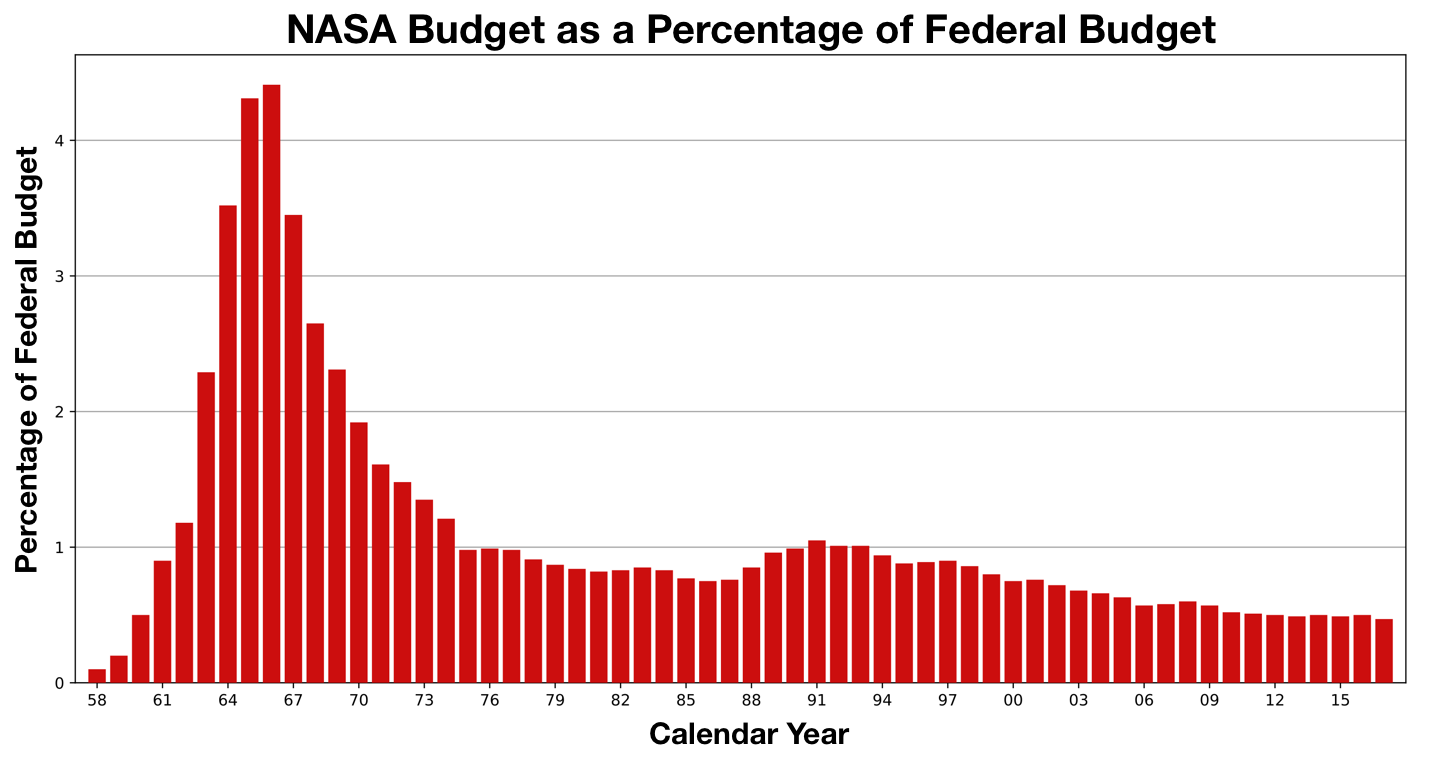
People living in the 1960s thought the moon landing was just the beginning. By 2024, they’d have imagined, there would be a permanent moon base, lots of space tourism, and even people walking around on other planets.

As it turns out, the 1960s were a fluke. It was the height of the Cold War and “desperate times call for desperate measures” justified all kinds of unusual behaviors—including spending five percent of the federal budget to one-up the Soviet Union in the space race. That brief spike in space expenditure put a man on the moon, captivated all of humanity and reminded us of what’s possible when we put our minds together.

Then the Cold War moved on, shifting its tensions to other arenas. Space became less of a critical mission and more of a fun hobby. What had been five percent of the federal budget in the mid-1960s dropped to one percent by the mid-1970s and 0.5 percent in recent decades.

Any hopes I had that the U.S. would decide to become rad about space again were dashed in 2011, when the space shuttle program was shut down for good. Now we couldn’t even launch astronauts into low Earth orbit. When we wanted to send Americans into space, we had to politely ask Russia to do it for us.

I get it. We have many more pressing needs than space. A politician campaigning today on dedicating five percent of the budget to space would be laughed out of the room.

It’s just that it’s such a shame. The moon landing was a tantalizing glimpse into the incredible potential of our species—and a frustrating reminder that without desperate times, that potential remains largely untapped.

Then came SpaceX. I first heard about it in 2012 when 60 Minutes did a segment on the company. Over the next few years, I watched as SpaceX kept defying expectations, successfully launching progressively bigger and more legit rockets into orbit.

In what is still the most surprising day of my life, one day in 2015 Elon Musk reached out to me, said he had read my recent blog post on AI, and asked if I’d be interested in writing about SpaceX. Over the next few months I visited the SpaceX facilities, looked at their rockets up close, interviewed dozens of their engineers, and talked with Musk about the big vision for the company. I wrote about it all in a big blog post.

At the time, SpaceX was singularly focused on one of the space industry’s holy grails: rocket reusability.

Imagine if every commercial airplane flight ended with the passengers parachuting to the ground and the plane crashing into the ocean. With every plane flying exactly once, a brand-new plane would be needed for every flight. Tickets would cost millions of dollars, limiting air travel to billionaires and governments. 

Until recently, that was how space travel worked. Every rocket flew once, making space available only to billionaires and governments. What if, somehow, rockets could be like planes, ending each mission by landing instead of crashing the rocket? Each rocket could be used hundreds of times instead of once, dramatically cutting down the price of space travel and revolutionizing the industry.

In late 2015 a SpaceX rocket launched, sent its payload into orbit, and for the first time in human history, came back down and landed. I watched from SpaceX headquarters. The cheer was so deafening you could feel the vibration move through your body. In the face of a million doubts, SpaceX showed that a private company could not only launch rockets but do it better than any government ever had. Soon, the U.S. government was using SpaceX, not Russia, to launch its astronauts.

But reusability was just a stepping stone on the way to SpaceX’s real mission: colonizing Mars. If you have critical information stored on a hard drive, it’s common sense to back up the info on a second hard drive. That’s how Elon Musk views humanity. We currently have all our eggs in one planet. To give our species the best chance of survival in the long run, he believes, we should live on multiple planets. We’re fortunate to have another potentially livable rocky planet nearby. Why not try to use it?

Bringing people to Mars requires a rocket far larger and smarter than any we had ever built. So SpaceX built Starship, a beast the height of a 40-story skyscraper.Image: Britannica

To make trips to Mars affordable, the rocket has to be reusable, which means this thing has to land. So SpaceX got busy innovating, designing a system to catch the landing rocket between two giant arms. Last week, SpaceX announced that on Sunday, October 13, they would perform Starship’s fifth test launch and, for the first time, attempt to catch the gargantuan rocket on the way down.

I knew one thing: I sure as shit wasn’t going to miss this. I made arrangements to travel to Boca Chica, Texas, to watch.

So the answer to Bari’s first text was easy. I love writing about anything related to space. Yes. 

But how about the second text?

And why you brought your daughter to see it?

Let me first say that “daughter” is generous. What I have is a little two-foot-tall, 19-month-old gnome. Many times over the course of the weekend journey, I asked myself the same question. Why did I decide to bring a toddler with me?

I asked myself that question at 6:30 a.m. Sunday morning while making the 30-minute walk down the beach from the hotel to the viewing spot, which would have been much easier without lugging a fussy, under-slept, 27-pound medicine ball with me—all for something she won’t begin to understand or appreciate or remember.

We arrived at our spot and waited. Then, suddenly, the bottom of the rocket exploded into color. The launch began in silence for a few seconds while the roaring sound zipped along the water toward us. Then it got loud. My daughter hated it, saying “No?” repeatedly, which is her way of pleading with me to make it stop. 

But soon, like everyone else, she was staring wide-eyed at the flying skyscraper as it bored its way upward through the thick atmosphere, painting a beautiful strip of vivid white and orange cloud across the clear sky. Way above us, we watched it separate into two little dots: The spaceship heading around the world with plans to crash into the Indian Ocean, and the rocket that was—somehow—turning around and coming back toward us.

I can say with confidence: Watching a skyscraper falling from the sky is one of the most surreal things I have ever seen. Noticing my daughter still fixated on the cloud, I redirected her attention to the falling rocket. Near the ground, with a new streak of fire shooting out of its engines, it slowly hovered its way over to the tower and into the gentle embrace of the robot arms. The crowd roared. My wife, who gives one percent as much of a shit as I do about space, was in tears.

It’s hard to wrap your head around SpaceX’s mission. If they actually succeed in putting a single human on Mars, let alone their goal of a million people, it will be one of the major milestones in not just human history but life history—on par with the moment animals first began to walk on land. Whether or not they end up pulling it off, space is officially exciting again.

But the reason rocket launches make people emotional isn’t about that. It’s the feeling of swelling pride that comes from being in awe of your own species. It’s the feeling of hope that comes from being reminded of our insane potential when thousands of people work together toward a goal. It’s the happy version of the post-9/11 feeling of wanting to hug every stranger you see.

These emotions are especially refreshing at a time when we’re surrounded by their polar opposite: the pessimism and petty cynicism that pervade our age of suffocating tribalism.

As the father to a smiley little gnome, I desperately want to shield her from the negativity that will swirl around her as she grows up. I won’t be able to do that. But what I can do is continually redirect her attention to the rocket, showing her all the ways our species is incredible. I can use “rocket launch emotion” as a parenting compass and try, as many times as I can, to give her experiences that fill her with that particular magical, high-minded feeling.

If along the way I also train her to be my little space nerd friend, all the better.
 

_______

If you like Wait But Why, sign up for our email list and we’ll send you new posts when they come out.

To support Wait But Why, visit our Patreon page.

_______

More Wait But Why space nerdery:
How (and Why) SpaceX Will Colonize Mars

The Fermi Paradox

4 Mind-Blowing Things About Stars

Read this next

18 comments

Leave a Reply

  1. Luis Ramirez Avatar
    Luis Ramirez
    Hide

    The moment I read this sentence caused a serious emotional reaction in me: "But what I can do is continually redirect her attention to the rocket, showing her all the ways our species is incredible." I will always remember this post for when it's my time to raise a kid.

    1. B Avatar
      B
      Hide

      Same exact sentence that did me in

  2. Alicia Avatar
    Alicia
    Hide

    testing!

  3. Patrick Avatar
    Patrick
    Hide

    Great text! Only detail I missed is that the space shuttle was reusable too. At least the shuttle bit. Wasn’t that the main part?

  4. Luis Ramirez Avatar
    Luis Ramirez
    Hide

    The moment I read this sentence caused a serious emotional reaction in me: "But what I can do is continually redirect her attention to the rocket, showing her all the ways our species is incredible." I will always remember this post for when it's my time to raise a kid.

    1. B Avatar
      B
      Hide

      Same exact sentence that did me in

  5. Patrick_McHargue Avatar
    Patrick_McHargue
    Hide

    Cool. I remember watching the moon landing on TV with my parents. After that, I laid down a National Geographic fold-out map of the moon on my floor, built a latticework over it, and started landing my own LEMs on it.

  6. Lucy Avatar
    Lucy
    Hide

    Beautiful writing Tim 🙂 Made me cry

  7. Ted Howard Avatar
    Hide

    I agree with Elon that we need access to space, but not that Mars is a sensible target.

    I get that there are depths of strategic complexity present, and deep stacks of risks, but the Moon has to be our target.

    We need massive amounts of mass in space if we are going to effectively mitigate some very well characterized existential risks to life (human and other), and the moon (not Mars, not in the first instance) is the only sensible place to launch that mass from (as it lacks and atmosphere, and has a much smaller gravity well than Earth, so we can get a lot of mass into orbit without the need of losing reaction mass (using mass drivers on the surface of the Moon).

    We have many problems we have to solve on Earth, or there is no future (on Mars of anywhere else).

    We must get over our attachment to simple certainty, and learn to live with diversity, complexity and uncertainty.

    We must accept that evolution is deeply more complex than current dogma would have us believe, and that contrary to that dogma, it is cooperation and responsibility that are foundational to the emergence and survival of complexity – at every level, necessarily.

    And cooperation is always vulnerable to the cheating problem, so demands expanding ecosystems of cheat detection and mitigation systems.

    Freedom is fundamental to being human, just as water is. And just like water, too little and we die of thirst, too much and we drown. If freedom is not balanced by appropriate levels of responsibility, then it is destructive, necessarily, just as a bull is destructive in a China shop.

    We need space.
    We need freedom.
    We need cooperation in diversity.
    We need responsibility – to detect and mitigate cheating at all levels.

    Nothing simple or certain in this.

    It demands of each of us the best that we can do, in the full knowledge that we are going to make mistakes, in our necessary ignorance.

    We are a new form of life, based on the old form of life, and it comes with whole new levels of demands for our highest levels of responsibility.

    I have huge respect for Elon, and like all of us, he is a fallible human being, one who has achieved some great things, and done more than a few not so great things; as we all must.

  8. William Croft Avatar

    Please research the abundant presence of the highly toxic 'perchlorates' on the Mars surface. Mars 'colony' is a fantasy, the same as Matt Damon's potatoes.

  9. Annelies Avatar
    Annelies
    Hide

    I love all of your writing, but this feels super one sided fanboy and makes me feel so worried. How can you ignore the fact that Elon Musk is a person who willingly makes our dark world so much darker every day. However good he would be doing in the rocket-department, it does not make up for the very real harm he causes worldwide.

    1. Lucas Avatar
      Lucas
      Hide

      From my perspective, Elon Musk’s recent contributions to SpaceX seem about as relevant as Gritty is to the Philadelphia Flyers. It’s Gwynne Shotwell who runs the company like a well-oiled machine. While I acknowledge that many of Musk’s recent actions and tweets have been troubling, I can still separate SpaceX from Musk and appreciate the incredible achievements of the company—accomplishments driven by the tireless work of the entire SpaceX team. I’m sure many of them, like myself, are not fans of Musk’s recent public statements.

    2. Today Avatar
      Today
      Hide

      What are these harms you're referring to?

      I see that Tim has described what Elon Musk views Mars colonization. He was also surprised that he reached out to him (it would be surprising to anyone). But I don't see where he is fanboying, or what the harms are. Tim has also made fun of Trump (and Biden) in a recent post on the debate, so I am not sure that he is showing a political bias if you have concern in that direction.

      All I'm aware about Elon Musk is that he has shifted from voting for Democratic candidates to supporting Donald Trump. Even if we assume that's what the "harm" is (I do not think it is), I'm not aware of anything else he's doing that's making "our dark world so much darker every day."

      As far as I'm aware, his visions are improving the world via EV adoption and superchargers, Starlink, SpaceX, and hopefully Neuralink.

      If I have any critique for Elon Musk, it's that he talks too much and lets his inside thoughts out too much. He does not let social sense stop him from speaking from a logical perspective, which can sometimes come off insensitive or difficult to understand. His actions, however, all appear to be beneficial for society and the planet.

      I'd like to know what you're speaking of on two fronts. Primarily, I'm curious what the harms are. I'm also wondering where the fanboying is in this article. Thank you.

      1. ccoder Avatar
        ccoder
        Hide

        You are not aware that Elon is espousing a white supremacist/fascist ideology on Twitter on a daily basis? Or that he retweets many conspiracy theories either uncommented or affirmatively?
        Since Elon started to more openly support Trump and the Republican party, we start to see, that he's not come that far from his Apartheid past.

        A few years ago, I was among the greatest fanboys of Musk and his many ventures. And I truly believed he was out to make humanities future brighter and better. Sadly, it seems the brighter and better is – in his mind – reserved for rich white people.

        I am grateful for what he did with Tesla, SpaceX and Neuralink, and bringing a forward-looking side into the public discussion. But his hate-spewing new alter ego is frankly disgusting.

        1. Today Avatar
          Today
          Hide

          I appreciate your measured response. I’ve heard about his extreme ideologies secondhand but have not seen any tweets supporting that notion. All I’ve seen is him not being able to keep his inside thoughts inside sometimes.

          This is nowhere near enough to confirm what you said: But I scrolled through his dozens of tweets in the last two days. There were a lot of tweets, but they were about Tesla and SpaceX work, gaming (Diablo 4), and what he calls “common sense” politics. Interestingly, I saw a retweet of an undercover recording of a Meta engineering admitting that Meta deprioritizes anti-Kamala content. I didn’t see anything where he said anything close to the ideology you mentioned, nor retweeting in implicit support of it — unless you count critiques of Kamala as white supremacist or fascist.

          I will need to dig further and maybe use a tool like Apify to scrape his tweets. (I just discovered it with a search, so I don’t know if it will work.) In the meantime, I’d be interested in seeing evidence of espousing the extreme ideology you mentioned on a daily basis.

        2. chaevans Avatar
          chaevans
          Hide

          I'd love to see these examples of "white supremacist/fascist ideology". In my experience reading his tweets, he is the exact opposite.

    3. eje0100 Avatar
      eje0100
      Hide

      I guess it's all in someone's perspective. I personally think Elon makes this bright awesome world even brighter. Keep living in your glass half empty world.

    4. Danica Avatar
      Danica
      Hide

      This article is expresses a beautiful sentiment about hope and humanity. If you read this and your takeaway was that it was one-sided, it says more about where your mind's at than anything else.

    5. William Avatar
      William
      Hide

      "These emotions are especially refreshing at a time when we’re surrounded by their polar opposite: the pessimism and petty cynicism that pervade our age of suffocating tribalism."

    6. Adam Paskowitz Avatar
      Adam Paskowitz
      Hide

      If you're going to begin your reply telling another person that he's "ignoring the fact that…", you really ought to state something that is, indeed, a fact.

      It's funny how incredibly one-sided your reply can be when all you're trying to do is accuse another person of being one-sided.