



4 Mind-Blowing Things About Stars

Oh come on.

You’re really gonna sit there and just focus on your life all day and not think about the universe at all?

Imagine if there were a bacterium in your fingernail who was smart enough to know a lot about the world—it had a pretty good sense of history, it had access to plenty of info about current events, and at night it could just turn its head upwards and look out at the world around it. But the bacterium decided instead to ignore all that almost all the time and instead obsess over whatever was going on in your fingernail.

We’d all be pretty unimpressed with that bacterium, wouldn’t we? And there you are, completely ignoring the fact that you live here—

—because you’re too busy putting on three different shirts because you can’t decide which one to wear, and people are getting drinks after work today so it’s important.

Since, as I’ve mentioned before, I’ve been seriously dating astronomy ever since I was three, one of Wait But Why’s missions will be to remind you not to constantly ignore the universe.

We’ll start by tackling an obvious topic today: stars.

When people think about the universe, they think about stars. Stars make up most of the visible matter in the universe, and despite all stars beyond our sun being unthinkably far away from us, we can see thousands of them with our naked eye at night.

For this post, I sifted through the endless fascinating facts about stars and picked out four that I find particularly mind-blowing—

1) There are an unfathomable number of stars in the observable universe.

So you know when you’re in a rural area at night and the moon isn’t visible and you can see a ton of stars?

In those optimal circumstances, you’re looking at around 2,500 stars at most. That’s about 1/100,000,000th of the total stars just in our own galaxy.

Speaking of which, take another look above at our gorgeous Milky Way. To help understand just how insanely big it is, here are a few facts:

– The diameter of the Milky Way is 100,000 light years. A light year is the distance light travels in a year. Considering light can travel around the Earth seven times in a second, a light year is a mind-bogglingly large distance. It would take our fastest spacecraft 18,000 years to travel one light year. And with the Milky Way, we’re talking about 100,000 of them.

– That also means that if you use a telescope to see a star on the far side of the galaxy, you’re actually seeing what the star looked like 100,000 years ago, since the light that left the star then is just reaching us now. Likewise, if at this moment, someone on the other side of the galaxy is checking out the Earth with a telescope, they’ll see a bunch of early humans and Neanderthals running around clubbing each other like fools.

– You might think that when you look closely at that above picture of the Milky Way, one of those little dots might be our sun. In fact, if you expanded the above photo to be the size of the Earth, you’d still need a microscope to be able to see our pinprick of a sun—if the Milky Way were the size of the Earth, the sun would be about 1/50th of a millimeter in diameter.

Massive. And all in all, the Milky Way contains between 100 and 400 billion stars.

And that’s just one galaxy.

In 1995, scientists picked out a little section of the night sky that was unusually devoid of stars. To the naked eye, and even in a normal telescope, this region looked empty and black. And the section was tiny—it covered the same amount of sky that a tennis ball would cover if it were 100 meters above you (and the image on the right shows the size of the region in comparison to the size of the moon in the sky at night).

The scientists used the Hubble Telescope to take a 10-day long exposure of the empty region to find out what was out there deep in the blackness. They came back with this:

Astonishing.

To be clear, nothing in this photo is a star. Each thing you see—even the faintest little dot—is an entire galaxy. There are over 10,000 in this image, each one containing around 100 billion stars. And again, this is all in a pinpoint little square of the night sky.

Scientists used the info from this photo to postulate that the observable universe contains over 100 billion galaxies, which puts the total stars in the observable universe at somewhere between 10^22 and 10^24, or around 100 sextillion stars.

To put that in perspective, people at the University of Hawaii spent an unreasonable amount of time calculating an estimate for the number of grains of sand on every beach in the world—7.5 quintillion or 7.5 x 10^18.

That means that for every grain of sand on every beach on Earth, there are about 10,000 stars in the universe.

Silliness.

2) Stars are not close to one another.

Binary star systems aside, most stars are sitting there with no one around for huge distances in any direction, completely bored.

Our sun is no exception—the closest star to us, Proxima Centauri, is 4.24 light years away, or 70,000 years away in our fastest spacecraft.

So if the sun were a 4cm-diameter ping pong ball in New York, the closest star is another ping pong ball 1,153km (743mi) away in Atlanta.

3) Some stars are unbelievably huge.

The largest stars are called red hypergiants. One absurdly large one is called VY Canis Majoris. If you stacked 1,420 of our suns on top of each other, you’d have the diameter of VY Canis Majoris. Here’s what it looks like next to the sun:

Or, to bring back the ping pong ball-size sun, that would make VY Canis Majoris the height of a 16-story building. It would take an airplane about 1,100 years to fly around it, and if VY Canis Majoris were in the center of our Solar System where our sun is, it would swallow up everything out to the orbit of Saturn.

Another red hypergiant almost as large as VY Canis Majoris is Betelgeuse. You can see Betelgeuse on any starry night as Orion’s upper left shoulder—

4) Some stars are incredibly tiny and dense.

When a large star dies by exploding in a supernova, a gravitational collapse can take place and result in a neutron star.

Normal matter is made of atoms, and atoms are made up almost entirely of empty space. The only thing that gives an atom its mass is the tiny nucleus in the middle. To visualize this, picture an atom being a large sphere with a diameter of 1km—that sphere is so big you could stack two Empire State Buildings inside of it without hitting the ceiling. If that sphere is an atom, the nucleus would be a single pea floating in the middle, and the mass of the whole atom would be the same as the mass of the pea.

What happens during a gravitational collapse into a neutron star is that the atoms are squished so hard together that each atom’s empty space gives way and the peas in the middle of each atom are suddenly all bunched together. So now imagine that 1km-diameter sphere, except picture that it’s packed full with peas. So instead of that 1km space having a mass of 1 pea, it now has a mass of about 1,000,000,000,000,000 peas.

This is what happens when a neutron star is formed—there’s no empty space, just the neutrons that make up an atom’s nucleus packed together—and it’s a quadrillion times denser than a normal star.

The result is a tiny star with a diameter of only around 24km whose mass is as much as three suns or one million Earths. Below is the size of a neutron star—imagine packing 1,000,000 Earths into it:
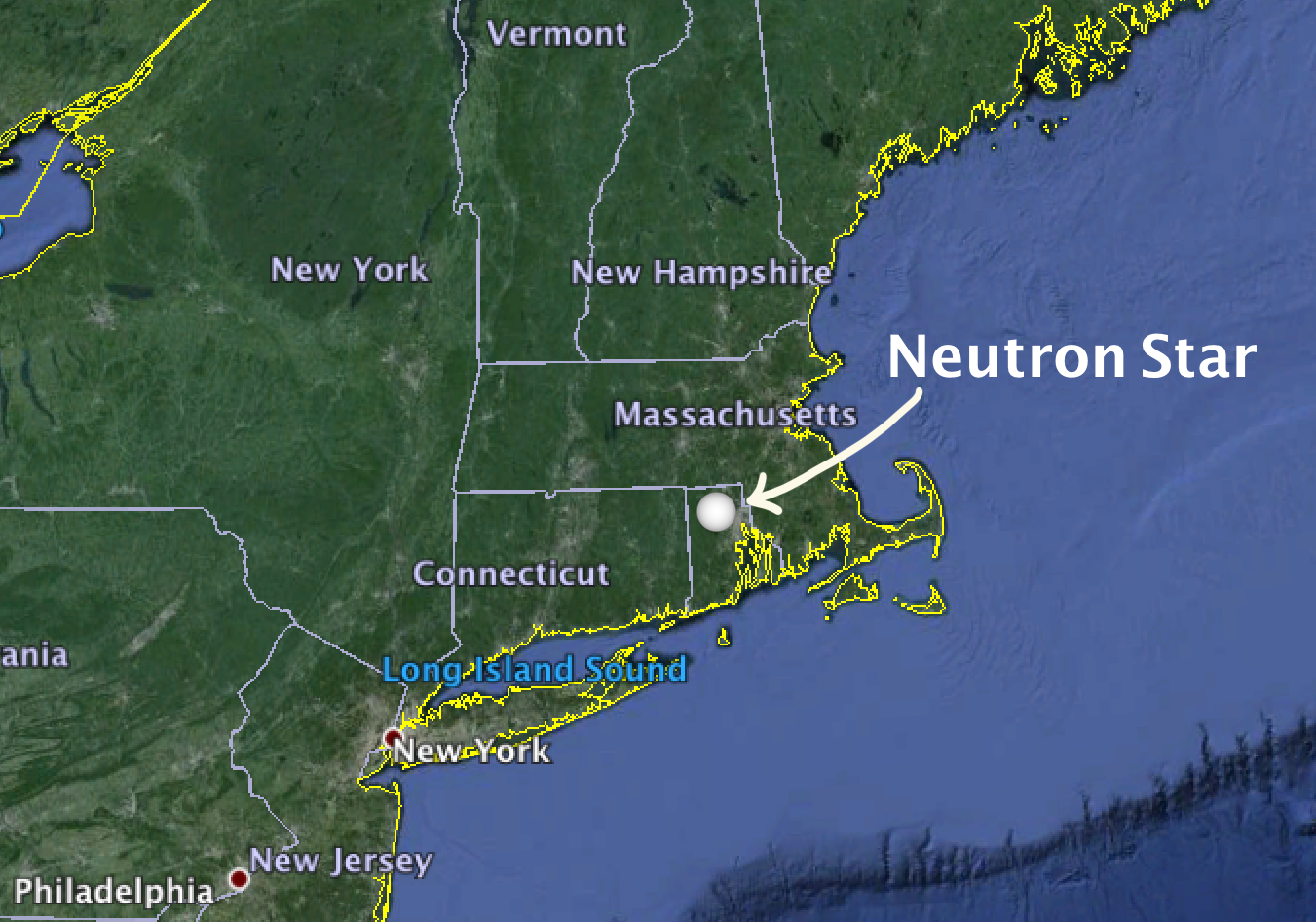
Some amazing neutron star facts:

– A teaspoon of it has the same mass as 900 Great Pyramids of Giza. 

The density of a neutron star is the same as compressing a Boeing 747 airplane into a small grain of sand.

– There are some that spin as fast as 642 times per second. That means that a dot on the star’s “equator” moves a greater distance than the Earth’s circumference every second.

– Neutron stars are hot. The inside of a neutron star is between 10^11 and 10^12 Kelvin—over 1,000 times hotter than the core of the sun.

Pretty overwhelming.

Okay, nice job. Now back to the fingernail.

Related Wait But Why Posts

How (and Why) SpaceX Will Colonize Mars

The Fermi Paradox

The AI Revolution: The Road to Superintelligence

_______

If you like Wait But Why, sign up for our email list and we’ll send you new posts when they come out.

To support Wait But Why, visit our Patreon page.

Read this next

73 comments

Leave a Reply

  1. mckillio Avatar
    mckillio
    Hide

    What happens to the electrons in a neutron star? And electrons don’t have mass?

    1. Andrew Avatar
      Andrew
      Hide

      Electrons do. They just have a negligible amount.

  2. Joey Peters Avatar
    Joey Peters
    Hide

    That’s Amazing!!!! Especially the density of atomic nuclei and how many stars are in the universe! Also, that a star goes supernova when the core reaches nuclear density. Remember your universe filling googolplex?

  3. RuthAMontgomery Avatar
    RuthAMontgomery
    Hide

    ….Some time hit the waitbutwhy Find Here

  4. […] 4 Mind-Blowing Things About Stars (This is not my favorite post, but you get the point) […]

  5. Paul Monfils Avatar
    Paul Monfils
    Hide

    Thank you for this captivating article.

  6. KylieCone Avatar
    KylieCone
    Hide

    I have to do a stupid science project model of stars and galaxies and they want a 3-5 min speech!!!!!

    1. Mike Avatar
      Mike
      Hide

      @kyliecone

      stupid? 🙁

      you make me sad.

    2. Rebecca  Avatar
      Rebecca
      Hide

      Well I was told to write 30 facts about stars

  7. […] wait but why: 4 Mind-Blowing Things About Stars. […]

  8. Alberto Avatar
    Alberto
    Hide

    Here is a beautiful website showing the scale of universe: http://htwins.net/scale2/

    Have fun!

  9. […] Nu stiu daca am mai zis pe aici: atunci cand am senzatia ca totul merge complet de-a-ndoaselea si imi vine sa-mi iau campii, ma uit la o emisiune despre astronomie sau citesc ceva de genul. In general, e suficient sa vad cateva cifre astronomice (d’oh!) ca sa-mi [re]vina mintea la cap si sa realizez din nou ca toate problemele alea groaznice care ma enervau nu inseamna, de fapt, nimic, nici cat un cacatel de musca pe o frunza care pluteste in Atlantic. Forget xanax, prozac sau ce-or mai recomanda medicii, uite aici exemplu de anti-depresiv. […]

  10. […] 4 Mind-Blowing Things About Stars: “In 1995, scientists picked out a little section of the night sky that was unusually devoid of stars. To the naked eye, and even in a normal telescope, this region looked empty and black. And the section was tiny—it covered the same amount of sky that a tennis ball would cover if it were 100 meters above you (and the image on the right shows the size of the region in comparison to the size of the moon in the sky at night). […]

  11. Anonymous Avatar
    Anonymous
    Hide

    Very nicely explained. I bet you loved the Powers of Ten video back in the day! It maybe had more visual impact before the advent of Google Earth, but still one of my favorite ways to imagine the size of the galaxy.http://www.youtube.com/watch?v=0fKBhvDjuy0

  12. Laurence W Avatar
    Hide

    Estimated time for a photon to bounce around inside the Sun before bursting from its surface as a little piece of sunlight: between 10,000 and 170,000 years.

  13. Anonymous Avatar
    Anonymous
    Hide

    This is absolutely amazing. And I loooove how you ended this post. Indeed back to the fingernail!

  14. mary Avatar
    Hide

    This has nothing to do with this post. But have you ever taken the Myers-Briggs personality test? It’s rather fascinating and I’ve spent hours procrastinating on… but I digress. Are you an INTP?

    1. Wait But Why Avatar

      I actually have been told I’m an INTP. Creepily well done…

    2. Anonymous Avatar
      Anonymous
      Hide

      Lol… I was going to ask you the same question. No, actually, I was going to announce that you are indeed an INTP 😀 No need to take the test now =))

  15. Anonymous Avatar
    Anonymous
    Hide

    waiting for clear skies to see this comet:http://earthsky.org/space/big-sun-diving-comet-ison-might-be-spectacular-in-2013

  16. Anonymous Avatar
    Anonymous
    Hide

    How scientists know about all density and temperature of stars? Its just speculation if u ask me

    1. Jarathor Avatar
      Hide

      Haha, nope. Start by reading about the Hertzsprung-Russel diagram. Actually no, that might be too much; start by reading about extremely basic atomic physics (say, the Bohr model of the hydrogen atom) and the theory of blackbody radiation – that will tell you how scientists can (extremely precisely) measure the temperature and composition of stars. Then go on to nuclear physics – that will tell you how they know how big stars are and how each of the regions inside a star behaves. Next up would be special relativity (specifically, relativistic doppler shift) and variable stars, which are the two main ways scientists measure distances to astronomical objects. I realize that somebody who thinks that science, at any stage, is “just speculation if u ask [them]” isn’t actually going to do so, but hey, what the heck, maybe somebody else will learn something.HR Diagram: https://en.wikipedia.org/wiki/Hertzsprung%E2%80%93Russell_diagramHydrogen Spectrum: https://en.wikipedia.org/wiki/Hydrogen_spectral_seriesNuclear reactions in stars: https://en.wikipedia.org/wiki/Nuclear_fusion#Important_reactionsRelativistic Doppler Shift: https://en.wikipedia.org/wiki/Relativistic_Doppler_effectStandard Candles (used to measure distances):

    2. Jarathor Avatar
      Hide

      Oops, left off the last one: https://en.wikipedia.org/wiki/Cosmic_distance_ladder

    3. Wait But Why Avatar

      Jarathor, I need to consult you when doing all future astronomy posts.

  17. Max Salganik Avatar

    Thanks for posting this. I’ve also been involved with astronomy since a young age and am now finishing building a 16″ f4.5 scope. Can’t wait to do my part and share the universe with anyone and everyone through the eyepiece 🙂

  18. Anonymous Avatar
    Anonymous
    Hide

    Great article! More people need to know this stuff.One thing I’d mention, though. You said “You can see Betelgeuse on any starry night as Orion’s upper left shoulder”. Technically you can only see it in the night sky during mostly the winter months, with January being the best time to view it. During summer it’s up during the day, so it’s drowned out by all that blue sky.

    1. Max Salganik Avatar

      *it’s best to see it around January in the evening sky. You can see it in the pre-dawn sky as early as August 🙂 Just a minor correction. Most people don’t realize just how much the sky “moves” over the course of a night. You can observe in the evening and then wake up pre-dawn and observe a whole different set of objects… or you can just stay up the whole night 😀

  19. Anonymous Avatar
    Anonymous
    Hide

    “There are an unfathomable number of stars in the observable universe.” ….. There IS…. is….. ‘number’ is singular.

    1. Anonymous Avatar
      Anonymous
      Hide

      “A big number of stars” = “a lot of stars”. “Lot” is also singular, but is still used with a plural verb: “there are a lot of stars”. It’s because the verb agrees with the word “stars”, not “number”. “A number of” can be omitted, and we will be left with “there _are_ stars”. If we were talking about “number”, it would go like this: “the number of stars is big”. Here the verb agrees with “number”: “the number _is_ big”. Only saying this because I’m reading this blog as part of my exam preparation 😀 In case I’m not the only one English learner here.

    2. Anonymous Avatar
      Anonymous
      Hide

      *not the only English learner here 🙂 Now back to studying 😀

  20. Hayley Courtney Avatar

    I’ve seen the video about the hubble before and was completely fascinated. I’ve been a huge lover of astronomy since I can remember. Excellent post. Looking forward to a blog on black holes. If not I’d settle for “why driving in the left lane under the speed limit makes you the biggest asshole on the planet.”

  21. Anonymous Avatar
    Anonymous
    Hide

    Are we alone in the universe? HOW THE FUCK DID IT ALL HAPPEN? Okay, I can understand how Henry Ford built his empire and +/- how car manufacturing works, BUT HOW THE FUCK DID NATURE/UNIVERSE come up with these neutron stars, black holes and shit? Mind – BLOWN. Why do I want to poop? Okay I drunk coffee, but who we are to go to wars and create BS (=religion), when there is just SO MUCH TO EXPLORE?I’m totally lost 🙁

    1. meticulousmike Avatar

      I agree.(that you are lost)

  22. Samuel Zamora Avatar

    Insane numbers man!!! “NY Canis Majoris”… Just absurdly colossal!! How big could be the gravity field of that thing?!! I ve seen some documentaries about the universe and never heard about those awesome facts that u have picked for us, like “the teaspoon of 900 pyramids”… thank you so much!! I would like to know how to compress all my clothes in just one suitcase 😉 without falling in orbit around it

    1. Jarathor Avatar
      Hide

      The magnitude of the gravitational potential is pretty easy to calculate: U(r)=-G*M/rAnd then the force is just -grad(U(r))=G*M/r^2=0.001203m/s^2 at the surface. This is actually much, much lower than the surface gravity of the Earth, because although VY Canoris Majoris is huge, it only weighs as much as 25 solar masses.

  23. Anonymous Avatar
    Anonymous
    Hide

    This is wildy fascinating, I agree. Dumb question: How does Hubble photograph deep space? On Earth, you can’t photograph a house, say, that is located behind a mountain. Things overlap in 3D space from one persons perspective, preventing you from seing what is behind solid objects. How come this doesn’t work in space? How come, with all the solid galaxies in front of other solid galaxies, we can still see into deep space. No matter how far away things are, nothing is in front of anything preventing us from seeing it. What’s with that?

    1. Jarathor Avatar
      Hide

      Space is really, really, really, really empty. There are things that block light in the universe though – light from distant stars is often attenuated by thin, dilute clouds of gas and the interstellar medium. Galaxies may look solid enough, but when two galaxies collide they basically just pass through each other without a single star touching another. Most of everything, to an astonishing degree, is “empty” space (zero-point energy notwithstanding).

    2. Yohami Avatar
      Hide

      How about the dark matter, dark energy and dark stuff?

    3. Jarathor Avatar
      Hide

      All completely invisible! They don’t interact through the electromagnetic force (i.e. via photons) so we can only infer their existence through gravitational lensing and the acceleration of the expansion of the universe.

  24. OMFGITSROHIT Avatar

    This is the kinkiest form of erotic humiliation. Your fetish for being humbled by the enormity of the universe.Nice read. I like how you take it upon yourself to shove people’s faces in the reality of their own insignificance. It’s a nice way to distract yourself from that of your own. Just as posting this comment is a nice way to distract myself from that of my own.

  25. Anonymous Avatar
    Anonymous
    Hide

    Thank you very much for your ongoing work.All very interesting, brightens my day, and provides some laughs for my colleagues in the office, each time I read your articles.

  26. Adriel M. Dalgaard Knott Avatar

    Just… Just… spechless… … … This leaves me with more questions than answers. Thank you, keep on with this good stuff!!!!!!

  27. Dick Avatar
    Dick
    Hide

    Wildly fascinating.

  28. Nate Bunger Avatar
    Hide

    back again, I am in a small town in the mountains of Colombia learning to Kite Surf. I was at the bus station going back to the city when your I got a message on my phone alerting me of your new blog post. I literally decided to stay, and miss the last bus home, because I had Internet connection where I was…haha, oh well, guess I get to kite surf again tomorrow, hehe… I now understand the meaning of quality content on a blog. I don’t think I’ve ever looked forward to reading a weekly article this much. Don’t self sabatoge 😉 your doing so awesome. looking forward to next weeks postNate

  29. Yohami Avatar
    Hide

    How is it possible that we have pictures of the milky way, which contains our solar system? we dont have a camera 100,000 light years away to take that selfie? Awesome post btw.

    1. Jarathor Avatar
      Hide

      Easy answer: we don’t! We do have plenty of pictures of spiral galaxies similar enough to ours that everyone just uses images of them instead. That picture, after a quick reverse image search, appears to be some combination of illustration and an image of Messier 51 – but it’s close enough to reality that it doesn’t really matter.

    2. Yohami Avatar
      Hide

      How do we even know it’s close enough?

    3. Jarathor Avatar
      Hide

      Well, even though we are inside the milky way, we can get a rough estimate of the shape of our galaxy by measuring lots and lots of stars and figuring out how far away they are (astronomers can also do this for clouds of gas and dust that make up the interstellar medium). After doing this enough (and some really fancy mathematical wizardry) we can make a rough map of our galaxy. Since we can observe thousands upon thousands of galaxies, we have a pretty good idea of what different types of galaxy look like in general. Using those two pieces of information, along with Photoshop, produces a fairly accurate map of the Milky Way.

    4. Yohami Avatar
      Hide

      Got it. Somehow this is like the bacteria looking around the finger and coming with a portrait of Angelina Jolie.

    5. Jarathor Avatar
      Hide

      Except I doubt bacteria have access to radio telescopes:https://en.wikipedia.org/wiki/Arecibo_Observatory:)

    6. Yohami Avatar
      Hide

      True 🙂

  30. Jarathor Avatar
    Hide

    Physics of Stars was almost certainly my favorite physics elective course – what makes everything you wrote more astonishing is how we figure these things out. For example, the ways we measure distances to stars (not to mention other galaxies) are really, really cool examples of problem solving. Because of optical effects like diffraction (d*sin(theta)=1.22*lambda for the interested) and more importantly, sheer distance, there are only a couple of stars in the sky that we can directly measure the size of – all others look like point sources of light. Literally everything else we know about the universe has to be inferred from indirect measurements (see the Hertzsprung-Russel diagram for a simple example on how we can derive how big stars are based on their effective temperature alone). Really, really cool stuff.

  31. Table10 Avatar
    Hide

    So, are you saying that we are an incredibly small part of the universe? What is the takeaway? Anyone?

    1. Hayley Courtney Avatar

      Maybe that humans need to stop thinking the world revolves around them.

    2. Anonymous Avatar
      Anonymous
      Hide

      Be careful what you wish for- you may find yourself thrown into the total perspective vortex.

  32. Anonymous Avatar
    Anonymous
    Hide

    So now you’ve gone and parked a neutron star on Rhode Island. Why do you hate Rhode Island?

    1. Wait But Why Avatar

      Such an unpleasant day in Rhode Island.

  33. Andrea S. Avatar
    Andrea S.
    Hide

    Regardless, this is a great post! Can you please do one of these on black holes next?

    1. Wait But Why Avatar

      Black holes are heavenly and upsetting. Yes, I’ll definitely get to them at some point.

  34. Unknown Avatar
    Hide

    The most amazing part of the post is the revelation that I apparently live in the Andromeda Galaxy.

    1. Wait But Why Avatar

      Ahhh good point. Fixed.Too bad, Andromeda is much prettier.

    2. Anonymous Avatar
      Anonymous
      Hide

      Still great post, but we don’t live in that galaxy either, whatever it is. We don’t have any pictures of the Milky Way from outside, because, well, how would we take them? Easy enough to adjust the text to say a galaxy *like* the one pictured.

    3. Anonymous Avatar
      Anonymous
      Hide

      No, it’s not. I like your blog but there are some inaccuracies here. This isn’t an artistic depiction but a computer-generated image carefully simulated, based on empirical data collected from astronomical observatories. That’s how scientists know how the Milky Way looks like. That’s not subjective art, but highly objective science.

    4. Anonymous Avatar
      Anonymous
      Hide

      That’s not an artistic depiction, seriously. Did you even bother to research about it? This photos are computer-generated, based on observations from the earth.

  35. Andrea S. Avatar
    Andrea S.
    Hide

    We don’t live on the Andromeda Galaxy 🙂

  36. Leftie Avatar
    Hide

    Love it! Space is an awesome thing to consider. Two things I would recommend just for any further interest…1. http://www.dailymotion.com/video/xa9raa_most-important-image-ever-taken-by_tech – a clip explaining a bit more about the Hubble Deep Field mentioned above. With a nice Pink Floyd soundtrack…2. The app Celestia, which lets you roam around space. I happily sit and forego 10 minutes of work to float around in the depths of space, read about the stars and planets. It’s good fun (if you’re into that sort of thing). I find it especially breath taking to go “Home” to the Sun from wherever I am in the universe, and fly up to it at the speed of light. But perhaps I’m just a nerd…Thanks for your work – this blog has become something I very much look forward to each week!

    1. Wait But Why Avatar

      I love that video. And downloading that app as I write this.

    2. Leftie Avatar
      Hide

      Just hoping Celestia is not too big a banana for your Instant Gratification Monkey…

    3. Kendric Beachey Avatar

      I don’t know how many nights I’ve been running Celestia and looked up to see it’s about half past go-to-bed o’clock. The monkey LOVES Celestia.

    4. Anonymous Avatar
      Anonymous
      Hide

      HAHAHA excellent reference to the IGM…oops i think my Monkey just came out!

  37. Anonymous Avatar
    Anonymous
    Hide

    Every word of that was jaw-dropping. Amazing!!

  38. Kimberly Davis Avatar

    This post took my breath away. Nicely done.