

Your Family: Past, Present, and Future

I have one living grandparent—my father’s mother, who’s 89.

Nana.

I visited Nana recently and went through the usual activities—talking about myself in a loud voice, fixing her “broken machine” by unminimizing the internet browser window, being told to slow down Timothy and get in the left lane, even though the turn is still a half mile ahead. But I also used the visit as an opportunity to do something I have not done nearly enough in my life—ask her questions about our family.

I don’t know you, but I can almost guarantee that you don’t ask your grandparents (or older parents) enough questions about their lives and the lives of their parents. We’re all incredibly self-absorbed, and in being so, we forget to care about the context of the lives we’re so immersed in. We can use google to learn anything we want about world history and our country’s history, but our own personal history—which we really should know quite well—can only be accessed by asking questions.

During my visit, Nana referred to herself as “the last of the Mohicans,” meaning basically everyone she spent her life with is dead—her husband, siblings, cousins, and friends are all gone. Besides that being the most depressing fact of all time, it was also a jarring wake-up call that a treasure trove of rich and detailed information about my family’s past exists in one and only one place—an 89-year-old brain—and if I kept dicking around, most of that information would be lost forever.

So on this visit, I started asking questions.

She was annoyed.

But it only took a couple minutes for her to become absorbed in storytelling, and I spent the next three hours riveted.

I learned more than I had ever known about her childhood. I knew she and my grandfather had grown up during the Great Depression, but I never really knew the unbelievable details—things like her seeing a mother and her children being thrown onto the sidewalk by their landlord and left there to starve and freeze until every neighbor on the block chipped in a coin or two from their own impoverished situation so the woman could rent a room for one more month.

I learned a ton about my four paternal great-grandparents—again, I had known the basic info about them, but it was the details that for the first time made them real people. Three of them grew up in rough New York orphanages—the fourth left everything she knew in Latvia in her mid-teens and took a boat alone across the Atlantic, arriving in New York to work in a sweatshop.

I even for the first time heard stories about my grandmother’s grandmother, who came over separately from Latvia and lived with the family for her last years—and apparently had quite the personality. Thankfully, she died in 1941, just months before she would have learned that her four sons (who unlike their mother and sister, stayed in Latvia because they had a thriving family business there) were all killed in the Holocaust.

I knew none of this. How did I just learn now that my great-grandmother’s four brothers died in the Holocaust? And now that, for the first time, I know my four paternal great-grandparents and great-great grandmother as real, complex people with distinct personalities, I cannot believe I spent my life up to now satisfied with knowing almost nothing about them. Especially since it’s their particular orphanage/sweatshop/Great Depression struggle that has led to my ridiculously pleasant life.

And as happy as I am that I at least scratched the surface of learning who these people were, I’m now sad about all of these other gray people:
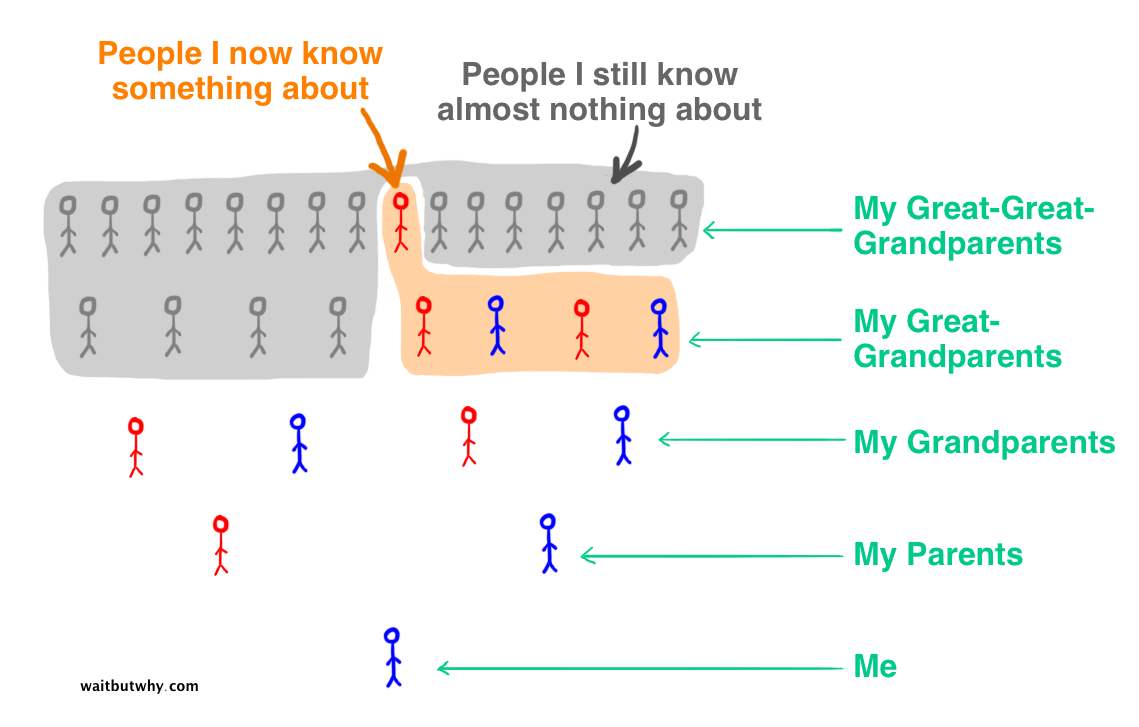
small stick figure family tree from Me to My Great-Great-Grandparents showing that you know almost nothing about your great-great-grandparents

All of this has gotten me thinking about genealogy and how fascinating it is as a concept. What happens if I just keep extending my family tree up and up and up? What exactly is a fourth cousin and how many of them do I have and where are they all right now? How weird is it that to some kid in 2300, I’m one of the old-fashioned-looking dudes really high in his family tree on a level with hundreds of others? Normally, I’d just go internet spiral about this on my own, but since Wait But Why exists, we’re gonna do it together—

The Past: Your Ancestor Cone

So let’s start with the past, and see what happens if we keep going up the family tree, or what I’ll call your Ancestor Cone:
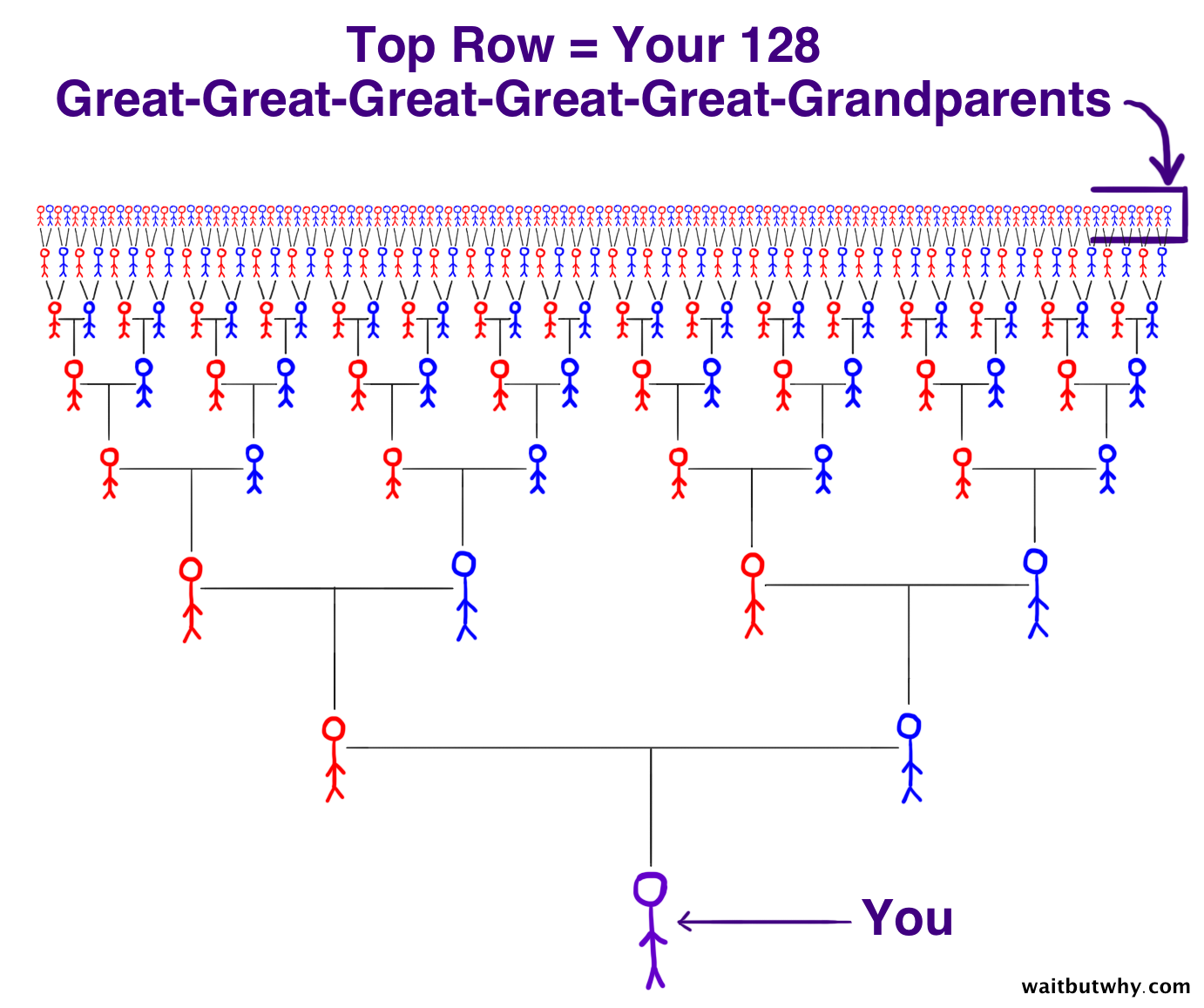
Big Family Tree from you to your 128 great-great-great-great-great-grandparents

You can see that things get hectic pretty quickly when you start moving back generations. The top row is the 128-person group of your great5 grandparents, or your grandparents’ grandparents’ great-grandparents. The thing that I find surprising is how recently in time you had such a large number of ancestors. Estimating an average generation at 25-30 years, most of those people were your current age around 1800-1825. So the early 19th-century world contained 128 random strangers going about their lives, each of whose genes makes up 1/128th of who you are today.

Who were they all? What countries did they live in? What did they all do with their lives? What tragedies did they endure and what were their greatest triumphs? What were the 254 parent-child relationships in this diagram like? Which of the 252 in-law relationships above were close and loving and which were angry and contentious?

The craziest thing to me is that this diagram, which only represents the last 200 years of your ancestry, contains 127 romantic relationships, each involving at least one critical sex moment and most of them probably involving deep love. You’re the product of 127 romances, just in the last 200 years alone.

Alright, I’m nervous about this, but I’m gonna take a crack at going back even further—
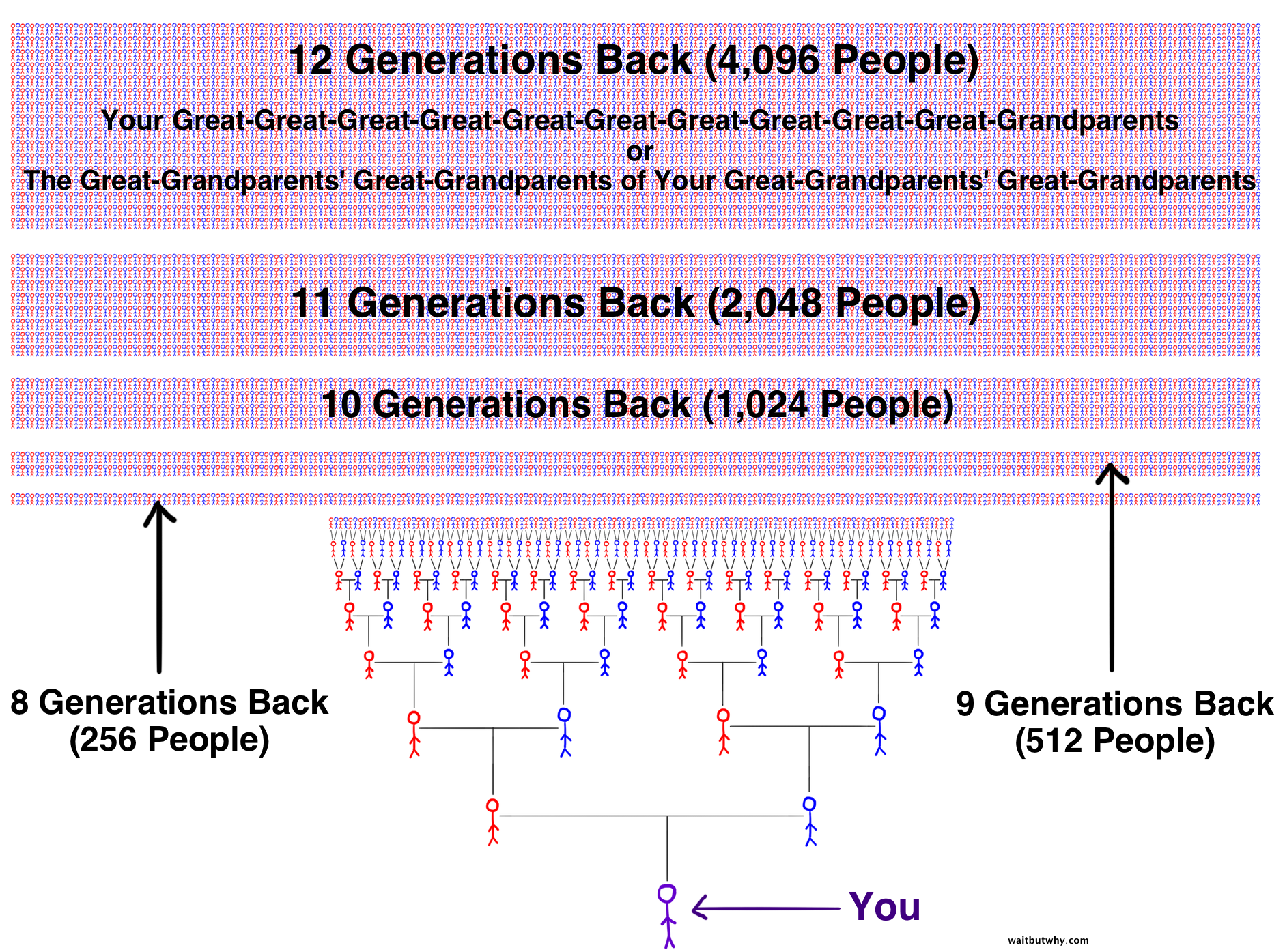
Huge Family Tree from you to 12 generations back where there are 4,096 people


Okay that got completely out of hand. This diagram only goes five generations farther back than the one above it and look at the insanity that took place.

The 4,096 human beings in the top section are your great10 grandparents. Most of them were your age in the second half of the 1600s, just as the Enlightenment was getting going in Europe.

You can see why it’s not really that impressive when someone tells you they are descended from famous royalty who lived a few hundred years ago. Look how many people you’re descended from only about 300 years back! Within that top section, there’s probably some royalty, in addition to some peasants, scholars, warriors, painters, prostitutes, murderers, lunatics, and any other kind of person who existed back then.

Finally, I know I already made this point in the evolution post, but look closely at that top section and notice that you can actually see 4,096 distinct tiny people in there—and realize that if you pluck just one of them from there, you would not exist today. Come on.

You may also be noticing that there’s something that doesn’t make sense about the way these numbers are zooming up exponentially—we’re at 4,096 going back three centuries, and continuing at that rate, our ancestor number goes like this:
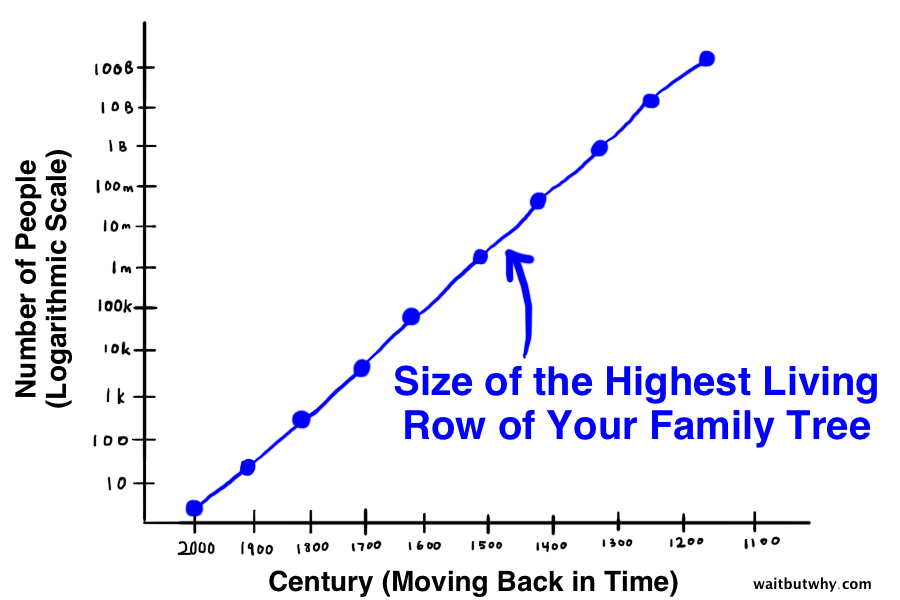
line representing the size of the highest living row of your family tree as you go back in time

That puts you at 68 billion ancestors around 1100 AD. The reason that’s problematic is that the world population goes like this:

blue line showing size of highest living family tree increasing as you go back in time crossing a red line representing the world population declining as you go back in time

So how do we explain this?

With a concept called pedigree collapse, which is what happens when people end up with a mate who is somewhat or very closely related to them. So for example, if two cousins had a child, that child would only have six great-grandparents, not eight. Or, to put it another way, there are eight filled great-grandparent spots on that child’s family tree, but two of the spots are duplicates of two other spots—
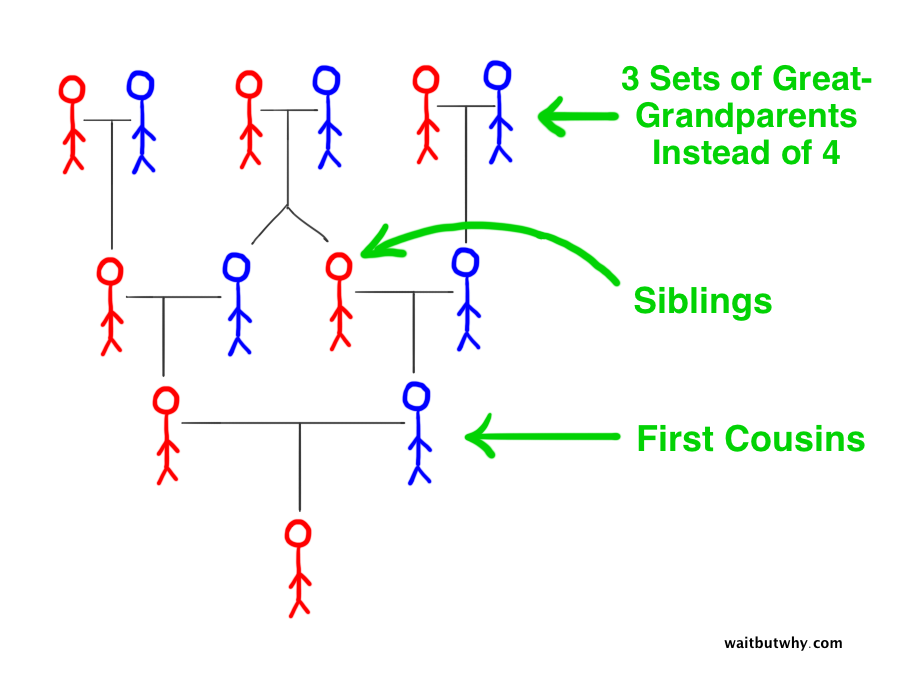
pedigree collapse stick family tree showing that the child of first cousins only has three sets of great-grandparents

Before you wince, absorb this fact: according to Rutgers anthropology professor Robin Fox, 80% of all marriages in history have been between second cousins or closer.Richard Conniff. “Go Ahead, Kiss Your Cousin.”

The reason for this is that for most of human history, people spent most of their lives in the same five mile radius, and the other people in that same area tended to be immediate and extended family. To get away from their extended family when courting, men would have to walk over five miles away, which after a long day of hunting you just don’t feel like doing.

In the Western World, this is largely a phenomenon of the past, but in many parts of the world, this is still a common practice—for example, in most of the Middle East and North Africa, over 50% of today’s marriages are between second cousins or closer.Richard Conniff. “Go Ahead, Kiss Your Cousin.”

So that group of 4,096 people above? A number of those spots are undoubtedly duplicates, meaning the real number of distinct people is likely a bit lower—and for someone a few thousand years ago, the number of 10th generation ancestors they’d have would be a lot lower than 4,096.

Because of pedigree collapse, if you extended your family tree way, way back, it would begin to get smaller, resulting in a diamond shape:
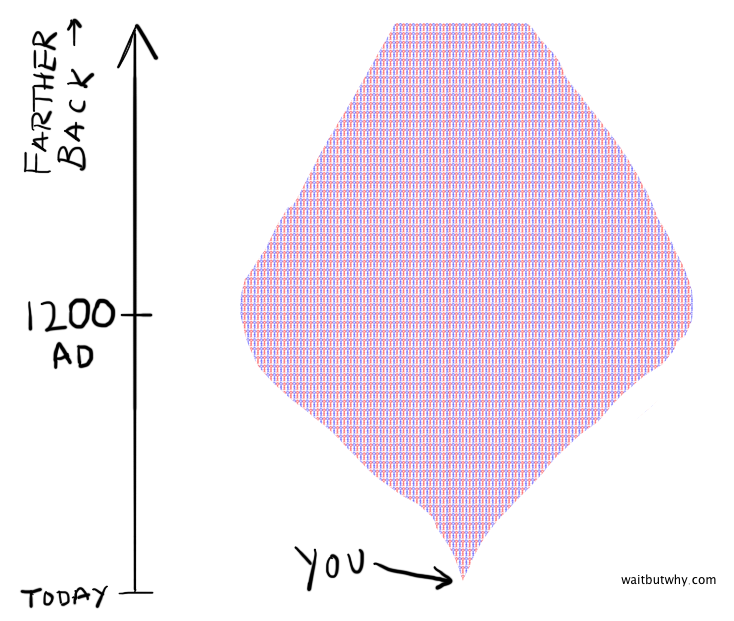
zoomed out view of pedigree collapse showing a family tree expanding from today to 1200AD and contracting as you go farther back in time

The widest point of the Ancestor Cone happens for most of us around 1200AD,The Straight Dope: 2, 4, 8, 16, … how can you always have MORE ancestors as you go back in time? when our family tree is near the total world population at the time. From that point on, pedigree collapse becomes a stronger factor than the normal upward x2 multiplier, and the tree converges inwards.

The Present: Your Living Relatives

So in this frenzy of procreation we’re all a part of, what’s the deal with our relation to the other people on this Earth today?

The simplest way to think about it is that every stranger in the world is a cousin of yours, and the only question is how distant a cousin they are. The degree of cousin (first, second, etc.) is just a way of referring to how far you have to go back before you get to a common ancestor. For first cousins, you only have to go back two generations to hit your common grandparents. For second cousins, you have to go back three generations to your common great-grandparents. For fifth cousins, you’d have to go back six generations until you arrive at your common pair of great-great-great-great-grandparents.

Since a lot of people get confused about cousin definitions, I made a little chart illustrating what a second cousin is.

visual diagram explaining second cousins

So notice that for you and your second cousin, A) your parent is a first cousin of their parent, B) you have grandparents that are siblings, and C) their parents are your common great-grandparents. For third cousins, everything just goes up a level—your parents are second cousins, your grandparents are first cousins, your great-grandparents are siblings, and you have a common pair of great-great-grandparents.

(For the whole “once/twice removed” thing, it’s about being on different generations—so your second cousin’s child is your second cousin once removed, because it’s one generation away from you; your grandfather’s first cousin is your first cousin twice removed. A straight second, third, or fourth cousin must be on your same generation level.)

The number of cousins you have grows exponentially as the degree of distance goes up. You may have a small number of first cousins, but you likely have hundreds of third cousins, thousands of fifth cousins, and over a million eighth cousins.

Because I got a little obsessed with this concept while doing this post, I decided to roll up the nerd sleeves and figured out a formula for this:

(n-1) 2d nd

—where n is the average number of children being had by a family and d is the degree of cousin you want to find the total number of (an explanation for this formula is at the bottom of the post). (P.S. I’m thrilled with myself right now.) (But also scared because there might be a better way to do this, so feel free to add suggestions in the comments.)

So to find out how many third cousins you’d have (d=3) if your family averaged having two children per couple (n=2), it would be (2-1) 23 * 23 = 64.

The number of fourth cousins you’d have (d=4) if your family averaged three children per couple (n=3) would be (3-1) 24 * 34 = 2,592.

Using this formula on yourself is hard, because you don’t know n, the average number of children your extended family is having—but you can get a general ballpark for the number using your nation’s average number of children per family statistic. I calculated some examples below:
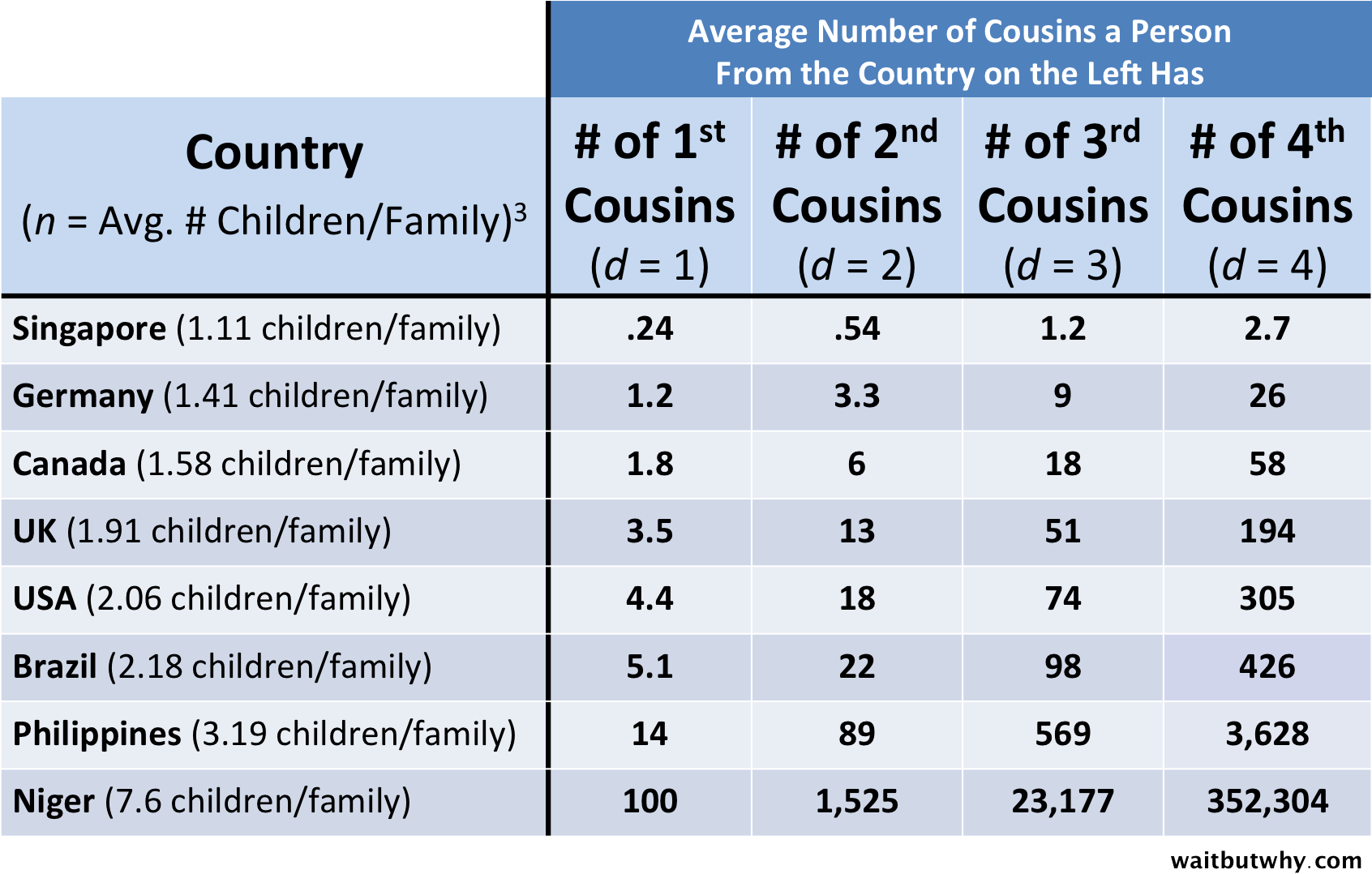
average number of cousins a person has by country, Singapore .24 first cousins and Niger 100 cousins

Most interesting to me is that these numbers go up so exponentially that taking the world average for number of children per family (2.36)http://www.nationmaster.com/graph/peo_tot_fer_rat-people-total-fertility-rate, you can use the formula to calculate that if breeding were mixed evenly across cultures and nations, the most distant relative you’d have on Earth would be a 15th cousin.

However, since breeding isn’t mixed evenly and is instead contained mostly within nations and cultures, the most distant person within your culture or ethnicity is probably closer to you than a 15th cousin, while the farthest relation you have on Earth is likely to be as far as a 50th cousin.The Straight Dope: 2, 4, 8, 16, … how can you always have MORE ancestors as you go back in time?

In any case, you have hundreds if not thousands of third and fourth cousins and you’re probably friends with some of them without realizing it—you might even be dating one of them.

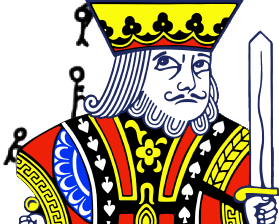
The other way to look at this is from the top down and see how quickly the distance of relation is magnified as generations move down—while you and your sibling grew up in the same house, your kids will be cousins who might or might not be friends and your grandkids might barely know each other. When it comes to your and your sibling’s great-grandkids, it’s likely they won’t ever meet, and your great-great-grandkids might be best friends with each other and will never realize that their great-great-grandparents were siblings.

A nice example of this phenomenon:
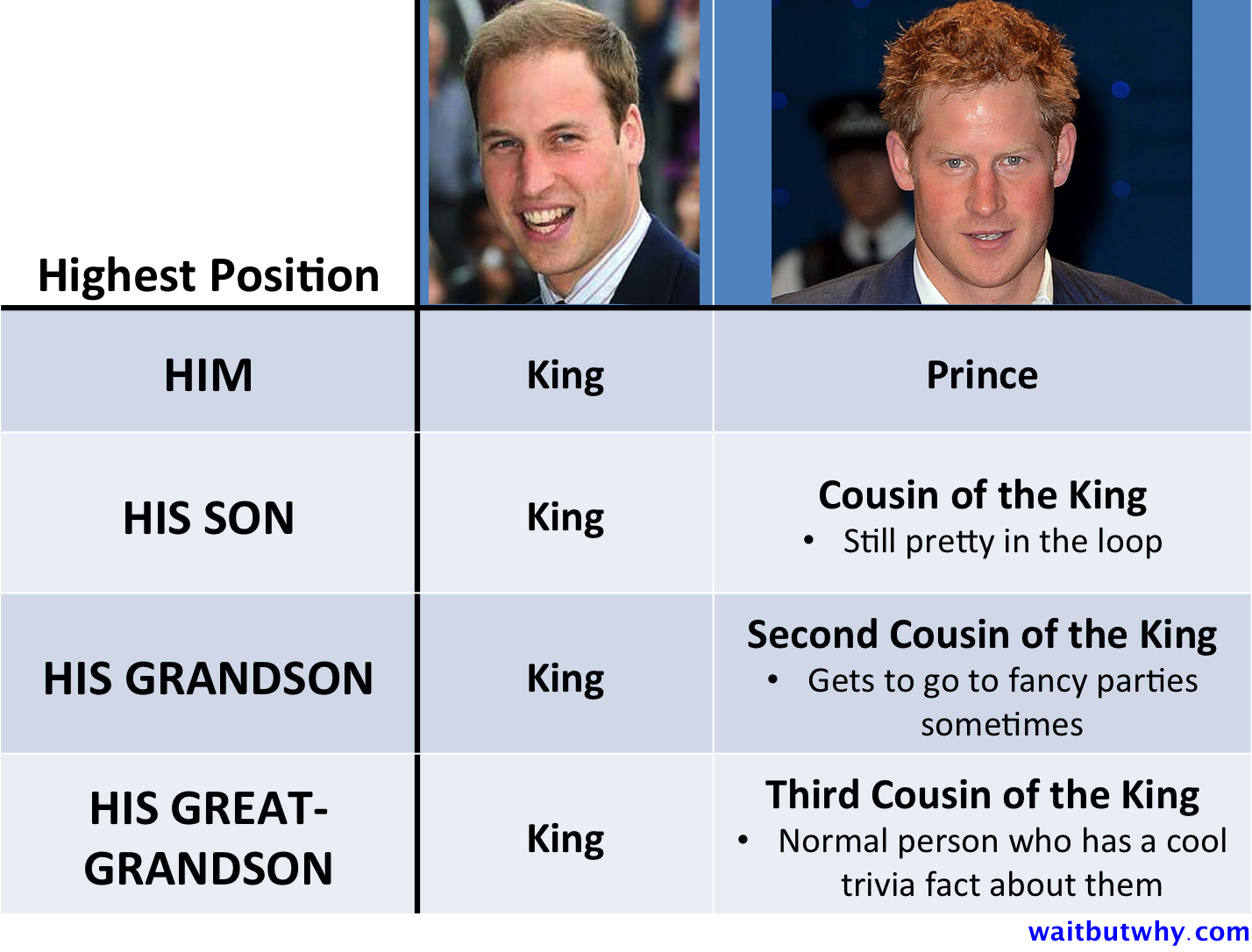
prince chart showing the king and how his son, grandson, and great-grandson are kings but the prince and his descendants are the first, second, and third cousins of the king


The Future: Your Descendant Cone

Maybe you won’t have children, or maybe your children won’t have children. But barring those possibilities, you’re likely to end up being either the great patriarch or matriarch of a Descendant Cone that will eventually make up a sizable chunk of the human race. In its first couple hundred years, before expanding into the thousands, it might look something like this:
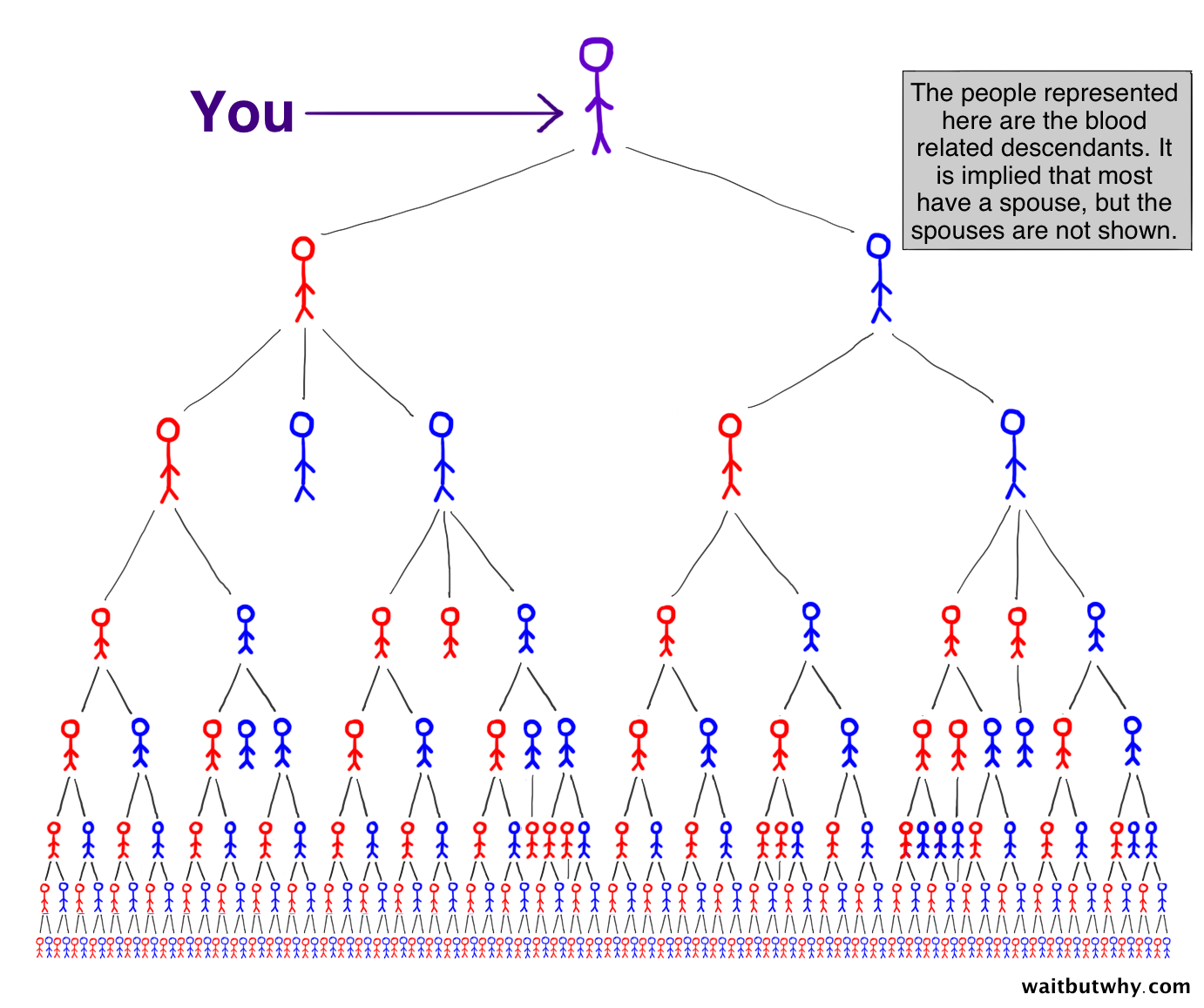
reverse family tree showing your blood related descendants.

Let’s take a closer look at one of your hundreds of great-great-great-great-great-grandchildren:

close up of the bottom row of your descendant tree with one stick figure highlighted and named Telia

Little Telia, born right around the year 2300, is as much a mystery to you as your ancestors from the early 1800s up above. She owes her life to you, and somewhere in her personality is a trait or two of yours—but that’s the extent of your connection.

Party’s Over

Now so far in this post, you’ve gotten to enjoy being featured as the key person in all the family trees we’ve drawn. You’ve been the child that thousands of romances have aligned perfectly together to produce. You’ve been the centerpiece of a large extended family with rings of siblings and cousins around you. And now, you’re the great founder of a vast cone of descendants.

But all you have to do is shift the perspective, and suddenly you’re one of some 17th Century guy’s ten thousand descendants; you’re the second, or third, or fourth cousin (it’s weird to think of yourself as just someone’s random second cousin); and to Telia, you’re no grand patriarch or matriarch—you’re an unbelievably random tiny stick figure high up on her Ancestor Cone and you’re fuzzy because Tim can’t figure out how to export high-resolution images from Pixelmator even though he tried a bunch of different things:
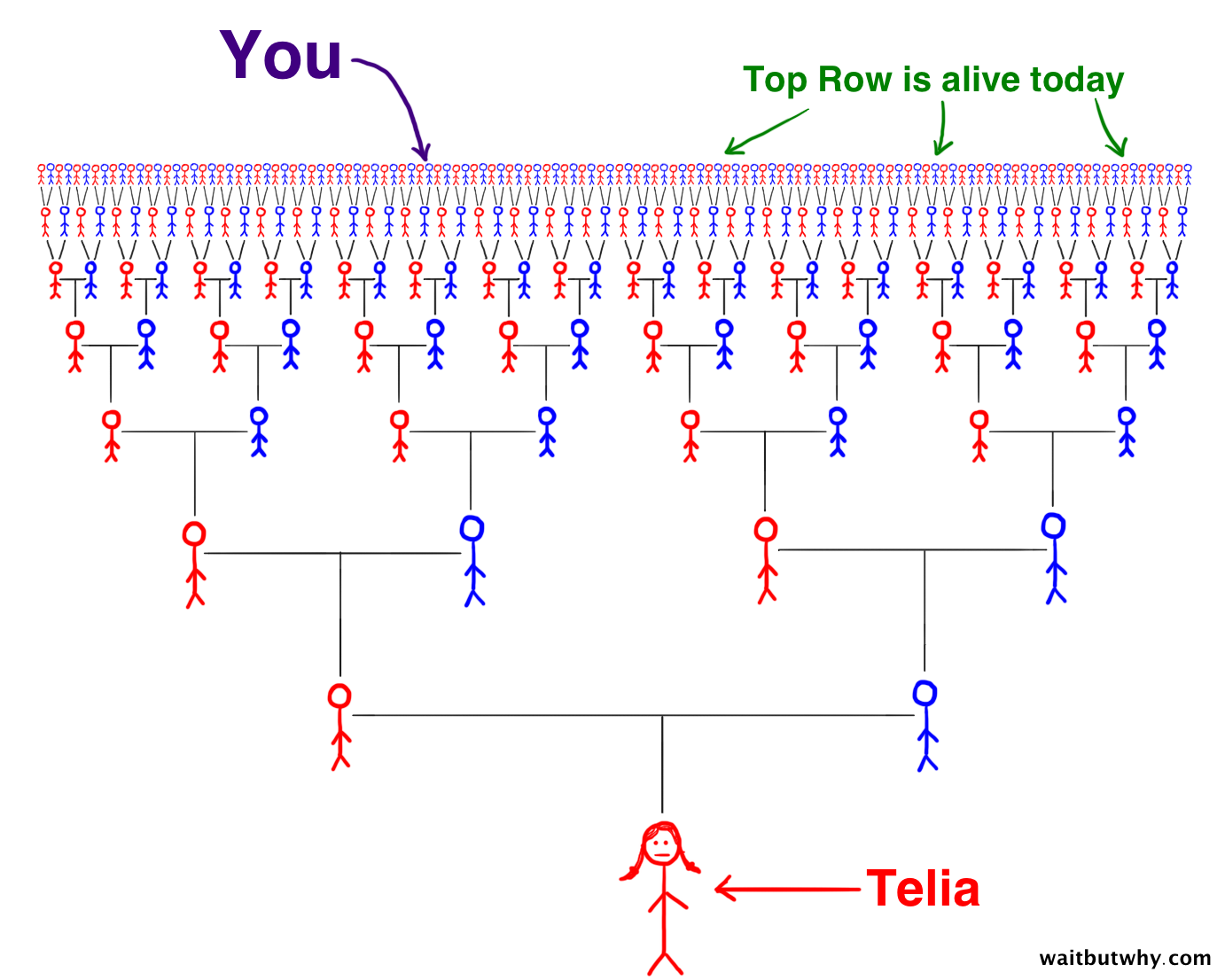
Telia Ancestor Cone showing you in the far top row with hundreds of other people alive today

Most of those people on the top line are alive today, and you have no idea who’s standing there on Telia’s top line with you—that guy who works at the coffee shop might be her great-great-great-great-great-grandparent too, the two of you just two of her hundreds of nameless, forgotten ancient ancestors.


Conclusions

  • Now I feel special and important and also I feel irrelevant and meaningless.
  • Writing this post has really hammered home the point that humans are mainly a temporary container for their genes. In 150 years, all 7,100,000,000 people alive today will be dead, but all of our genes will be doing just fine, living in other people.
  • After the first conclusion point, I was teetering on whether to feel good or bad about all of this. Then, I depressed the shit out of myself with the second point. But to throw my moping ego a bone, I’ll consider an interesting idea, that my descendants might not need to ask their Nana questions to learn about my life and get to know me a bit—technology changes everything. In 100 years, my great-great-grandson might be able to easily pull up all kinds of info/photos/videos and learn whatever he wants to, which I’m sure will be nothing because the last thing he’ll be thinking about is what his great-great-grandfather was like. Dammit.
  • In any case, for now, there’s really only one good way to learn about where you came from—so start asking.


_______

If you like Wait But Why, sign up for our email list and we’ll send you new posts when they come out.

To support Wait But Why, visit our Patreon page.

___________


Other WBW Posts That Put Your Life in Perspective:

Meet Your Ancestors (All of Them)

Your Life in Weeks

What Makes You You?


Explanation of the Cousin Calculation Formula

The formula is (n-1) 2d nd

—where n is the average number of children being had by a family and d is the degree of cousin you want to find the total number of.

It boils down to a simple multiplication of the number of top-level siblings [(n-1) 2d] times the number of “eventual offspring on your generation level” each of those top-level siblings ultimately produces (nd).

Example 1

For a first cousin, the “top-level” is one’s parents’ generation because that’s the generation where we move “sideways” in the family tree before heading “down” to the first cousins. In this example, the number of “top-level siblings” is the number of blood-related aunts and uncles one has, or the number of combined siblings of one’s parents. We get that number by multiplying the total number of children in an average family minus one (that will get us the number of siblings since subtracting the one removes the parent) times the number of our top-level ancestors we need siblings for (in this case, two, since there are two parents). So for a first cousin calculation, the number of top-level siblings if the average family has three children (n = 3) is (3 – 1) * 21, or two siblings times two parents, equals four top-level siblings.

The second part is figuring out how many eventual first cousins each top-level sibling will produce. Since we’re using an average number of children in a family, culture, or nation as a constant n, we just need to multiply each top-level sibling by n to get their number of children. Since their children will have the same number of children n, to go down two generations we would multiply the top-level siblings by n2—this can be simplified as nd. For first cousins, we’d just need to multiply by n once because we’re just going down one generation.

So to get the number of first cousins in a family that always has three kids, d=1 and n=3, and (n-1) 2d nd comes out to 4 x 3 = 12. This is correct because your parents have four combined siblings and each has three kids.

Example 2

To find the number of third cousins someone has if everyone has two kids, we make n=2 and d=3. Here, the top-level siblings are on the great-grandparent level, because it’s their siblings whose great-grandkids are your third cousins—it’s on the great-grandparent level that we move sideways and then down to get to our third cousins.

So the number of great-grandparent siblings here is (n-1) 2d = (2-1) 23 = 8. This makes sense because you have eight great-grandparents and each one has one sibling (since in this example everyone has two kids, or one sibling). Each great-grandparent has nd = 23 = 8 great-grandchildren (since we’re moving four generations down and having two kids at each step), so the total number of third cousins in this example is 8 x 8 = 64.

______

Sources

Richard Conniff. “Go Ahead, Kiss Your Cousin.”

The Straight Dope: 2, 4, 8, 16, … how can you always have MORE ancestors as you go back in time?

NationMaster Fertility Rate by Country

John E. Pattison (2007), Estimating Inbreeding in Large Semi-isolated Populations: Effects of Varying Generation Length and of Migration, American Journal of Human Biology 19(4):495-510

The chapter All Africa and her progenies in Dawkins, Richard (1995). River Out of Eden.

Read this next

177 comments

Leave a Reply

  1. Tyler Peter Wayne Titus Avatar
    Tyler Peter Wayne Titus
    Hide

    You only took into account people without offspring in your descendant cone, ignoring that reality in your ascendant cone. You need to take into account both pedigree-collapse AND dead-ends (PLUS some other scenarios you’ve failed to take into account) from the observers pov for both ascent AND descent if you want data that is not (or less so) cooked.

  2. Tammy King Avatar
    Tammy King
    Hide

    My grandparents were born in 1881,1883, 1878, and 1882. Go figure again!

  3. Darcy Reeder Avatar

    Love your blog; have read it for many years, but I really don’t think you’ve got the evidence to make this claim: “The widest point of the Ancestor Cone happens for most of us around 1200AD”

    I looked at your attribution. You link to The Straight Dope, where they base the 1200AD idea on a 1978 estimate by demographer Kenneth Wachter (whose name they misspell). I read a bit more about Kenneth Wachter and found that his analysis that’s being referenced here (“Ancestors at the Norman Conquest”) was specifically about England, which he viewed as a closed society without immigration, and he based his assertion of low level of cousin marriages in England at the time on his own family tree.

    So your “most of us” assertion seems unjustified by the evidence, and also quite Anglocentric.

  4. PM Avatar
    PM
    Hide

    Wow! This is really amazing post!

    I’ve been very lucky and got a chance to spend a lot of time with few of my grand-parents and was able to get some great stories. I use MyHeritagre site for our vast family tree (over 3,500 people…dating back to 1250 ad).

    I never looked at the Math, but your post has just introduced a whole new thing for me to work on. Gosh, I wished I had found this back in 2014.

  5. Jerome Barry Avatar
    Jerome Barry
    Hide

    One 1st cousin married a Ugandan, another married a Japanese. I figure I’m not much more than 20th cousin to everyone living on earth today.

  6. Max Holland Avatar
    Max Holland
    Hide

    Antidote to the (reductionist and scientifically incorrect) perspective “humans are mainly a temporary container for their genes” – https://www.researchgate.net/publication/279250151_Anthropologies_as_Stories_of_Life

    Biggest take-away from Tim’s article – the “individualism” of the US and some other cultures is way off…

  7. Paul Avatar
    Paul
    Hide

    Great post. My Dad died very suddenly in 1990, Mum after a short illness in 2001. I am now trying to organise Mum’s collection of old photos. Many are blank on the back, most of those she did write on (I think one of my sisters suggested it to her in the late 1990s) have first names only, knowing who is who is hard. I know more about Mum’s ancestors than Dad’s (he travelled a long way to be here), so I’m glad you had that chat with your Nana.
    A bit of Mum’s family tree has a father and son combination both called Moses. I think I read somewhere that this kind of thing leads to stories of very long-lived people in the past – the father (or even grandfather)’s birth record is found, the son’s death record, and nothing in between.

  8. Riggls Avatar
    Riggls
    Hide

    A family story — My paternal grandmother (Ruthie) always said her husband (Quig) was a “son of immigrants”. So I had this story in my head that great-granddad, from Germany, met great-grandma, from Scotland; they married and had 3 children. They had a small grocery store in Reading, PA; the family lived upstairs.

    After Nana Ruthie died in 1987 (age 93), a relative of my father’s sent a little book about the geneaology his family. That book said the first Stavers (or Stoevers) came to America in the early 1600s. So, I sat there and wondered why Ruthie said that Quiq was son of immigrants. Then it occurred to me — she could claim being descended from the original Pilgrims. So anyone after that was an immigrant.

    This certainly explained her “son of immigrants” jabs and showed her hubris of being a Daughter of the Mayflower!

  9. Riggls Avatar
    Riggls
    Hide

    This post about families (going back and going forward) was fascinating. The hardest fact for me to digest is that at 73 I’m the oldest living person in my family tree. Three of my four siblings have died – the only living one will turn 65 next November. Three first cousins on my mother’s side have pre-deceased me. There are 4 first cousins on my father’s side who are younger than me and might still be alive in their 50’s and 60’s. I’ll have to ask my daughter, who keeps up on all family things.

    My parents passed in 2017 (both of them age 96); My four grandparents (whom I knew) died in the 1970-1980 range. I knew one great grandmother who died at 99 in 1964. My family has done quite a bit of geneaology, some of which I have access to.

    My father’s father family traces back to the late 1600’s when 2 brothers emigrated from Germany. My father’s mother claimed a relative who came over on the Mayflower. (so she was more than Daughter of the Revolution; she was Daughter of the Mayflower.) My mother’s family was traced back to the year 1,000 when Ethelred the Unready (probably a Celt – so England/ northern European) was the patriarch. But I no longer have the “tree” that two Great Uncles created in the 1960’s.

    I have family stories back to great-grandparents. So I’m pretty lucky.

  10. TerriLeeNC Avatar
    TerriLeeNC
    Hide

    Another fascinating post – you have an amazing mind! But all I can think about is how LUCKY you were that your Nana could still tell you stories about your family, and you thought to ask her. My sweet 90 year old Mom has dementia, and oh, how I wish I’d recorded the family stories I barely listened to, before she forgot it all. Please: Ask your parents and grandparents to tell you their stories while they still can, and write them down/record them!

    1. A Life Untold Avatar

      I totally agree with you on this! I also wish I could have asked my grandparents about their life, but didn’t have the foresight and now it’s too late. I did sit with my parents though and asked them every question I ever wanted to know. I got so much out of the experience that I started a business because of it (www.alifeuntold.com)!

  11. Moorthy Vivek Avatar
    Moorthy Vivek
    Hide

    Awesome…Never knew that you were my cousin. Nice to meet you Tim..

  12. Grandpa^20 to all humanity Avatar
    Grandpa^20 to all humanity
    Hide

    We should also consider the future analogy of pedigree collapse. Assume the human population stabilizes to a value around 10billion in the next century as is predicted. And according to Tim’s graphs above it takes about 750 years to accrue 10Billion ancestors. These two facts together suggest the following amazing symmetric fact. Every person alive in 2800AD will be descended from every person alive today.

  13. Dario Impini Avatar
    Dario Impini
    Hide

    Your ancestors contribute to who you are — what you look like, how smart you are, the color of your eyes, hair, skin, the size of your nose, how hairy you are, and… what about…”YOU”? That is, that internal self aware consciousness that is you? If your father was someone else, it would be someone else that was born, and not you. A completely different person. But what about your grandfather or grandmother? Would you still be…”you”? What about 3 or 4 generations back? 1/16 of your identity… would you still be “you”? Would you still be here as your self aware identity? Or would you be someone else? What about 9 or 10 generations back?

  14. Traline DeMon Spencer Avatar

    After reading this it makes me question having a genealogy dna test to see where my ancestors came from. Doesn’t the exponential growth of your family tree make it incredibly hard to pinpoint 1 single country of origin? Or maybe I’m not aware of other processes that makes those test accurate.

  15. Traline DeMon Spencer Avatar

    After reading this it makes me question having a genealogy dna test to see where my ancestors came from. Doesn’t the exponential growth of your family tree make it incredibly hard to pinpoint 1 single country of origin? Or maybe I’m not aware of other processes that makes those test accurate.

    1. Traline DeMon Spencer Avatar

      I wonder why my comment got 8 down votes. Nothing is said was controversial or bad. Weird.

  16. Nilay Avatar
    Nilay
    Hide

    I would expect that our ancestor cones are narrower than the full world population around 1200, and reach their peak width much closer to present day. Most of our ancestors likely lived in the same area/community for many generations or at least the same country/continent – so our distant ancestors would likely be clustered into a smaller number of people, not just through running into world population barriers, I think. Also, I wonder how changing trends such as having fewer children and upcoming patterns such as climate change/likely shrinking populations in generations to come, etc. would influence the descendant tree into a smaller tree for most of us.

  17. Antonia Rosina Gauer Avatar
    Antonia Rosina Gauer
    Hide

    My parents were first cousins! It was legal back then and may still possibly be in the UK.

    1. Millie Avatar
      Millie
      Hide

      Not sure why you’re singling out the UK here. Cousin marriage is still legal in many countries, and in 26 US states, so…

  18. GuccizBud Avatar
    GuccizBud
    Hide

    So it’s okay if I boink my cousin then? Aw-riiiight !

  19. Jenny Fynn Avatar
    Jenny Fynn
    Hide

    jennyfynn@global.co.za

  20. Melayahm Avatar
    Melayahm
    Hide

    Sorry, I started to zone out when you got to the algebra, but I came back for the end!

    1. Mary Buerkley Avatar
      Mary Buerkley
      Hide

      A GOOD READ. puts things in perspective, now genealogy is more important than ever!!!! I want my descendants to KNOW ME! (will they, really?)

  21. A Life Untold Avatar

    So true: “I don’t know you, but I can almost guarantee that you don’t ask your grandparents (or older parents) enough questions about their lives and the lives of their parents.”

    This is exactly why I started A Life Untold, giving everyone an easy guide to interview loved ones and turn the conversation into a beautiful hardcover book. You can check it out here: http://www.alifeuntold.com

    1. Traline DeMon Spencer Avatar

      Such an amazing idea for a gift. All of my grandparents are dead and my dad recently got diagnosed with Alzheimers and age related dementia. We have a lot of heart disease and diabetes in our family so most die around 60 – 65. I have sickle cell so my life expectancy is around 45. I wish I had asked more questions from my family but better late than never. I’m on a mission to gather every scrap of information and every story I can find. Your site is an answer to my prayers. Lol Thanks!

  22. JD Eveland Avatar
    Hide

    I’ve been doing genealogy research for several years through ancestry.com. Recently, I came across an interesting connection – a man born about 1630 who is a common ancestor of mine through both my maternal and paternal lines of descent. I wrote about this in a column called “Fun with genealogy” (https://bit.ly/2rmKi6F if you’re interested in the details). I also discovered that I’m about 1/48 or so Mohawk, despite being otherwise almost entirely of English and German ancestry. I’m not sure it proves anything, but family stories are fun, and do help us to understand if only a bit how we got to be who we are.

  23. FrankieF Avatar
    FrankieF
    Hide

    Sometimes when I’m spending hours on genealogy research, I do wonder if that time would be better spent with my living family. I can trace my tree back a few hundred years in different directions. Something I find odd/depressing while I’m tracing the tree is that if I look at all of the hundreds of descendants of my great great great great grandfather, many are alive today but I feel very little interest in making contact with them because, well, we’re barely related. If I flip the tree, would my 4th great grand father have any interest in speaking to me if I could meet him, e.g. if heaven existed like in the movies? He’d have his own kids, his own ancestors and even with infinite time, I doubt we’d do more than have a coffee every century or two.

    1. Mary Buerkley Avatar
      Mary Buerkley
      Hide

      this is fascinating!!! there’s a case recently of a teenager who had died, but came back afterwards, and he talked of meeting his ‘anscestors’!!! yess, he knew they were his relatives, and they were so happy to meet him! that was so comforting, our ancestors will know we are theirs!!!!!

  24. Milan Avatar
    Milan
    Hide

    The formula seems to be incorrect. With the given example of 2 kids per family and counting for 3rd cousins (n=2, d=3) writing it out and counting the number of 3rd cousins will yield 16 (see image) instead of the predicted 64.

    I propose a different formula: 2 (n-1) n^d
    Let’s break it down.
    2: You have 2 sides of your family, one from each parent, so you need only count the cousins from one side then double it to get your final count.
    n-1: You need to exclude “your side” of the tree that falls too close to the degree you’re computing for, e.g. counting 1st cousins and assuming 2 kids per family, your grandpa has 2 kids (one of them is your dad) and both of them have 2 kids each but you’re only interested in counting the kids of your uncle so you deduct your dad at the start (2 kids aka dad and uncle -1 dad). Another example, counting 2nd cousins and assuming 3 kids per family, you’ll want to exclude your grandpa from the count of kids in his family (3 kids -1 grandpa) so that you won’t include your 1st cousins (kids of your 2 uncles) or yourself and your 2 other siblings. This is the same as with the original formula.
    n^d: The number of eventual kids of your generation. If there are 2 kids per family and you’re looking at the first cousins, that’s 2^1. 2 kids per family, second cousins, 2^2. Again, this is the same as with the original formula.

    So with the formula above, if you’re counting 3rd cousins with 2 kids per family you get:
    2 (2-1) 2^3
    2 (1) 8
    16

  25. richardlhartig Avatar
    richardlhartig
    Hide

    ^^^^^Home incom source by why… <..~~~.. Find Here

  26. DonaldSNelson Avatar
    DonaldSNelson
    Hide

    ^^^^^Reset your job with waitbutwhy.. < ***** Find Here

  27. ChrisJHenning Avatar
    ChrisJHenning
    Hide

    Last 40 year Best Home Income with waitbutwhy.. < ……. Find Here

  28. KathrynDAshby Avatar
    KathrynDAshby
    Hide

    Last 40 year Best Home Income with waitbutwhy.. < ……. Find Here

  29. Jr. Avatar
    Jr.
    Hide

    If you think about it a little, its sad to think about the chances that a distant cousin has killed his greatest cousin who decided to text and drive.

  30. LaurineEBailey Avatar
    LaurineEBailey
    Hide

    …..All time hit the waitbutwhy Find Here

  31. StephanieCCarr Avatar
    StephanieCCarr
    Hide

    ….All time hit the waitbutwhy Find Here

  32. Tipsy Avatar
    Tipsy
    Hide

    Richard Dawkins in the references, boo ya.

  33. Steve Weeks Avatar
    Steve Weeks
    Hide

    In my part of the US throw in the late 1800’s polygamy issue for a small section of southern Utah/Nevada and you have a hell of mess figuring out who belongs to who.

  34. moshe hill Avatar
    moshe hill
    Hide

    i’m not sure how much cross-over audience this site has with The Flash tv show, but essentially they made a direct correlation between a character and one of his 128 great great great grandparents. i didn’t buy what they were selling, because of this article.

    1. androphiles Avatar
      androphiles
      Hide

      We only have 32 great-great-great grandparents each. We have 128 5x great grandparents.

  35. Eolande Eliva Avatar
    Eolande Eliva
    Hide

    In my years working as a nurse I’ve felt incredibly privileged with the life stories I’ve heard. I often encouraged people (especially the elderly), to record their stories for future generations. I’m grateful my father did this but sadly was adding more detail, when he died suddenly. Through him, I discovered I was related to the Captain of the Titanic..tho that’s probably not something to boast about. LOL

  36. Marek Kaszycki Avatar
    Marek Kaszycki
    Hide

    One word of comment about pedigree collapse. It doesn’t have to involve first cousins or even second cousins. First and second cousin marriages would have been rare, primarily occurring between nobility, but incest was forbidden since ancient times. If it’s common to marry third cousins (who might not even know they’re familty!) still reduce the number of grandparents. It’s easily possible to trace lineage of a person to maybe just 100 people in the great^10 granparent level, possible if they lived in a relatively peaceful country, and their heredity would not include any marriage between first or second cousins.

    1. Abraham Avatar
      Abraham
      Hide

      Yes, that was my point, though I allowed first cousins couples to see how it collapses faster. I am mildly interested in the actual maths involved.

  37. Chris Renaud Avatar
    Chris Renaud
    Hide

    I wonder if there would be some way to change the average sibling size between generations for the formula? For example I know almost all of my grandparent’s generation has an average of 1.2 siblings (about) but my mothers generation has an average of 2+ for sure
    Anyway interesting post, and though I do know a bunch of my second and third cousins, its cool to think about how many I dont know

  38. vanshaak Avatar
    vanshaak
    Hide

    Why did you have to repost this now? My grandma died last month, you asshole. Now I can’t ask her anything. Nah just kidding, she had dementia anyway.

  39. Bob W Avatar
    Bob W
    Hide

    Interesting stuff. My mom simply wrote a life book when she was around 80 with my sister’s help. It went back to her beginning in 1920. Her grandchildren read it at her bedside as she died.
    I knew dad and his parents pretty well and much of their history.
    Here is a pretty amazing fact —
    I knew my grandparents well and grandpa was born in 1890. I hope to know my grandson fairly well. One of my current sons is 7 years old. If he has a child at age 31 and that child lives until age 100, that means I will have known well people who lived from 1890 to 2140 a span of 250 years. I consider that my knowing people span. At our current rate of change that essentially covers 99.9% of all we will have learned as humans.
    Here is a more amazing fact —
    There are at least 8 known people alive today whose fathers not only lived during the civil war but fought during the civil war. How amazing is that. The math is pretty basic.
    They fought at age 16 in 1865. They fathered children in 1935 at age 70. Their children are now 80. (actually they are older and the numbers are not exact) There are 100s if not 10s of thousands of people alive today whose fathers were alive during the civil war.
    One thing you neglected on you numbers was to figure in for people whose great grandfather was also their father. This is actually a pretty common historical deal for the same reasons you mentioned that people don’t like to travel far. So a man has a child (often dozens of children with 10 wives) his children have children, they have children and then as a 70 year old man he ends up fathering a child with his great granddaughter. Not that uncommon. Don’t forget that first cousins were and still are very common. In breeding is the primary reason that breeds develop specific looks, characteristics genetic issues.

  40. Ric Skinner Avatar
    Ric Skinner
    Hide

    Now I completely understand this thing called “genealogy”. And from this excellent dissertation I draw 2 conclusions: (1) Sex is hereditary, and (2) If your parents didn’t have kids, chances are you won’t either.

  41. naath Avatar
    naath
    Hide

    Looking at the history of the British royals odds-on one of Harry’s grand-children might end up married to the monarch… (more recent events suggest this is rather less likely)

  42. Pirate Avatar
    Pirate
    Hide

    I just can’t believe how mistaken this article is in assuming that somewhere in the 1200, all of the human population had something to do with you.

    First of all, transports were not developed. If you lived in Asia, 99% of your ancestors are Asian and you have very VERY little chance of having African or westerner ancestors. Same goes for any continent (except those where people migrated to, like the US).

    In Europe, there are many many regions where EVERYONE’s ancestors have always been from this particular region, even if it’s been invaded by armies who may have raped women, the highest likelyhood is that women carried children of men from their region (+ a soldier wouldn’t travel millions of miles in a lifetime either).

    Also, if your dad’s 2 brothers married your mom’s 2 sister and you marry one of your cousins, your children marry one of the other cousins (as you said yourself, this was often the case with forced marriages), your children’s chidren will ALL only have 4 great great grand parents , Instead of 16 as you assumed it..

    So your theory of having millions of ancestors in the 12th century is completely inadequate, there are millions, maybe billions of people who have no other common blood with each other than when cavemen tribes split up hundreds of thousands of years ago.

    Please study a little bit about the movements of populations throughout history before writing such non-sense assuming that genealogy is mathematic..

  43. drklassen Avatar
    drklassen
    Hide

    Note that in genealogy circles, the terms grandaunt and granduncle have
    been adopted for the titles of your grandparents’ siblings instead of
    starting right out with great. That way, the number of great’s tells
    you the generation without an offset based on direct or indirect
    lineage.

  44. Mary Kissane Avatar
    Mary Kissane
    Hide

    Your urge to question your last remaining grandparent reminded me of a wonderful quote, said to be an old African proverb, “When an old man [or in your and many of our cases, an old woman] dies, a library burns to the ground.”

  45. Abraham Avatar
    Abraham
    Hide

    You mention pedigree collapse and ipso facto you ignore it. Take for example a small isolated village of about 3000 people. If you do that kind of maths, you expect it to collapse at the 12th generation. It is not like this. It depends on the consanguinity usual relationships. Siblings are not generally allowed to couple, but sometimes happens. First cousins are allowed to couple, but it is not well regarded, except for very small villages. And then, up to second cousins, everyone is allowed to couple with relatives. It can also happen that two siblings are of different age enough that the childs of one sibling can couple the grandchild of the other. The point is that some people take several roles in your genealogy, many more when you get to 3rd grade. You may not notice it because you usually don’t look past your grandparents.

    This is happening all the time in every generation. So, for your grandparents you can have up to 4, sometimes 3 (3,99 likely, because siblings breeding is not so common). For your grand-grandparents you can have up to 8, but 6 or even 5 is possible. Let’s say 6,5 (in a small village, cousins coupled is common). For your grand grand grandparents you take the list of possible grandparents for your parents (6,5 each one), add it (13) and take off the couples that are made from people that existed before in that list (30%?). So, now, it can happen that you have 16 g-g-grandparents, but it is more likely to be 9. For the next generation you have even more people in your list that can share couples, so even if your 5th grade parents can theoretically be 32, they are more likely to be 9 again, the same number as your 4th grade parents. Eventually, every people in the village is going to be related to each one, but it doesn’t happen so fast as your exponential growth was implying.

    This for a small village. In a town or city you need several more generations to watch the collapse, but the maths are the same.

    PS: It is not so easy to be king related.

    1. Abraham Avatar
      Abraham
      Hide

      Sorry, I mistook a number. If your parents are siblings, then you have only 2 grandparents, not 3.

    2. Annie Blanchard Avatar
      Annie Blanchard
      Hide

      Charles Darwin married a first cousin. So did Albert Einstein. First cousin marriages were NOT that uncommon nor were they only for royalty (someone else said). Perfectly acceptable until recently. And still going on, just not done openly. I found this out when researching ancestors in the US who married first cousins in the mid 1700’s. Also not that uncommon among those who came over on the Mayflower and their descendants.

  46. Wolf Hayfield Avatar
    Wolf Hayfield
    Hide

    End would have been different if you had written the AI Article before that XD, nice Post

    1. Tim Urban Avatar
      Tim Urban
      Hide

      Yes.

  47. Niels Monberg Avatar

    This great post reminded me of an image I got a while ago. It is imagining that I held hand with my father as he was my age, and he held HIS father at that age, and so on. If a generation is, say 25 years, and it’s been 100.000 years since humans emigrated from Africa, the line of generations would be less than 4 kilometers long. I got to wonder how that line would look? i guess pretty alike in the oldest end, and only a bit diverse in the newer end.
    Bu it amazed me that it is no longer than that. I hope I have gotten you startet with this, Tim.
    Love your blog, and can’t wait to see what you have got for us after your absence.

  48. William Allman Avatar
    William Allman
    Hide

    I only have one correction–20 years is considered one generation, not 25-30. It’s only been in very recent times that people wait that long to have children. For the vast majority of human existence women had children soon after puberty, for the simple reason that the average life expectancy was only about 40-50 years.

    1. CyrixInstead Avatar

      Which makes the stats even more mind blowing!

    2. jimfetterolf Avatar
      jimfetterolf
      Hide

      In natural societies puberty comes later, maybe around 18, then women have children ’til they die, around age 35 or so in childbirth. So 25 is a reasonable average generation. Me and my siblings cover a ten year spread, but our average generation would be in the middle.

  49. Larry S. Avatar
    Larry S.
    Hide

    Interesting article about this subject in the May 2002 issue of The Atlantic:

    http://www.theatlantic.com/magazine/archive/2002/05/the-royal-we/302497/

  50. olddockeller Avatar
    olddockeller
    Hide

    The other interesting factoid, though, is how mitochondria and the Y chromosome meander through that mix of ancestors. ONE male of those 4096 people in the 1600s had my y chromosome, and ONE female had my mitochondrial DNA. I wonder who?

    1. Parker Avatar
      Parker
      Hide

      Excellent point. I think in our haste to rend the standing patriarchy we have neglected the obvious fact that patriarchal and matriarchal direct lineage is a major determiner of who we are and the order of society past, present, and future. As DNA testing expands and more unique markers are identified against solid genealogical research the truth will out as it were.

  51. Helen Holshouser Avatar
    Helen Holshouser
    Hide

    Just incredible! thank you so much! I might have to share this like a hundred thoughsand times! LOL

  52. happyscrapper Avatar
    happyscrapper
    Hide

    Awesome article!!! Thank you!

  53. Chris Avatar
    Chris
    Hide

    What about ethnicity. Would the formula change? I’m Asian & I heard that Genghis Khan fucked everyone he could. So the cone should look a bit different as it transcends downwards. Probably like 1 blue stick man at the top & all the reds representing the women he violated during his drunken stupor after each victorious conquest.. then the following generation would also be a tangled mess of web, if he still managed to get it on..

    1. Parker Avatar
      Parker
      Hide

      Excellent point. Amazing how many die without children and equally amazing the psychotic lengths some megalomaniacs go to in order to satiate their appetites. Not to speak ill of anybody’s ancestors…

    2. redape Avatar
      redape
      Hide

      Not entirely true. The Genghis haplogroup was shared between Genghis and many others in his clan…perhaps hundreds. That means the Mongols as a group simply had to have many matings with women of those they conquered. And I think it’s still only about 12% of the Asian population with that haplogroup.

  54. […] came upon this piece a little while ago and realised that it in some ways paralleled my own interest in genealogy. […]

  55. Jack Liu Avatar
    Jack Liu
    Hide

    So…. How many years later will I have my genes in the entire human race?

    1. NA Avatar
      NA
      Hide

      You already do, except it’s backwards. All life shares the same common ancestor and therefore components of that ancestor’s genes, if you go back far enough. You share about 99.99% of your genes with all other humans. You also share about 50% of your genes with bananas.

    2. Chris Avatar
      Chris
      Hide

      I guess if you are Genghis Khan, you already spermed the whole asian population with your DNA. But then again, you are Jack Liu,

  56. MutantHuman Avatar
    MutantHuman
    Hide

    However, we are now at a turning point. In previous ancestry, all genes were passed via sex and random mutations. Going forward, we will manufacture genes that never existed, and incorporate them into our family trees. Should be interesting!!

    1. Parker Avatar
      Parker
      Hide

      in-Corporate is definitely the right word for it…

  57. Toti Avatar
    Toti
    Hide

    Lol i could say i literally lived this post…i went back to italy last year in search of my ancestors and ended up hooking up with my mom’s third cousin (who’s about my age because his grandmother – my greatgrandfather’s first cousin – gave birth to his mom at about 45). We’re still together and as happy as can be, it makes xmas and birthdays commitments so much easier!

  58. […] A different way of looking at your family; how many people around you might actually be a 5th or 6th cousin? From my favourite blog, Wait But Why: Your Family: Past, Present and Future […]

  59. ur2tents Avatar
    ur2tents
    Hide

    This article confirms what I’ve always sensed. Unless you’re Samuel Clemens (or any brilliant person

    who’s genius is recognized and acknowledged), you’re forgotten in a few generations. Doesn’t matter how many kids you have.

  60. Beelzebub Jones Avatar
    Beelzebub Jones
    Hide

    this whole topic was an obsession when i was a kid. the millions of great great great…great grandparents. the obvious cross pollination that had to happen and the realization that we are all cousins. love the way you dissected and graphed it. thank you.

  61. Mukesh Avatar
    Mukesh
    Hide

    I stumbled on your website accidentally. After reading first article I am hooked to your website. I am going through your all old articles one by one. This post reminds me a billboard signs I saw which says something like “If we go back far enough all of us are related”

  62. […] Your Family: Past, Present, and Future […]

  63. […] Your Family: Past, Present, and Future […]

  64. Susan Brown Avatar
    Susan Brown
    Hide

    Did you factor in the probable fact that even though there are two parents for every person, due to the primitive proclivities of men past and present, one father may have scores of offspring who have no idea that the reason they have so much in common is that they are half siblings. This will collapse the tree somewhat.

  65. […] avós e antepassados em geral, mais percebemos o quanto nós somos ignorantes sobre eles. Há um post em um blog que eu adoro, que fala justamente sobre isso:“But I also used the visit (to my […]

  66. Elaine Avatar
    Elaine
    Hide

    I find asking a specific question then standing back and listening brings the best results. One really interesting question I suggest everyone asks their parents and grandparents is: how did you meet your partner? Until modern times, most met someone from the same or the next village; since WW1 my family have travelled and been finding partners from other communities; also occupations suddenly changed from generations of farming to almost anything

  67.  Avatar
    Anonymous
    Hide

    There was a girl with the same last name in the same year in my high school, and my parents had no idea who she was (as far as my dad knew, both his parents came over from Italy by themselves without others in the family). However, there are probably thousands of people with my last name in Italy, so there is no doubt we are related on some scale and just had relatives come over to the US at different times, and coincidentally ended up living in a similar area and going to the same high school at the same time. Very weird to think about.

  68.  Avatar
    Anonymous
    Hide

    Not everyone’s DNA will still be rolling along in three centuries. We are wiping out small pockets of indigenous, traditional people and cultures at an alarming rate. They are probably repositories of some of the greatest genetic diversity on the planet due to their isolation and lack of cross-breeding with the rest of us in the developed or developing world. Some have unique adaptations to climate, disease, and other conditions. Besides their inherent right to exist and maintain their way of life, we should also consider protecting them to protect the resilience of the human gene pool.

  69.  Avatar
    Anonymous
    Hide

    My mother has often told me about her family being thrown out off the house while she was still sitting on the toilet, and they were banging on the toilet door. In The Netherlands people employed by some farmer lived in one of the small houses on the land of that farmer, so when the farmer fired the man in the family (in my grandparent’s case, because the government had decided on a 5-day week, so my uncles wanted a 5-day week, as they were allowed by law, but the farmer didn’t want to give it to them_ the whole family was thrown out of their house. It was post WWII, and new houses were being build, so my mother and her parents and siblings had to stay for a while in a large public building until a house was finished and they were alowed to live there. My grandfather and his sons started working in the city in construction, ‘cos there was a lot of work in construction just after WWII. Still, my father had to sue his former employer to get at least part of the money he was owed for all those years of work for that farmer.

  70. arnold Avatar
    arnold
    Hide

    Great post I really enjoyed it

  71. […] “Now I feel special and important and also I feel irrelevant and meaningless.” https://wait-but-why-production.mystagingwebsite.com/2014/01/your-family-past-present-and-future.html […]

  72. TonyV Avatar
    TonyV
    Hide

    Two thoughts on the comments above.
    Don’t worry too much about being related distantly to unpleasant neighbours. I only had to go back 3 generations in my family to discover an ancestor who would have been imprisoned for many years in modern times for his cruelty and criminality. You need to worry about your own family maybe more than your neighbours.
    I had my DNA sampled a few years back in an effort to link to a well-researched family with the same surname because I’d hit a brick wall. It failed. We weren’t related. Later I discovered so many examples of births out of wedlock that I started to consider how much we really know about our ancestors. For example was the man I thought of as our grandfather actually the father of my father? if the answer for whatever reason is “no” it doesn’t change the maths but it sure as hell changes the things you thought you may have inherited from the grandfather you you knew. Maybe that’s why my DNA search was negative…I was looking under the wrong name!

  73. Me Avatar
    Me
    Hide

    Fit a loada pish. I acnn trace my family tree backs to viking days without payin this lot.

  74. […] and we’re all cousins. Check out the charts on Wait But Why. I think we should plan a planetary-wide reunion […]

  75. GreenT Avatar
    GreenT
    Hide

    I was just remarking to my boss the other day how sad it is that most people have no clue about who their relatives were just 120 years ago. So, I loved this post because it gives my world some context, if not names and faces. I’m a 51-year old adult adoptee, married with 3 step-daughters (whom I love dearly) and my first biological child on the way. So, it’s pretty cool to see that I’ve now got a chance to “cone” in the genetic sense too. But it begs the question: if we can now conceive that we’re all real-as-shit cousins, why the hell do we continue to hurt each other? (Yes, I know, you always hurt the ones you love. But seriously.) You’d think that may be Putin or Kim Jong-whatever (or even Dick Cheney) might say, “Oh wait, hold up. That’s my cuz.” But no. Why not though? Are we simply just a bunch of genetically violent bastards who killed and ate all the Neanderthals and, hey, when famine hits one day, you’re next? Or what? There’s a post I’d like to read.

  76. […] https://wait-but-why-production.mystagingwebsite.com/2014/01/your-family-past-present-and-future.html […]

  77. SMDXS Avatar
    SMDXS
    Hide

    It was all so so interesting when I was the center of attention. Then you throw the last graphic up there and just blow my mind. I mean literally. Mind. Blown. And by literally I mean the new definition of the word, not the literal definition of the word.

  78. Verity Violet Avatar
    Verity Violet
    Hide

    What about all the wars, and things like the Black Death (plague) during medieval times, in which about a quarter of the earth’s population at the time died? Wouldn’t that make a difference to some of those huge numbers in the charts?

    1. Verity Vi again Avatar
      Verity Vi again
      Hide

      OOps, sorry, I forgot I’d already left a comment. Just ignore the second one.

  79. Satyender Avatar
    Satyender
    Hide

    You are mentally sick and i love you man:)

  80. Verity Violet Avatar
    Verity Violet
    Hide

    Maybe this is a silly question, but you don’t seem to factor in historical events like the major wars, and the Black Death of medieval times, which took out a sizeable chunk of the earth’s population — wouldn’t this have left some noticeable gaps in the ranks of those enormous numbers in your charts?

  81. […] An interesting confluence of topics and ideas has emerged in some recent articles I’ve read. While I was working my way through the December 2013 issue of the Association of Professional Genealogists Quarterly, The New York Times published A.J. Jacobs opinion piece, “Are You My Cousin?,” and then a client pointed me to the blog post at Wait But Why titled “Your Family: Past, Present, and Future.” […]

  82. Maria Antonia Marturet Avatar
    Maria Antonia Marturet
    Hide

    This is by far your best article, loved it! Great work!!

  83. Derek Avatar
    Derek
    Hide

    I enjoy thinking about the fact that we think technology will allow people of the future to see all this information we are creating, and yet to somebody 4000 years from now will they have any idea what a CD or hard disk drive contains? Imagine knowing nothing about CDs, and trying to decipher what they were used for. They are shiny, have colorful pictures and text on them, and some patterns. Artwork? Decorations? Money? Signs of personal affluence? And how many items that we currently find from 4000 years ago do we make those same assumptions because they are shiny, have colorful pictures and text, and some patterns…

  84. Penny Avatar
    Penny
    Hide

    An interesting snippet about the British royal family is that Prince Philip, the Queen’s husband, is in line to the throne. So an extended set of assassinations and accidents could result in him inheriting the throne from his grandson. However he is about position 600, and he is in his nineties, which means it’s a bit late for him to do anything much if he did become king.

  85. Jenn Avatar
    Jenn
    Hide

    This was fascinating!! I do have one question about the math though… I understand how the family tree is narrower at the top because of the cousin marriages, but if the 80% of all marriages are cousins, wouldn’t that stay somewhat consistent over a number of generations, preventing the widening of the family tree in the middle? Nerdy question, I know, but thats where my brain went. 🙂

  86. […] Your Family: Past, Present, and Future This is pretty cool but be aware that it makes a bunch of assumptions. […]

  87. Marianne Avatar
    Marianne
    Hide

    My brain just exploded- augh!

  88. Panic monster Avatar
    Panic monster
    Hide

    Greetings from Brazil! Along with TIm Ferriss, your blog is the one and only amazing reads of the week!
    Keep doing the great job!

  89. Melanie Avatar
    Melanie
    Hide

    I shared this particular post with my Grade 9 class. We are studying genetics at the moment. They absolutely loved it!

    Melanie Blair
    Johannesburg
    South Africa

  90. Tim Avatar
    Tim
    Hide

    Wow, that’s amazing. Ouch, my brain hurts. Math sucks, I hate you.

  91. Marshall Avatar
    Marshall
    Hide

    Is there any way to account for unknown pedigree collapse? It would seem that were I to marry someone inside my ethnicity there would be at least some overlap in pedigree, even if we are 15th cousins.

  92. Chris Avatar
    Chris
    Hide

    Thanks for this. It’s absolutely fascinating!

    And to think I only signed up to follow your blog because of some amusing cat pictures!!!! 🙂

  93. Jeannie Avatar
    Jeannie
    Hide

    G’Day! I live in (almost) ‘outback Australia’ and after reading this article, I am probably related to everyone who has replied! Amazing read.

  94. Govndarajan Avatar
    Govndarajan
    Hide

    Fantastic. one should have both time and patience to grasp this lovely article.

  95. Andrew B Avatar
    Andrew B
    Hide

    I’m a relatively new reader to Waitbutwhy but this is why I love your writing. I get so absorbed. Awesome blog!

  96. pb. Avatar
    pb.
    Hide

    when i was in eighth grade, we had to do a social studies “culture” project where we recorded our family history. i interviewed my great-grandmother only months before she died and got a recording of her singing a cajun song and clapping, laughing and speaking in cajun french.

    the only issue with this is the most accessible recording technology for an eighth grader in louisiana in 1995 was cassette tape. so, now i have 4 cassettes of family members telling stories and who owns a cassette player anymore?

    1. Kumbah Avatar
      Kumbah
      Hide

      If you have access to Amazon.com (online), you can get one there, or at Radio Shack – but don’t wait too long, they (RS) filed for bankruptcy. Also, Goodwill or a thrift shop of any kind – or flea market – will do better, as the funds go to better use usually. I wish thee great luck ! 🙂

  97. Tom R Avatar
    Tom R
    Hide

    My father know all the family history going back a hundred and fifty years and who his second, third, fourth and even fifth cousins were because he grew up in an Irish village when knowing such things were important. But we never sat him down and recorded it. I have regretted it every day since he died. So ask your now before it is too late.

  98. V not for Vendetta Avatar
    V not for Vendetta
    Hide

    now I feel sick because most/all the shitty people I’ve met in the real life are probably my not-so-distant relatives. it’s like knowing that your are related to tape worms *reads some of the older articles* well poop.

  99. […] https://wait-but-why-production.mystagingwebsite.com/2014/01/your-family-past-present-and-future.html […]

  100. Leonard Avatar
    Leonard
    Hide

    I am going to use this in my Science class in a few months. I have been looking for material to augment a lesson on population growth and it is great. I will also check your math because that’s what I do, but I expect it will be fine.

  101. Deb Veight Avatar
    Deb Veight
    Hide

    I’ve been working n family tree or about 17 yrs. Now..
    And one thing hat I t infused with is the difference between
    First,second third cousins etc, and cousins removed?
    What are they being removed from? Eel like I’m being disowned…lol

  102. Deb Avatar
    Deb
    Hide

    Totally awesome post, which I appreciate as an amateur geologist and a science teacher. I enjoy the concept that I am the result of so many serendipitous event such as crop choices, and perhaps “the pretty girl wore a bone necklace at the tribal gathering that day.” The statement that 80% of all marriages in history were second cousins or closer seems realistic. At an event for the recovery of the endangered whooping crane, a geneticist from the Smithsonian told us not to fret too much about mutations in a population that has a small gene pool. He said the royal family of India (if I remember correctly) had been interbreeding for 2000 years. His comment was basically that “inbreeding will weed out the harmful mutations if you keep at it long enough”. It got a big laugh, but I would love to hear more data.

  103. Frank Avatar
    Frank
    Hide

    Hi,

    Thank you for this entertaining and enlightening post. Just a side note: not all languages count cousins the same way as English. In Russian a cousin is a brother or sister once removed, but the “once removed” part is often left out. In Icelandic frændi (male) and frænka (female) mean any close relative that’s not a brother, father or a son, i.e. there’s no difference between a cousin, an uncle or a nephew.

    Regards,
    Frank.

    1. Gene Avatar
      Gene
      Hide

      Not really. The “once removed” thing here means a generation apart, and in Russian first cousins are “cousins”, or “second brothers/sisters”, and they are of the same generation. Second cousins are “third brothers/sisters”, and so on.

  104. Gail Avatar
    Gail
    Hide

    Whoa! This whole post totally blows my mind! And I have been doing genealogy for over 40 years! I love the perspective of looking at my descendants and realizing that I could be neighbors with THEIR ancestors and never know it! It gives the term “family of man” new meaning.
    Gail at seezooeyrun.wordpress.com

  105. anon and anon Avatar
    anon and anon
    Hide

    I believe that the rules of succession to the throne of the UK have changed: now the oldest child of the current monarch, of any gender, is first in line. I think.

    1. CyrixInstead Avatar
  106. Tony Banks Aguma Avatar
    Tony Banks Aguma
    Hide

    Ur a genius…u plug up d holes n spaces in my lyf

    1. R1ckr011 Avatar
      R1ckr011
      Hide

      i heard you’re ideas and their definitely good

  107. rage Avatar
    rage
    Hide

    My grandfathers’ mind is narrowed down so much that he’s not really capable of ‘meeting new people’ anymore, and since I only saw him once a year on crowded familygatherings I would be ‘a new people’. Too bad, since I finally collected the courage to start visiting him and ask about his EPIC warstories. (once a jewish woman living in US sent me a message on facebook if I knew a family with my last name where she went into hiding during WW2 (afterwards she went to america). Turned out she hided at a family that was friends with my grandfather).

    My mothers parents are still alive and smart though. But get so much attention of their six children that i’m still very scared that they wouldn’t appreciate my company and would be too polite to say so. And I would be afraid too ask questions since I know my grandfather saw his father get shot by the Germans and my grandmother doesn’t really have a nice past as well.

    Maybe I should start being less of a pussy.

    Anyway: for procrastinators tuesday ends before office-hours on wednesday (when it goes for turning in schoolassignments it goes for turning in blogs as well), you studied at harvard, so probably live near it. NY time is gmt-5. I’ll check this blog at 8 + 6 = 14:00 on wednesdays Dutch time. Thank you!

    1. carolyn Avatar
      carolyn
      Hide

      @ rage.

      I am a grandmother, GO ask your grandparents. I will tell you a secret of a grandparent. THEY LOVE THEIR GRANDCHILDREN, even if they do not get to see them very often. THEY long for you to come and see them. I know firsthand. I have a teenaged grandson I do not get to see very much anymore, because he is a teenager and doing teenage things, which I am happy he is doing, but I miss him.

      Go see them, and give them each a hug and a kiss on the cheek. You will not regret it.

      1. rage Avatar
        rage
        Hide

        Hm. But would you feel the same when you had tons of teenage grandsons?

        (still, I will take your advice, thanx 🙂

  108. JES Avatar
    JES
    Hide

    Great article about a lot of the same stuff in The New Yorker, back in 1985 (subscription required to read online):

    http://www.newyorker.com/archive/1985/05/13/1985_05_13_051_TNY_CARDS_000341255

  109. DS Avatar
    DS
    Hide

    For some reason, this post took me to a sad place: those of us who had relatives die in the Holocaust or other genocide event have way fewer possible cousins out there.

  110. anonymous. Avatar
    anonymous.
    Hide

    I love how you ruin an article by “dicking around” early on. Lost me right there.

    1. CyrixInstead Avatar

      Your loss.

  111. Karina Avatar
    Karina
    Hide

    awesome

  112. […] you into genealogy? Not depressed enough? This hilarious article, Your Family: Past, Present, and Future, is sure to make you laugh and cry. Here are two quick snippets: “according to Rutgers […]

  113. Michel Avatar
    Michel
    Hide

    Great work Tim! Another awesome post!

  114. anonymous Avatar
    anonymous
    Hide

    “Walking, I am listening to a deeper way. Suddenly all my ancestors are behind me. Be still, they say. Watch and listen. You are the result of the love of thousands.” Linda Hogan (b.1947) Native American writer

    1. Voracious Reader Avatar
      Voracious Reader
      Hide

      Beautiful! Thanks for sharing.

  115. Ros Avatar
    Ros
    Hide

    Your brain is protecting you Tim: if you started each post knowing how EPIC and UNSTOPPABLE it was going to become, you’d never start. Thank you for a great read and for making my brain hurt, again.

  116. ragebol Avatar
    ragebol
    Hide

    not read it yét. Will do after this reply. But what does tuesday mean for Dutch time, GMT+1? At what time in the Netherlands is yóur tuesday finished? Or, where do you live so I can calculate it myself.

  117. Lashom Avatar
    Lashom
    Hide

    Your drawings are so fun to look at. So colorful. They make their points so clearly.

    I’ve read every post on Wait But Why and this is the first time I’ve commented.

  118. Diana Elizabeth Avatar
    Diana Elizabeth
    Hide

    I love this. I just asked my dad and mom if they would do video stories, they said yes and with documents (immigration and photos). I just learned that my great grandpa was the teacher for the Last Emporer of China. I would have never known. I look forward to using my HandyCam to document my parents telling stories. Thank you for this great post.

    1. Wait But Why Avatar
      Wait But Why
      Hide

      That’s pretty rad. The last emperor was a little troubled boy.

  119.  Avatar
    Anonymous
    Hide

    hahaha this was the perfect medicine for my petty high-school-dance-I-asked-him-but-does-he-like-me-back woes. Sometimes we all just need a little reality check of our own insignificance. Thanks for that, seriously.

  120.  Avatar
    Anonymous
    Hide

    Great, great, great stuff, Tim. Wait But Why never disappoints. Consistently the best thing on the Internet.

  121. amy Avatar
    amy
    Hide

    Does the ancestor cone and pedigree collapse go back to Adam and Eve, you think?

    1.  Avatar
      Anonymous
      Hide

      Depends on what you believe

    2. wobster109 Avatar
      wobster109
      Hide

      It will go back to “Y-chromosomal Adam”, your great^14000 grandfather, a “disgusting, highly unpleasant man who probably raped people”. 🙂
      Source: https://wait-but-why-production.mystagingwebsite.com/2013/12/your-ancestor-is-jellyfish.html

  122. Jacob Avatar
    Jacob
    Hide

    Man oh man was this good. I really never read long articles, I just don’t have the patience or time or discipline. And that rule goes right out the window with Wait But Why. This was a pure pleasure to read; fascinating, educational, funny, visual. Like a great class. I was also on the floor laughing when you opened up about your personal troubles in the middle of a paragraph towards the end. Definitely gonna send this one around to everyone I know.

  123. RT Avatar
    RT
    Hide

    I am definitely procrastinating by writing this post, but I expect some of you may find it very relevant.

    Re “The Present: Your Living Relatives” – as you (Tim) probably know, there are over-the-counter DNA tests that allow you to test whether you share DNA with (= are related to) other people in the testing company’s database. 23andMe is telling me I’m related to over a thousand people that have tested with them. (FTDNA’s Family Finder test is similar to 23andMe’s, but 23andMe is preferred because FTDNA’s procedure for finding matches on the X chromosome is lame, and this special case of matching is important.) The companies attempt to predict your relationship to a given person with matching DNA, based on the number and size of DNA segments you share with your match. Here is a paper that describes the basis for this comparison: “Cryptic Distant Relatives Are Common”
    http://www.plosone.org/article/info%3Adoi%2F10.1371%2Fjournal.pone.0034267

    Interestingly, MOST of your living relatives share no detectable DNA with you. (The “detectable” DNA thresholds are based on the statistical limitations of the microarray SNP test used, as well as the endogamy of the population — the following comments apply to a “typical” American/English population but not to, for example, Ashkenazim.) Chances are, any two specific people who are 5th cousins or more distant will not share detectable DNA:
    https://customercare.23andme.com/entries/21263528
    On the other hand, you have SO many living relatives who are 5th cousins or greater, there are still TONS of random distant relatives that you do share DNA with. You can contact them all, at least the ones that have already been tested, and say “Hi.”

    An interesting question, “How much of your genome do you inherit from a particular ancestor?” is addressed here:
    http://gcbias.org/2013/11/04/how-much-of-your-genome-do-you-inherit-from-a-particular-ancestor/
    Two related posts are
    http://gcbias.org/2013/12/02/how-many-genomic-blocks-do-you-share-with-a-cousin/
    http://gcbias.org/2013/10/20/how-much-of-your-genome-do-you-inherit-from-a-particular-grandparent/

    Richard

  124.  Avatar
    Anonymous
    Hide

    Great post, so thoroughly researched and thoughtfully presented. It really is mind blowing stuff. p.s.
    is Tim spending too much time in the Dark Playground ?

  125. vblayney@gmail.com Avatar
    vblayney@gmail.com
    Hide

    Won’t Harry’s future sons be nephews of a King William? Still, all the other factoids by generation of their lives will be on track.

    1. Sandra Avatar
      Sandra
      Hide

      Yeah, but not of his son, King George.

  126. G Taylor Avatar
    G Taylor
    Hide

    Very impressive on the math side of things; I’ll have to think about the equation, my brain’s frazzled at the moment. Two immediate thoughts though:
    1) This could easily have been split into a “To be continued…” with more to come next week. If that helps alleviate some of the panic mindset.
    2) Adoption. Genes are definitely one thing, but I dare say how you are raised has some influence on things down the line. It’s also another confounding variable, because while there must BE an actual mother (who died in childbirth?) tracing back, the awareness of who’s a cousin of who can get murky. Thinking a bit of the movie “Philomena”. …But then I’ve never understood anything beyond being a first cousin.

    My regards to your Nana, may you have more conversations.

    1. Wait But Why Avatar
      Wait But Why
      Hide

      1) I did that once (with the procrastination posts), but I kind of don’t like doing it cause when you post only once a week, that one post ends up taking up a half a month.

      2) Interesting. The big family tree is still real and full and accurate, but it’s true that a number of the people on it may have never met the parents above them or been raised by them.

  127. […] Your Family: Past, Present, and Future: https://wait-but-why-production.mystagingwebsite.com/2014/01/your-family-past-present-and-future.html?utm_source=List&utm_cam&#8230; […]

  128. Lv Avatar
    Lv
    Hide

    How cool is that there are actual people in Latvia reading your blog? Like myself

    1. Wait But Why Avatar
      Wait But Why
      Hide

      Very cool. Apparently my great-grandmother who immigrated was from a place called Talsin? Or something like that. It’s on the list to visit.

  129. hmmdew Avatar
    hmmdew
    Hide

    And now I’ve completely forgotten why I opened my internet browser in the first place.

  130. Traci Browne Avatar
    Traci Browne
    Hide

    Love when your post arrives in my inbox and it’s proof that not everything has to be between 250 and 500 words. I love the way you shift the perspective. Growing up I had the privilege of spending a lot of time with not just both sets of grandparents but being babysat and spending quality time with great grandparents as well. Perhaps it’s the writer in me, but I spent most of my time with them listening to family stories. They all loved a willing audience and once you got them started there was an endless supply of fascinating tidbits about aunts and uncles, great aunts and uncles, great great grandparents, and of course my mom and dad. Best times I ever spent in my life were listening to them.

    1. Wait But Why Avatar
      Wait But Why
      Hide

      I think part of the problem is for many people, the quality years they get to spend with their grandparents are in their first 15 or 20 years, and people that age are typically just less interested in learning about stuff like their ancestors and less aware of how precious and fleeting the time they get to spend with grandparents is. And the 25 or 35 or 45-year-old in them that would love to hear grandparent stories often no longer has the chance to.

  131. jskwrite Avatar
    jskwrite
    Hide

    Thanks for posting this stuff… I actually have tried documenting stuff like this for others. Only problem I have with the calculations was that second cousin numbers are based upon current birth rate, not that at the time of the great-grandparents.

    1. Wait But Why Avatar
      Wait But Why
      Hide

      Great point. “n” should have its own formula that integrates previous rates.

  132. Verdun Avatar
    Verdun
    Hide

    Thank you! I feel like I really needed someone to explain this to me. Mind blown. 🙂

  133. The Baker Avatar
    The Baker
    Hide

    Every week this blog crushes. Don’t you ever wait until Wednesday to post something again. I couldn’t sleep last night knowing I hadn’t had my fix.

  134. wobster109 Avatar
    wobster109
    Hide

    The math is correct and elegantly explained. Thanks for calculating and showing how you got it!

    1. Wait But Why Avatar
      Wait But Why
      Hide

      Phew!

  135. Rafa Avatar
    Rafa
    Hide

    This is the best fucking blog ever. No one else comes close.

    1. Amber Avatar
      Amber
      Hide

      I agree!

      1. Wait But Why Avatar
        Wait But Why
        Hide

        Thank you!

  136. Feeling Terribly Significant & Unsignificant Avatar
    Feeling Terribly Significant & Unsignificant
    Hide

    … and not really sure what to do with that. Except pull out that geneology book my mother lent me and then go pepper my grandparents with questions for a couple of days. That sounds like a plan.

  137. Still Slicing Ham in A Supermarket for Shitty Rude Customers.. Avatar
    Still Slicing Ham in A Supermarket for Shitty Rude Customers..
    Hide

    Wow! This is why I love this blog!