



Myers-Briggs: How WBW readers compare to the general population

In the recent mailbag post, one of the reader questions I answered was about my Myers-Briggs (MBTI) type.

I answered that I had tested as an INTP, something that seemed to surprise no one. (Since then, I took a different version of the test, which told me I was an ENTP, perpetuating my lifelong confusion about whether I’m an introvert or an extravert.)

Anyway, at the end of my answer, I included a link to a survey asking Wait But Why readers about their own MBTI type (along with a link to a quick online MBTI test for those who didn’t know theirs). Just under 6,000 people answered the survey, and the results were pretty interesting. We’ve broken them down below.

First, a little more about the test. MBTI is probably the most famous personality test. It assesses people on four different binary criteria, assigning them to one side or the other in each, grouping everyone who takes it into one of 16 four-letter types. The Myers & Briggs Foundation describe the four areas like this on their website:

  • Introversion (I) or Extraversion (E): Do you prefer to focus on the outer world or on your own inner world?
  • Sensing (S) or Intuition (N): Do you prefer to focus on the basic information you take in or do you prefer to interpret and add meaning?
  • Thinking (T) or Feeling (F): When making decisions, do you prefer to first look at logic and consistency or first look at the people and special circumstances?
  • Judging (J) or Perceiving (P): In dealing with the outside world, do you prefer to get things decided or do you prefer to stay open to new information and options?
  • There are 16 types, each a different combination of those 8 letters. ISFJ, ENTP, etc.

Myers-Briggs is hugely controversial. Some experts swear by it. Many businesses rely on it for key hiring and management decisions. 2 million people take it every year. But many others feel the opposite, claiming the test is misleading, meaningless, and “sciencey snake oil“.

One such critic is Wait But Why’s friend Adam Grant, a best-selling author and Wharton’s top-rated professor, who wrote me this email after I published the mailbag post:

Loved your mailbag, until the sickening moment when you took the MBTI.

Well, then.

Turns out Adam has written multiple articles about why the MBTI sucks. This led to us having a technically-challenged discussion about the MBTI in Central Park, so Adam could explain to me why he disliked the test.

And that’s all fine—but you know what? I still like the test. Sure, maybe it’s a little not real. And no, it probably shouldn’t be used to hire people. But when it comes to taking a free online test for 10 minutes and then sending that same test to all my friends and family to make them take it and then permanently branding all of them in my head with their four-letter type and then using that information to make reckless oversimplifications about who they are—it’s my favorite test in the world.

And another good use for it? Assessing Wait But Why’s readership and comparing it to the rest of the country.

So without further delay, here are the results:

5,944 people took the survey. Here’s how they broke down:

MBTI survey results showing frequency of each type among WBW readers with INTP and INTJ being the most common answer

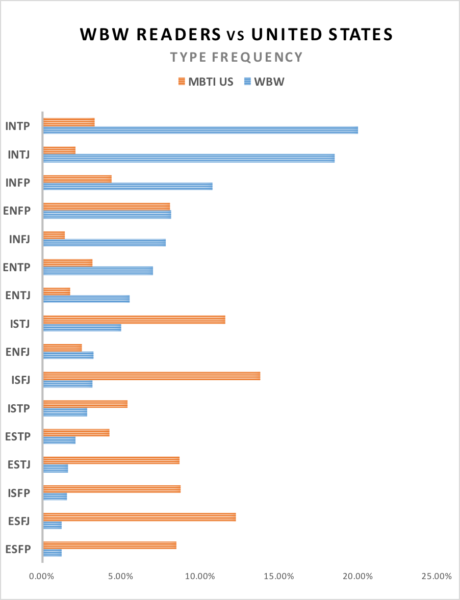
So over a third of WBW readers said they were either INTP (20%) or INTJ (18.6%), while ESFP was the least popular answer at 1.2%. Now let’s order these from most to least common:

WBW-vert-lg

What’s the main thing I see here? N’s. Lots and lots of N’s. In fact, the seven most common WBW reader types have an N in them. I don’t know MBTI that well, but I think that means WBW readers tend to be outrageously heady.

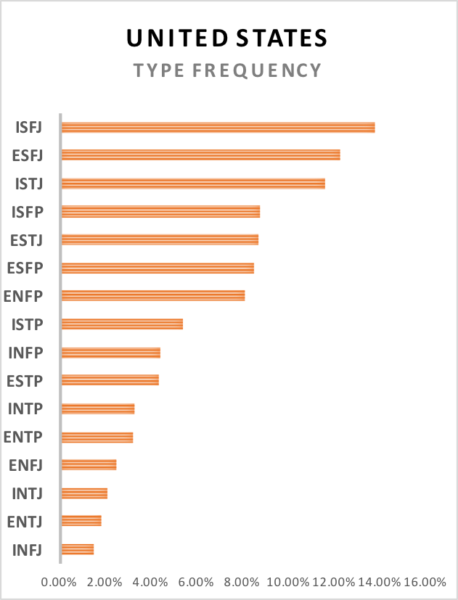
Now let’s look at the MBTI breakdown of the whole US. These are the results of a Myers-Briggs survey of the US between 1997 and 2002:
US-vert

What do I see here? S’s. So many S’s. It’s the reverse of the WBW results—the six most common types across the US have an S in them. And the INTP’s and INTJ’s that dominate the WBW readership? Turns out those are pretty rare types in the general population, while the ESFP’s that were nowhere to be found in the WBW survey are pretty common in the real world. (Note: Only about half of the WBW respondents were from the US, but there was very little difference between the US-only WBW results and the complete WBW results—so we felt fine comparing the worldwide WBW readership to the US MBTI results.)

Let’s put both sets of results on the same graph (in order of most common to least common among WBW readers):
WBWvsUS-vert

Pretty not similar. And if you’re an ENFJ, congrats—you manage to be the only type that’s rare among both sets.

Let’s take a look at each of the four criteria on its own, for both WBW readers and the whole US:

WBW-IE US-IE
WBW-NS US-NS
WBW-TF US-TF
WBW-JP US-JP

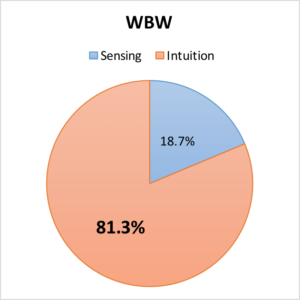
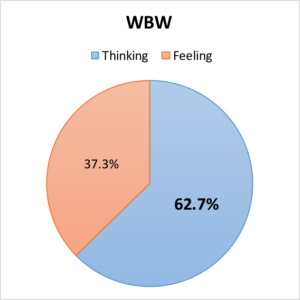
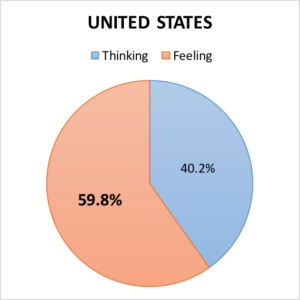
So WBW has significantly more Introverts and Thinkers than the general population, but again, the most striking contrast is in the N/S comparison. N’s make up only 26.7% of the US but a whopping 81.3% of WBW readers.

So there you have it. And I had fun. Take that, Adam Grant.

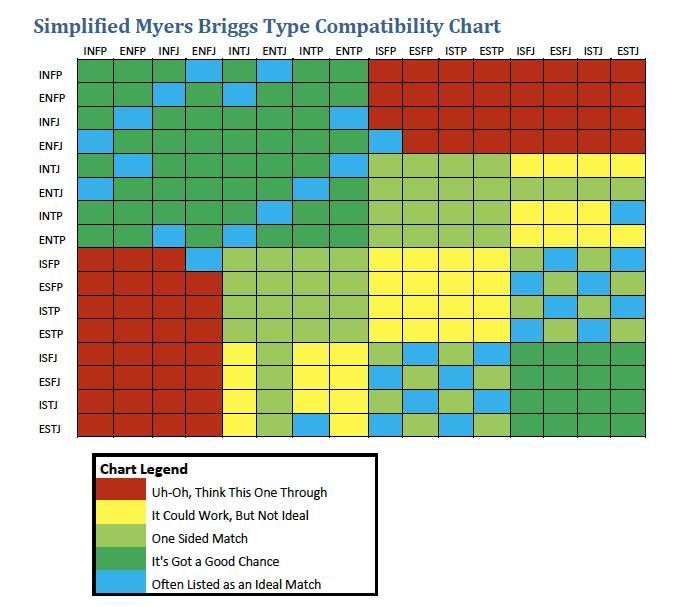
I’ll leave you with a chart I’m sure will make all MBTI critics furious. Make sure to follow it strictly for all relationship decisions:
c595d7e69ab2afa27ffb0a6f66ac125e

Two deep dives into the human mind for all of you N people:

Religion for the Nonreligious – an attempt to be more conscious

The Cook and the Chefan examination of how to live like an original

_______

If you like Wait But Why, sign up for our email list and we’ll send you new posts when they come out.

To support Wait But Why, visit our Patreon page.

Read this next

17 comments

Leave a Reply

  1. Darian Avatar
    Darian
    Hide

    Been a WBW fan since 2014. Took the official MBTI test a couple years ago and am INTP. This makes me so happy.

  2. Kushal Shiv Avatar
    Kushal Shiv
    Hide

    I’m an INFJ

    I’ve been exploring MBTI since sometime now & one of the most important thing I realised is that those 4 letters don’t really tell a whole lot of story about myself. However, these 4 letters tell me a whole lot when I match them to “cognitive functions”

    This is what I found on web about cognitive functions:
    According to Jung, the “cognitive functions” are the two scales of Sensing-Intuition and Thinking-Feeling. These are the ways in which humans process information and think about the world. Then each function can be expressed both in an extraverted manner or an introverted manner.

    Apparently this gives birth to something called as function stack for each personality type & suddenly these 4 letters make more sense. Like function stack of an INFJ looks like this:

    Primary: Introverted intuition (Ni)
    Auxiliary: Extroverted feeling (Fe)
    Tertiary: Introverted thinking (Ti)
    Inferior: Extroverted sensing (Se)

    This also explains why sometimes extroverts feel they are introverts & sometimes introverts feel they are extroverts.

  3. May Avatar
    May
    Hide

    I’m a long-time fan of WBW and an I/E NTP. I am also an Assessment professional trained to use and interpret various psychometric (and other) instruments.
    I know the MBTI well. Although you get a four letter code, it’s not intirely binary. Each dimension is a continuum. You can fall anywhere on that continuum. The closer your score is to the midline on a dimension, the more flexible you are on that continuum. Some dimensions are more ‘hard-wired’, genetically speaking, than others. One INTP does not equal another INTP if the scores are quite different – although it gives you the general ballpark you like to play in.

    People falling close to the midline of E/I (such as Tim) are often referred to as ‘ambiverts’ – they can shift between introversion and extraversion fairly easily, depending on environmental demands. Stronger scores mean your preference is more fixed. You are less likely to shift to the other side, even when the situation requires it. There is a lot of subtlety possible in interpreting the MBTI.

    The E/I dimension is the most ‘hard-wired’ of the four. Its is least impacted by environmental demands especially if the score is very strong. This means if you are a strong I in an E world, you suffer more. And vice versa.
    The J/P dimension is the one most easily influenced by the environment. If you are an NP (like me) and your work requires you to be an SJ at times (also me) you learn (through lots of painful sweat and tears) how to be good at structuring work, keeping records, meeting deadlines etc. But when on my own time I always revert to ‘NP’ behaviour (lose track of time, highly flexible, overwhelmed by detail). And its always hard work for me to be SJ. The same will be true of others operating in ‘the other zone’ daily. It eats up your energy to act against type.

    All psychological assessment tools are an oversimplification of a very complex, changeable subject. Of course there are lots of other factors at play that will influence how an MBTI type is expressed in real time. Despite all the criticism it has received the MBTI is an excellent tool for development.
    As a ‘self-report’ questionnaire with transparent questions, it is relatively easy to ‘fake’ or ‘skew’ in a particular direction. As such it should never be used for selection decisions. It was never meant for that.

    In development situations where people are motived to grow and answer as honestly as they can, it’s a brilliant tool.

  4. Khushi Avatar
    Khushi
    Hide

    I’m an intp, and you are too relatable for me to be any other type so I wasn’t surprised.

    1. FeiFei Dow Avatar
      FeiFei Dow
      Hide

      Hi, I’m INTP and have never met another INTP in my life. I’ve met 3 INFJs even though they are the rarest. Could we chat?

  5. Oliver Langheim Avatar
    Oliver Langheim
    Hide

    ISFJ

  6. smart dude Avatar
    smart dude
    Hide

    INTP

  7. Selena Teng Avatar
    Selena Teng
    Hide

    This is extremely amusing, as Wait But Why is the most mentally relatable website I’ve ever come across.
    -INTP

    1. FeiFei Dow Avatar
      FeiFei Dow
      Hide

      Hi, could we chat?

      1. ST Avatar
        ST
        Hide

        Can you elaborate a bit?

  8. otto9n9otto Avatar
    Hide

    About Carl Jung, whose “psychology” is the basis for the MBTI: http://people.wku.edu/jan.garrett/jung_talk.htm

  9. Julia Marie Avatar
    Julia Marie
    Hide

    I LOVE THIS ARTICLE SO MUCH OMFG THIS IS SO VALIDATING. I’m a huge Myers Briggs fan and if this doesn’t prove its legitimacy than idk what the fuck. I think the issue when it comes to Myers Briggs in validity/ reliability tests is that it’s too binary – I believe that people can be dead center on a trait, or they can be high on both ends of the same trait. For example, a lot of people are high in both introversion and extroversion. And for F vs. T – I believe that high emotions and a logical/ unfeeling/ emotionally disconnected thought process can be present in the same brain. I know that’s true in mine.

    I’m just gonna keep going with all the traits because why not. P vs. J – it’s common to be super disorganized and also love your life being in order. N vs. S – this is the one that cannot change. I firmly believe that you’re either one way or the other. I think that explains some articles I’ve read – that it’s good to look for somewhat opposite traits when it comes to a life partner, so you’ll change and grow, but you should both be N’s or both be S’s.

    My conclusion: the reason a person might get wildly different responses is because they are either neutral on a trait or high at both ends of a trait. Maybe they answer the questions differently when they retake the test, depending on their mood – but I have a strong feeling that no matter what, the N/S thing is real. And I think a lot can be said for the people who continuously score the same, even years later (I’m one of those).

    1. Truth Seeker Avatar
      Truth Seeker
      Hide

      Spoken like someone who has absolutely no clue about the cognitive functions. Hogwash. Please be educated before sharing opinions.

  10. Mintaka Avatar
    Mintaka
    Hide

    Hmm, interesting. I’ve always tested as either an INTJ (usually) or INTP (as a teenager/younger adult). It’s funny to see that that’s basically a lot of the readership of this site. No wonder I like it so much.

  11. beccasawesomeblog Avatar
    beccasawesomeblog
    Hide

    I’m an ENTP female and, like you, I think the whole MBTI thing is super interesting (sometimes scarily accurate) if taken with a decent-sized handful of salt. Humans love to put things in boxes, and sometimes things don’t really belong in boxes, because a one-size-fits-whatever-is-in-this-box approach doesn’t always apply.
    That said, I was really intrigued by the results you present, particularly the relationship chart. I’ve always figured that the difference between S and N is pretty important to me, and ENTPs (according to the chart) work better with LITERALLY EVERY N-type than any S-type. Stupid S-types. And stupid my ex.

  12. MJ Avatar
    MJ
    Hide

    Hi. I watched your TedTalk and figured you were an ENTP. So I wanted to verify this and pleased to see you actually talked about this on your blog.

    AWESOME.

    -infp

  13. Beatrix Avatar
    Beatrix
    Hide

    I’m an ENTJ woman. I took the test several times already, in the last 3 years and got always ENTJ, but with changing percentages. The last time I took it was a week ago, and it showed me exactly the kind of change in my personality I’ve also noticed already! I got way more judging and got even more into thinking since I’ve started studying, but also got less self-confident in my own skills and my level of assertiveness has sunk as well. My own example shows me how exact and trustworthy this test is!
    I love the fact, that you always have the same view of things as me 🙂