




The Ant-Honey Problem

Question:

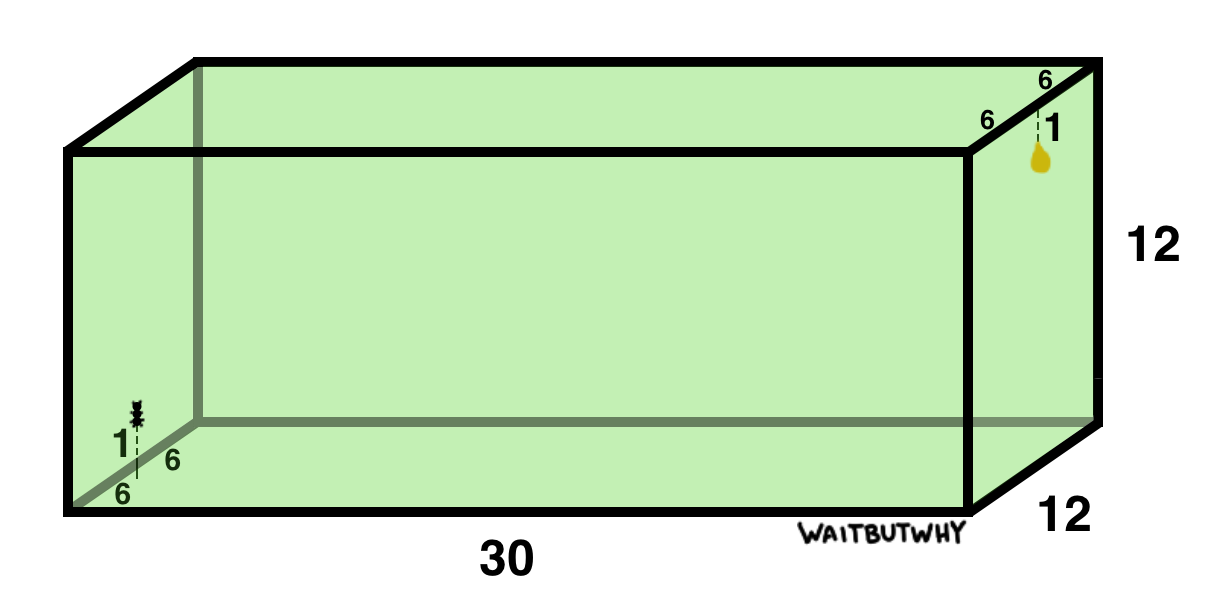
An ant is inside the box, 1 cm from the bottom, and wants to go eat the drop of honey on the opposite side, 1 cm from the top. Both the ant and the honey are exactly 6 cm from the walls. Crawling on inside of the box, what’s the shortest distance the ant can crawl to get to the honey?
– ANSWER BELOW –

.

.

.

.

.

.

.

.

.

.

.

.

.

.

.

.

.

.

.

.

.

.

.

.

.

.

.

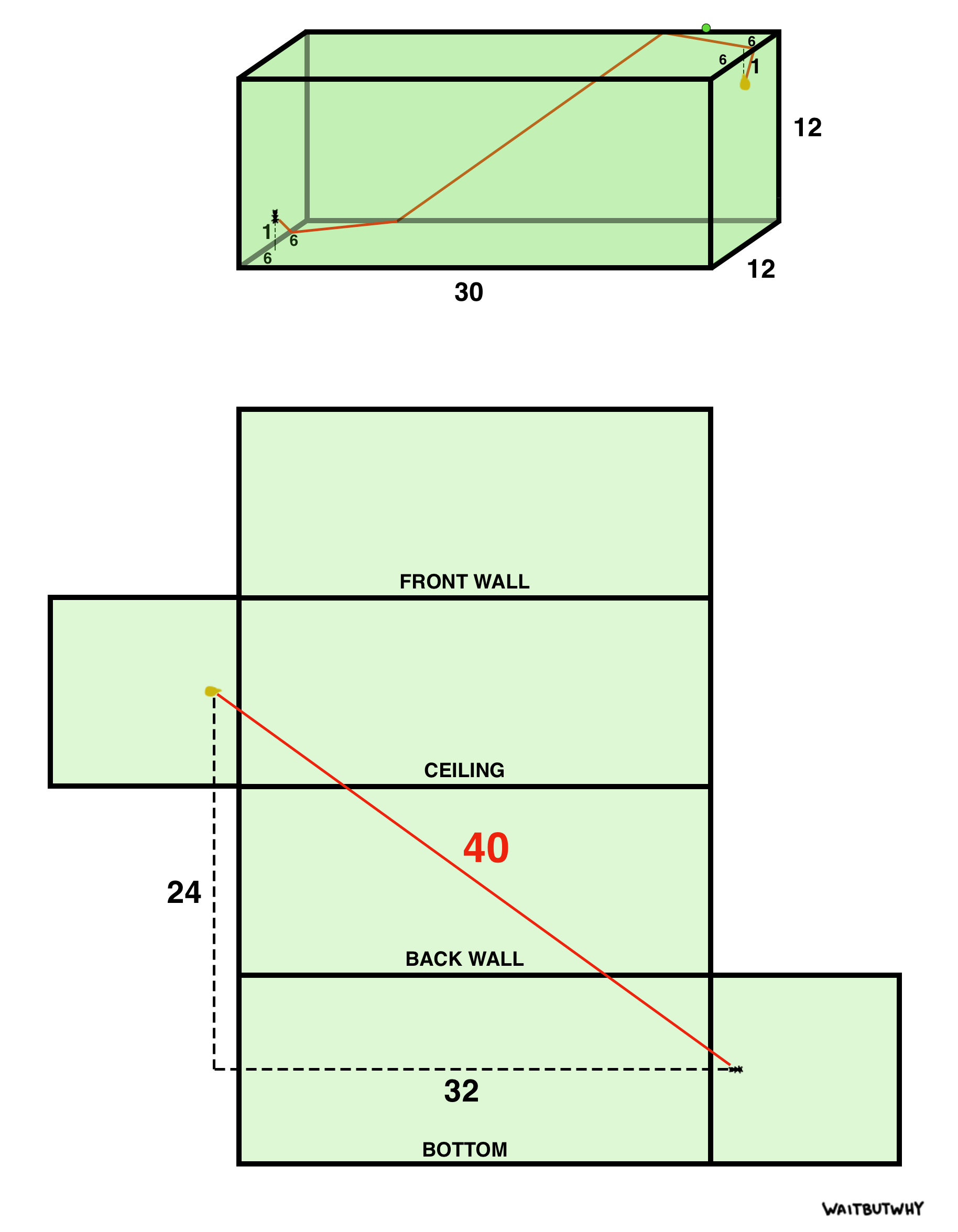
Answer: 40
Read this next

17 comments

Leave a Reply

  1. Isaak Avatar
    Isaak
    Hide

    If the ant dropped to the bottom without effort, it could reduce it's -x distance to 31, and cut the path down closer to 39 inches! Given the ant doesn't bang his head and forget the Pythagorean theorem on the way down.

    1. Isaak Avatar
      Isaak
      Hide

      cm*, forgive my Americanness

  2. 동전파스직구 Avatar

    The best cheap Japanese online shopping mall. 동전파스직구

  3. Oren Montano Avatar
    Oren Montano
    Hide

    I got 37.3 by walking along wall to back wall to wall in a direct line to the honey.

    Cut the top 1cm and bottom 1 cm of the box and you should see the path as a straight line with 2 turns at the corners.

  4. Jonas Avatar
    Jonas
    Hide

    I would say that, given that gravity is working from top to bottom, the answer should be 30cm:
    The ant drops itself the meakly 1 cm to the bottom of the box and then slowly strolls over the 30 cm to the other shortside to where the honey now have trickled down.
    IF the box instead is in a weightless state the ant just performs a skilled jump and lands directly on the honey. 😉

  5. matt j Avatar
    matt j
    Hide

    Now that’s thinking outside the box. No, can’t be. Surely it’s thinking inside the box. Hmmm. How about : Thinking around the box?

  6. Mo Avatar
    Mo
    Hide

    oh no, I forgot the inevitable ceiling of ant boxes. With an open box I geometrically approximated a solution down to 41,204

  7. Roger Avatar
    Roger
    Hide

    36? Go down, straight along and then up 5. 1+30+5.

    1. Steve Avatar
      Steve
      Hide

      He said the most direct way, so you have to pretend the ant moved diagonally.

    2. Derek Avatar
      Derek
      Hide

      it would be up 11, giving you 42

  8. Steve Avatar
    Steve
    Hide

    Visit the Wait But Why wiki! I created this site dedicated solely to Tim Urban’s amazing work. Help us grow this site! It also has an idea lab for us to discuss this book while we’re waiting for the official one.

    https://wait-but-why.fandom.com/wiki/Wait_But_Why_Wiki

  9. Steve Avatar
    Steve
    Hide

    Second.

  10. James Avatar
    James
    Hide

    Hey Tim, how do you show that 40 is the shortest solution?

    1. Steve Avatar
      Steve
      Hide

      Pythagorean Theorem?

      1. Steve Avatar
        Steve
        Hide

        To those who my comment:

        While Tim Urban is correct, using the Pythagorean Theorem 24²+32²=1600, then √1600=40, also works.

        But yeah, Tim’s way is far easier and more direct.

        1. Steve Avatar
          Steve
          Hide

          Meant to say “To those who disliked my comment”.

    2. Tim Urban Avatar
      Tim Urban
      Hide

      You can unfold the box in a bunch of ways and in each case, connect the ant and honey with a straight line. This configuration produces the shortest route.