



From 1,000,000 to Graham’s Number

Welcome to numbers post #2.

Last week, we started at 1 and slowly and steadily worked our way up to 1,000,000. We used dots. It was cute.

Well fun time’s over. Today, shit gets real.

Before things get totally out of hand, let’s start by working our way up the still-fathomable powers of 10—

Powers of 10

When we went from 1 to 1,000,000, we didn’t need powers—we could just use a short string of digits to represent the numbers we were talking about. If we wanted to multiply a number by 10, we just added a zero.

But as you advance past a million, zeros start to become plentiful and you need a different notation. That’s why we use powers. When people talk about exponential growth, they’re referring to the craziness that can happen when you start using powers. For example:

If you multiply 9,845,625,675,438 by 8,372,745,993,275, the result is still smaller than 829.

As we get bigger and bigger today, we’ll stick with powers of 10, because when you start talking about really big numbers, what becomes relevant is the number of digits, not the digits themselves—i.e. every 70-digit number is somewhere between 1069 and 1070, which is really all you need to know. So for at least the first part of this post, the powers of 10 can serve nicely as orders-of-magnitude “checkpoints”.

Each time we up the power by one, we multiply the world we’re in by ten, changing things significantly. Let’s start off where we left off last time—

106 (1 million – 1,000,000) – The amount of dots in that huge image we finished up with last week. On my computer screen, that image was about 18cm x 450cm = .81 m2 in area.

107 (10 million) – This brings us to a range that includes the number of steps it would take to walk around the Earth (40 million steps). If each of your steps around the Earth were represented by a dot like those from the grids in the last post, the dots would fill a 6m x 6m square.

108 (100 million) – Now we’re at the number of books ever published in human history (130 million), and at the top of this range, the estimated number of words a human being speaks in a lifetime (860 million). Also in this range are the odds of winning the really big lotteries. A recent Mega Millions lottery had 1-in-175,711,536 odds of winning. To put those chances in perspective, that’s about the number of seconds in six years. So it’s like knowing a hedgehog will sneeze once and only once in the next six years and putting your hard-earned money down on one particular second—say, the 36th second of 2:52am on March 19th, 2017—and only winning if the one sneeze happens exactly at that second. Don’t buy a Mega Millions ticket.

109 (1 billionI’m using the American short scale system—in the British long scale system, you don’t get to a billion until 1012. – 1,000,000,000) – Here we have the number of seconds in a century (about 3 billion), the number of living humans (7.125 billion), and to fit a billion dots, our dot image would cover two basketball courts.

1010 (10 billion) – Now we’re up to the years since the Big Bang (13.7 billion) and the number of seconds since Jesus Christ lived (60 billion).

1011 (100 billion) – This is about the number of stars in the Milky Way and the number of galaxies in the observable universe (100-400 billion)—so if a computer listed one observable galaxy every second since Christ, it wouldn’t be anywhere close to finished currently.

1012 (1 trillion – 1,000,000,000,000) – A million millions. The amount of pounds the scale would show if you put the whole human race on it (~1 trillion), the number of seconds humans have been around (~100,000 years = ~3 trillion seconds), and larger than both of those totals combined, the number of miles in one light year (6 trillion). A trillion is so big that you’d only need 4 trillion millimeters of ribbon to tie a bow around the sun.

1013 (10 trillion) – This is about as big as we can get for numbers we hear discussed in the real world, and it’s almost always related to nations and dollars—the US nominal GDP in 2013 was just under $17 trillion, and its debt is currently just under $18 trillion. Both of those are dwarfed by the number of cells in the human body (37 trillion).

1014 (100 trillion) – 100 trillion is about the number of letters in every published book in human history, as well as the number of bacteria in your body.Upsetting. Also in this range is the total wealth of the world ($241 trillion, which we discussed at great length in a previous post).

1015 (1 quadrillion) – Okay goodbye normal words. People say the words million, billion, and trillion a lot. No one says quadrillion. It’s really uncool to say the word quadrillion.Luckily, I’m not cool. Most people opt for “a million billion” instead. Either way, there are about a quadrillion ants on Earth. Comparing this to the bacteria fact, it’s like you have 1/10th of the world’s ants crawling around inside your body.

1016 (10 quadrillion) – It’s in this range that we get to the number of playing cards you’d have to accidentally knock off the table to cover the entire Earth (89 quadrillion). People would be mad at you.

1017 (100 quadrillion) – The number of seconds since the Big Bang. Also the number of references to Kim Kardashian that entered my soundscape in the last week. Please stop.

1018 (1 quintillion) – Also known as a billion billion, the word quintillion manages to be even less cool than a quadrillion. No one who has social skills ever says the word quintillion. Anyway, it’s the number of cubic meters of water in all the Earth’s oceans and the number of atoms in a grain of salt (1.2 quintillion). The number of grains of sand on every beach on Earth is about 7.5 quintillion—the same number of atoms in six grains of salt.

1019 (10 quintillion) – The number of millimeters from here to the closest next star (38 quintillion millimeters).

1020 (100 quintillion) – The number of meter-long steps it would take you to walk across the whole Milky Way. So many podcasts. And heard of a Planck volume? It’s the smallest volume scientists talk about, so small you could fit 100 quintillion of them in a proton. More on Planck volumes later. Oh, and our dot image? By the time we get to 600 quintillion dots, the image would cover the surface of the Earth.

1021 (1 sextillion) – Now we’re even beyond the vocabulary of the weirdos. I don’t think I’ve ever heard someone say “sextillion” out loud, and I hope to keep it that way.

1023 (100 sextillion) – A rough estimate for the number of stars in the observable universe. You also had to deal with this number in high school—602 sextillion, or 6.02 x 10²³—is a mole, or Avogadro’s Number, and the number of hydrogen atoms in a gram of hydrogen.

1024 (1 septillion) – A trillion trillions. The Earth weighs about six septillion kilograms.

1025 (10 septillion) – The number of drops of water in all the world’s oceans.

1027 (1 octillion) – If the Earth were hollow, it would take 1 octillion peas to pack it full. And I think we’ve heard just about enough from octillion.

Okay so now let’s take a huge leap forward into a whole different territory—somewhere where the Earth’s volume is too tiny and the Big Bang too recent to use in examples. In this new arena of number, only the observable universe—a sphere about 92 billion light years across—can handle the magnitude we’re dealing with.I’m going to use the term “universe” to refer to the observable universe so I don’t have to type observable 49 times in this post.

1080 –  To get to 1080, you take trillion and you multiply it by a trillion, by a trillion, by a trillion, by a trillion, by a trillion, by a hundred million. No dot posters being sold for this number. So why did I stop here at this number? Because it’s a common estimate for the number of atoms in the universe.

1086 – And what if you wanted to pack the entire observable universe sphere with peas? You’d need 1086 peas to make it happen.

1090 – This is how many medium size grains of sand (.5mm in diameter) it would take to pack the universe full.

A Googol – 10100

The name googol came about when American mathematician Edward Kasner got cute one day in 1938 and asked his 9-year-old nephew Milton to come up with a name for 10100—1 with 100 zeros. Milton, being an inane 9-year-old, suggested “googol.” Kasner apparently decided this was a reasonable answer, ran with it, and that was that.59 years later, Sergey Brin and Larry Page named their new search engine after this number because they wanted to emphasize the large quantities of information the engine could provide. They spelled it wrong by accident.

So how big is a googol?

It’s the number of grains of sand that could fit in the universe, times 10 billion. So picture the universe jam-packed with small grains of sand—for tens of billions of light years above the Earth, below it, in front of it, behind it, just sand. Endless sand. You could fly a plane for trillions of years in any direction at full speed through it, and you’d never get to the end of the sand. Lots and lots and lots of sand.

Now imagine that you stop the plane at some point, reach out the window, and grab one grain of sand to look at under a powerful microscope—and what you see is that it’s actually not a single grain, but 10 billion microscopic grains wrapped in a membrane, all of which together is the size of a normal grain of sand. If that were the case for every single grain of sand in this hypothetical—if each were actually a bundle of 10 billion tinier grains—the total number of those microscopic grains would be a googol.

We’re running out of room here on both the small and big end of things to fit these numbers into the physical world, but three more for you:

10113 – The number of hydrogen atoms it would take to pack the universe full of them.

10122 – The number of protons you could fit in the universe.

10185 – Back to the Planck volume (the smallest volume I’ve ever heard discussed in science). How many of these smallest things could you fit in the very biggest thing, the observable universe? 10185. Without being able to go smaller or bigger on either end, we’ve reached the largest number where the physical world can be used to visualize it.

A Googolplex – 10googol

After popularizing the newly-named googol, Krasner could barely keep his pants on with this adorable new schtick and asked his nephew to coin another term. He could barely finish the question before Milton opened his un-nuanced mouth and declared the number googolplex, which he, in typical Milton form, described as “one, followed by writing zeroes until you get tired.”Fucking Milton. At this, Krasner showed some uncharacteristic restraint, ignoring Milton and giving the number an actual definition: 10googol or 1 with a googol zeros written after it. With its full written-out exponent, a googolplex looks like this:

1010,000,000,000,000,000,000,000,000,000,000,000,000,000,000,000,000,000,000,000,000,000,000,000,000,000,000,000,000,000,000,000,000,000

So a googol is 1 with just 100 zeros after it, which is a number 10 billion times bigger than the grains of sand that would fill the universe. Can you possibly imagine what kind of number is produced when you put a googol zeros after the 1?

There’s no possible way to wrap your head around that number—the best we can do is try to understand how long it would take to write the number. What I wrote above is just the exponent—actually writing a googolplex out involves writing a googol zeros. First, let’s figure out where we’d write these zeros.

As we’ve discussed, filling the universe with sand only gets you a ten billionth of the way to a googol, so what we’d have to do is fill the universe to the brim with sand, get a very tiny pen, and write 10 billion zeros on each grain of sand. If you did this and then looked at a completed grain under a microscope, you’d see it covered with 10 billion microscopic zeros. If you did that on every single grain of sand filling the universe, you’d have successfully written down the number googolplex.

And just how long would it take to do that?

Well I just tested how fast a human can reasonably write zeros, and I wrote 36 zeros in 10 seconds.When my father was my age, he had children. At that rate, if from the age of 5 to the age of 85, all I did for 16 hours a day, every single day, was write zeros at that rate, I’d finish one half of a grain of sand in my lifetime. You’d need to dedicate two full human lives to finish one grain of sand. About 107 billion human beings have ever lived in the history of the species. If every single human dedicated every waking moment of their lives to writing zeros on grains of sand, as a species we’d have by now filled a cube with a side of 1.7m—about the height of a human—with completed sand grains. That’s it.

Now to get a glimpse at how big the actual number is—as the Numberphilers explain, the total possible quantum states that could occur in the space occupied by a human (i.e. every possible arrangement of atoms that could happen in that space) is far less than a googolplex. What this means is that if there were a universe with a volume of a googolplex cubic meters (an extraordinarily large space), random probability suggests that there would be exact copies of you in that universe. Why? Because every possible arrangement of matter in a human-sized space would likely occur many, many times in a space that vast, meaning everything that could possibly exist would exist—including you. Including you with cat whiskers but normal otherwise. Including you but a one-foot tall version. Including you exactly how you are except instead of a pinky finger on your left hand you have Napoleon’s penis there as your fifth finger. What I’m saying isn’t science fiction—it’s the reality of a space that large.

Graham’s Number

You know how sometimes you go through life, and you’re lost but you don’t even know it, and then one day, the right person comes along and you realize what you had been looking for this whole time?

That’s how I feel about Graham’s number.

Huge numbers have always both tantalized me and given me nightmares, and until I learned about Graham’s number, I thought the biggest numbers a human could ever conceive of were things like “A googolplex to the googolplexth power,” which would blow my mind when I thought about it. But when I learned about Graham’s number, I realized that not only had I not scratched the surface of a truly huge number, I had been incapable of doing so—I didn’t have the tools. And now that I’ve gained those tools (and you will too today), a googolplex to the googolplexth power sounds like a kid saying “100 plus 100!” when asked to say the biggest number he could think of.

Before we dive in, why is Graham’s number even a number people talk about?

I’m not gonna really explain this because the explanation is really boring and confusing—here’s the official problem Ronald Graham (a living American mathematician) was working on when he came up with it:

Connect each pair of geometric vertices of an n-dimensional hypercube to obtain a complete graph on 2n vertices. Color each of the edges of this graph either red or blue. What is the smallest value of n for which every such coloring contains at least one single-colored complete subgraph on four coplanar vertices?

I told you it was boring and confusing. Anyway, there’s no single answer to the problem, but Graham’s proof includes a lower and upper bound, and Graham’s number was one version of an upper bound for that Graham came up with.

He came up with the number in 1977, and it gained recognition when a colleague wrote about it in Scientific American and called it “a bound so vast that it holds the record for the largest number ever used in a serious mathematical proof.” The number ended up in the Guinness Book of World Records in 1980 for the same reason, and though it has today been surpassed, it’s still renowned for being the biggest number most people ever hear about. That’s why Graham’s number is a thing—it’s not just an arbitrarily huge number, it’s actually relevant in the world of math.

So anyway, I said above that I had been limited in the kind of number I could even imagine because I lacked the tools—so what are the tools we need to do this?

It’s actually one key tool: the hyperoperation sequence.

The hyperoperation sequence is a series of mathematical operations (e.g. addition, multiplication, etc.), where each operation in the sequence is an iteration up from the previous operation. You’ll understand in a second. Let’s start with the first and simplest operation: counting.

Operation Level 0 – Counting 

If I have 3 and I want to go up from there, I go 3, 4, 5, 6, 7, and so on until I get where I want to be. Not a high-powered operation.

Operation Level 1 – Addition 

Addition is an iteration up from counting, which we can call “iterated counting”—so instead of doing 3, 4, 5, 6, 7, I can just say 3 + 4 and skip straight to 7. Addition being “iterated counting” means that addition is like a counting shortcut—a way to bundle all the counting steps into one, more concise step.

Operation Level 2 – Multiplication

One level up, multiplication is iterated addition—an addition shortcut. Instead of saying 3 + 3 + 3 + 3, multiplication allows us to bundle all of those addition steps into one higher-operation step and say 3 x 4. Multiplication is a more powerful operation than addition and you can create way bigger numbers with it. If I add two eight-digit numbers together, I’ll end up with either an eight or nine-digit number. But if I multiply two eight-digit numbers together, I end up with either a 15 or 16-digit number—much bigger.

Operation Level 3 – Exponentiation (↑)

Moving up another level, exponentiation is iterated multiplication. Instead of saying 3 x 3 x 3 x 3, exponentiation allows me to bundle that string into the more concise 34.

Now, the thing is, this is where most people stop. In the real world, exponentiation is the highest operation we tend to ever use in the hyperoperation sequence. And when I was envisioning my huge googolplexgoogolplex number, I was doing the very best I could using the highest level I knew—exponentiation. On Level 3, the way to go as huge as possible is to make the base number massive and the exponent number massive. Once I had done that, I had maxed out.

The key to breaking through the ceiling to the really big numbers is understanding that you can go up more levels of operations—you can keep iterating up infinitely. That’s the way numbers get truly huge.

And to do this, we need a different kind of notation. So far, we’ve worked with a different symbol on each level (+, x, and a superscript)—but we don’t want to have to remember a ton of different symbols if we’re gonna be working with a bunch of different operations levels. So we’ll use Knuth’s up-arrow notation, which is one symbol that can be used on any level.

Knuth’s up-arrow notation starts on Operation Level 3, replacing exponentiation with a single up arrow: ↑. So to use up-arrow notation, instead of saying 34, we say 3 ↑ 4, but they mean the same thing.

3 ↑ 4 = 81
2 ↑ 3 = 8
5 ↑ 5 = 3,125
1 ↑ 38 = 1

Got it? Good.

Now let’s move up a level and start seeing the insane power of the hyperoperation sequence:

Operation Level 4 – Tetration (↑↑)

Tetration is iterated exponentiation. Before we can understand how to bundle a string of exponentiation the way exponentiation bundles a string of multiplication, we need to understand what a “string of exponentiation” even is.

So far, all we’ve done with exponentiation is one computation—a base number and a power it’s raised to. But what if we put two of these computations together, like:

222

We get a power tower. Power towers are incredibly powerful, because they start at the top and work their way down. So 222 = 2(22) = 24 = 16. Nothing that impressive yet, but check out:

3333

Using parentheses to emphasize the top down order: 3333 =  33(33) = 3327 =3(327) = 37,625,597,484,987 = a 3.6 trillion-digit number

Remember, a googol and its universe-filling microscopic mini-sand is only a 100-digit number. So all it takes is a power tower of 3s stacked 4 high to dwarf a googol, as well as 10185, the number of Planck volumes to fill the universe and our physical world maximum. It’s not as big as a googolplex, but we can take care of that easily by just adding one more 3 to the stack:

33333 = 3(3333) = 3(3.6 trillion-digit number) = way bigger than a googolplex, which is 10(100-digit number). As for a googolplex itself, power towers allow us to immediately humiliate it by writing it as:

1010100 or, more typically, 1010102. So you can imagine what kind of number you get when you start making tall power towers. Tetration is intense.

Now those towers are Level 3, exponential strings, the same way 3 x 3 x 3 x 3 is a Level 2, multiplication string. We use Level 3 to bundle that Level 2 string into 34, or 3 ↑ 4. So how do we use Level 4 to bundle an exponential string? Double arrows.

3333 is the same as saying 3 ↑ (3 ↑ (3 ↑ 3)). We bundle those 4 one-arrow 3s into 3 ↑↑ 4.

Likewise, 3 ↑↑ 5 = 3 ↑ (3 ↑ (3 ↑ (3 ↑ 3))) = 33333

4 ↑↑ 7 = 4 ↑ (4 ↑ (4 ↑ (4 ↑ (4 ↑ (4 ↑ 4))))) = a power tower of 4s 7 high.

Here’s the general rule:

tetration generally

We’re about to move up another level, and this is about to become more complex, so before we move on, make sure you really understand Level 4 and what ↑↑ means—just remember that a ↑↑ b is a power tower of a’s, b high.

Operation Level 5 – Pentation (↑↑↑)

Pentation, or iterated tetration, bundles double arrow strings together into a single operation.

The pattern we’ve seen is each new level bundles a string of the previous level together by using a term as the length of the string. For example:
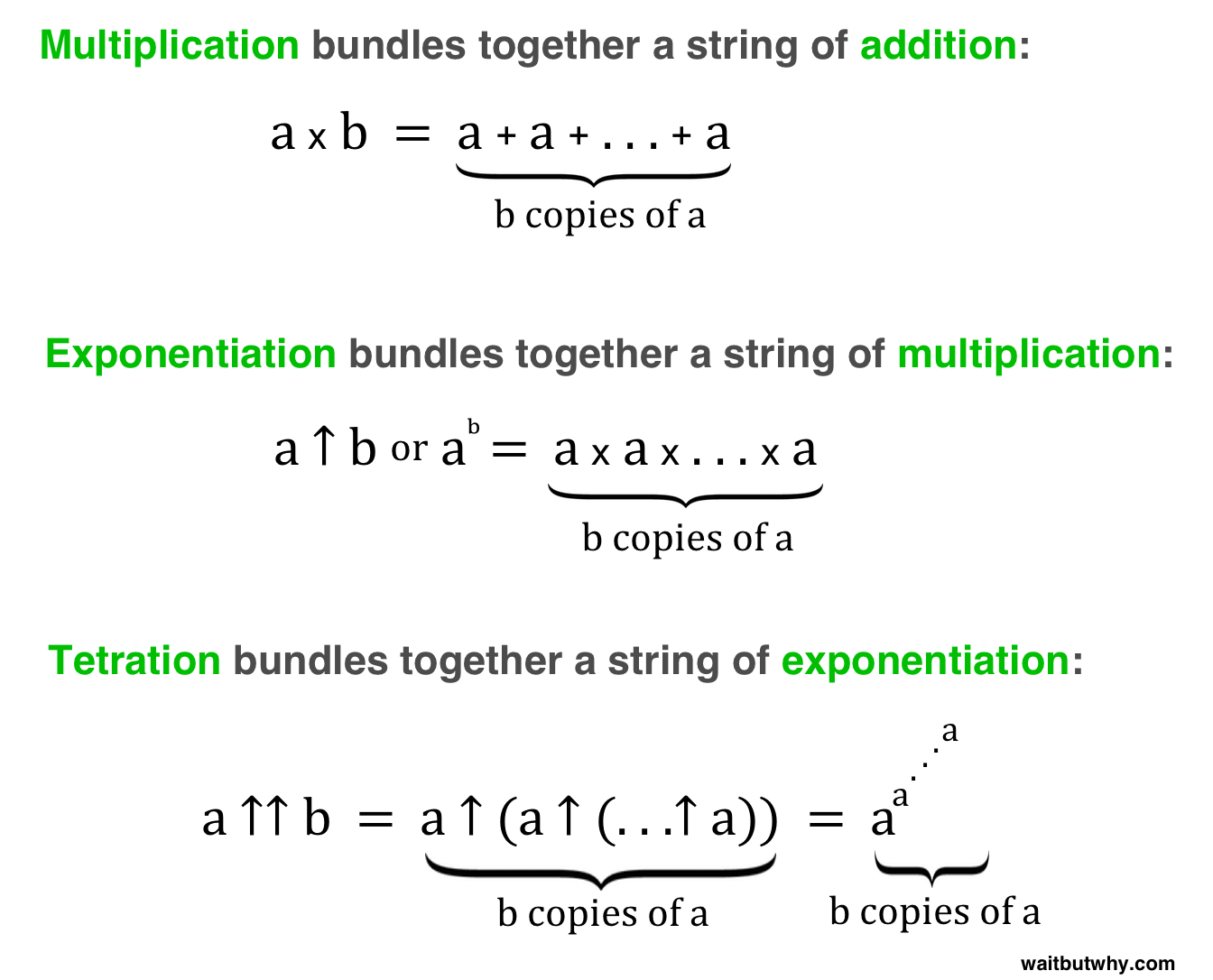
string bundle examples

In each case, is the base number and is the length of the string being bundled.

So what does pentation bundle together? How can you have a string of power towers?

The answer is what I call a “power tower feeding frenzy”. Here’s how it works:

You have a string of power towers standing next to each other, in a particular order, all using the same base number. The thing that differs between them is the height of each tower. The first tower’s height is the same number as the base number. You process that tower down to its full expanded outcome, and that outcome becomes the height of the next towerYou then process that tower, and the outcome becomes the height of the next tower. And so on. Each tower’s outcome “feeds” into the next tower and becomes its height—hence the feeding frenzy. Here’s why this happens:

3 ↑↑↑ 4 means a string of (3 ↑↑ 3) operations, 4 long. So:

3 ↑↑↑ 4 = 3 ↑↑ (3 ↑↑ (3 ↑↑ 3))

Remember, when you see ↑↑ it means a single power tower that’s high, so:

3 ↑↑↑ 4 = 3 ↑↑ (3 ↑↑ (3 ↑↑ 3)) = 3 ↑↑ (3 ↑↑ 333)

Now, you might remember from before that 333 = 327 = 7,625,597,484,987. So:

3 ↑↑↑ 4 = 3 ↑↑ (3 ↑↑ (3 ↑↑ 3)) = 3 ↑↑ (3 ↑↑ 333) = 3 ↑↑ (3 ↑↑ 7,625,597,484,987)

So the first tower of height 3 processed down into 7 trillion-ish. Now the next parentheses we’re dealing with is (3 ↑↑ 7,625,597,484,987), where the outcome of the first tower is the height of this second tower. And how high would that tower of 7 trillion-ish 3s be? 

Well if each 3 is two centimeters high, which is about how big my written 3’s are, the tower would rise about 150 million kilometers high, which would touch the sun. Even if we used tiny, typed 2mm 3’s, our tower would reach the moon and back to the Earth and back to the moon forty times before finishing. If we wrote those tiny 3’s on the ground instead, the tower would wrap around the earth 400 times. Let’s call this tower the “sun tower,” because it stretches all the way to the sun. So what we have is:

3 ↑↑↑ 4 = 3 ↑↑ (3 ↑↑ (3 ↑↑ 3)) = 3 ↑↑ (3 ↑↑ 333) = 3 ↑↑ (3 ↑↑ 7,625,597,484,987) = 3 ↑↑ (sun tower)

This final 3 ↑↑ (sun tower) operation is a power tower of 3’s whose height is the number you get when you multiply out the entire sun tower (and this final tower we’re building won’t even come close to fitting in the observable universe). And we don’t get to our final value of 3 ↑↑↑ 4 until we multiply out this final tower.

So using ↑↑↑, or pentation, creates a power tower feeding frenzy, where as you go, each tower’s height begins to become incomprehensible, let alone the actual final value. Written generally:
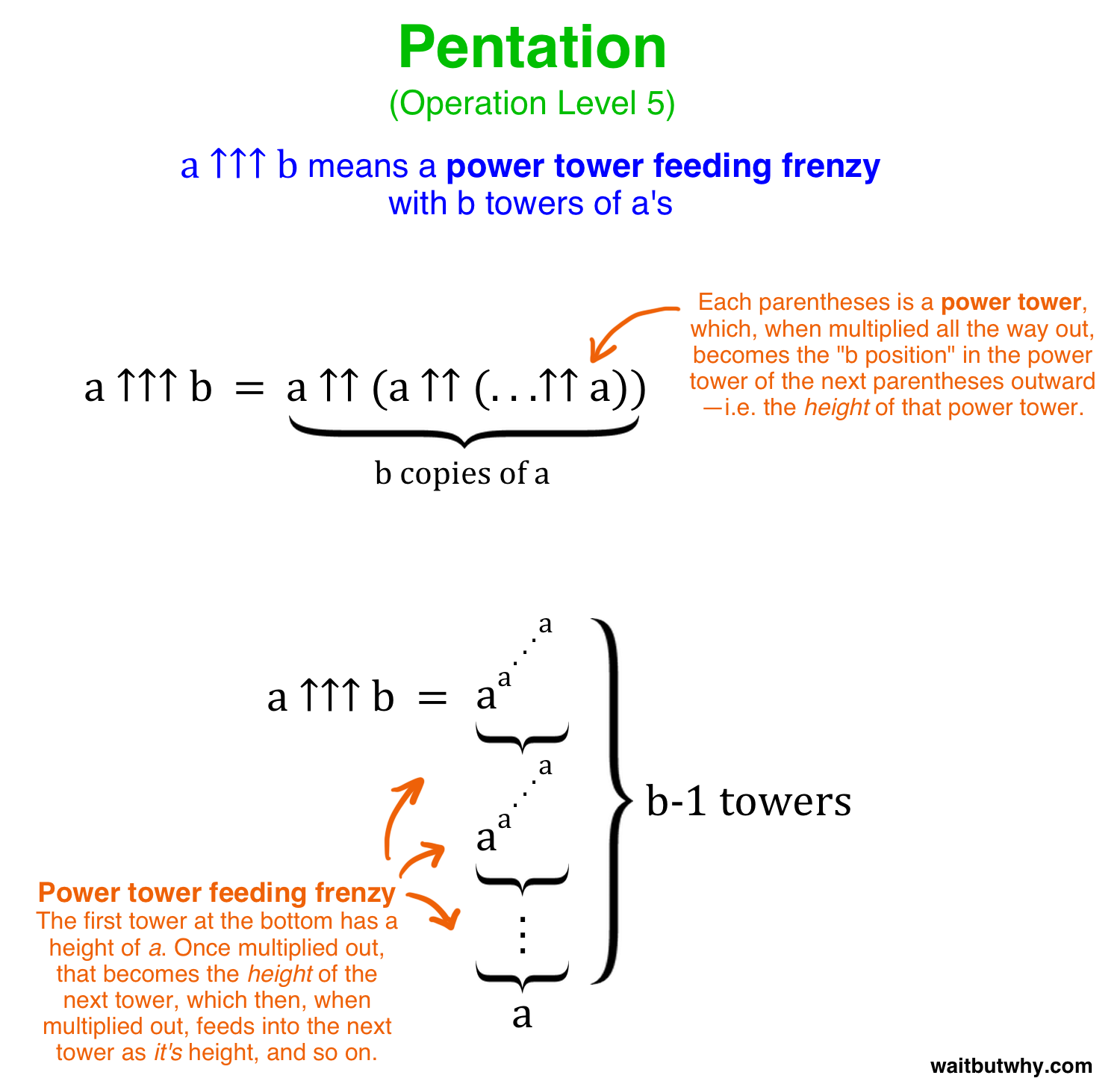
pentation generally

We’re gonna go up one more level—

Operation Level 6 – Hexation (↑↑↑)

So on Level 4, we’re dealing with a string of Level 3 exponents—a power tower. On Level 5, we’re dealing with a string of Level 4 power towers—a power tower feeding frenzy. On Level 6, aka hexation or iterated pentation, we’re dealing with a string of power tower feeding frenzies—what we’ll call a “power tower feeding frenzy psycho festival.” Here’s the basic idea:

A power tower feeding frenzy happens. The final number the frenzy produces becomes the number of towers in the next feeding frenzy. Then that frenzy happens and produces an even more ridiculous number, which then becomes the number of towers for the next frenzy. And so on.

3 ↑↑↑↑ 4 is a power tower feeding frenzy psycho festival, during which there are 3 total ↑↑↑ feeding frenzies, each one dictating the number of towers in the next one. So:

3 ↑↑↑↑ 4 = 3 ↑↑↑ (3 ↑↑↑ (3 ↑↑↑ 3))

Now remember from before that 3 ↑↑↑ 3 is what turns into the sun tower. So:

3 ↑↑↑↑ 4 = 3 ↑↑↑ (3 ↑↑↑ (3 ↑↑↑ 3)) = 3 ↑↑↑ (3 ↑↑↑ (sun tower))

Since ↑↑↑ means a power tower feeding frenzy, what we have here with 3 ↑↑↑ (sun tower) is a feeding frenzy with a multiplied-out-sun-tower number of towers. When that feeding finally finishes, the outcome becomes the number of towers in the final feeding frenzy. The psycho festival ends when that final feeding frenzy produces it’s final number. Here’s hexation explained generally: 
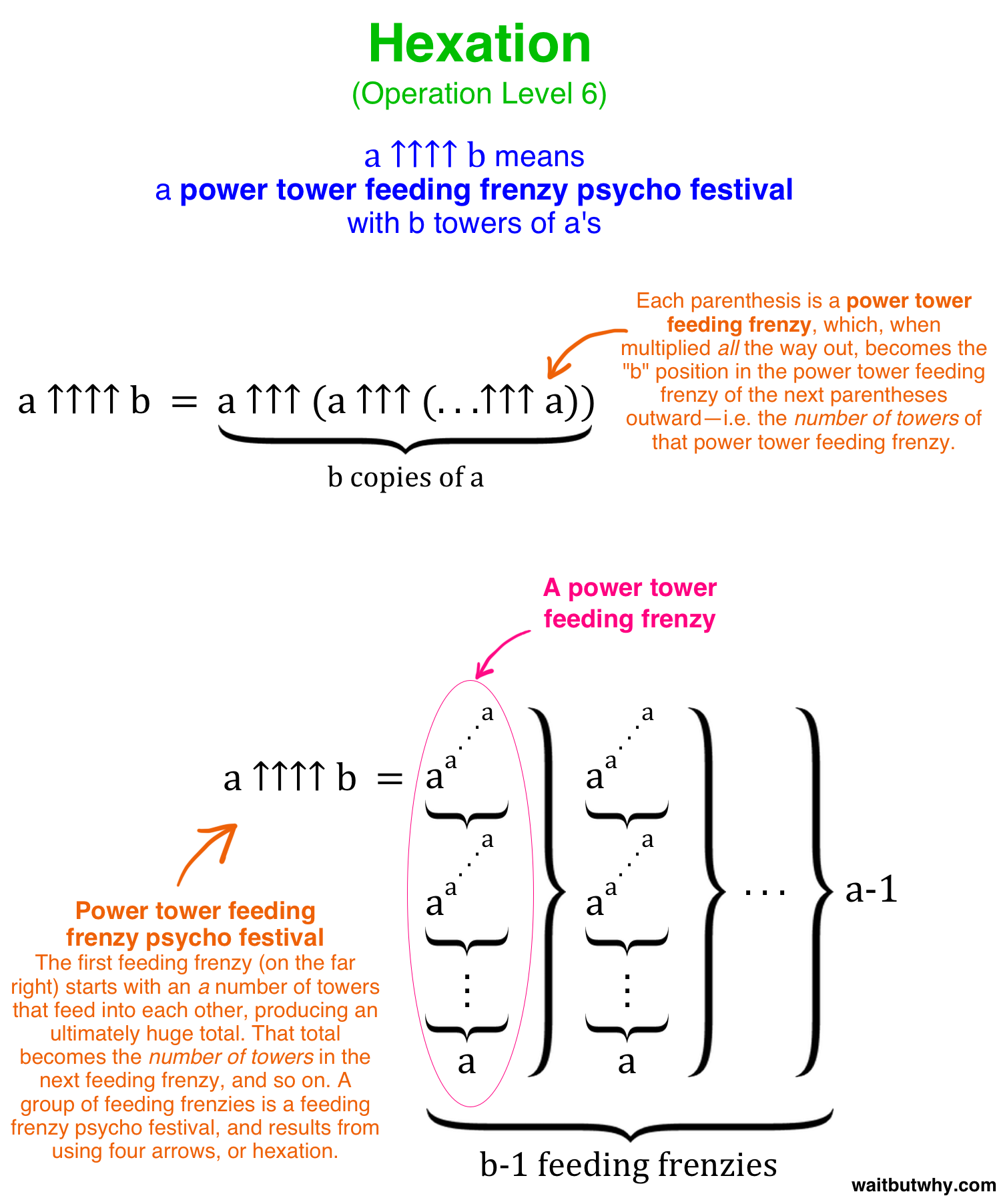
hexation generally

And that’s how the hyperoperation sequence works. You can keep increasing the arrows, and each arrow you add dramatically explodes the scope you’re dealing with. So far, we’ve gone through the first seven operations in the sequence, including the first four arrow levels:

↑ = power
↑↑ = power tower
↑↑↑ = power tower feeding frenzy
↑↑↑↑ = power tower feeding frenzy psycho festival

So now that we have the toolkit, let’s go through Graham’s number:

Graham’s number is going to be equal to a term called g64. We’ll get there. First, we need to start back with a number called g1, and then we’ll work our way up. So what’s g1?

g1 = 3 ↑↑↑↑ 3

Hexation. You get it. Kind of. So let’s go through it.

Since there are four arrows, it looks like we have a power tower feeding frenzy psycho festival on our hands. Here’s how it looks visually:

grahams festival

So g1 = 3 ↑↑↑↑ 3 = 3 ↑↑↑ (3 ↑↑↑ 3), and we have two feeding frenzies to worry about. Let’s deal with the first one (in red) first:

g1 = 3 ↑↑↑↑ 3 = 3 ↑↑↑ (3 ↑↑↑ 3) = 3 ↑↑↑ (3 ↑↑ (3 ↑↑ 3))

So this first feeding frenzy has two ↑↑ power towers. The first tower (in blue) is a straightforward little one because the value of b is only 3:

g1 = 3 ↑↑↑↑ 3 = 3 ↑↑↑ (3 ↑↑↑ 3) = 3 ↑↑↑ (3 ↑↑ (3 ↑↑ 3)) = 3 ↑↑↑ (3 ↑↑ 333)

And we’ve learned that 33= 7,625,597,484,987, so:

g1 = 3 ↑↑↑↑ 3 = 3 ↑↑↑ (3 ↑↑↑ 3) = 3 ↑↑↑ (3 ↑↑ (3 ↑↑ 3)) = 3 ↑↑↑ (3 ↑↑ 333) = 3 ↑↑↑ (3 ↑↑ 7,625,597,484,987

And we know that (3 ↑↑ 7,625,597,484,987) is our 150km-high sun tower:

g1 = 3 ↑↑↑↑ 3 = 3 ↑↑↑ (3 ↑↑↑ 3) = 3 ↑↑↑ (3 ↑↑ (3 ↑↑ 3)) = 3 ↑↑↑ (3 ↑↑ 333) = 3 ↑↑↑ (3 ↑↑ 7,625,597,484,987) = 3 ↑↑↑ (sun tower) 

To clean it up:

g1 = 3 ↑↑↑↑ 3 = 3 ↑↑↑ (3 ↑↑↑ 3) = 3 ↑↑↑ (sun tower) 

So the first of our two feeding frenzies has left us with an epically tall sun tower of 3’s to multiply down. Remember how earlier we showed how quickly a power tower escalated:

3 = 3
33 = 27
333 = 7,625,597,484,987
3333 = a 3.6 trillion-digit number, way bigger than a googol, that would wrap around the Earth a couple hundred times if you wrote it out
33333 = a number with a 3.6 trillion-digit exponent, way way bigger than a googolplex and a number you couldn’t come close to writing in the observable universe, let alone multiplying out

Pretty insane growth, right?

And that’s only the top few centimeters of the sun tower.
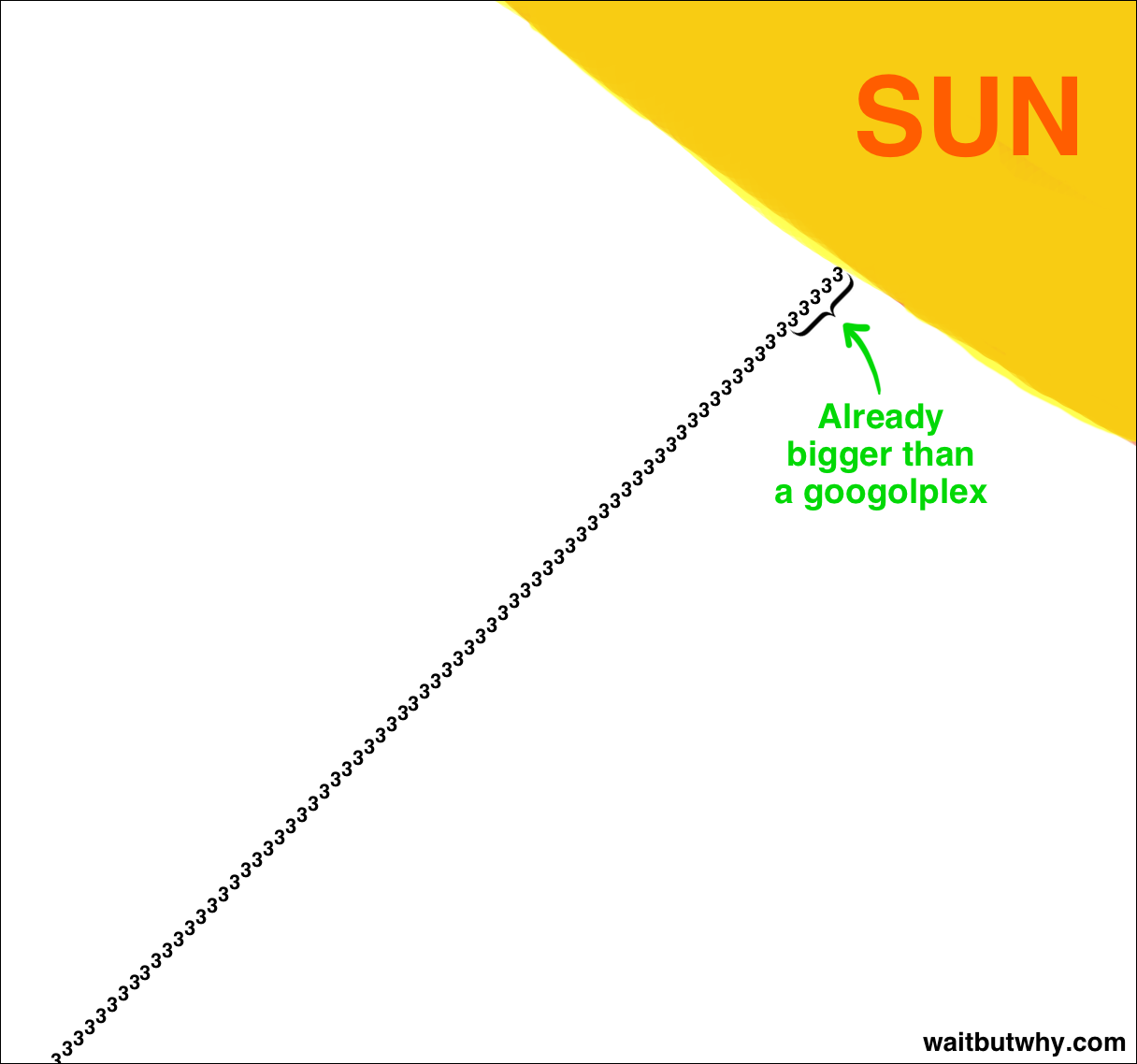
sun tower

Once we get a meter down, the number is truly far, far, far bigger than we could ever fathom. And that’s a meter down.

The tower goes down 150 million kilometers.

Let’s call the final outcome of this multiplied-out sun tower INSANITY in all caps. We can’t comprehend even a few centimeters multiplied out, so 150 million km is gonna be called INSANITY and we’ll just live with it.

So back to where we were:

g1 = 3 ↑↑↑↑ 3 = 3 ↑↑↑ (3 ↑↑↑ 3) = 3 ↑↑↑ (sun tower) 

And now we can replace the sun tower with the final number that it produces:

g1 = 3 ↑↑↑↑ 3 = 3 ↑↑↑ (3 ↑↑↑ 3) = 3 ↑↑↑ (sun tower) = 3 ↑↑↑ INSANITY

Alright, we’re ready for the second of our two feeding frenzies. And here’s the thing about this second feeding frenzy—

So you know how upset I just got about this whole INSANITY thing?

That was the outcome of a feeding frenzy with only two towers. The first little one multiplied out and fed into the second one and the outcome was INSANITY.

Now for this second feeding frenzy…

There are an INSANITY number of towers.

We’ll move on in a minute, and I’ll stop doing these dramatic one sentence paragraphs, I promise—but just absorb that for a second. INSANITY was so big there was no way to talk about it. Planck volumes in the universe is a joke. A googolplex is laughable. It’s too big to be part of my life. And that’s the number of towers in the second feeding frenzy.
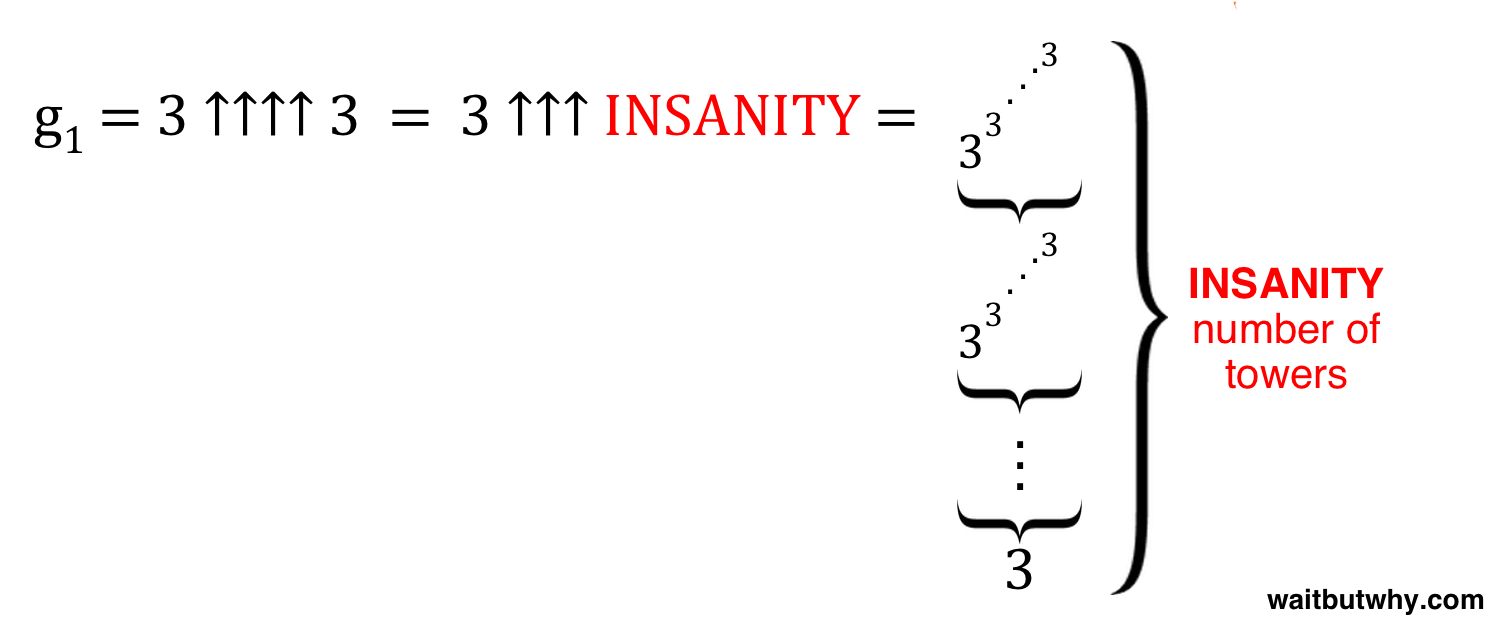
insanity

So we have an INSANITY number of towers, each one being multiplied allllllllll the way down to determine the height of the next one, until somehow, somewhere, at some point in a future universe, we multiply our final tower of this second feeding frenzy out…and that number—let’s call it NO I CAN’T EVEN—is the final outcome of the 3 ↑↑↑↑ 3 power tower feeding frenzy psycho festival.

That number—NO I CAN’T EVEN—is g1.

Now…

I want you to look at me, and I want you to listen to me.

We’re about to enter a whole new realm of craziness, and I’m gonna say some shit that’s not okay. Are you ready?

So g1 is 3 ↑↑↑↑ 3, aka NO I CAN’T EVEN.

The next step is we need to get to g2. Here’s how we get there:
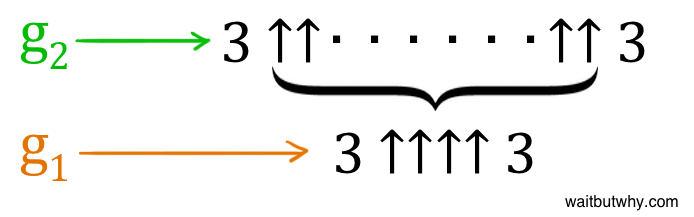
g2

Look closely at that drawing until you realize how not okay it is. Then let’s continue.

So yeah. We spent all day clawing our way up from one arrow to four, coping with the hardships each new operation level presented us with, absorbing the outrageous effect of adding each new arrow in. We went slowly and steadily and we ended up at NO I CAN’T EVEN.

Then Graham decides that for g2, he’ll just do the same thing as he did in g1, except instead of four arrows, there would be NO I CAN’T EVEN arrows. 

Arrows. The entire g1 now feeds into g2 as its number of arrows.

Just going to a fifth arrow would have made my head explode, but the number of arrows in g2 isn’t five—it’s far, far more than the number of Planck volumes that could fit in the universe, far, far more than a googolplex, and far, far more than INSANITY. And that’s the number of arrows. That’s the level of operation g2 uses. Graham’s number iterates on the concept of iterations. It bundles the hyperoperation sequence itself.

Of course, we won’t even pretend to do anything with that information other than laugh at it, stare at it, and be aroused by it. There’s nothing we could possibly say about g2, so we won’t.

And how about g3?

You guessed it—once the laughable gis all multiplied out, that becomes the number of arrows in g3.

And then this happens again for g4. And again for g5. And again and again and again, all the way up to g64.

g64 is Graham’s number.

All together, it looks like this:
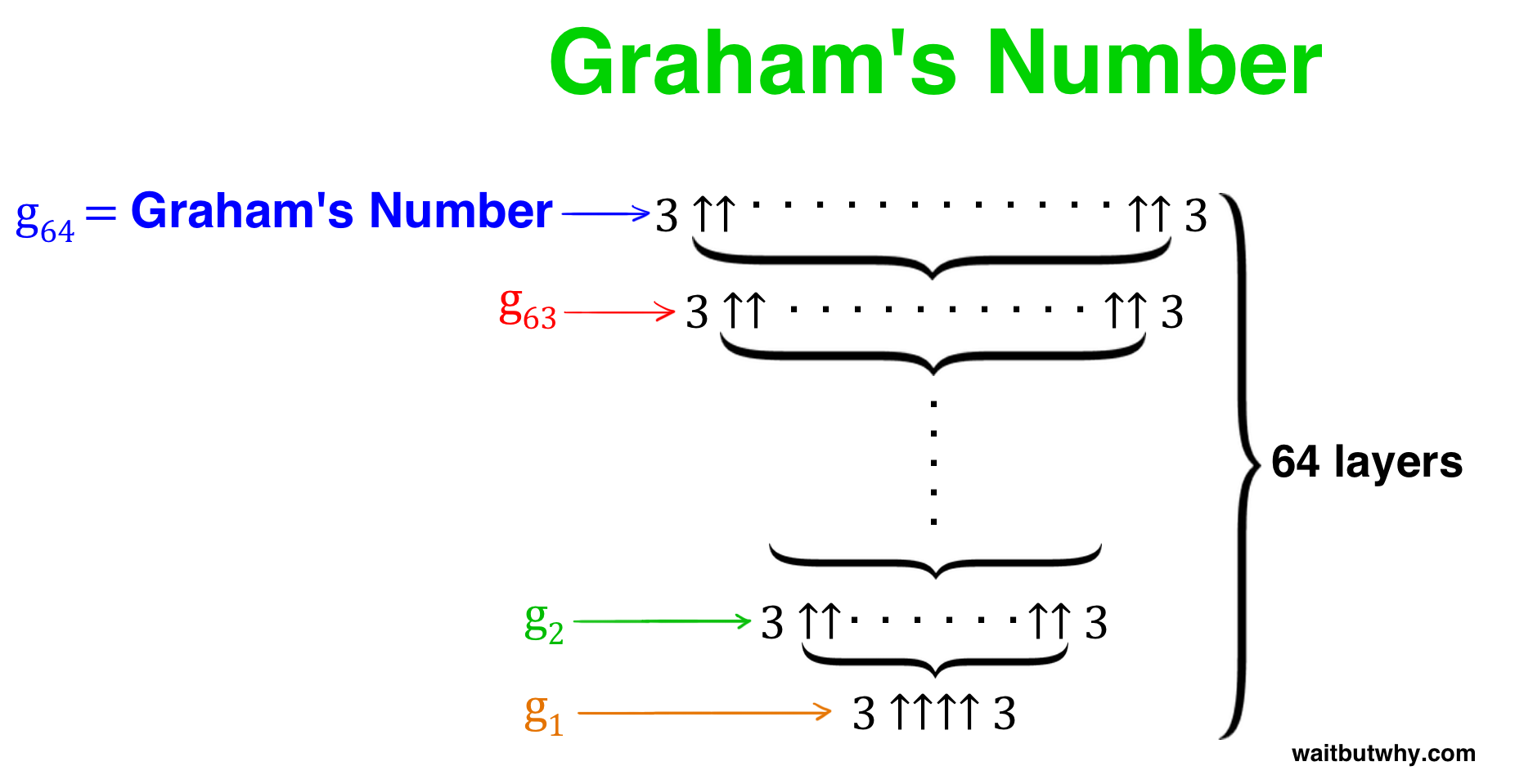
grahams number

So there you go. A new thing to have nightmares about.

________

P.S. Writing this post made me much less likely to pick “infinity” as my answer to this week’s dinner table question. Imagine living a Graham’s number amount of years.Or a g65 number of years, which would be (3 [Graham’s number of arrows] 3)…or a gg64 number of years…I could go on. Even if hypothetically, conditions stayed the same in the universe, in the solar system, and on Earth forever, there is no way the human brain is built to withstand spans of time like that. I’m horrified thinking about it. I think it would be the gravest of grave errors to punch infinity into the calculator—and this is from someone who’s openly terrified of death. Weirdly, thinking about Graham’s number has actually made me feel a little bit calmer about death, because it’s a reminder that I don’t actually want to live forever—I do want to die at some point, because remaining conscious for eternity is even scarier. Yes, death comes way, way too quickly, but the thought “I do want to die at some point” is a very novel concept to me and actually makes me more relaxed than usual about our mortality.

P.P.S If you must, another Wait But Why post on large numbers.

If you liked this, you’ll probably also like:

Fitting 7.3 billion people into one building

What makes you you?

What could you buy with $241 trillion?

_______

If you like Wait But Why, sign up for our email list and we’ll send you new posts when they come out.

To support Wait But Why, visit our Patreon page.

Read this next

330 comments

Leave a Reply

  1. John Zalewski Avatar
    John Zalewski
    Hide

    The afterlife exists, of course.

  2. MGS 1234YT Avatar
    MGS 1234YT
    Hide

    Well that’s fun. I just came here for a fun fact…NOT A FULL-ON EXISTENTIAL CRISIS! I kept spiraling, because even if there is G, we can do crazy stuff, like G^G, or G↑↑↑↑G, or (G↑↑↑↑G)↑↑↑↑(G↑↑↑↑G), and one could keep going infinitely…and STILL NEVER REACH INFINITY! Please send help. Nothing matters. I can’t even…

    P.S: This was really well explained. Helped me understand Tetration, Pentation, and Hexation much better. Broke my mind, but I was still able to understand it! 😅

  3. narutojaja111 Avatar
    narutojaja111
    Hide

    How rappers would be like if they learned how to read Graham’s number? I propose:

    Imma win the rap game, Im making bank
    I fuck g⁶⁴ bitches daily, they want sum cash

  4. James  Avatar
    James
    Hide

    Add gramination and nunination. Gramination would repeat nunation, then omination, then hexation, then pentation, then tetration, then exponentiation, then multiplication, then addition, then counting. It would be a power tower feeding frenzy psycho festival too tall way too tall tower.

  5. James Avatar
    James
    Hide

    g64 is smol. Do one about tree 3. Or TREE(TREE(TREE(TREE(999999)))). Or (TARxg(g(g(g64))))g64.

  6. Jakob Avatar
    Jakob
    Hide

    I want to add somethibg new, omniation. Omniation would be higher then hexation, and every number would be hexationed, and then every number would be pentationed, and then every number would be tetrationed, and finally every number would be exponentiationed. so what this would be is that omniation would be all the others in it aswell

  7. a Avatar
    a
    Hide

    instead of g64, how bout g(g64)

    1. WombatMan Avatar
      WombatMan
      Hide

      Or iterate the concept again.
      I call it Wombat’s number, or W₆₄
      W₁ is equal to G₁↑↑↑↑G₁
      W₂ is equal to G₂↑–W₁–↑G₂
      W₃ is equal to G₃↑–W₂–↑G₃
      —————–
      W₆₄ is equal to G₆₄↑–W₆₃–↑G₆₄
      Maybe larger than Tree(3) (which by the way I’ve never been able to understand, at least the progression of Graham’s number makes sense and you can appreciate the mind-numbing enormity of it; Tree(1)=1, Tree(2)=3, Tree(3) is larger than Graham’s number… what??? lower bound estimated at ~g₃↑187196₃), and not even a scratch on Rayo’s number.

  8. dlr_on_PM Avatar
    Hide

    every 70-digit number is NOT somewhere between 10^69 and 10^70,

    The key word here is BETWEEN

    10^69 is a 70-digit number
    10^70 is a 71-digit number

    so the numbers between 10^69 and 10^70 leave out one 70-digit number, 10^69 itself.

    (example

    10^2 is a 3 digit number 100

    10^3 is a 4 digit number 1000

    all 3 digit numbers are NOT between the numbers 100 and 1000 —

    the 3 digit number 101 is between 100 and 1000;

    the 3 digit number 999 is between 100 and 1000;

    but the 3 digit number 100 is duh, not between 100 and 1000. )

  9. SSM24 Avatar
    SSM24
    Hide

    To me, the funniest thing about Graham’s number is actually that it was one of two numbers he came up with in that proof, the upper and lower bounds on that graph theory problem. Graham’s number was the upper bound. You want to know what the lower bound was?

    6.

    Yep. The upper bound is this monstrously incomprehensible number that’s so large you need to use advanced math to even understand how utterly pointless it is to begin trying to wrap your head around it… and the lower bound is six. Way to narrow it down, eh?

  10. David Sims Avatar
    David Sims
    Hide

    On the contrary, you would want to live forever, provided that you could start over from your youth every 2000 years or so. I have a story in which the protagonist begins as an ordinary girl about to finish elementary school, but begins transforming into a pagan goddess (a genetic throwback to a divine race that became extinct through racial interbreeding with mortals about 40000 years ago). One of the things pagan goddesses can do is replicate material objects in the same way that we can copy files from one computer to another. So Brenda Jones copies herself at the age of 22, and, when she’s 1600 years old or thereabout, she creates another copy of herself at that younger age, spends a couple of centuries training her in advanced goddess ways, hands over power (as Empress of the Solar System Empire) and retires to spend her last 200 years among the outer planets reading science fiction and playing fantasy computer games… and helping the new Empress from time to time. This goes on for at least the 16 billion years during which humanity, led by Brenda clones, colonizes every galaxy that people on Earth in the 21st century could see by light that has been traveling for 800 million years or less. So a cosmically long existence of a person need only be broken up into chunks of a few millennia in order to be a generally happy one.

    1. David Sims Avatar
      David Sims
      Hide

      The first three chapters of Divine Heritage, which tells the story of how Brenda Lynn Jones got her start as a pagan goddess.

      https://mewe.com/group/626b551167ca5d112fd42944

  11. Strange Guy Avatar
    Strange Guy
    Hide

    “6.02 x 10²³—is a mole, or Avogadro’s Number, and the number of hydrogen atoms in a gram of hydrogen…”

    Except that it’s not. Come on, it’s like the first problem on Na kids do in school. The answer would be twice lower.

    1. WombatMan Avatar
      WombatMan
      Hide

      Twice lower? I think you’re off a bit there.
      Atomic weight of Hydrogen is 1.00784 g/mol; so one mole of hydrogen is 1.00784 grams. Close enough if you round it.
      Tim’s right on this one.

      1. Strange Guy Avatar
        Strange Guy
        Hide

        It’s a problem from school textbooks )) He mixed up ‘moleculas’ and ‘atoms’.
        There are 6.022×10^23 hydrogen moleculae in one mole, and consequently 12.044×10^23 atoms (since hydrogen molecula consists of 2 atoms)

        1. WombatMan Avatar
          WombatMan
          Hide

          Nope, you’ve mixed it up. Tim got it right.
          H2 has a molecular mass of ~2, therefore a mole of hydrogen molecules has a mass of about 2 grams. But he didn’t say a mole of hydrogen molecules, he said a mole of hydrogen atoms. 1 mole of hydrogen atoms has a mass of 1 gram.
          A mole is a number, and doesn’t have to refer to molecules, it can quite happily refer to individual atoms as well.

          1. Strange Guy Avatar
            Strange Guy
            Hide

            https://www.vedantu.com/question-answer/explain-why-the-number-of-atoms-in-one-mole-of-class-11-chemistry-cbse-5fa8c561ce9ce85d09f3fda3
            or
            https://www.doubtnut.com/question-answer-chemistry/how-many-atoms-are-present-in-1-mole-of-hydrogen-gas–647237554

            really… I still remember my chemistry curriculum. It’s a basic problem, may be the first they give you on the topic of moles and Avogadro number.

            “number of hydrogen atoms in a gram of _hydrogen_.” That’s the quote from the article.
            It so happend that hydrogen is a diatomic gas. And it so happened that the answer is ~12×10^23 exactly because it’s diatomic.
            He didn’t say ‘gram of atoms’ as you stated (which would be weird but in that case his result would be ok).

            You don’t have to believe me though. You can just open a school chemistry textbook.

            1. WombatMan Avatar
              WombatMan
              Hide

              Again you’re not correctly interpreting what he wrote.
              His exact words were “number of hydrogen atoms in 1 gram of hydrogen”
              It doesn’t matter that H2 is a diatonic molecule, because he’s not talking about molecules.

              But if you want to go through that route then
              m(H2) = 2 g/mol
              1 g H2
              1 g ÷ 2 g/mol = 0.5 mole of H2
              Well guess what, that’s 1 mole of hydrogen atoms.

              Btw I don’t need to open a high school chemistry book, I have a master’s in chemistry, that’ll do.

            2. Strange Guy Avatar
              Strange Guy
              Hide

              “Again you’re not correctly interpreting what he wrote.”

              huh? What interpretation are you talking about? I literally gave you a quote. And it’s not freaking Shakespeare to interpret. The phrase was pretty simple and obvious.

              “because he’s not talking about molecules.”
              No. He’s talking about ‘hydrogen’ (read the quote). If you don’t know what hydrogen is you can look it up in wikipedia or google it. It might come as a surprise, but it’s a gas. Two-atomic gas.
              Usually, when people say ‘hydrogen’ they mean hydrogen (the gas), unless specified something else (like ‘metallic hydrogen’, ‘hydrogen isotope’ etc). Just like when people say ‘water’ they mean H2O, and when they say ‘oxygen’ they mean O2.
              So, don’t go back on your own words. He never said anything about ‘1 gram of hydrogen atoms’. He said ‘hydrogen’

              ” I have a master’s in chemistry”
              And I’m a Shaolin-temple master in seventh generation ))
              I actually gave you a link to a CBSE _chemistry lection_, master. Just to refresh your memories.
              So there two options:
              1) You’re right, and modern chemistry is a lie, all teachers are liers, and textbooks are lying, and it’s only you who are smart enough to understand it.
              2) Probably there’s no conspiracy and you just don’t want to admit that you’re wrong.

              I’m not insisting, but you know, from aside it looks a bit… not in your favor.
              And to be honest I’m not good at talking with geniuses (and those denying official science are probably geniuses, while I’m not), so farewell…

            3. WombatMan Avatar
              WombatMan
              Hide

              I did read the quote, multiple times.
              “the number of hydrogen atoms in a gram of hydrogen.”

              A hydrogen atom has an atomic mass of 1 g/mol, a hydrogen molecule has a molecular mass of 2 g/mol, because as you said, it has 2 hydrogen atoms.
              So 1 gram of hydrogen contains 0.5 mole of hydrogen molecules, which is 1 mole of hydrogen atoms.

              And what did he say?
              “the number of hydrogen atoms in a gram of hydrogen.”

              The links you gave me contain correct information, but do not change the fact that 1 gram of hydrogen contains 1 mole of hydrogen atoms.

              Nothing I’m saying goes against established science. I’m not deviating at all from it.
              So option 3, you made a small mistake, easy enough to do.

              You said: “He never said anything about ‘1 gram of hydrogen atoms’. He said ‘hydrogen’”

              Except he did. Here’s the quote from Tim for a third time.

              “the number of hydrogen ATOMS in a gram of hydrogen.”

              1 gram of hydrogen
              0.5 mole of hydrogen molecules
              1 mole of hydrogen atoms.

              Edit to add:
              I’m not completely sure where your mistake is coming in, so maybe some nomenclature will clear it up. To make sure we’re actually talking about the same thing.
              H by itself is an atom. 1 proton, 1 electron; atomic mass = 1 g/mol (rounded)
              H₂ is a molecule, two atoms of H covalently bonded together. 2 protons, 2 electrons; molecular mass = 2 g/mol (again, rounded).
              Because there are two hydrogen atoms (H) per hydrogen molecule (H₂), for every mole of hydrogen molecule you have 2 moles of hydrogen atoms making it up. A hydrogen molecule cannot be referred to as a hydrogen atom, but rather two hydrogen atoms.

              1 mole of hydrogen molecules (H₂) will therefore be 2g of hydrogen (remember, it’s molecular mass is 2 g/mol, or 2 grams per mole), made up of 2 moles of hydrogen atoms (H).

              So 1 gram of hydrogen is half that. 0.5 mole of hydrogen molecules (H₂), made up of 1 mole of hydrogen atoms (H)
              Which matches with what Tim said.

              Link to Vanderbilt university with a highlighted line saying exactly what I just did.

              Also, sarcasm aside, I only brought up my masters because of your insistence that I go learn some basic chemistry, which came across as a bit snarky, apologies if you didn’t mean it that way. But seriously man, this stuff is so ridiculously simple to me because I’ve been doing it at post graduate level for over 20 years now.

    2. Guest Avatar
      Guest
      Hide

      This part confused me as I don’t remember ever coming across this number at school. I’m not from the US though.

  12. Ben Taylor Avatar
    Ben Taylor
    Hide

    I’m defining a new number Z.
    I first define the function WOOD(n) being such that
    WOOD(n) = WOOD(WOOD(n-1)) [n > 0]
    and WOOD(0) = TREE(G) where G = Graham’s number.
    so WOOD(1) = WOOD(TREE(G))
    and WOOD(2) = WOOD(WOOD(TREE(G))),
    and WOOD(3) = WOOD(WOOD(WOOD(TREE(G))))
    etc.
    Now Z is defined such that, Graham has Graham’s number children, each of which spends their whole career defining as big a number as possible, and probably doing far better than me at it. While they’re not busy doing that, they also manage to find the time to also have Graham’s number children. This process continues for a Graham’s number of generations.
    After Graham’s number generations, all the numbers Graham’s lineage have produced are all raised to the power of each other, call this number Y.
    Z is defined as WOOD(Y).

  13. Ben Taylor Avatar
    Ben Taylor
    Hide

    I’m defining a new number Z.
    I first define the function WOOD(n) being such that
    WOOD(n) = WOOD(WOOD(n-1)) [n > 0]
    and WOOD(0) = TREE(G) where G = Graham’s number.
    so WOOD(1) = WOOD(TREE(G))
    and WOOD(2) = WOOD(WOOD(TREE(G))),
    and WOOD(3) = WOOD(WOOD(WOOD(TREE(G))))
    etc.
    Now Z is defined such that, Graham has Graham’s number children, each of which spends their whole career defining as big a number as possible, and probably doing far better than me at it. While they’re not busy doing that, they also manage to find the time to also have Graham’s number children. This process continues for a Graham’s number of generations.
    After Graham’s number generations, all the numbers Graham’s lineage have produced are all raised to the power of each other, call this number Y.
    Z is defined as WOOD(Y).

  14. RickHavoc Avatar
    RickHavoc
    Hide

    I think there’s a little mistake in this.

    You say that a googol = the whole universe filled with sandgrains, times 10 billion. That part is clear to me.

    But when you explain googolplex you say that it’s like writing 10 billion zeroes on each sandgrain filling the universe.
    That is merely the visualization of a googol, not googolPLEX!
    If I understand correctly, the ‘plex would indeed be the repeating of that writing zeroes on every sandgrain process a googol times.

    I hope someone can help clear this up!

    1. Jeff Avatar
      Jeff
      Hide

      I think what’s being said is that if you write 10 billion zeroes on each sand grain you will have written 1 followed by a googol of zeroes, ie you will have written down the number googolplex. Kinda like saying if I write 1 followed by six zeroes then I’ve written the number one million, but I wouldn’t actually have written a million zeroes?

  15. Aditya  Avatar
    Aditya
    Hide

    Lol and it’s still not big enough. Tree(3) is way bigger than it. And then there is the BB i.e the Busy Beaver Number which is said to be so large that the Graham’s number is significant as 0.

  16. endlessnumbers Avatar
    endlessnumbers
    Hide

    I’m crazy, I want to count it, so this could take as long as the observable universe, so God forbid forever.

  17. Kristoph Avatar
    Kristoph
    Hide

    Gonna be the dumb guy here. You lost me at Operation 3, and Knuth’s Arrow. I can’t make sense of your explanation.
    I feel like I’m being ‘John Olivered’. Telling me something to see if I just nod my head, or say WTF?
    I’m sure I’m missing something, but I have to stop you and say WTF.
    I can’t continue the article until I can at least grasp Operation 3.
    I’m sure I’ll have more questions later.

    1. kirinobestwaifu Avatar
      kirinobestwaifu
      Hide

      So, if you have 3 ↑↑ 3 that’s just 3^3^3 or a power tower of height = 3. In other words, your concatenating 3 consecutive exponentiations. Now, 3 ↑↑↑ 3 would be involve concatenating the concatenation of powers three times, that is, joining together 3 power towers.

      So, you start with the first power tower, 3 ↑↑ 3 = 3^3^3. Now, the result of that determines the height of the second tower, so you end with 3^3^…^3^3 where the number of threes is 3^3^3 = 7,625,597,484,987.

      Now, for the final tower (remember, the second number after the three arrows was 3, so there are 3 concatenations of power towers) you take the result of 3^3^…^3^3, that is the “sun tower”, and make another power tower with a height that uses that number.

      So, you’d end up with 3^3^…^3^3 such that there are a “sun tower” ( 3 ^ 7,625,597,484,987 ) number of threes. Once you compute the entire tower of height “sun tower” then you get the result of 3 ↑↑↑ 3.

      I hope the explanation is clear, I tried not to skip any step so as to not miss any crucial detail.

  18. ammo Avatar
    ammo
    Hide

    And in this case, we’ll refer to Graham’s Number as *static crackling in brain, which exploded when we got past INSANITY*

  19. Richi German is also op Avatar
    Richi German is also op
    Hide

    um

  20. Akshad Avatar
    Akshad
    Hide

    Next Article in the series- Infinite Explained

  21. MABfan11 Avatar
    MABfan11
    Hide

    Graham’s Number is pretty easy to represent in BEAF: {3,65,1,2}

    now imagine how big {3,65,65,65} is…

    1. Michael Gerardi Avatar
      Michael Gerardi
      Hide

      Where’s the BEAF?

      1. MABfan11 Avatar
        MABfan11
        Hide

        Bowers’ Exploding Array Function
        you can read about it on Googology wiki:
        https://googology.fandom.com/wiki/Bowers%27_Exploding_Array_Function

        1. Michael Gerardi Avatar
          Michael Gerardi
          Hide

          I guess that wasn’t actually funny *heh*

          1. Kristoph Avatar
            Kristoph
            Hide

            Well, I laughed

  22. Caleb Hale Avatar
    Caleb Hale
    Hide

    RAYO(TREE(g64)))

  23. Shimon Bar-Mordecai Avatar
    Shimon Bar-Mordecai
    Hide

    I struggle with the maths behind this. Forgive the pedestrian question, but if the number of atoms in the observable universe is 10^80, why would it take 10^86 peas to pack it, or 10^90 grains of sand? Shouldn’t the number of objects *larger* than atoms needed to pack the universe be smaller than the number of atoms themselves? It takes more grains of sand than peas, for example; shouldn’t it take more atom-sized objects (ie: atoms) than both?

    1. Caleb Hale Avatar
      Caleb Hale
      Hide

      From what I understand, a perfect vacuum does not contain atoms, but makes up a significant portion of the universe. Hence, filling these vacuums and thus the observable universe would take significantly more particles than are currently in existence.

  24. Joe Peters Avatar
    Joe Peters
    Hide

    Last night, I started looking into SSCG, and I’m already blown away by how fast it grows. TREE(2)=3

    1. Joe Peters Avatar
      Joe Peters
      Hide

      I don’t know why my phone went all crazy like that, but it did. Sorry about that. SSCG (1)

      1. Joe Peters Avatar
        Joe Peters
        Hide

        What’s wrong with my phone? Why does it keep doing that?

        1. Joe Peters Avatar
          Joe Peters
          Hide

          SSCG(1)

          1. Joe Peters Avatar
            Joe Peters
            Hide

            Oh no, not again!!!!! tree(3) and tree(n) above mean TREE(3) and TREE(n) , respectively.

  25. bob cl Avatar
    bob cl
    Hide

    it doesn have any mearning, cant be used for counting or describing
    or relating, or comparing

    1. ohpr Avatar
      ohpr
      Hide

      Actually it does have a use in counting, just something really specific.

  26. Šimo_Čemeričinović Avatar
    Šimo_Čemeričinović
    Hide

    There us a bigger number. Human stupidity.

    1. bob cl Avatar
      bob cl
      Hide

      typo

      1. Nine teenths Avatar
        Nine teenths
        Hide

        ????

  27. Delsmi Avatar
    Delsmi
    Hide

    Entertaining article.

    Just a thought about the postscriptum: Everyone interested in things like that should read “The Jaunt” by Stephen King. Truly terrifying. It’s a short story but it “May be longer than you think”

    1. bob cl Avatar
      bob cl
      Hide

      story dumb 1 – if was driven insane they would not be lucid before unable to handle present, 2- ether is not what is used, intravenous propofol – 3 if time dilation (which doesnt make sense) anesthesia wouldnt help, 4 conservation of energy,. 5 hair turn white from age but not body? 6 heart attacks are from lack of blood, he would have died earlier

      1. ohpr Avatar
        ohpr
        Hide

        Yeah, it falls apart on closer inspection

      2. Delsmi Avatar
        Delsmi
        Hide

        Well it was a suggestion and i didn’t examine it in a lab to be honest. Nothing else to say…

        1. bob cl Avatar
          bob cl
          Hide

          LOl good reply

          1. Delsmi Avatar
            Delsmi
            Hide

            Sorry if it was a bit snarky, was a bit angry on that day in general. No hard feelings?

            1. bob cl Avatar
              bob cl
              Hide

              i liked it so…

            2. Delsmi Avatar
              Delsmi
              Hide

              Same

    2. imercuryous Avatar
      imercuryous
      Hide

      Read it a long time ago and I hear ya!

  28. araf Avatar
    araf
    Hide

    But why stop at g64 ? What is so special about 64 ? … why don’t g64 continue to g65….g66…..etc……? (Prey tell)

    1. ABG Avatar
      ABG
      Hide

      It’s the upper bound of a mathematical proof for a problem described earlier in the article.

  29. Izzy Gray Avatar
    Izzy Gray
    Hide

    i think the simulation just broke
    Except we’re still here. Hmmm

  30. Ingo Blechschmidt Avatar
    Ingo Blechschmidt
    Hide

    > Of course, we won’t even pretend to do anything with that information other than laugh at it, stare at it, and be aroused by it. There’s nothing we could possibly say about g2, so we won’t.

    Except that we know its final digit. The number g_2, and also Graham’s numbers, ends in a 7.

    1. Chris Barton Avatar
      Chris Barton
      Hide

      I know a bigger number.

      Exactly the same number, but with an 8 instead of a 7.

      I call it Chris’s number

  31. Zoo Avatar
    Zoo
    Hide

    i wantd to find big numbr for me 2rd grade sience clas. I was bord
    i ended up in ditention for writng a papr about gramms numbr bc it was two complacated for there tini brieans

  32. Cutie Booty Cotton Tail Avatar
    Cutie Booty Cotton Tail
    Hide

    I used to be terrified of the idea of living forever while simultaneously being afraid of ceasing to exist. I think the concept only seems frightening because, as you pointed out, we lack the brain power to comprehend very large numbers. However, this proves nothing about our brains’ abilities to last forever. There are already many things about our own brains that we can’t comphrehend (such as an infinite number of possible combinations of synapses) and our inability to visualize these things all at once doesn’t make our brains stop working. What is the point of trying to imagine eternity all at once? Can you really even imagine the next year of your life all at once? Or even the next month? Does your inability to do so make you want to stop existing? I’m guessing that no, it doesn’t. We take life in tiny increments. One fraction of a second at a time. We can make plans for the near future with ease, but trying to imagine ALL time between now and any point in the future (greater than a week or maybe even a day for some) is overwhelming. Furthermore, why stress about how any version of your distant future self will feel? In a few hundred years this current version of yourself will be an infant by comparison. Would the current version of yourself allow the 5 year old version of yourself to make decisions regarding your potential immortality? Would the 5 year old even really understand the concept of the distant future or the concept of adulthood? Perhaps our brains would reach a new level of maturity in time and the things we find hard to imagine right now will come easily. Anyway, I loved your article and thought you made some interesting points. I’m glad you found a way to comfort the part of you that fears eternity. I thought I would share how I comfort myself in case you ever need a different perspective to soothe those fears.

    1. kirinobestwaifu Avatar
      kirinobestwaifu
      Hide

      I agree, there’s also just so much potential in a infinite lifespan. I’d also like to add that, while some people might fear that there’s not enough “disk space” or brain power in us to remember/be aware of everything that could happen during a unending life, we have to recognize that we already forget many unnecessary details of our day-to-day life. So, if we lived longer I think the brain would adapt and free our mental “disk space” more effectively, or at least recycle that information in other ways. Not to mention that we employ many devices to remember things for us, and who knows, maybe brain interfaces will make it possible to expand our information-retaining capabilities, or allow memories to be transferred to external storage devices.

  33. Caleb Birtwistle Avatar
    Caleb Birtwistle
    Hide

    Then someone comes up with a use for g65

  34. Thomas Avatar
    Thomas
    Hide

    Thank you for making a subject that is completely hard to understand enjoyable to read and laugh at. I feel like I was able to walk away from this with some of my sanity still intact. Haha!

  35. Whats Left of Righteous Avatar
    Whats Left of Righteous
    Hide

    Stupid question: How can the universe be measured?

    How can it even be accurately defined? Is it not just a theory?

    The infinity of numbers would suggest to me that there are no bounds to the universe.

    Sorry if this gets a little to philosophical.

    1. Sama__ Avatar
      Sama__
      Hide

      We know the univers is 14 billion years old going light speed and keep accelerate in all direction since the start, it is only an approximation because it is expanding continiously, but it is around a sphere that is 45 billion light years radius…
      I am not a specialist and this might be even bigger then espected but anyway,

      The infinity of numbers and the physical infinity of our univers has nothing in common, it is writting though all this article, we created ways to create insanely big numbers that has no use to our physical world,
      IN FACT GRAHAM NUMBER IS THE ANSWERE TO A PROBLEME WITH N DIMENSION…

      In conclusion, univers is huge but not “infinite” mathematicly and you might concider double check this beautifull article or even google the subsequent questions that might come with it…

      Sorry if that looked angry-typed but it is about the topic itself..

    2. Alan Moll Avatar
      Alan Moll
      Hide

      We can only measure the observable universe, which has a radius of about 46 billion light years. The entire universe (i.e., beyond what we can see) may be finite, but much bigger, or it may be infinite. We really don’t know.

  36. I_Have_Spoken Avatar
    I_Have_Spoken
    Hide

    you should create a YouTube channel

  37. DonutLord Avatar
    Hide

    Imagine a g googolplex (googolplex is in subscript) number of years….
    IMAGINE A g [GRAHAMS HUGE FUCKING NUMBER] NUMBER OF YEARS

  38. Tremil Avatar
    Tremil
    Hide

    I remember thinking about really huge numbers in my youth, around the same time as Graham; 1975-1978 I believe, because I was delivering newspapers in the morning at the time, and in my solitude my thoughts often wandered into philosophy around science and the universe – what else is there to think about at 5 a.m. when nobody else is up? My thoughts at the time were quite similar to Ronald Graham’s. I tried to find a way to write the biggest number I could think of, and I got to power towers and levels. I also figured out what I thought was the best way to write such huge numbers, would be to use the 10^10…10 etc. as a standard because with these big numbers it would be difficult to know the difference between e.g. 3^3….3 and 4^4…4.

    I find the idea of levels very interesting, and I imagine how one could extend this to oven higher heavens. Is there a particular reason for stopping at level 64? Why not continue all the way to “Grahamplex”? (A number with a Graham’s number of levels!)

    1. R H Avatar
      R H
      Hide

      Of course you could easily create bigger numbers using this scheme. However, remember that the original purpose of the Graham number wasn’t to create a huge number, but to find a _lowest possible upper bound_ beyond which a specific mathematical statement would always be true, and G64 was the best he could come up with at the time. Actually, that’s not entirely true, the number that actually features in the proof is apparently slightly smaller, but this one was significantly easier to explain. Significantly smaller upper bounds have been found in later years.

      Also note that mathematics has come up with far larger numbers since, larger even than the number you describe above. See for example TREE(3), SSCG(3), or Rayo’s Number.

  39. Sai suvvidh Avatar
    Sai suvvidh
    Hide

    Your page is awesome

  40. John Avatar
    John
    Hide

    For those who want to play with absurdly large numbers, I’ve found a game that uses numbers beyond Graham’s number:
    https://www.kongregate.com/games/Patcail/ordinal-markup

  41. levi Avatar
    levi
    Hide

    it is called lefitity and is bigger than many numbers.

  42. levi Avatar
    levi
    Hide

    i made a number because i thought it would be fun.

  43. Rand Avatar
    Rand
    Hide

    Having fun learning about the fascinating subject of big numbers. Maybe like a lot of people, I try to visualize the number into something relatable. Grahams number is the one I’m thinking of. I like the Planck volume and observable universe comparison. Just how many of them would it take to be filled with Planck volumes to hold all of Grahams numbers digits? Anybody ever figure that out? Or is it unfigurable? Thanks.

    1. lax Avatar
      lax
      Hide

      It would take about a Graham’s Number of Universes to put it’s digits on every Plank Volume. Even a G(63) universes is not enough.

      1. Rand Avatar
        Rand
        Hide

        Mind boggling, and numbingly amazing all at the same time. Absolutely incredible amount.
        I honesty had no idea. Thanks for putting some perspective to it all.

  44. KnightOfTheNite Avatar
    KnightOfTheNite
    Hide

    I highly recommend an edit of the names that are used on this page to describe the units (quantities), conform S.I. (if necessary by first making the intermediate step towards uniformity (i.e. use kilometers or miles but not both).

  45. Chas Busek Avatar
    Chas Busek
    Hide

    10000000000000000000000000000000000000000000000000000000000000000000000000000000000000000000000000000000000000000000000000000000000000000000000000000000000000000000000000000000000000000000000000000000000000000000000000000000000x Graham’s number

  46. Random Guy JCI Avatar
    Random Guy JCI
    Hide

    Is no one gonna ask why the Googol guy is named both Krasner and Kasner??

  47. anonymous Avatar
    anonymous
    Hide

    my brain is broke

  48. Armando Ferrara Avatar
    Armando Ferrara
    Hide

    So a googolplex is 10(100-digit number). Then you just have to write out 1 followed by hundred zeros and there you have a googolplex. I see this pattern: 10^2 = 1 00, 10^3 = 1 000, 10^4 = 10 000, so forth. Also a googol = googolplex. Since 10^100 = googol, and (10)^(10^100) = (10)^(100-digit number) = 1 followed by hundred zeros. I interepreted that on Wikipedia.Also how come that 10^3003 is Millinillion but googolplex does´t have a name?

    1. Liggliluff Avatar
      Liggliluff
      Hide

      No, you’ve made a mistake there. A 100-digit number does not have the value of 100. Example:
      10^3 = 1 000, we agree on, a 4-digit number.
      10^(4-digit number) is not 10 000, because this 4-digit number is 10 000, so 10^(4-digit number) is 1 followed by a 4-digit number of zeros (a 1000 zeros).

      A googolplex is a 1 followed by a googol number of zeros, much more than just 100 zeros.

      1. Armando Ferrara Avatar
        Armando Ferrara
        Hide

        Thank you!

  49. BruceTindall Avatar
    BruceTindall
    Hide

    Great explanation, but it kinda sucks that you dissed Milton Sirotta so bad. I think he did quite well for a 9 year old kid. Also, Kasner’s explanation in his book “Mathematics and the Imagination” is quite good and I’m disappointed you didn’t reference that book although it’s obvious that you’ve read it. Other than that, Mrs. Lincoln, great play.

  50. Ryan Vanchure Avatar
    Ryan Vanchure
    Hide

    Ok, so I only just discovered numbers like Graham’s Number and TREE(3), etc.. But with quantum computing becoming a much more real and accessible tool for certain professionals too use wouldn’t sometime in the 2020’s quantum computing be able to figure out FULL sun tower? I remember seeing some video about quantum computing finding an answer in 200 seconds that would’ve taken 10,000 years for non quantum computers.

    1. l_l Avatar
      l_l
      Hide

      There isnt enogh matter in the universe to store the result so, no.

      1. Armando Ferrara Avatar
        Armando Ferrara
        Hide

        So a googolplex is 10^(100-digit number). Then you just have to write out 1 followed by hundred zeros and there you have a googolplex. Also, a googol = googolplex since10^100 = googol, and (10)^(10^100) = (10)^(100-digit number) = 1 followed by hundred zeros and since 10^2 = 1 00, 10^3 = 1 000, 10^4 = 10 000, 10^100 = googolplex. I interepreted that on Wikipedia.Also how come that 10^3003 is Millinillion but googolplex does´t have a name?

        1. Liggliluff Avatar
          Liggliluff
          Hide

          You’ve “spammed” this misconception here; but you’ve made the mistake of thinking a 100-digit number has the value of 100, which is wrong. A googol is a 1 followed by a googol number of zeros (much more than just 100 zeros). – I’m going to put this reply on all your replies, so people don’t get misinformed.

        2. Louis E. Avatar
          Louis E.
          Hide

          Besides your mixing up the numbers of zeroes…”millinillion” and “millillion” are variant names used by different people,and short scales and long scales give different values for the same names.The system I devised (look up the put.com web project “Counting really,Really,REALLY High”) uses “kilillion” for 10^6000 and kilillio-illion for 10^(10^6000) and many named numbers are much much bigger than that.

  51. KARARYU THE DRAGON GHOUL Avatar
    KARARYU THE DRAGON GHOUL
    Hide

    Too bad for the scaredies, Tim. We actually do exist forever and beyond the Universe’s restarting cycles. and even beyond, ever. There is no such thing as “the void of nothingness”. Ancient manuscripts, all Mankind’s sacred books, Greek philosophers, prophets, grimoires, Descartes, Lavoisier, the particle-accelerator Physics and Quantum bookbloating paraphernalia state there is no such thing as utter nihilistic destruction of anything that exists in the Universe or ceasing existence, or even non-existence, only transformations throughout the many possible quantum Universes and timespaces. Even the intergalactical void is full of particles and radiation, and some imaginary or conceptual, impractical “perfect void” – with no matter, no radiation, nothing – is a form of EXISTENCE itself, and EXISTS as an idea before it all. There is no form of perfect “void space”, and were there, it would be impossible to make it cease its existence, too. Infinitive Eternity thus, is not a blessing or a promise from a deity or the like – it is rather a CONVICTION, a PERPETUAL SENTENCE. “Cogito, ergo sum”. Sorry, dude. Enjoy the courtesy ride.

  52. Priyabrata Avatar
    Priyabrata
    Hide

    Nice article but have you wondered what’s bigger than Graham’s number…
    For more info, check out this one!

    1. Joe Peters Avatar
      Joe Peters
      Hide

      Thanks!

      1. Joe Peters Avatar
        Joe Peters
        Hide

        I know TREE(n) eventually dominates G(n), yet TREE(1)=1, and TREE(2)=3. Yet TREE(3)>>G187,196. I get the feeling TREE(n) dominates G(n) for all values for n> or =3. Is that right? Hen3ry gave a more satisfactory lower bound for TREE(3).

    2. Armando Ferrara Avatar
      Armando Ferrara
      Hide

      Also, a googol = googolplex since10^100 = googol, and (10)^(10^100) = (10)^(100-digit number) = 1 followed by hundred zeros and since 10^2 = 1 00, 10^3 = 1 000, 10^4 = 10 000, 10^100 = googolplex. I interepreted that on Wikipedia.Also how come that 10^3003 is Millinillion but googolplex does´t have a name?

      1. Liggliluff Avatar
        Liggliluff
        Hide

        You’ve “spammed” this misconception here; but you’ve made the mistake of thinking a 100-digit number has the value of 100, which is wrong. A googol is a 1 followed by a googol number of zeros (much more than just 100 zeros). – I’m going to put this reply on all your replies, so people don’t get misinformed..

  53. Jennifer_Reitz Avatar

    Graham’s number astonishes me, but it does not frighten me. I want to live a full Graham, and look forward to the next Graham’s Graham of years beyond that. I do not ever want to die, I cannot even comprehend the thought of wanting to at any point ever. I want to see that last ‘7’ at the end of Graham’s number.

    1. J Avatar
      J
      Hide

      You are foolish if you actually want to live that long. I bet you’d want to die by the 1000th year.

  54. zubair Avatar
    zubair
    Hide

    I love this post. It’s so easy to understand your explanation. it’s the best post I have ever read till now.

  55. Billy Rainbow Avatar
    Billy Rainbow
    Hide

    Cool. You’ve arrived at a countable number, Graham’s number. That means it exists in a one-to-one correspondence with some Natural number in the set { 1, 2, 3, … }. (Makes sense, counting started the discussion.) A good start on Real Infinity has been made, but there’s still a ways to go. Georg Cantor characterized Natural numbers as having a cardinality – countableness – of “Aleph-naught,” a symbol this textbox won’t let me draw. It’s the Hebrew letter aleph with a 0 subscript. Real numbers insert an infinite number of numbers in between each consecutive pair of Natural numbers, giving the Real numbers a cardinality of “Aleph-one.” Clearly, the cardinality calculation can be extended infinitely, one example being inserting a Real number sequence in between each real number – or going further, in between each digit of every Real number in the whole infinite set. Or, consider Power Sets. Take your pick. There are plenty of opportunities available. Georg Cantor spent his last days in a lunatic asylum. Some people think he just wandered off into one of his infinities. Yet in the post above, we stop with a number that’s only just countable. Finite. It’s not even possible to get Achilles past the tortoise with something like that!

    1. Micha_Elyi Avatar
      Micha_Elyi
      Hide

      ₀א

  56. azonicrider32 Avatar
    azonicrider32
    Hide

    what has the world come to… discussing how many zeros you can or can’t imagine behind a number..
    try imagining infinity if you want to impress yourself.

    1. Liggliluff Avatar
      Liggliluff
      Hide

      Infinity isn’t a number 😛
      It’s a concept, but not a number.

    2. YourExcellency Avatar
      YourExcellency
      Hide

      You don’t need to “imagine infinity.” Let go of the need for limits, start points, end points and other comparative references that is conditioned by societies living in a finite domain.

      Tim’s “there is no way the human brain is built to withstand spans of time like that” exemplifies that conditioning. Of course no human brain will withstand a span of time even marginally longer than the one it is built for. But there is no reason a mind must accept limits. The fright it feels when confronted with the possibility no limits is of external origin.

  57. jackie chan Avatar
    jackie chan
    Hide

    That’s my D’s length

    1. G S Avatar
      G S
      Hide

      really bro.. like really?

  58. Vadim Aznalin Avatar
    Vadim Aznalin
    Hide

    https://www.youtube.com/watch?v=dgnDnRVFET8

  59. Simeon Meister Avatar
    Simeon Meister
    Hide

    So.. at 10^80 you’re saying that’s how many atoms is in the universe and at 10^86 you’re saying that’s how many peas you would need to fill the universe, I’m not computing that haha

    1. Robbe Debraekeleer Avatar
      Robbe Debraekeleer
      Hide

      5% of the Universe is made out of matter… So the remaining 95% is not made out of atoms, but can be filled with peas ????

  60. Hen3ry Avatar
    Hen3ry
    Hide

    And, with the Elon Musk tweet, lots of random new posts suggesting g(65) et al.

  61. Otto Waalkes Avatar
    Otto Waalkes
    Hide

    And once you realized the insanity of grahams number, you should check the number TREE(3).
    It is defined by a simple game, everyone can understand. And it is so big, that Graham’s number is essentially zero compared to it.
    https://www.youtube.com/watch?v=3P6DWAwwViU

    1. Tenzin the goat Avatar
      Tenzin the goat
      Hide

      I found one bigger and it’s called Freidman’s SSCG(3) which is much much bigger than TREE (3) which is already unthinkable

      1. Armando Ferrara Avatar
        Armando Ferrara
        Hide

        Googol = Googolplex. Since 10^1 = 10, 10^2 = 1 00, 10^3 = 1 000, 10^4 = 10 000, 10^100 = googol, and (10) ^ (10^100) = (10) ^ (100-digit number) = 1 followed by hundred zeros. Then a googol = a googolplex. I interpreted that on Wikipedia and following the logic 10^1, 10^2.

        1. Louis E. Avatar
          Louis E.
          Hide

          10^100=100-digit number
          10^100-digit number=number with 10^100 digits.

        2. Cat Butler Avatar
          Cat Butler
          Hide

          It’s not 100 zeroes, it’s a googleplex of zeroes. Stop spamming that answer

  62. Germanicus . Avatar
    Germanicus .
    Hide

    1/(Grahams number) seconds = The amount of time that passes between the traffic light turning green and a NYC taxi behind you honking his horn.

    1. Micha_Elyi Avatar
      Micha_Elyi
      Hide

      Light bends in a gravity field. That’s why the cabbie behind you sees the light turn green before you do. The light curved around you to reach him* first. It’s physics.

      * “him” because females don’t want an equal chance to end up as a cab driver; feminists demand that females be more equal than men

      1. Armando Ferrara Avatar
        Armando Ferrara
        Hide

        Googol = Googolplex. Since 10^1 = 10, 10^2 = 1 00, 10^3 = 1 000, 10^4 = 10 000, 10^100 = googol, and (10) ^ (10^100) = (10) ^ (100-digit number) = 1 followed by hundred zeros. Then a googol = a googolplex. I interpreted that on Wikipedia and following the logic 10^1, 10^2, 10^3

        1. Gagaz Avatar
          Gagaz
          Hide

          bruh googol is 1 followed by 100 zeroes, googolplex is 1 followed by googol zeroes so if 100=googol then googol=googolplex. 100 is not equal to googol.10^100 is not equal to 10^googol so googolplex is not equal to googol hence proved blud

  63. Darklordgwyn Avatar
    Darklordgwyn
    Hide

    Why does it stop at G64? Why not G65, or G66, or G700, or Ggoogleplex, or Gg?

    1. David Coleman Avatar

      There are even bigger numbers than Graham’s number like Loaders number and Rayo’s number but you could always just write whatever number someone thought of +1. That’s why maths has the concept of infinity.

  64. Kenivia Avatar
    Kenivia
    Hide

    what if g2 is actually g1 {g1*arrows} g1

  65. Umiljata Zver Avatar
    Umiljata Zver
    Hide

    Now that escalated quickly!

  66. Esteban Avatar
    Esteban
    Hide

    So… how does graham even has defined that number if literaly nothing can calculate that number? also: WHO DA#### NEEDS HAT NUMBER? I mean, if te solution to that wierd question is only MINIMALY near G64, no, MINIMALY near G1, no, even worse, NEAR INSANITY, its incalculable.

  67. Joe Peters Avatar
    Joe Peters
    Hide

    I’ve read this post many times before, and I think this is BY FAR the best walkthrough of Graham’s number I’ve ever seen. I have mixed feelings about this post. Next time, can you try walking me through TREE(3)? Also, I’m very curious to know what it’d be like to live for G64 or even G1 years. I think it’d feel so weird to be a googolplex^googolplex years old. Maybe I’d enjoy it so much I’d want to live forever, or maybe I’d be so freaked out by all the monsters that I’d be begging for info death just so I could stop living. Also, I find 24!, 52!, 54!, and 70! interesting, as well as the half-lives of bismuth-209 and tellurium-128, as well as the Hawking evaporation time of supermassive black holes.

    1. Graham Ian Mann Gogs Avatar
      Graham Ian Mann Gogs
      Hide

      https://www.youtube.com/watch?v=3P6DWAwwViU&t=79s

      1. Joe Peters Avatar
        Joe Peters
        Hide

        Thank you. This video you shared with me is the best video or other representation of TREE(3). It’s a very fun game. Is there any hyperoperation sequence such as the one outlined above by Tim for the largest proven lower bound for TREE(3)? If so, what?

        1. Nobody Avatar
          Nobody
          Hide

          You start running into bad problems. TREE(3) itself is not bounded very well – the best lower bound I found is g(g(g(…1)))))…))), where the number of g’s is

          g(100000-ish).

          While that seems large, it’s probably a vast understatement. Once you want to build a function that grows at a similar speed as TREE(n), you need lots of ordinal

          numbers.

          The basic idea is the fast-growing hierarchy, which is a way to name functions that produce large numbers. Subscripts got messed up in the formatting, so just subscript mentally whatever is between f and the parentheses.

          f0(n) = n+1

          f1(n) = f0(f0(…f0(n))) with n f0’s, also known as 2*n

          f2(n) = f1(f1(…f1(n))) with n f1’s, also known as (2^n)*n

          f3(n) = f2(f2(…f2(n))) with n f2’s, also roughly 2↑↑n (actually more, but it’s common to just throw away some of the extra terms, here the n multiplied by at f2)

          f4(n) = f3(f3(…f3(n))) with n f3’s, also roughly 2↑↑↑n

          In general, fa(n) > 2↑a-1n

          Here comes the trick: Let’s say fω(n) = fn(n).

          That’s about 2↑(n arrows) n. Now, we can continue:

          fω+1(n) = fω(fω(…fω(n))) with n fω’s, also roughly g(n) – work it out on paper if you want.

          This is the jump called “iterating on the concept of iteration” in the article.

          fω+2(n) = fω+1(fω+1(…fω+1(n))) with n fω+1’s, also roughly g(g(g(g(…n)))) with n g’s

          You probably see where this goes. We can define:

          f2ω(n) = fω+n(n)

          Now continue to 2ω+1, etc. You’ll then get to 3ω, which “reduces” to 2ω+n. Continue on to ω2, which “reduces” to nω. At this point, we’re FAR beyond the realm of Graham’s number, which is about fω+1(64). But we’re not at TREE(n) yet. We’re building up a system of what’s called ordinal numbers. I once went through a different arrow system, Conway chained arrows, and expanded them all the way to (I guess) ω^ω^ω^ω. But that’s still not TREE(n) yet. I put up my system online (but a

          few details are inconsistent, so it might not be perfectly understandable) here. You can get even higher – to an endless chain of ω’s in a power tower (which reduces to a power tower n ω’s tall), also called ε0. Beyond that, it becomes a bit tedious and hard to format in a comment.

          The bottom line is: There exists a function tree(n), much weaker than TREE(n). Its strength in the fast-growing hierarchy is represented by the Small Veblen ordinal. That was too much for me, but I managed to get my head around the Feferman-Schütte ordinal, which is smaller: basically, after ε0 comes ε1, which is an infinite power tower of ε0’s. Then ε2, etc. The whole thing happens again in the subscript, going all the way to εω, εε0, until an infinite subscripted chain of ε’s, kinda like a power tower upside down. That is ζ0. Here we go again. Now repeat the process ω times (defining that is hard). Repeat the process as many times as you just got. Repeat forever. That’s the Feferman-Schütte ordinal.

          TL;DR:

          It’s easy to define a function that outgrows g(n). You can iterate on

          that function in increasingly clever ways to get all sorts of HUGE numbers by

          “iterating on the concept of iteration”, iterating on that, and iterating on the levels of iteration depth you do. That concept is extended mathematically beyond all reason and formalised. That’s the only way to talk meaningfully about the size of TREE(3).

          TL;DR of the TL;DR: The hyperoperation sequence you ask for does exist, and

          it is what would happen if you appended ten more articles on this.

          TL;DR of the TL;DR of the TL;DR: TREE(n) is amazingly large.

          Some extra, more rigorous reading:

          https://math.stackexchange.com/questions/313134/how-does-tree3-grow-to-get-so-big-laymen-explanation?rq

          https://googology.wikia.org/wiki/Fast-growing_hierarchy

          1. Nobody Avatar
            Nobody
            Hide

            Disqus made the comment oddly formatted. Sorry.

            1. Joey Peters Avatar
              Joey Peters
              Hide

              It’s ok. Thanks for the best formula for it I’ve ever seen!

            2. Joey Peters Avatar
              Joey Peters
              Hide

              Also, Does that make TREE3 larger than graham’s number^graham’s number?

            3. Hen3ry Avatar
              Hen3ry
              Hide

              I suspect you’re still missing something here. The entire point of inventing insane recursion patterns is that it is the fastest a number can grow. Exponentiation is completely useless compared to even the stuff used for G, let alone the extended operations. If I could have said “TREE(3)” is less than G^G, I would have said that and not the wall of text.

            4. Joey Peters Avatar
              Joey Peters
              Hide

              So I take that answer to be yes.

            5. Joe Peters Avatar
              Joe Peters
              Hide

              I probably should’ve asked instead if TREE(3) is larger than G^^G. (ie: a power tower of graham’s numbers stacked graham’s number high.) Though I get the feeling it must be.

              Also, Tim, I think I found a fix to your drawing on G2. I saw 3^^……^^3, which I fixed to 3 (G1 up arrows) 3=3 (3^^^^3 up arrows) 3. Also, by universe, I assume you mean observable universe. We don’t know how big the total universe is, and it may well be infinite in extent (by contrast, we know that TREE(3), let alone graham’s number, is finite).

            6. Hen3ry Avatar
              Hen3ry
              Hide

              Still not getting it… even a power tower is weak. TREE(3) is on a completely different level than G, and you need completely new tools.

            7. Louis E. Avatar
              Louis E.
              Hide

              So is TREE(Graham’s Number) finite?

            8. Hen3ry Avatar
              Hen3ry
              Hide

              Per Kruskal’s tree theorem, it is.

            9. Joe Avatar
              Joe
              Hide

              It’s a shame that g(3(^187,196)3) became a common lower bound for TREE(3). I found a video today that TREE(3) is MUCH, MUCH larger than G………………………..G(64). See
              Graham array notation and will it beat TREE(3)? on Youtube (sorry my computer wouldn’t let me share the link).
              Also, is there a proof that tree(3), (as opposed to TREE(3) is larger than graham’s number?

          2. Joe Peters Avatar
            Joe Peters
            Hide

            Whoa!!!! Is there any hope of figuring out what TREE3 equals? What hyper-operation would it even take to discuss it?

            1. Hen3ry Avatar
              Hen3ry
              Hide

              Figuring out? Not in this universe – it is too small to fit even a written representation of g(1). But you can work with the value in a somewhat meaningful way (and compare it with other large numbers) if you use the formalism I described. Disqus is bad at formatting of the ordinals (and inserts paragraph breaks at random if you paste anything in your comment), so my explanation probably didn’t make a whole lot of sense. The googology link is the best I can give you.

  68. Daniel Arseneault Avatar
    Daniel Arseneault
    Hide

    yeah, if you thought g64 was bad just imagine g65… or even worse, gg1… or WAY worse, ggg………..gg1 with a g1 amount of g’s, what i like to call gh1 (the h stands for hyper, as this is iterated g’s. you can see where im going.). gh2 would be a g2 amount of g’s, and gh(g1) is what i like to call ghh1. and so on… until we get to u1 (the u now stands for Ultimate), which would be a gh1 amount of h’s after the g. then u64 would be the Ultimately Huge Number.

    1. A Person Avatar
      A Person
      Hide

      And this is used in what mathematical proof? Also what about uu64?

      1. Daniel Arseneault Avatar
        Daniel Arseneault
        Hide

        by that logic, what about uuu64? WHAT ABOUT TREATING THE G’S LIKE U’S?

  69. lj307 Avatar
    lj307
    Hide

    This was fun. Fun as fuck.

  70. Sensorfire Avatar
    Sensorfire
    Hide

    Can you guys believe that that hedgehog actually ended up sneezing at the 36th second of 2:52am on March 19th, 2017? Crazy, right?

    1. Unknow0059 Avatar
      Hide

      No. What’s crazy is the chances of whoever got that prediction right.

    2. Bobbawaffle Avatar
      Bobbawaffle
      Hide

      No, what’s crazy is that eventually, someone WILL guess the correct sneezing second EVERY time a hedgehog sneezing contest happens. EVERY TIME. It’s inevitable, which is why, I suppose people play sneezing contests.

  71. GuccizBud Avatar
    GuccizBud
    Hide

    I can’t take it anymore. My brain is full. Back to porn.

  72. GuccizBud Avatar
    GuccizBud
    Hide

    Dude … without a doubt, the best part of your writing is the little circled numbers with the funny hidden messages behind them — they are FOOKING HILARIOUS, for real. 🙂

  73. Joseph Wu Avatar
    Joseph Wu
    Hide

    try TREE(3)

    1. Grizzly01 Avatar
      Grizzly01
      Hide

      I’ll see your TREE(3), and raise you Rayo’s Number.

  74. Richard Rabinowitz Avatar
    Richard Rabinowitz
    Hide

    And then some smart aleck comes along and suggests a Graham’s number of arrows…. This whole thing is ridiculous

    1. Jylppy81 Avatar
      Jylppy81
      Hide

      Well, that would be g65.

  75. Bogdan Radu Avatar
    Hide

    Will to live, where are you? I lost ya!

  76. Apofis Avatar
    Hide

    What is this triviality about numbers? We must fold space-time onto itself and transcend these silly things such as Graham’s numbers. At some point the number doesn’t really matter!

  77. David McBain Avatar
    David McBain
    Hide

    Freakin’ me out…..I could not follow it past exponentiation.

  78. bobthelob Avatar
    bobthelob
    Hide

    “10^80 – To get to 10^80, you take trillion and you multiply it by a trillion, by a trillion, by a trillion, by a trillion, by a trillion, by a hundred million. No dot posters being sold for this number. So why did I stop here at this number? Because it’s a common estimate for the number of atoms in the universe.

    10^86 – And what if you wanted to pack the entire observable universe sphere with peas? You’d need 1086peas to make it happen.”

    So more peas would fit in the observable universe than atoms in the universe? Or am I an idiot?

  79. Orang Yousefian Avatar
    Orang Yousefian
    Hide

    Now instead of each 3 put the graham number itself !!! And then calculate it!!! And repeat the process graham number times ! How about that !!and repeat what i said graham number tmes again .yoooohooooooo hooooo

  80. maurae1 Avatar
    maurae1
    Hide

    ===== Brelliant Quality Of performance wwhhy… <..~~~.. make money online

  81. MarthaFErvin Avatar
    MarthaFErvin
    Hide

    Best Quality performance waitbutwhy… <…… Find Here

  82. JeffreyHNelson Avatar
    JeffreyHNelson
    Hide

    22222Ultra Income source by waitbutwhy Find Here

  83. Lefuld Avatar
    Lefuld
    Hide

    < ✜✱✪✪✲✜ +waitbutwhy +*********….. < Now Go R­e­­a­d M­o­r­e

    33

  84. Sawly1971 Avatar
    Sawly1971
    Hide

    < col Hiiiiiii Friends..''.——–''▬▬▬▬★★ that's a full enjoy with+ waitbutwhy+ ********* < Find More='' ……..''

    ????????????????????????????????????????????????????y

  85. Augustine Esterhammer-Fic Avatar
    Augustine Esterhammer-Fic
    Hide

    One problem with the segment on the Googolplex (I hope I’m not the guy repeating someone else’s idea):

    “random probability suggests that there would be exact copies of you in that universe. Why? Because every possible arrangement of matter in a human-sized space would likely occur many, many times in a space that vast, meaning everything that could possibly exist would exist—including you.”

    But the universe doesn’t tend toward random arrangements. Maybe there are [10 to the 10 to the 70] possible arrangements of atoms in a human-sized space. That wouldn’t mean that you’d find that random space with any frequency. Every day of our 3.5 billion year evolution was another day of chance events influencing whether or not YOUR specific genes are passed down. For that random human-sized space to be arranged into a Tim Urban, it would have to follow an equally contingent series of events. If you calculate the odds of yourself existing, not as a single probability of random particles, but as a probability of events beginning with a mostly hydrogen universe, I think the number would be many times higher.

  86. Impirren RyRy Avatar
    Impirren RyRy
    Hide

    I got very, very worried once I saw Sextillion was nowhere near as far down the page as I thought it would be.

  87. Red Sage Avatar
    Red Sage
    Hide

    W. O. W.

    This still makes more sense to me than irrational quadratic equations.

  88. qusdis Avatar
    qusdis
    Hide

    What’s truly amazing about Graham’s Number is the “pound for pound” insanity you get out of moving from exponentiation to tetration. I am easily able to construct larger numbers by, say, doing G64 factorial, etc., but it was genius to come up with tetration in the first place, whereby 3^3^3^3 is already bigger than a googol.

  89. Ishraq Quayyum Avatar
    Ishraq Quayyum
    Hide

    Here’s a video about Graham’s number. It features the man himself: Ron Graham. https://www.youtube.com/watch?v=HX8bihEe3nA

  90. Hennie Randolph Avatar
    Hennie Randolph
    Hide

    who is this graham character anyhow

  91. Darkness3827 Avatar
    Darkness3827
    Hide

    This could go on infinitely where you have g(g (g… g (64)…) where the number of g’s is grahams number. and then you could do the same thing where whatever that new number is is the amount of g’s, then do that again with this 2nd new number. Thinking that if you could some how calculate this number instantly and if you kept plugging this in once a second and getting a new number and so on for your entire life (or for all of time) and you would still be 0% of the way to infinity is a pretty terrifying thought.

  92. Matthus Gougeus Avatar
    Matthus Gougeus
    Hide

    http://googology.wikia.com/wiki/Googology_Wiki

    1. Cookie Fonster Avatar

      i am a regular contributor to that wiki and i approve this comment

  93. stcoleridge Avatar
    stcoleridge
    Hide

    I was reading this, but had to take a break. When I picked up my iPhone again there was an ant running around in it … sort of an analogy to me vs the G64 concept.

  94. godsmotive Avatar
    godsmotive
    Hide

    I wrote a book called Infinity Squared…but it wasn’t supposed to actually mean anything…just a catchy title and looked neat using the symbols on the cover.

  95. Chris O'Sullivan Avatar

    https://www.youtube.com/watch?v=4J9MRYJz9-4

  96. Socrates Avatar
    Socrates
    Hide

    I’m a nuclear physicist and I must say we don’t think much about numbers larger than the age of the universe, that’s mostly it for us. This is quite interesting. Gave me more of a headache than reading about infinity and Georg Cantor, because I just accepted this is beyond comprehension. With this I tried… unfortunately.

    1. Matthus Gougeus Avatar
      Matthus Gougeus
      Hide

      What ? Even Avogadro’s number is bigger than the age of the universe in seconds.

      1. Penisman Avatar
        Penisman
        Hide

        assume he meant the “size” of the universe

  97. Phill Avatar
    Phill
    Hide

    You always make me laugh in these posts. You can make even some of the most dull topics hilarious! Think about what an actual feeding frenzy psycho festival would look like! Lol! Insane people walking around eating tonnes of things…

  98. Sean Avatar
    Sean
    Hide

    but what about Graham’s number + 1?

    1. Grotoff Avatar
      Grotoff
      Hide

      It’s not comprehendable by our meat brains, but there is no limit of the real numbers. When we say a number continues to infinity, we’re serious. If you want to know about the more or less practical use of the number, it’s an upper bound in the solution to a geometry problem. Look Numberphile’s videos about it.

  99. Guest Avatar
    Guest
    Hide

    I don’t really get why Graham’s number is G64. 64 seems randomly chosen but it probably isn’t, can someone explain?

    1. Matthus Gougeus Avatar
      Matthus Gougeus
      Hide

      g64 is an upper bound to the solution of the problem about n-dimensional hypercubes.

  100. Bassam Abdul-Baki Avatar
    Bassam Abdul-Baki
    Hide

    Good read. I recently learned about Busy Beavers (http://en.wikipedia.org/wiki/Busy_beaver). Talk about a crazy sequence.

  101. […] https://wait-but-why-production.mystagingwebsite.com/2014/11/1000000-grahams-number.html […]

  102. […] https://wait-but-why-production.mystagingwebsite.com/2014/11/1000000-grahams-number.html […]

  103. […] That's pretty big, right? Not. Even. It turns out you can construct numbers that are so much larger than a googolplex, that it's gonna light your head on fire just to read about them. Put on your asbestos hat and feast your eyes on Graham's Number. […]

  104. Peter Tibbles Avatar
    Peter Tibbles
    Hide

    I’ve just invented Pete’s number. Graham’s number is G64 (in his notation), so
    I’d like to lay claim to G(Graham’s number).

    Get your head around that one.

    1. Cookie Fonster Avatar

      although this is a tricky number to get your head around, rest assured you aren’t the first to come up with G(Graham’s number). it’s a common retort to graham’s number alright.

      1. Peter Tibbles Avatar
        Peter Tibbles
        Hide

        Oh dear, foiled again.

        1. Alec Rhea Avatar
          Alec Rhea
          Hide

          and you could then recursively define G(G(64)) as H(64), then keep going until we had H(H(64)) and define that as I(64) so on and so forth. You’re iterating the iteration of iterating iteration, so on and so forth.

          1. Aximili Avatar
            Aximili
            Hide

            If you wanna see some some truly vast numbers, many of which absolutely dwarf g64 and everything you just described along with it, go have a look at Jonathan Bowers’ homepage: http://www.polytope.net/hedrondude/scrapers.htm

            You will need the notation described here to even begin to understand any of this: http://www.polytope.net/hedrondude/array.htm

            You’ll find Graham’s number in the sixth-smallest group he defined, and then it just keeps going. I don’t know how or why, but it would appear that coming up with huge numbers is all that guy does for a living.

    2. Meh Avatar
      Meh
      Hide

      The whole reason Graham’s number is significant is because it’s an insanely large number that actually serves a practical purpose. Arbitrarily constructing large numbers isn’t really impressive in itself.

  105. Tacoplex Avatar
    Tacoplex
    Hide

    For those who’d like to imagine living LONG time here’s weird japanese vid.
    http://www.youtube.com/watch?v=CN_eL5ukCbw

    1. Degu Avatar
      Degu
      Hide

      That went very differently than I thought it would. It was actually kind of rewarding. I’d do that.

  106. alterreg Avatar
    alterreg
    Hide

    is g64-1 a prime?

    1. Cookie Fonster Avatar

      no, since it’s a difference of two perfect cubes (graham’s number (it’s a cube since it’s just a huge power tower of 3’s) and 1), it can be factored with the formula for factoring differences of cube, which means it is composite.

      1. Cookie Fonster Avatar

        and to add on, the largest known prime number isn’t even close to graham’s number or even a googolplex – it has only 17 million digits.

    2. the bang! Avatar
      the bang!
      Hide

      No becuase its even!Grahams number is odd so subtract 1 and you’ll get an even number.

      1. alterreg Avatar
        alterreg
        Hide

        i really meant to subtract 1

    3. Aximili Avatar
      Aximili
      Hide

      Not a chance. It’s a power of three, therefore it must be an odd number. And any odd number minus 1 is an even number, none of which (except for 2) are prime.

  107. […] which he, in typical form, described as “one, followed by writing zeroes until you get tired.”6 At this, Krasner showed some uncharacteristic restraint, ignoring Milton and giving the number […]

  108. Wile E. Coyote Avatar
    Wile E. Coyote
    Hide

    Where does TREE3 fall in at? I thought that was a biggy.

    1. Cookie Fonster Avatar

      nobody knows for sure, but even extremely weak lower bounds are MUCH larger than graham’s number.

      1. Wile E. Coyote Avatar
        Wile E. Coyote
        Hide

        Is TREE3 an infinate number? AKA: a method and not a number? Lower bounds seems like just a numeric equation that is infinite. On the contineum to nowhere or everywhere. I guess google jr., (forgot his name), was correct googleplex is a one with a zero and another zero….until you get tired of writing zeros. Then googleplex plus 1, then 2, then ………..googleplex to towers………….. Are upper bounds also infinite? I surely am missing information but nobody will be able to count the highest, or will they

        1. Cookie Fonster Avatar

          no, TREE(3) is a well-defined finite number.

          1. Wile E. Coyote Avatar
            Wile E. Coyote
            Hide

            OK that’s what I thought. Thanks for the reply. Now what about these lower bounds numbers though?

    2. Michael Tiemann Avatar

      An extremely weak lower bound for TREE(3), is A(A(…A(1)…)), where the number of As is A(187196). A(n) = Ackerman(n,n).

      A(1) = 3
      A(A(1)) = A(3) = 61
      A(A(A(1))) = A(61) A(64)
      So TREE(3) ~ a nesting of A(A(A(…(G64)…))) that’s (A(187196) – 4) deep.

      But that is again insignificant compared to SSCG(3), where SSCG is Friedman’s Simple Sub-Cubic Graph function. That number can be at least a deep nesting of TREE(TREE(…(TREE(3))…)). I don’t know exactly how deep, but possibly TREE(3) deep.

  109. garthpool Avatar
    garthpool
    Hide

    About living for eternity, suppose you could forget everything that had happened more than two hours before, or some time period of your choice. And if you could change that time period at will, that would be even better. Assuming, of course, that all experiences would be good. Maybe they would all be bad. That seems to be a possibility in an infinite universe.

  110. Mogumbo Gono Avatar
    Mogumbo Gono
    Hide

    A trillion trillion up arrows isn’t even a smidgen of infinity.

    And there are different levels of infinity…

    But fortunately, infinity isn’t a number at all.

  111. ravensperch Avatar
    ravensperch
    Hide

    This post has a lot of similarities to a virus. As a result, it hacked the limits of my comprehension. Installing a new hard drive. Loading…..

  112. […] Owning A Ferrari For A Year Was A Disappointment – One Day, I Will Die on Mars – From 1,000,000 to Graham’s Number – Cycling over the Pyrenees with one leg – Inside Facebook’s Plan to Wire the […]

  113. […] From 1,000,000 to Graham’s Number. From 1,000,000 to Graham’s […]

  114. Pelishka Avatar
    Pelishka
    Hide

    What about the busy beaver function? The fastest growing sequence that one can conceive (without going meta). It makes the series (g1,g2,g3,…) look like a really slow one!!!! and actually grows faster than any computable sequence.

  115. odput Avatar
    odput
    Hide

    When I read what g2 was and figured out where we were going to get to g64, I had one of those 3rd level of consciousness “whoa” moments. It was the first one I had since reading about Tim’s levels of consciousness. It was pretty awesome.

  116. Dr. Strangelover Avatar

    Dr. Strangelover’s Number: Whatever the Greatest Number Is + 1

    1. Cookie Fonster Avatar

      this “number” is cheating in the large number discussion, trying to make the new largest number. well guess what: there is NO greatest number. if you want to make a large number, actually make your own large number and not some bullshit like “the biggest number + 1”.

  117. V. Avatar
    V.
    Hide

    This post made me love math.

  118. arpit maheshwari Avatar
    arpit maheshwari
    Hide

    Most mind blowing post that i have ever read. When You reached gogolplex(or something like that) I wanted this post to never end. But hey, I was too early and in the end I was begging for death.

  119. foobie Avatar
    foobie
    Hide

    Goodstein’s function grows _much_ faster than Graham’s number (function).

    You want to see a big number, you have to ask a proof theorist, not a combinatorialist.

    1. Eliza Qwghlm Avatar
      Eliza Qwghlm
      Hide

      Tim wrote a 6,000 word essay on large numbers, and you ONE UPPED him in only 26!!

      God, I admire you.

      1. Cookie Fonster Avatar

        well, of course he didn’t describe goodstein’s function in detail

        1. jeffhre Avatar
          jeffhre
          Hide

          And he didn’t show if why and how Goodstein’s number could be of any importance equal to or greater than…John Doe’s number.

  120. Nat Williams Avatar
    Nat Williams
    Hide

    You’re ignoring probably the best part about Graham’s Number. From the original paper:

    “Is it possible to improve significantly the estimates of these numbers? For example, in Corollary 12, the
    upper bound on N(l, 2, 2) given by the theorem is truly enormous, where, in fact,
    the exact bound is probably < 10."

    It is the worst upper bound ever.

    1. Cookie Fonster Avatar

      Yeah, I find it funny how graham’s number is an EXTREMELY huge upper-bound – even the current bound is 2^^(2^^(2^^9)), which is still quite big.

      Then again, some numbers bigger than Graham’s number have been used in mathematics not just as an upper-bound. for example, TREE(3), a number discovered by Harvey Friedman, is the answer to the problem:

      “What is the longest possible length of a sequence of 3-labeled trees such that no tree is homeomorphically embeddable into a later tree?”

      It’s a fairly simply problem that leads to a surprisingly big solution, TREE(3). It’s not known exactly how big TREE(3) is, but we know that it’s far far far far far far larger than Graham’s number.

      And there are still bigger numbers like that – for example SCG(13) or the numbers that we can make from the finite promise games, and the busy beaver function as well.

  121. […] https://wait-but-why-production.mystagingwebsite.com/2014/11/1000000-grahams-number.html […]

  122. […] Urban, do Wait But Why, leva-nos pelo insano caminho […]

  123. Habfast Avatar
    Habfast
    Hide

    Having done set theory, this is still by far smaller than the cardinality of the continuum (number of real numbers): http://en.wikipedia.org/wiki/Cardinality_of_the_continuum

    Which itself is far far smaller than other sets (see http://en.wikipedia.org/wiki/Beth_number)

    Sincere apologies for being pedant and annoying, I generally don’t do that.

    1. Guest Avatar
      Guest
      Hide

      You’re being unnecessarily pedantic, of course any number no matter how big will be 0% of not even the number of real numbers, but the number of integers (the smallest infinite number)…

  124. Eliza Qwghlm Avatar
    Eliza Qwghlm
    Hide

    I saw someone’s post that said your brain wouldn’t explode, it would collapse into a black hole if it contained this much information. I did a quick calculation, and it would take a lot less information than a googol before the collapse.

    Quick research estimates a black hole forms at the mass of 40 suns. The mass of our sun is 2 x 10^30 kg, so a black hole requires 8 x 10^31 kg of mass to form. The human brain has 1.36 kg of mass. It would require 8 / 1.36 = 5.9 x 10^31 brains to form a black hole.

    The human brain contains an estimated 100 billion neurons, each potentially holding an estimated 1,000 bits of data. The total data held by a single brain is estimated at 100 trillion, or 10^14, bits of data.

    So by my calculation, 5.9 x 10^31 brains would hold 5.9 x 10^45 bits of data before the collapse.

    So don’t feel bad if you can’t comprehend Graham’s number. It wouldn’t be healthy for you if you did.

    1. Isaac Churchill Avatar
      Isaac Churchill
      Hide

      Not sure what you meant by “a black hole forms at the mass of 40 suns”, the earth would form a black hole if it was crushed to the size of a pea

      1. Eliza Qwghlm Avatar
        Eliza Qwghlm
        Hide

        Fair point. I read the European Southern Observatory’s website to mean it requires approximately 40 solar masses to form a black hole: http://www.eso.org/public/usa/news/eso1034/

        You are correct, a micro black hole can theoretically appear at much smaller sizes, as long as the volume is sufficiently small. Thanks for the correction. That makes the question more interesting: assuming 1,200 cubic cm for a human brain, what is the mass required before it forms a black hole? I am assuming it is less than 8 x 10^31 kg (and therefore, able to hold a lot less data than 5.9 x 10^45), but my personal neurons don’t contain the math skills to figure it out.

  125. Eliza Qwghlm Avatar
    Eliza Qwghlm
    Hide

    Wonderful post, Tim. Would you be able to calculate / predict how far into a single power tower the world’s largest supercomputer could calculate and multiply all the way down?

  126. dreamfeed Avatar
    dreamfeed
    Hide

    “I’m not gonna really explain this because the explanation is really boring and confusing”

    Just because you don’t understand it doesn’t mean it’s boring. If you watched a movie in a language you don’t understand, you would probably be bored, but you wouldn’t say it was necessarily a boring movie.

    1. Cookie Fonster Avatar

      Actually, the problem is quite simple. You can check out my explanation of it below:

      https://sites.google.com/site/pointlesslargenumberstuff/home/1/1_9

      Just because the number is huge doesn’t mean the problem is utterly esoteric.

      1. Cookie Fonster Avatar

        Link is now changed:

        https://sites.google.com/site/pointlesslargenumberstuff/home/2/2_4

        1. Cookie Fonster Avatar

          link changed again if anyone cares:

          https://sites.google.com/site/pointlesslargenumberstuff/home/2/2_5

  127. GC Avatar
    GC
    Hide

    (That’s “mathematician”. Why can’t I spot those errors BEFORE hitting “submit”??)

  128. GC Avatar
    GC
    Hide

    To a mathematiciaon, Graham’s Number (or any other number you can name) is “small”. Why? However large it is, there is only a finite set of integers that are smaller than it, but an infinite set of integers that are larger. There are no “large” numbers!

    1. BarnZarn Avatar
      BarnZarn
      Hide

      you forgot negatives

  129. Cookie Fonster Avatar

    Wow, great blog post! I have a lot of experience with very large numbers, including those that make Graham’s number look tiny, and I have to say this is quite an impressive coverage of really big numbers. The best part is that you specifically clear up that Graham’s number is no longer the record holder for largest number in a mathematical proof 🙂

  130. Phill Avatar
    Phill
    Hide

    Eternal Life? – if there’s even a hint of a chance that we live on for infinity after death – I’d at least want to be on God’s side – Couldn’t imagine the hell of being against him for that long! I’m checking out this Jesus Bible thing!

    1. GuesssWho Avatar
      GuesssWho
      Hide

      A God cruel enough to do that to people doesn’t deserve a moment of my infinite time.

    2. Louis E. Avatar
      Louis E.
      Hide

      “The things that you’re li’ble to read in the Bible,it ain’t necessarily so.”

  131. Brian Avatar
    Brian
    Hide

    Why did he stop at G64?

    1. Cookie Fonster Avatar

      it was used as a serious upper-bound in a mathematical proof.

  132. Frank Avatar
    Frank
    Hide

    Wow, sorry I had to give up on understanding Graham’s Number… my mind’s definitely too small to hold it.

  133. mofo harry Avatar
    mofo harry
    Hide

    Excellent post Tim. In the domain of geeks and nerds who love the numbers but are normally incapable of human emotions and humour, you make the subject both interesting and enjoyable to read.
    You deserve a Honorary Doctorate from an Ivy League school.

  134. Peter Piper Avatar
    Peter Piper
    Hide

    I had a thought sequence that went like this:

    1. “Big numbers are big!”
    2. “Yea, big numbers are big, but the difference between big numbers is also big. Millionaires and Billionaires are two TOTALLY different classes of people and levels of wealth. I think most people lump them all together – even in the same breath of our national dept in the trillions”.
    3. “I want $1Googol
    4. “WTF do we worry about counting our petty dollars. My head hurts.”

    Fun times, cannot wait to forget I read this article and go back to thinking I am good with numbers.

  135. Roberto Lorenzo Avatar
    Roberto Lorenzo
    Hide

    ¨Weirdly, thinking about Graham’s number has actually made me feel a little bit calmer about death, because it’s a reminder that I don’t actually want to live forever—I do want to die at some point, because remaining conscious for eternity is even scarier¨

    I like this quote very much. it is very appealing to my way of thinking, it made me calmer as well. Also I invite those loving christians to read this article so they get a glimpse of what eternity means, which hopefully makes them realize how absurd the eternal life they hope for or eternal suffering they wish upon non believers is…

  136. […] 10 being “I’d rather walk on broken glass.” traffic in LA is the equivalent of Graham’s Number in […]

  137. math but not english Avatar
    math but not english
    Hide

    no need for almost all of the apostrophes in this article.

    1. math but not english Avatar
      math but not english
      Hide

      by which i mean a select few, of course.

    2. Tim Urban Avatar
      Tim Urban
      Hide

      I know. But writing “3s” is just kind of upsetting?

  138. Eli Peter Avatar
    Eli Peter
    Hide

    I never thought I’d be so unsettled by a number.

    I just bought a 2TB hard drive which feels like oceans of space, yet the biggest number I could store would be 2^16,000,000,000,000, or <2^^4 if I understand tetration right.

    That's laughably small on the graham scale. Even if you mined all of the matter in the universe for HD-making material you still couldn't even write down anything bigger than g1.

    I need to lay down.

    1. PleaseMathsStopYou'reHurtingMe Avatar
      PleaseMathsStopYou’reHurtingMe
      Hide

      I believe that you couldn’t even come close to the googolplex, so g1 seems really far beyond reach.

  139. Thomas Peyrin Avatar
    Thomas Peyrin
    Hide

    Actually, Graham’s sequence is not the fastest growing one. Nothing can beat busy beavers 🙂 http://www.scottaaronson.com/writings/bignumbers.html

  140. V Avatar
    V
    Hide

    curious fact, last digit of Graham’s number (in base ten) is 7

  141. Jon Tretten Avatar
    Jon Tretten
    Hide

    So, I watched this video: https://www.youtube.com/watch?v=HX8bihEe3nA. I’m not sure how to explain this, so I would recommend you watch it yourself, if you haven’t so already.

    My thought was: Graham’s number (GN) is the number of dimensions where the configuration you want to avoid HAS to happen. But then, a cube in not 2, 3 or 4 dimensions (the latter which has 2^120 different pairings of “points”), but GN dimensions – how many different pairings of points can you have?

    I have a feeling that number just dwarfs GN… I think I’m done for today.

  142. meregoround Avatar
    meregoround
    Hide

    When I realised that Maths was a form of philosophy, the world made more sense. It also made this post easier to swallow. Thanks for distracting me from my real work for a bit, also fun reading your posts!

  143. wobster109 Avatar
    wobster109
    Hide

    Tim, a word of advice. You’re excellent at giving names and personalities to abstract concepts. It’s an excellent mental shorthand that helps us understand. However I found “power tower feeding frenzy psycho festival” very hard to think about. It’s too many syllables, hard to say, sounds too similar to the just-plain “power tower feeding frenzy”, and that made it very hard to think about. I had to try very hard to keep those concepts clear in my mind. “Sun tower” was excellent: short and with vivid imagery. I would’ve stuck with “frenzy” (or “feeding frenzy”) and perhaps “psycho party”.

  144. jamaicanworm Avatar
    jamaicanworm
    Hide

    Among the powers of 10 under a googol, 10^67 holds a special place in my heart. Why? The number of ways you can arrange a standard deck of 52 cards is 52!, or about 8 x 10^67.

    So in your example of playing cards covering the earth, imagine each card actually being a differently-arranged deck of cards. Then we’d need something like 10^50 earths to fit them all.

    What does this mean? Whenever you’re shuffling a deck of cards, the chances that this precise shuffle (or any shuffles along the way) has ever existed in human history is almost too small to comprehend.

    So remember, your shuffles are one-of-a-kind. Just like you.

    1. Roxolan Avatar
      Roxolan
      Hide

      (Assuming manual shuffles of a somewhat organised deck are truly random.)

  145. Gabriel Santos Avatar
    Gabriel Santos
    Hide

    It’s official, Math is scarier than Death !

  146. Joey Avatar
    Joey
    Hide

    I am now sure Tim Urban is INSANE to be able to think about this things! Truly mind blowing! Thanks for sharing anyway. I like how you connected this insanity numbers with how insane it is to live forever

    1. Roberto Lorenzo Avatar
      Roberto Lorenzo
      Hide

      These*

  147. Rodrigo Gomes Avatar
    Rodrigo Gomes
    Hide

    This time you really entered a Psycho Festival. I love math, but could not keep up from the moment when hexation entered the stage.

    Note: no post next week because I need to recover in a mental health clinic. *FTFW*

  148. Felipe Lisbôa Avatar
    Felipe Lisbôa
    Hide

    Interesting article, but I still don’t speak numbers… (・・。)ゞ

  149. Mihai Avatar
    Mihai
    Hide

    Another pretty amazing fact. The explosion of a supernova is just about as energetic as a few octillion nuclear warheads detonating all at once.

  150. Bogdan Voicu Avatar
    Bogdan Voicu
    Hide

    Cool! I’ve enjoyed reading the whole post and it was indeed mindblowing. Just a sidenote: numbers are fun to play with, interesting to observe, but one should keep in mind that numbers are just inside our brain, not real. They help us grasp the reality (or whatever we think is real) but at some point they diverge from our own reality. What I mean is that understanding the reality with the help of numbers is quite straightforward, while the reverse (what Tim in the last two posts has tried to do) can prove tricky. And again mindblowing.

  151. Kate Avatar
    Kate
    Hide

    I stopped when i got to Graham’s number and felt a headache coming on. I can’t decide if you’re a genius or a really (to the power of googol) weird person!!

  152. marisheba Avatar
    marisheba
    Hide

    I definitely had the same reaction to the infinity possibility in the dinner party conversation: “Oh, so I actually DO want to die someday. That’s…comforting.”

  153. Ron Burgundy Avatar
    Ron Burgundy
    Hide

    You can throw your big numbers around all you like but I’m still kind of a big deal.

  154. Soundarya Avatar
    Soundarya
    Hide

    Thank you for blowing my mind

  155. Neal Smith Avatar
    Neal Smith
    Hide

    So in my state, teachers now have to have us do a “getting to know you” sheet, where you answer questions about you so teachers can document that you know them. So, being who I am, I put really sarcastic answers. One of the questions was “How many M&Ms can you fit in your mouth?” So I put “Graham’s number m&ms.” But here’s the kicker. To pose something so mind-numbingly large that your brain instantly creates Francium and sticks it in water, couldn’t you go with the lowercase g syntax to, say, g65? or g66? those are values, no matter how useless they are. So the other number question was “how many pieces of pizza have you eaten at once?” So I wrote down all the graham’s number definitions, and then I said “g(googolplex)” (note: I’m using parentheses because I have no easy access to subscript). That means (I did no math of this, but I’m sure) if you had the 64th g number for every planck volume in the observable universe, it’s not even close. In fact, there is insufficient data for a meaningful answer (bonus points).

    1. Krattz Avatar
      Krattz
      Hide

      I had to do those too but we had to share it with the class as well… the only information that would have been of any use to my teachers was none of my classmate’s business… I just left them blank but your idea is way better

    2. Rodrigo Gomes Avatar
      Rodrigo Gomes
      Hide

      sponsored post -> Graham’s number m&ms in one’s mouth would be a delicious thing to do.

  156. DK Avatar
    DK
    Hide

    SCREW YOU TIM
    I HAD AN EXAM THIS MORNING AND I WANTED TO READ YOUR POST TO CALM ME DOWN AND GET MY MIND OFF IT, NOT GIVE ME AN EXISTENTIAL MELTDOWN

  157. Great Pierre Avatar
    Great Pierre
    Hide

    My mind was blown, setting flames to the rest of my skull, and sending splatters of my squishy brain all over the walls.

  158. Thomas Avatar
    Thomas
    Hide

    Really good work as always:) I wonder what was the amount of work to prepare and write this. Was that only a week or did you have a part of it ready?
    Tiny mistake at the definition of Graham’s problem, you obtain a complete graph on 2^n and not 2n vertices.
    Keep up the good work.

  159. Regine Avatar
    Regine
    Hide

    This is giving me palpitations.

  160. DeeDee Massey Avatar
    DeeDee Massey
    Hide

    When dealing with math, the word INSANITY is appropriate. I look forward to numbers post #3 and the realm of LUDICROUS numbers. I wish my college math professors had been a fraction of this brilliant at presenting concepts. Tim, just don’t start striving to predict your own death date or writing manifestos. Hey, wait….. 🙂

    http://www.lomont.org/Math/Talks/Mathematics%20and%20Insanity.pdf

  161. TarheelBornGal Avatar

    You are much, much smarter than me. My brain is aching, and I couldn’t even finish this post. But thank you for being there for those who can understand it all!

  162. Jon Lizarraga Diaz Avatar
    Jon Lizarraga Diaz
    Hide

    I like how every post usually takes you to the limit of a certain matter, and then a step further.Maybe two steps further. This post took me FAR beyond what my brain is able to process, so as I was being taken way to many steps further than I feel comfortable with, my brain just shut down and I couldn’t do anything but laugh.

    I don’t think I can go back to work now. everything seems so futile.

    1. Michael Avatar
      Michael
      Hide

      Yeah, at pentation I just skimmed to the end to see where the crazy would end, without trying to follow it. Whoosh.

  163. Dijana Avatar
    Dijana
    Hide

    This post is the FIRST time in my Whole Entire Life that I felt grateful for that stalwart mathematical practice of ignoring a variable because it’s considered irrelevant. I don’t pretend to know why you enjoy this sort of thing, I freely confess it’s completely beyond me, but why worry that if it takes several Graham’s worth of ants to make a string from here to the edge of the Universe? Surely, nobody is every going to measure warp speeds according to how many sour patch kids takes from here to z8 GND 5296.
    I just don’t know why you have to come over all faint over something that essentially just means ‘Lots’.
    *shakes head in bewilderment*

  164. Karson Avatar
    Karson
    Hide

    I was in almost in hysterics of laughter after finishing this post. Do you know why he stopped at g64? Not that we need more, Jesus. I’m not sure I even want to know the answer as I am now afraid of math in a very real way.

  165. Christine Avatar
    Christine
    Hide

    Wow! I’ve read it twice now and am amazed at how well you are able to make comprehensible just how incomprehensible the incomprehensible is. And I’m also feeling a little regret to have spent the past fifteen years actively avoiding anything mathy. Numbers are… so cool…

  166. Tom Miller Avatar
    Tom Miller
    Hide

    To anyone interested about Huge numbers and infinity, I’d recommend this BBC documentary that will unravel your mind! “BBC Horizon – To Infinity and Beyond” http://www.dailymotion.com/video/x1kab09_bbc-horizon-2010-to-infinity-and-beyond-pdtv-xvid_tech

  167. chingareke kuuraya Avatar
    chingareke kuuraya
    Hide

    This English major bowed out at googleplex 🙁

    1. TarheelBornGal Avatar

      Ditto for this psych major turned software engineer, now retired!

    2. Krattz Avatar
      Krattz
      Hide

      I *just* made it (partly because i saw Numberphile’s explanation ages ago) I feel ready for university now…

  168. Vinay Kapadia Avatar
    Vinay Kapadia
    Hide

    Love big numbers, love this post! I’ve heard of Graham’s Number before, but only explained as a ridiculously large number. This provides a really good explanation to wrap my brain around it.

  169. M1zzu Avatar
    M1zzu
    Hide

    Let’s just think about a few additional crazy things:
    1. There are debates in science whether the universe (the whole thing) might actually be or will become infinitely big.
    2. 1 and Graham’s Number and any other number are equally insignificant to infinity.

    1. Truliner Avatar
      Truliner
      Hide

      Those are truly crazy… One level of craziness after Graham’s number. I think just now my concept of infinity evolved a little when I was thinking about an universe that is g64 light-years wide… And still it’s “lot” less than infinity (like you pointed out). Mind = blown.

  170. SJ P Avatar
    SJ P
    Hide

    For others like me who can’t possibly comprehend the silliness of typed numbers like that – this is basically the gist of this post illustrated visually, to scale, from a Planck Length to the distance to the Hubble Deep Field. Also, the existence of a Japanese Spider Crab is pretty much reason #1 why I wouldn’t ever possibly pick infinity as a life span.

    http://htwins.net/scale2/

  171. wobster109 Avatar
    wobster109
    Hide

    Re: footnote 7 – When my parents were my age, they packed up a suitcase and started over in a new country where they barely spoke the language. And here I am surfing the internet at my desk job.

  172. Guest Avatar
    Guest
    Hide

    What about different sizes of infinities?

  173. jasvisp Avatar
    jasvisp
    Hide

    I can’t handle this…..numbers are like a foreign language to me! When I scrolled down to see how long this post was my eyes landed on the word ‘Insanity’…… think I’ll stop there.

  174. samuel Avatar
    samuel
    Hide

    Amazing, thanks for this post!

  175. Anonymous Avatar
    Anonymous
    Hide

    Excellent post, however, I am here representing the spelling police to report on three possible mispellings of “googol” as “google.” The first instance is in superscript and is located in the paragraph immediatley proceeding the heading “A Googolplex – 10googol.” The second and third instances are located in the second paragraph proceeding the heading “Operation Level 3 – Exponentiation (↑)”; one is in superscript and one is in normal text. If you meant to do this then, by all means, disregard me completely.

    1. Tim Urban Avatar
      Tim Urban
      Hide

      Incredible how hard it is to type googol and not revert subconsciously to google. Thanks and fixed.

  176. Michael Avatar
    Michael
    Hide

    “I do want to die at some point”

    Note: no post next week

    Tim, are you okay?

  177. Utens Avatar
    Utens
    Hide

    I walked out of the room in denial when I looked at the passage from g1 to g2

    1. Tim Urban Avatar
      Tim Urban
      Hide

      It’s not okay.

  178. Unqlefungus Avatar
    Unqlefungus
    Hide

    Math classes have made many a student more comfortable with the concept of death. Depending on the instructor, one can actually long for it.

    1. Noah Knowles Avatar
      Noah Knowles
      Hide

      ☣☣☣☣☣☣-waitbutwhy–with,the,google yahoo,twitter,best

      Read Full Article

      ☣☣☣☣☣☣☣Get More Info ☛ SEE MORE HERE’S

  179. musiceon8 Avatar
    Hide

    1 little 2 little 3 little Graham, 4 little 5 little 6 little Graham, 7 little 8 little 9 little Graham, 10 little Graham’s Number…said nobody ever x(

  180. Bill Warren Avatar
    Bill Warren
    Hide

    Wow.

  181. Michael Avatar
    Michael
    Hide

    Another thought I just had Re: living to infinity, and somewhat relevant to this post is: if you live forever, EVERY possible thing that can happen within the universe WILL happen to you will happen an infinite number of times. You will have years, decades, centuries that will be identical in every way to years, decades, and centuries that you’ve had before. You will get bored of literally every quantum state, and will eventually be begging for death.

    1. Mattchenzo Avatar
      Mattchenzo
      Hide

      Michael, I am certainly no expert but to the best of my knowledge that isn’t the way it works. There are infinite numbers (decimals) between 1 and 2, but none of them are 3. Living forever would not guarantee that every possible thing happens to you an infinite number of times, or even once. I’m on my phone or I would get you a reference, but the reasoning is the same reason pi can have infinite digits, be none repeating, but still not contain every finite combination of numbers.

      1. Michael Avatar
        Michael
        Hide

        I totally understand what you’re talking about. I think my main point still stands, however, in that you will eventually hit a point where every single life event is a duplicate of one that came before it (though some theoretically possible things may never happen). While 1 and 2 contain an infinite number of numbers, all different, I don’t think the same is true of quantum states. Whether or not everything theoretically possible will eventually happen has something to do, I think, with the inherent randomness of the universe which is a physics can of worms I am not qualified to open.

        My basic point though was that there will eventually be no more novelty, except perhaps in the exact sequence in which things happen. But the length of sequences that are copies of previous sequences will probably get longer and longer as you live longer expanses of life i.e. first you will have a day that is an exact copy of a day you’ve had before, and eventually you will have entire billion-year spans that are identical to ones you’ve experienced before. I have no mathematical proof to back this up with, just intuition, so I’m hoping someone can bring in some math to either back me up or prove me wrong.

        1. Mattchenzo Avatar
          Mattchenzo
          Hide

          I certainly agree with your point. Eventually, there is no more novelty no matter what you did. There are several great sci-fi short stories that deal with that concept. Good point!

    2. (!) BEAUDISM Avatar
      (!) BEAUDISM
      Hide

      ‘..you will get bored….’ (?) huh….You can NEVER experience the same ‘sequence’ as you bring to it the consciousness gleaned from the previous one…and therefore the perception will be different……..any repeated action is experienced DIFFERENTLY because consciousness has been (however slightly) altered…….so don’t panic about ‘living’ too long……or(?)

  182. Phil Orme Avatar
    Phil Orme
    Hide

    Wow i will re read this when my head stops hurting.

  183. KIC Avatar
    Hide

    One day I’m going to be a googolionaire

  184. Schneck Avatar
    Hide

    .. (I don’t know why it’s here twice)…

  185. slovoflud Avatar
    slovoflud
    Hide

    I’ve watched and read a lot about Graham’s number and I think I kind of get it (not comprehend it), but I’m always stumped by “what about Graham’s number + 1” friend comment. I just loose it and go watch Numberfile on youtube again…

    1. Andrew James Stevens Avatar
      Andrew James Stevens
      Hide

      Graham’s number is still finite despite being incomprehensibly big so you can arbitrarily create a larger number by adding one to it.

      1. Tim Urban Avatar
        Tim Urban
        Hide

        You can always make any number bigger. With Graham’s number, you could just square it or do Graham’s number to its own power, or like I mentioned in a footnote, you could make the number of Graham’s number “layers” Graham’s number instead of 64. The reason Graham’s number in particular is worth discussing more than any of those fabricated larger numbers is that it actually has some relevance in the world of math. So it’s not that it’s the biggest possible number—it’s just the biggest possible relevant one (or at least it was in 1980).

        1. Andrew James Stevens Avatar
          Andrew James Stevens
          Hide

          Yes, got that. You got alot further than me with the visualisation of it, although it always breaks down quickly with our current perception of reality. Disturbingly, even g(Grahams number) tends to zero when compared to the mathematical concept of infinity (not a number, but can be expressed as x/0), which parallels eternity, which in turn makes death look like a pretty cushty option. A perspective that I didn’t expect Grahams number to give me, so thank you.

        2. Truliner Avatar
          Truliner
          Hide

          That’s actually what I was hoping this article to elaborate more, that how the Graham’s number is relevant in math. But I know other websites too!

          1. Cookie Fonster Avatar

            yeah, graham’s problem is in fact not something insanely complicated like so many people think! it’s actually quite simple, and there are several pages on the internet that do a good job of explaining it.

  186. Andrew James Stevens Avatar
    Andrew James Stevens
    Hide

    Maths – removing deaths’ sting.