




How to Pick a Career (That Actually Fits You)

Hey readers! Quick note before we jump in:

This is a post about something I’ve been wanting to write about forever: careers. Society tells us a lot of things about what we should want in a career and what the possibilities are—which is weird because I’m pretty sure society knows very little about any of this. When it comes to careers, society is like your great uncle who traps you at holidays and goes on a 15-minute mostly incoherent unsolicited advice monologue, and you tune out almost the whole time because it’s super clear he has very little idea what he’s talking about and that everything he says is like 45 years outdated. Society is like that great uncle, and conventional wisdom is like his rant. Except in this case, instead of tuning it out, we pay rapt attention to every word, and then we make major career decisions based on what he says. Kind of a weird thing for us to do.

This post isn’t me giving you career advice really—it’s a framework that I think can help you make career decisions that actually reflect who you are, what you want, and what our rapidly changing career landscape looks like today. You’re not a pro at this, but you’re certainly more qualified to figure out what’s best for you than our collective un-self-aware great uncle. For those of you yet to start your career who aren’t sure what you want to do with their lives, or those of you currently in the middle of your career who aren’t sure you’re on the right path, I hope this post can help you press the reset button on your thought process and get some clarity.

Finally, it feels very good to put this post up. It’s been way, way too long. The last year has been pretty frustrating for me and anyone who likes Wait But Why—a lot of build-up of ideas with none of the satisfying release of those ideas on the blog (most of my last year has been spent working on another, way longer post). I’m hoping this WBW Dark Ages era is nearing its end, because I miss hanging out here. Thanks, as always, to the small group of ridiculously generous, ridiculously patient patrons who have stuck with us through such a slow period.

– Tim

PDF: If you want to print this post or read it offline, the PDF is probably the way to go. You can buy it here.

_______

Your Life Path So Far

For most of us, childhood is kind of like a river, and we’re kind of like tadpoles.

We didn’t choose the river. We just woke up out of nowhere and found ourselves on some path set for us by our parents, by society, and by circumstances. We’re told the rules of the river and the way we should swim and what our goals should be. Our job isn’t to think about our path—it’s to succeed on the path we’ve been placed on, based on the way success has been defined for us.

For many of us—and I suspect for a large portion of Wait But Why readers—our childhood river then feeds into a pond, called college.And other higher education. We may have some say in which particular pond we landed in, but in the end, most college ponds aren’t really that different from one another.

In the pond, we have a bit more breathing room and some leeway to branch out into more specific interests. We start to ponder, looking out at the pond’s shores—out there where the real world starts and where we’ll be spending the rest of our lives. This usually brings some mixed feelings.

And then, 22 years after waking up in a rushing river, we’re kicked out of the pond and told by the world to go make something of our lives.

There are a few problems here. One is that at that moment, you’re kind of skill-less and knowledge-less and a lot of other things-less:
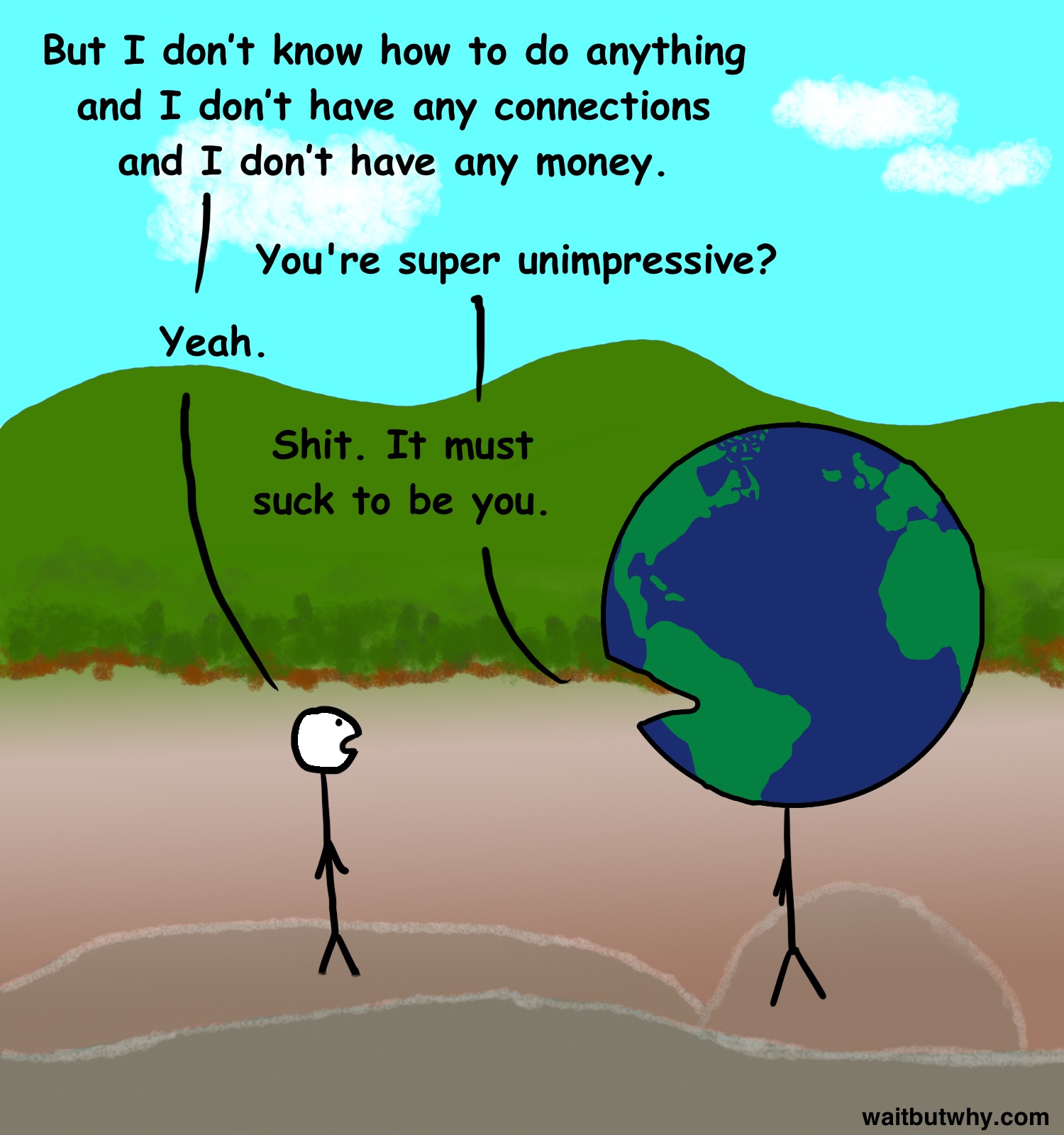
But before you can even address your general uselessness, there’s an even bigger issue—your pre-set path ended. Kids in school are kind of like employees of a company where someone else is the CEO. But no one is the CEO of your life in the real world, or of your career path—except you. And you’ve spent your whole life becoming a pro student, leaving you with zero experience as the CEO of anything. Up to now, you’ve only been in charge of the micro decisions—”How do I succeed at my job as a student?”—and now you’re suddenly holding the keys to the macro cockpit as well, tasked with answering stressful macro questions like “Who am I?” and “What are the important things in life?” and “What are my options for paths and which one should I choose and how do I even make a path?” When we leave school for the last time, the macro guidance we’ve become so accustomed to is suddenly whisked away from us, leaving us standing there holding our respective dicks, with no idea how to do this.

Then time happens. And we end up on a path. And that path becomes our life’s story.

At the end of our life, when we look back at how things went, we can see our life’s path in its entirety, from an aerial view.

When scientists study people on their deathbed and how they feel about their lives, they usually find that many of them feel some serious regrets. I think a lot of those regrets stem from the fact that most of us aren’t really taught about path-making in our childhoods, and most of us also don’t get much better at path-making as adults, which leaves many people looking back on a life path that didn’t really make sense, given who they are and the world they lived in.

So this is a post about path-making. Let’s take a 30-minute pre-deathbed pause to look down at the path we’re on, and ahead at where that path seems to be going, and make sure it makes sense.

The Cook and the Chef—Revisited

In the past, I’ve written about the critical distinction between “reasoning from first principles” and “reasoning by analogy”—or what I called being a “chef” vs. being a “cook.” Since writing the post, I notice this distinction everywhere, and I’ve thought about it roughly 2 million times in my own life.

The idea is that reasoning from first principles is reasoning like a scientist. You take core facts and observations and use them to puzzle together a conclusion, kind of like a chef playing around with raw ingredients to try to make them into something good. By doing this puzzling, a chef eventually writes a new recipe. The other kind of reasoning—reasoning by analogy—happens when you look at the way things are already done and you essentially copy it, with maybe a little personal tweak here and there—kind of like a cook following an already written recipe.

A pure verbatim recipe-copying cook and a pure independently inventive chef are the two extreme ends of what is, of course, a spectrum. But for any particular part of your life that involves reasoning and decision making, wherever you happen to be on the spectrum, your reasoning process can usually be boiled down to fundamentally chef-like or fundamentally cook-like. Creating vs. copying. Originality vs. conformity.

Being a chef takes a tremendous amount of time and energy—which makes sense, because you’re not trying to reinvent the wheel, you’re trying to invent it for the first time. Puzzling your way to a conclusion feels like navigating a mysterious forest while blindfolded and always involves a whole lot of failure, in the form of trial and error. Being a cook is far easier and more straightforward and less icky. In most situations, being a chef is a terrible waste of time, and comes with a high opportunity cost, since time on Earth is immensely scarce. Right now, I’m wearing J. Crew jeans and a plain t-shirt and a hoodie and Allbirds shoes, because I’m trying to conform. Throughout my life, I’ve looked around at people who seem kind of like me and I’ve bought a bunch of clothes that look like what they wear. And this makes sense—because clothes aren’t important to me, and they’re not how I choose to express my individuality. So in my case, fashion is a perfect part of life to use a reasoning shortcut and be a cook.Also hoodies are cozy and Allbirds are like wearing socks all the time and jeans are magical pants you never have to actually wash unless you spill something colorful on them.

But then there are those parts of life that are really really deeply important—like where you choose to live, or the kinds of friends you choose to make, or whether you want to get married and to whom, or whether you want to have kids and how you want to raise them, or how you set your lifestyle priorities.

Career-path-carving is definitely one of those really really deeply important things. Let’s spell out the obvious reasons why:

Time. For most of us, a career (including ancillary career time, like time spent commuting and thinking about your work) will eat up somewhere between 50,000 and 150,000 hours. At the moment, a long human life runs at about 750,000 hours. When you subtract childhood (~175,000 hours) and the portion of your adult life you’ll spend sleeping, eating, exercising, and otherwise taking care of the human pet you live in, along with errands and general life upkeep (~325,000 hours), you’re left with 250,000 “meaningful adult hours.”Fun meals and exercise fall into this category. So a typical career will take up somewhere between 20% and 60% of your meaningful adult time—not something to be a cook about.

Quality of Life. Your career has a major effect on all the non-career hours as well. For those of us not already wealthy through past earnings, marriage, or inheritance, a career doubles as our means of support. The particulars of your career also often play a big role in determining where you live, how flexible your life is, the kinds of things you’re able to do in your free time, and sometimes even in who you end up marrying.

Impact. On top of your career being the way you spend much of your time and the means of support for the rest of your time, your career triples as your primary mode of impact-making. Every human life touches thousands of other lives in thousands of different ways, and all of those lives you alter then go on to touch thousands of lives of their own. We can’t test this, but I’m pretty sure that you can select any 80-year-old alive today, go back in time 80 years, find them as an infant, throw the infant in the trash, and then come back to the present day and find a countless number of things changed. All lives make a large impact on the world and on the future—but the kind of impact you end up making is largely within your control, depending on the values you live by and the places you direct your energy. Whatever shape your career path ends up taking, the world will be altered by it.

Identity. In our childhoods, people ask us about our career plans by asking us what we want to be when we grow up. When we grow up, we tell people about our careers by telling them what we are. We don’t say, “I practice law”—we say, “I am a lawyer.” This is probably an unhealthy way to think about careers, but the way many societies are right now, a person’s career quadruples as the person’s primary identity. Which is kind of a big thing.

So yeah—your career path isn’t like my shitty sweatshirt. It’s really really deeply important, putting it squarely in “Definitely absolutely make sure to be a chef about it” territory.

Your Career Map

Which brings us to you. I don’t know exactly what your deal is. But there’s a good chance you’re somewhere in one of the blue regions—

—which means your career path is a work in progress.I personally hope my retirement is just as rich and vibrant as a career path, which means I’ll need to continue to reflect on my path in Retirement Orchard.

Whether you’re yet to start your career or well into it, somewhere in the back of your mind (or maybe in the very front of it) is a “Career Plans” map.

We can group map holders into three broad categories—each of which is well-represented in the river, in the pond, standing on the shore, and at every stage of adult life.

One group of people will look at the map and see a big, stressful question mark.

These are people who feel indecisive about their career path. They’ve been told to follow their passion, but they don’t feel especially passionate about anything. They’ve been told to let their strengths guide them, but they’re not sure what they’re best at. They may have felt they had answers in the past, but they’ve changed and they’re no longer sure who they are or where they’re going. 

Other people will see a nice clear arrow representing a direction they feel confident is right—but find their legs walking in a different direction. They’re living with one of the most common sources of human misery, a career path they know in their heart is wrong.

The lucky ones feel they know where they want to go and believe they’re marching in that direction.

But even these people should pause and ask themselves, “Who actually drew this arrow? Was it really me?” The answer can get confusing.

I’m pretty sure all of these people would benefit from a moment of career path reflection.

The Okay But Why Do You Think You Can Help Me With My Career Reflection You Draw Stick Figures for a Living Blue Box

Extremely fair question. One thing I always ask myself as I pick topics to write about is, “Am I qualified to write about this?” Here are the reasons I decided to take on this topic:

1) I have spent most of the last 20 years in a perpetual state of analyzing my own career path.

2) My path has taken a lot of turns—from wanting to be a movie star when I was 7 to wanting to be the president when I was 17 to wanting to write film scores when I was 22 to wanting to be an entrepreneur when I was 24 to wanting to write musicals when I was 29 to most recently wanting to be a writer-ish guy.

3) After being pretty all over the place about my career path for most of my life, I actually love my job now. That’s always subject to change, but being able to look at the decision-making processes that led me to confusing or frustrating places, side by side with the decisions that led me to a more fulfilling place, has offered me some wisdom on where people tend to go wrong.

4) On top of having my own story to look at, I’ve had a front-row seat for the stories of my dozen or so closest friends. My friends seem to share my career path obsessiveness, so between observing their paths and talking with them about those paths again and again along the way, I’ve broadened my views on the topic, which helps me to distinguish between the lessons that are my-life specific and those that are more universal.

5) Finally, this isn’t a post about which careers are better or worse than others or which career values are more or less meaningful—there are lots of social scientists and self-help authors out there with good data on that, and I’m not one of them. It’s instead a framework that I think can help a career-path reflector better see their own situation, and what really matters to them, clearly and honestly. This framework has worked really well for me, so I think it can probably be helpful for other people too.

Now that you’ve taken a fresh look at your Career Plans map, along with whatever arrow may or may not be on it, put it down and out of sight. We’ll come back to it at the end of the post. It’s time now for a deep dive—let’s think about this from scratch. From first principles.

___________

In the cook-chef post, I designed a simple framework for how a chef makes major career choices. At its core is a simple Venn diagram.

The first part of the diagram is the Want Box, which contains all the careers you find desirable.

The second part of the diagram is the Reality Box. The Reality Box is for the set of all careers that are realistic to potentially achieve—based on a comparison, in each case, between your level of potential in an area and the general difficulty of achieving success in that area.
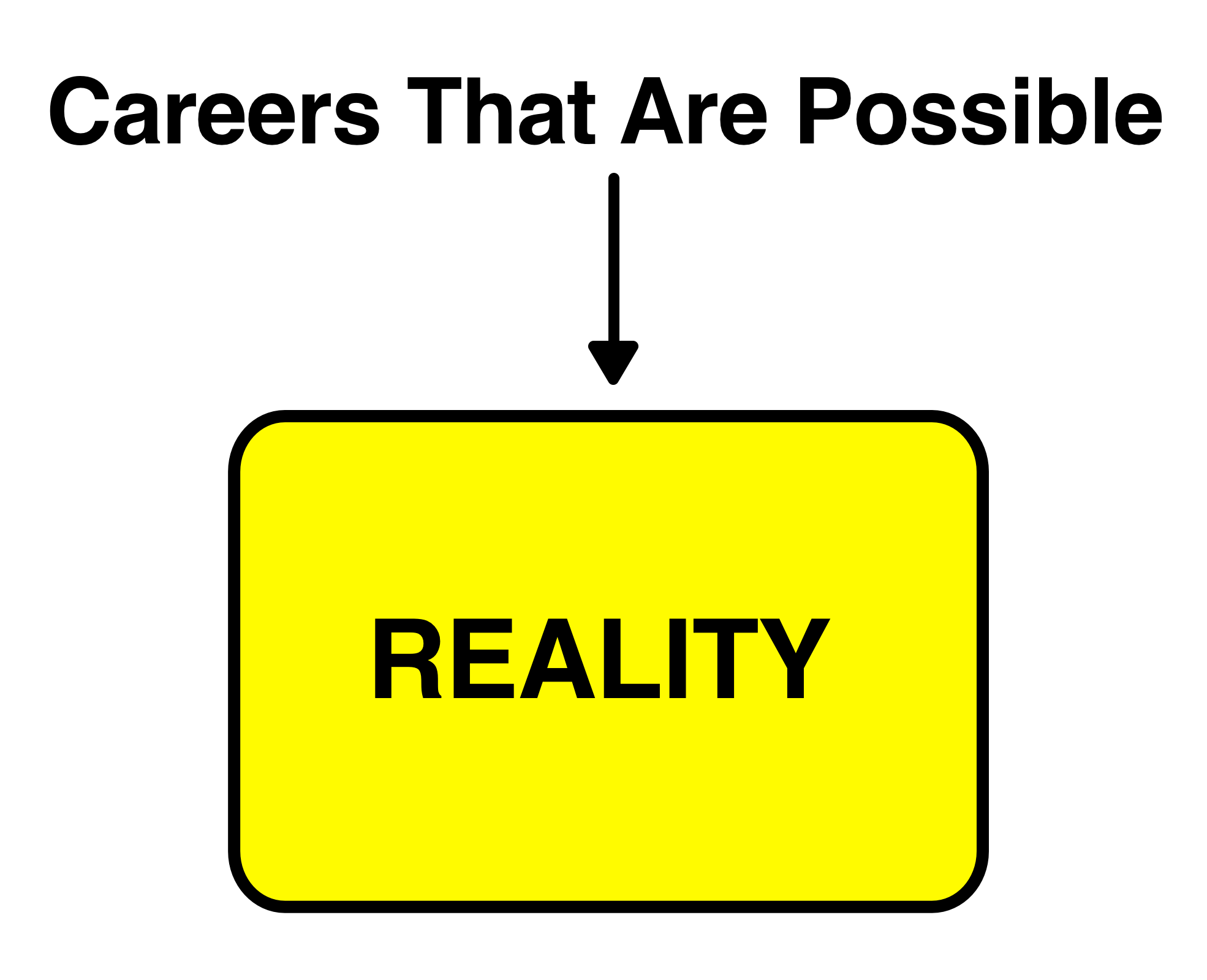
The overlapping area contains your optimal career path choices—the set of arrows you should consider drawing on your Career Map. We can call it the Option Pool.
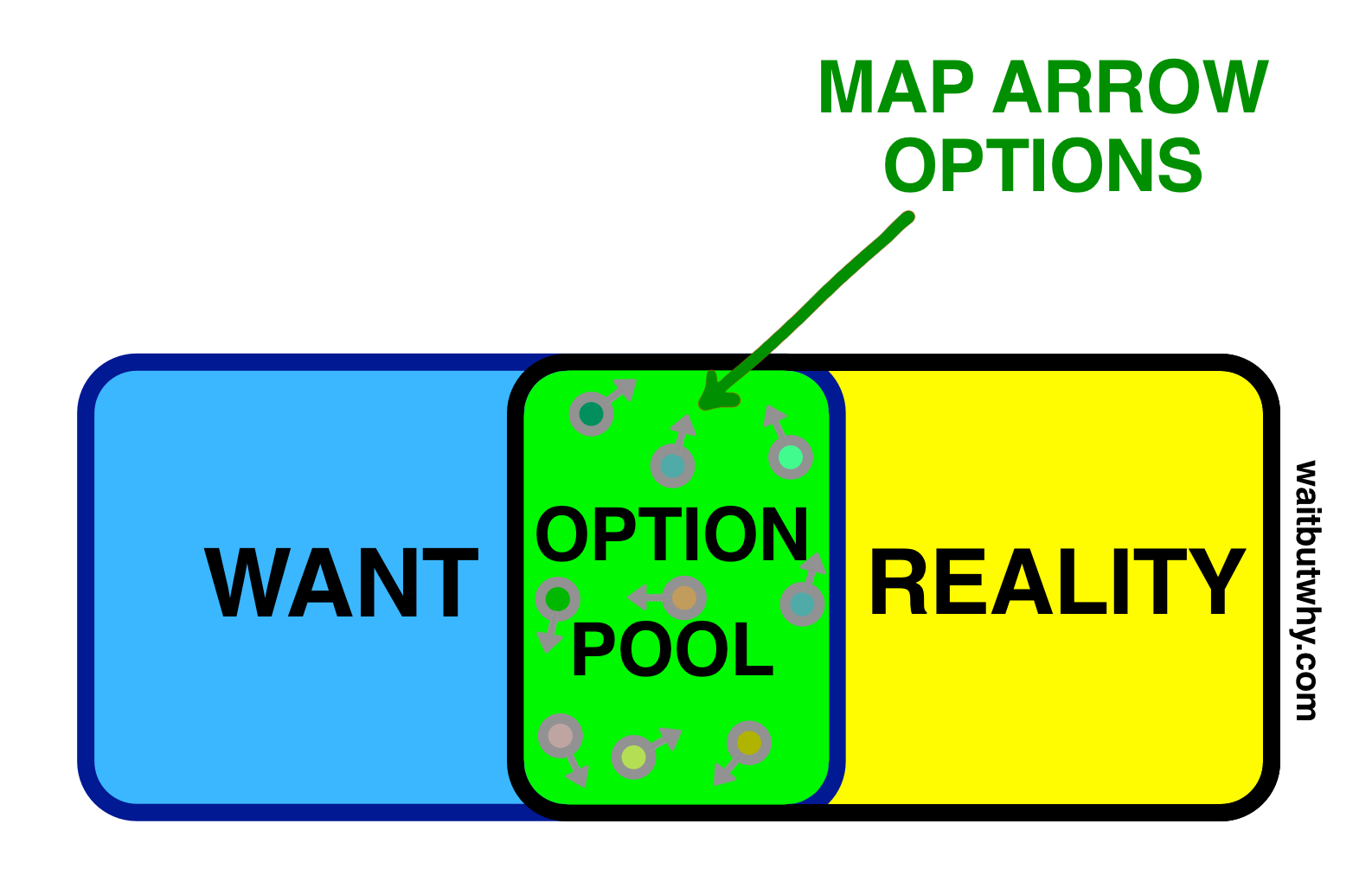
This is straightforward enough. But actually filling in these boxes accurately is way harder than it looks. For the diagram to work, it has to be as close to the truth as possible, and to get there, we have to lift up the hood of our subconscious and head down. Let’s start with the Want Box.

Deep Analysis, Part 1: Your Want Box

The hard thing about the Want Box is that you want a bunch of different things—or, rather, there are a bunch of different sides of you, and each of them wants—and fears—its own stuff. And since some motivations have conflicting interests with others, you cannot, by definition, have everything you want. Going for one thing you want means, by definition, not going for others, and sometimes, it’ll specifically mean going directly against others. The Want Box is a game of compromise.

The Yearning Octopus

To do a proper Want Box audit, you need to think about what you yearn for in a career and then unpack the shit out of it. Luckily, we have someone here who can help us. The Yearning Octopus.

We each have our own personal Yearning OctopusYou know he’s actually a Yearning Pentapus, I know he’s actually a Yearning Pentapus, and he knows he’s actually a Yearning Pentapus—but let’s just leave it alone. in our heads. The particulars of each person’s Yearning Octopus will vary, but people also aren’t all that different from each other, and I bet many of us feel very similar yearnings and fears (especially given that I find that Wait But Why readers tend to have a lot in common).

The first thing to think about is that there are totally distinct yearning worlds—each living on one tentacle. These tentacles often do not get along with each other.

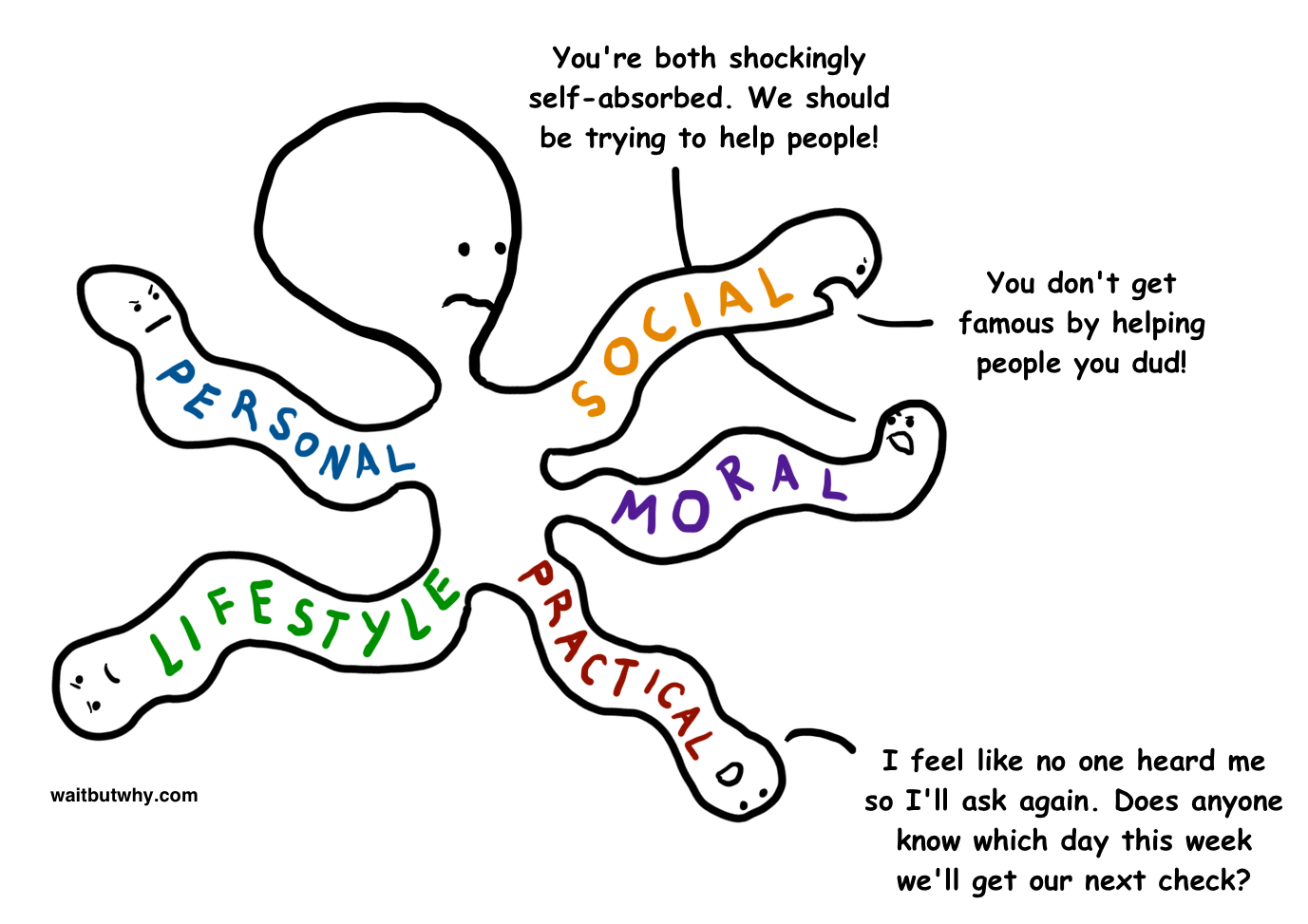
It gets worse. Each tentacle is made up of a bunch of different individual yearnings and their accompanying fears—and these often massively conflict with each other too.

Let’s take a closer look at each tentacle to see what’s going on.
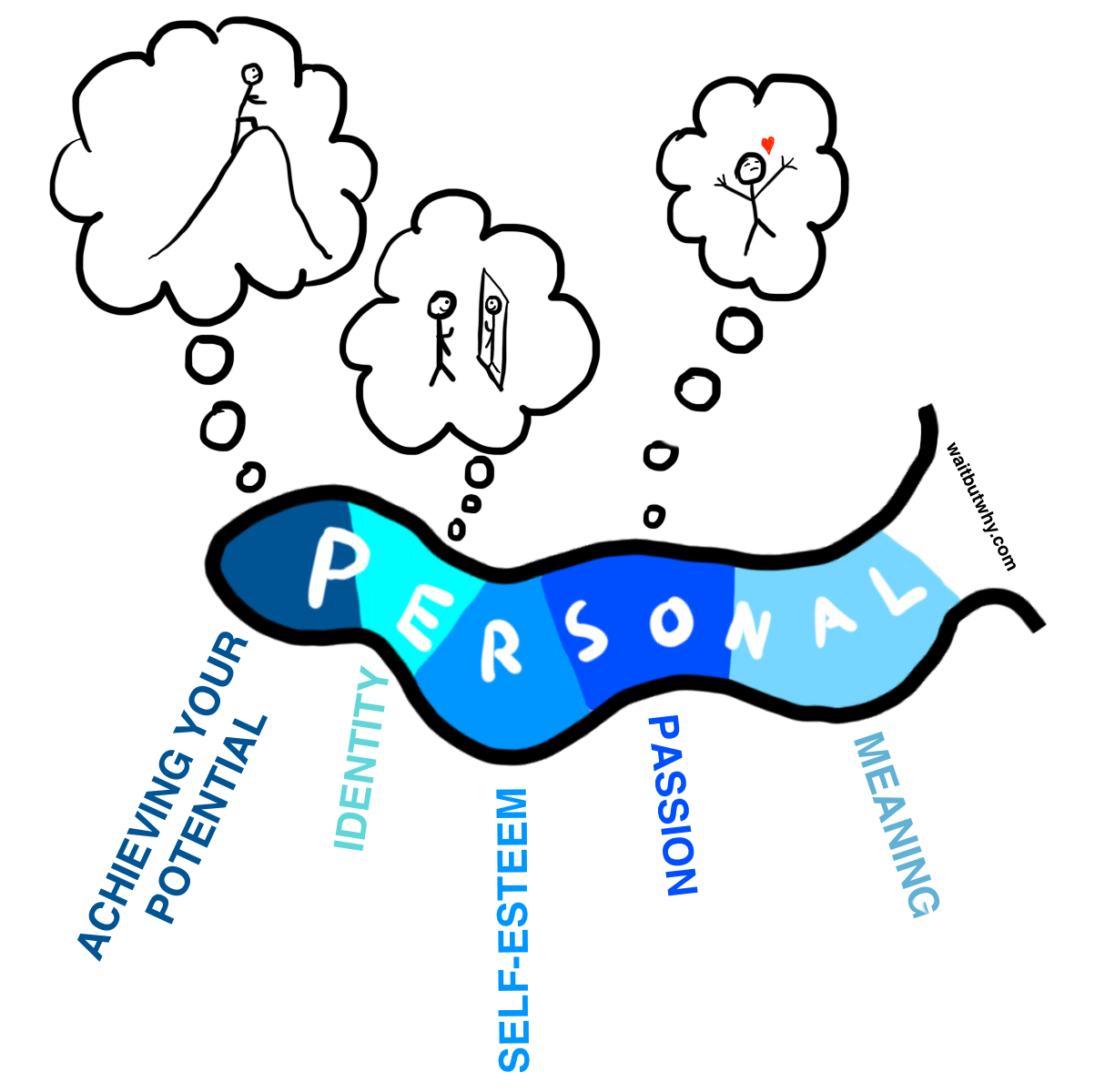
The Personal Yearnings tentacle is probably the hardest one to generalize here—it’s pretty particular to each of us. It’s a reflection of our specific personality and our values, and it bears the burden of probably the most complex and challenging human need: fulfillment. It’s also in the shit dealing with not only our current selves, but a bunch of our past selves too. The dreams of 7-year-old you and the idealized identity of 12-year-old you and the secret hopes of 17-year-old you and the evolving passions of your current self are all somewhere on the personal tentacle, each throwing their own little fit about getting what they want, and each fully ready to make you feel horrible about yourself with their disappointment and disgust if you fail them. On top of that, your fear of death sometimes emerges on the personal tentacle, all needy about you leaving your mark and achieving greatness and all that. The personal tentacle is why you don’t find very many billionaires content to spend the rest of their life sipping cocktails on the beach—it’s a highly needy tentacle.

And yet, the personal tentacle is also one that often ends up somewhat neglected. Because in many cases, it’s the ickiest set of yearnings to really go for; because the fears of this tentacle aren’t scary in an immediate way—they creep in out of the background over time; and because the personal tentacle is always at risk of getting bowled over early in your career by the powerful animal emotions of the other tentacles. This neglect can leave a person with major regrets later on once the dust settles. An unfulfilled Personal Yearnings tentacle is often the explanation, for example, behind a very successful, very unhappy person—who may believe they got successful in the wrong field.

The Social Yearnings tentacle is probably our most primitive, animal side, with its core drive stemming back to our tribal evolutionary past. On the tentacle are a number of odd creatures.

As we’ve discussed before on this blog, we all have a Social Survival Mammoth living in our heads who’s earth-shatteringly obsessed with what other people think of us. This means he craves acceptance and inclusion and being well-liked, while likewise being petrified of embarrassment, negative judgment, and disapproval. He really really really wants to be in the in-group and he really really really doesn’t want to be in the outgroup. He’s quite cute though.

Then there’s your ego, who’s a similar character but even more needy. Your ego doesn’t just want to be accepted; it wants to be admired, desired, and fawned upon—ideally, on a mass scale. More upsetting to it than being disliked is being ignored. It wants to be relevant and important and widely known.

There are other characters milling about as well. Somewhere else on the social tentacle is a little judge with a little gavel who gets very butthurt if it thinks people aren’t judging you fairly—if you’re not appropriately appreciated. It’s very important to the judge that people are aware of exactly how smart and talented you think you are. The judge is also big on holding grudges—which is the reason a lot of people are driven more than anything by a desire to show that person or those people who never believed in them.

Finally, some of us may find a loving little dog on our social tentacle who wants more than anything in the world to please its owner, and who just cannot bear the thought of disappointing them. The one problem with this adorable creature is that its owner isn’t you. It’s a person with so much psychological power over you that, if you’re not careful, you may dedicate your whole career to trying to please them and make them proud. (It’s probably a parent.)

The Lifestyle Yearnings tentacle mostly just wants Tuesday to be a good day. But like, a really pleasant, enjoyable day—with plenty of free time and self-care and relaxation and luxuries.

It’s also concerned with your life in the big picture being as great as possible—as far as your lifestyle tentacle is concerned, you should be able to do what you want to do in life, when and how you want to do it, with the people you like most. Life should be full of fun times and rich experiences, but it should also roll by smoothly, without too much hard work and as few bumps in the road as possible.

The issue is, even if you place a high priority on your lifestyle yearnings, it’s pretty difficult to keep the whole tentacle happy at the same time. The part of the tentacle that just wants to sit around and relax will hold you back from sweating to build the kind of career that offers long-term flexibility and the kind of wealth that can make life luxurious and cushy and full of toys. The part of the tentacle that only feels comfortable when the future feels predictable will reject the exact kinds of paths that may generate the long-term freedom another part of the tentacle longs for. The side of you that wants a stress-free life doesn’t get along very well with the side of you that thirsts to be hang gliding off a cliff in Namibia like Richard Branson.
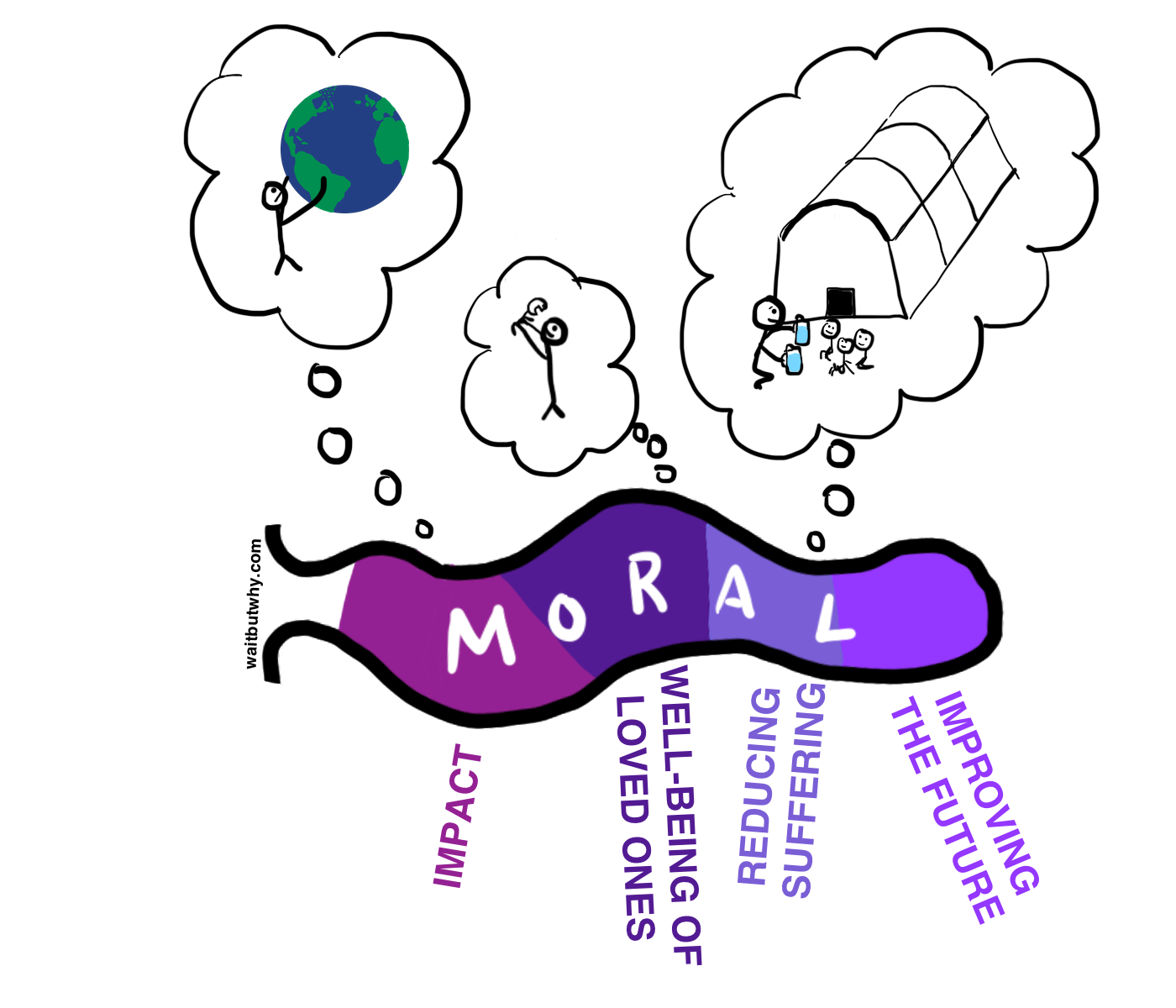
The Moral Yearnings tentacle thinks the rest of the tentacles of your Yearning Octopus are a real pack of dicks—each one more self-involved and self-indulgent than the next. The parts of you on the moral tentacle look around and see a big world that needs so much fixing; they see billions of people no less worthy than you of a good life who just happened to be born into inferior circumstances; they see an uncertain future ahead that hangs in the balance between utopia and dystopia for life on Earth—a future we can actually push in the right direction if we could only get our other tentacles out of our way. While the other tentacles fantasize about what you would do with your life if you had a billion dollars in the bank, the moral tentacle fantasizes about the kind of impact you could make if you had a billion dollars to deploy.

Needless to say, the other tentacles of your Yearning Octopus find the moral tentacle to be insufferable. They also can’t begin to understand philanthropy for philanthropy’s sake—they think, “Other people aren’t me, so why would I spend my time and energy working to help them?”—but they can understand philanthropy for their own motive’s sake. While the moral and lifestyle tentacles tend to be in direct conflict, others may sometimes find common ground—the social tentacle can get very into philanthropy if it’ll happen to win you respect and admiration from a highly regarded social group, and some people’s personal tentacle may find the meaning or self-worth it so craves in a philanthropic endeavor.

That’s why, when you do something philanthropic—or anything altruistic, really—there are a few separate things going on in your head. The part of you determined to get proper public credit for the deed lives on your social tentacle; the part of you that thinks “God I’m a good person” lives on your personal tentacle; and the part of you that really loves seeing the person or group you helped be better off lives on your moral tentacle. Likewise, not doing anything for others can hurt you on multiple tentacles—the moral tentacle because it feels guilty and sad, the social tentacle because this may cause others to judge you as a selfish or greedy person, and the personal tentacle because it may lower your self-esteem.

Your Practical Yearnings tentacle thinks all of this is fine and great—but it would also like to point out that it’s March 31st and your rent is due tomorrow, and the funny thing about that is that it logged into your bank account and saw that the number of dollars in it is actually less than the number of dollars that your landlord will need from you sometime in the next 34 hours. And yeah it knows that you deposited that check on Thursday and that it’s supposed to clear tomorrow morning, but your practical tentacle also could have sworn that just last month, all the tentacles promised that they’d make some sacrifices in order to build up at least a little bank account cushion so that simply paying the rent wouldn’t have to be really fucking stressful every month. Your practical tentacle also can’t help but notice that your social tentacle offered to buy a round of drinks for all nine people you went to the bar with last Saturday so those people would think of you as a classy, generous person, and that your lifestyle tentacle chose to rent what sure seems like a pretty nice-ass apartment for someone now living check to check, and that the updates have gotten real quiet from your friend about that bagel delivery service he started six months ago that your moral tentacle happily invested $2,500 in to help it get off the ground, and oh also that meanwhile your personal tentacle has everyone sweating their dick off working at two comedy-writing internships simultaneously that somehow manage to bring in less money combined than you made dressing up as an Egyptian enchantress to wait tables at Jekyll & Hyde sophomore year of college.

At its basic level, your practical tentacle wants to make sure you can eat food and wear clothes and buy the medicine you need and not live outside. It doesn’t really care how these things happen—it just wants them to happen. But then everyone else on the octopus makes your practical tentacle’s life super hard by being fucky about things. Every time your income goes up, your lifestyle tentacle decides to raise the bar on what it wants and expects, leaving your practical tentacle continually in the shit trying to cover it all so you don’t have to run up your credit card debt. Your personal tentacle has all of these weird needs that take up a lot of time and more often than not aren’t exactly big money-makers. And while your practical tentacle would be totally down to just ask your rich uncle for money to help out, your social tentacle outlawed asking others for money because “it’s not a good look,” with your personal tentacle chiming in that “yeah, we’re better than that.”

So that’s the situation. You’ve got this Yearning Octopus in your head with five tentacles (or however many yours has), each with their own agenda, that often conflict with each other. Then there are the distinct individual yearnings on each tentacle, often in conflict amongst themselves. And if that weren’t enough, you sometimes have furious internal conflict inside a single yearning. Like when your desire to pursue your passion can’t figure out what it’s most passionate about.

Or when you want so badly to be respected, but then you remember that a career that wins the undying respect of one segment of society will always receive shrugs from other segments and even contemptuous eye rolls from other segments still.

Or when you decide to satisfy your urge to help others, before realizing that the part of you that wants to dedicate your life to helping to mitigate humanity’s greatest existential risks has palpable disdain for the part of you that would rather make a tangible positive impact on your local community—while the part of you that can’t stand the thought of the millions of today’s humans without access to clean water finds both of those other yearnings to be pretty cold and heartless.

So yeah, your Yearning Octopus is complicated. And no human in history has ever satisfied their entire octopus—that’s why you’ll never find it fully smiling. Human yearning is a game of choices and sacrifices and compromise.

Dissecting the Octopus

With that in mind, let’s return to your Want Box. When we think about our career goals and fears and hopes and dreams, our consciousness is just accessing the net output of the Yearning Octopus—which is usually made up of its loudest voices. Only by digging into our mind’s subconscious can we see what’s really going on.There are printouts at the bottom of the post if you’d like to work through your analysis on paper.

The cool thing is that we all have the ability to do that. The stuff in your subconscious is like stuff in the basement of a house. It’s not off-limits to us—it’s just in the basement. We can go look at it anytime—we just have to A) remember that the house has a basement, and B) actually spend the time and energy to go down there, even though going down there might suck.

So let’s head to the basement of your mind to look for the octopus. Unless you’re one of those people who’s really practiced at analyzing your subconscious, it might be dark in the basement, making it hard to see your octopus. The way to start turning the lights on is by identifying what your conscious mind currently knows about your yearnings and fears, and then unpacking it.

Like if there’s a certain career path that sounds fantastic to you, unpack that. Which tentacles in particular are yearning for that career—and which specific parts of those tentacles?

If you’re not currently working towards that career you supposedly yearn for, try to figure out why not. If you think it’s because you’re afraid of failing, unpack that. Fear of failure can emerge from any of the tentacles, so that’s not a specific enough analysis. You want to find the specific source of the fear. Is it a social tentacle fear of embarrassment, or of being judged by others as not that smart, or of appearing to be not that successful to your romantic interests? Is it a personal tentacle fear of damaging your own self-image—of confirming a suspicion about yourself that haunts you? Is it a lifestyle tentacle fear of having to downgrade your living situation, or of bringing stress and instability into a currently predictable life? Or maybe that fear of a living situation downgrade isn’t actually emerging from your lifestyle tentacle, but more so from your social tentacle—in other words, is it possible you’re indifferent about the apartment change itself but super concerned about the message a lifestyle downgrade sends to your friends and family? Or are there financial commitments you simply cannot back out of at the moment, and your practical tentacle is in a genuine panic about how you’ll make ends meet should this career switch take longer than expected to work out, or not work out at all? Or are a few of these combining together to generate your fear of making the leap?

Perhaps you don’t really think it’s fear of failure that’s stopping you, but something else. Maybe it’s a dread of the change in identity—both internally and externally—that inevitably accompanies a career move like this. Maybe it’s the heavy weight of inertia—an intense resistance to change—that seems to exist in and of itself and overpowers all of your other yearnings. In either case, you’d want to unpack the feeling and ask yourself exactly which tentacles are so opposed to an identity shift, or so driven by inertia.

Maybe you pine to be rich. You fantasize about a life where you make $1.2 million a year, and you feel a tremendous drive to make it happen. All five tentacles can feel a desire for wealth under certain circumstances, each for their own reasons. Unpack it.

As you unpack an inner drive to make money, maybe you discover that at its core, the drive is more for a sense of security than for vast wealth. That can be unpacked too. A yearning for security at its simplest is just your practical tentacle doing what your practical tentacle does. But maybe it’s not actually basic security you want as much as a guarantee of a certain level of fanciness demanded by your lifestyle or social tentacle. Or perhaps what you really want is a level of security so over-the-top secure it can no longer be called a security yearning—instead, it may be an impulse by the emotional well-being section of your lifestyle tentacle to alleviate a compulsive financial stress you were raised to forever feel, almost regardless of your actual financial situation.

The answers to all of these questions lie somewhere on the tentacles of your Yearning Octopus. And by asking questions like these and digging deep enough to identify the true roots of your various yearnings, you start to turn on the basement light and acquaint yourself with your octopus in all its complexity.

You’ll also come to understand which of your inner yearnings seem to speak the loudest in your mind and carry the most pull in your decision-making processes. Pretty quickly, a yearning hierarchy will begin to reveal itself. You’ll identify yearnings that speak loudly and get their way; yearnings that cry at the top of their lungs but get continually elbowed out of the way by higher-prioritized parts of the octopus; yearnings that seem resigned to their low-status positions in the hierarchy.

Searching for Imposters

We’re making good progress—but we’re just getting started. Once you have a reasonably clear picture of your Yearning Octopus, you can start doing the real work—work that takes place another level down in your subconscious, in the basement of the basement. Here, you can set up a little interrogation room and one by one, bring each yearning down into it for a cross-examination.

You’ll start by asking each yearning: how did you end up here, and why are you the way you are? Desires, beliefs, values, and fears don’t materialize out of nowhere. They’re either developed over time by our internal consciousness as observations and life experience pour in, or they’re implanted in us from the outside, by someone else. In other words, they’re the product of either you the chef or you the cook.

So the goal here in your creepy interrogation room is to tug on the faces of each of your yearnings to find out if it’s authentically you, or if it’s someone else disguised as you.

You can pull on a yearning’s face by playing the Why Game. You’ll ask your initial Why—Why is this something I want?—and get to some kind of Because. Then you’ll keep going. Why did that particular Because lead you to want what you now want? And when did that particular Because gain so much gravity with you? You’ll get to a deeper Because behind the Because. And if you continue with this, you’ll usually discover one of three things:

1) You’ll trace the Why back to its origin and reveal a long chain of authentic evolution that developed through deep independent thought. You’ll pull on their face and confirm that the skin is real.

2) You’ll trace the Why back to an original Because that someone else installed in you—I guess the only reason I actually have this value is because my mom kind of forced it on me—and you realize that you never really thought to consider whether you actually independently agree with it. You never stopped to ask yourself whether your own accumulated wisdom actually justifies the level of conviction you feel about that core belief. In a case like this, the yearning is revealed to be an imposter pretending to be an authentic yearning of yours. You pull on its face and it’s a mask that comes off, exposing the yearning’s original installer underneath.

3) You’ll trace the Why back and back and get kind of lost in a haze of “I guess I just know this because it’s true!” This could be an authentic you thing, or just another version of #2, in an instance where you can’t recall the moment this feeling was installed in you. Somewhere deep in you, you’ll have a hunch about which it is.

In a #1 scenario, you can be proud that you developed that part of you like a chef. It’s an authentic and hard-earned feeling or value.

In a #2 or maybe #3 scenario, you’ve discovered that you’ve been duped. You’ve let someone else sneak onto your Yearning Octopus while you weren’t looking. When it comes to that particular belief of yours, you’re a cook following someone else’s recipe—an obedient robot reciting desires and fears out of someone else’s brain.

There’s a chance you’re an unusually wise person whose examination reveals an octopus developed mostly by you and kept readily up to date. More likely, you’re like me and most of my friends—your interrogation room reveals some definite imposters, or at least a lot of ambiguity. Like, underneath one mask, you’ll find your mom.

You’ll pull off others to reveal the values and judgments of broader conventional wisdom, or the viewpoints of your more immediate community, or what’s considered cool by the dominant culture of your generation or the immediate culture within your closest group of friends.
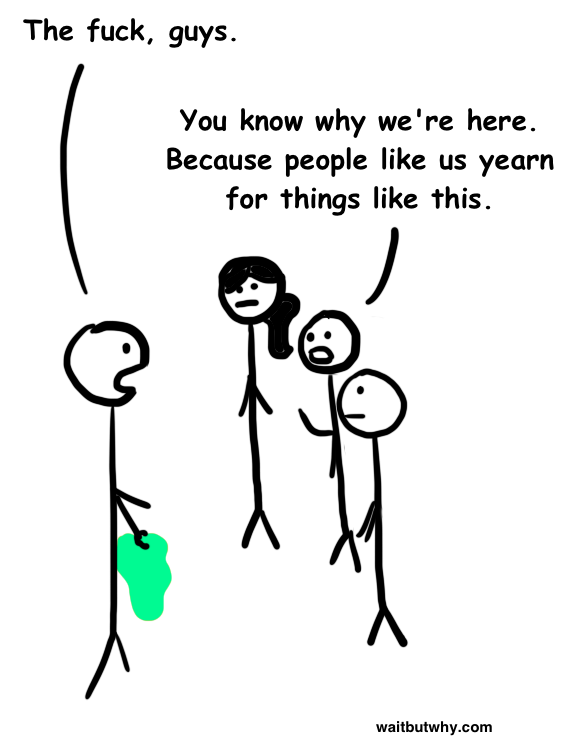
Sometimes you’ll get to the end of a Why-Because pathway only to find the philosophy in a famous novel, or something a celebrity hero of yours once said in an interview, or a strong opinion one of your professors always repeated.

You might even find that some of your yearnings and fears were written by you…when you were seven years old. Like a childhood dream that was etched into the back of your consciousness as the thing you believe you really want, when you’re being truly honest.

The interrogation room probably won’t be that fun a time. But it’s time well spent—because you’re not your 7-year-old self, just like you’re not your parents or your friends or your generation or your society or your heroes or your past decisions or your recent circumstances. You’re Current-Age You—the only person, and the only version of yourself, who is actually qualified to want and not want the things you want and don’t want.

To be clear, this isn’t to say that it’s wrong to live by the words of a wise parent or a famous philosopher or friends you respect or the convictions of a younger you. Humble people are by definition influence-able—influences are an important and inevitable part of who each of us is. The key distinction is this:

Do you treat the words of your external influences as information, held and considered by an authentic inner you, that you’ve carefully decided to embrace? Or are your influences themselves actually in your brain, masquerading as inner you?

Do you want the same thing someone else you know wants because you heard them talk about it, you thought about it alongside your own life experience, and you eventually decided that, for now, you agree? Or because you heard someone talk about what they want or fear, and you thought, “I don’t know shit and that person does, so if they say X is true, I’m sure they’re right”—and then you etched those ideas into your mind, never again feeling the need to question them?

The former is what chefs do. The latter is what you do when you’re being an obedient robot. And a robot is what you become when at some point you get the idea in your head that someone else is more qualified to be you than you are.

The good news is that all humans make this mistake—and you can fix it. Just like your subconscious is right there for viewing if you want to view it—it’s also there for changing and updating and rewriting. It’s your head—you’re allowed to do with it what you want.

So it’s time for some evictions. Masked imposters have to go. Even mom and dad.

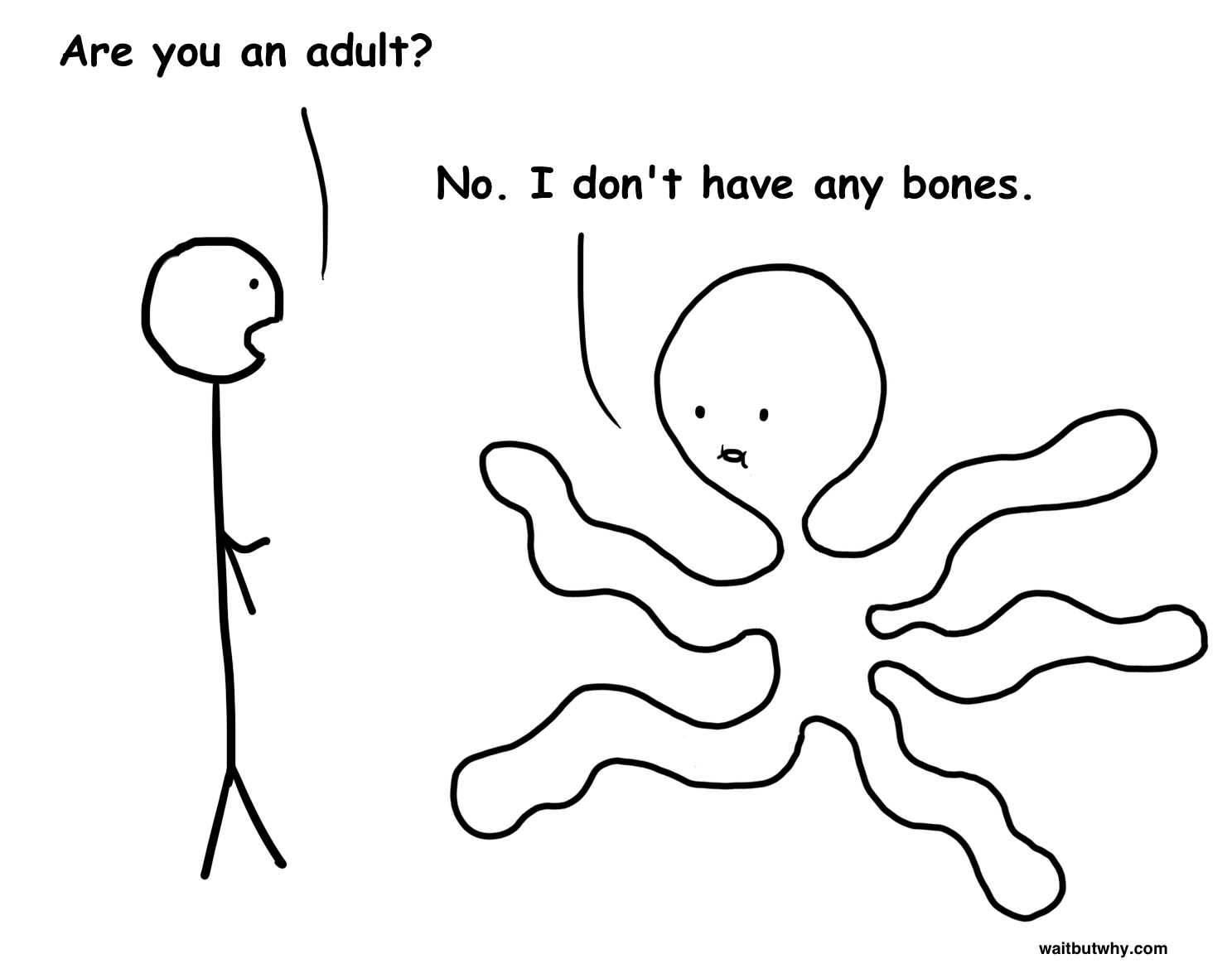
At the end of this, your octopus may look a little barren, leaving you feeling a little like you don’t know who you even are anymore. We usually think of this as a bad feeling, or even an existential crisis, but it actually means you’re doing better than most people.
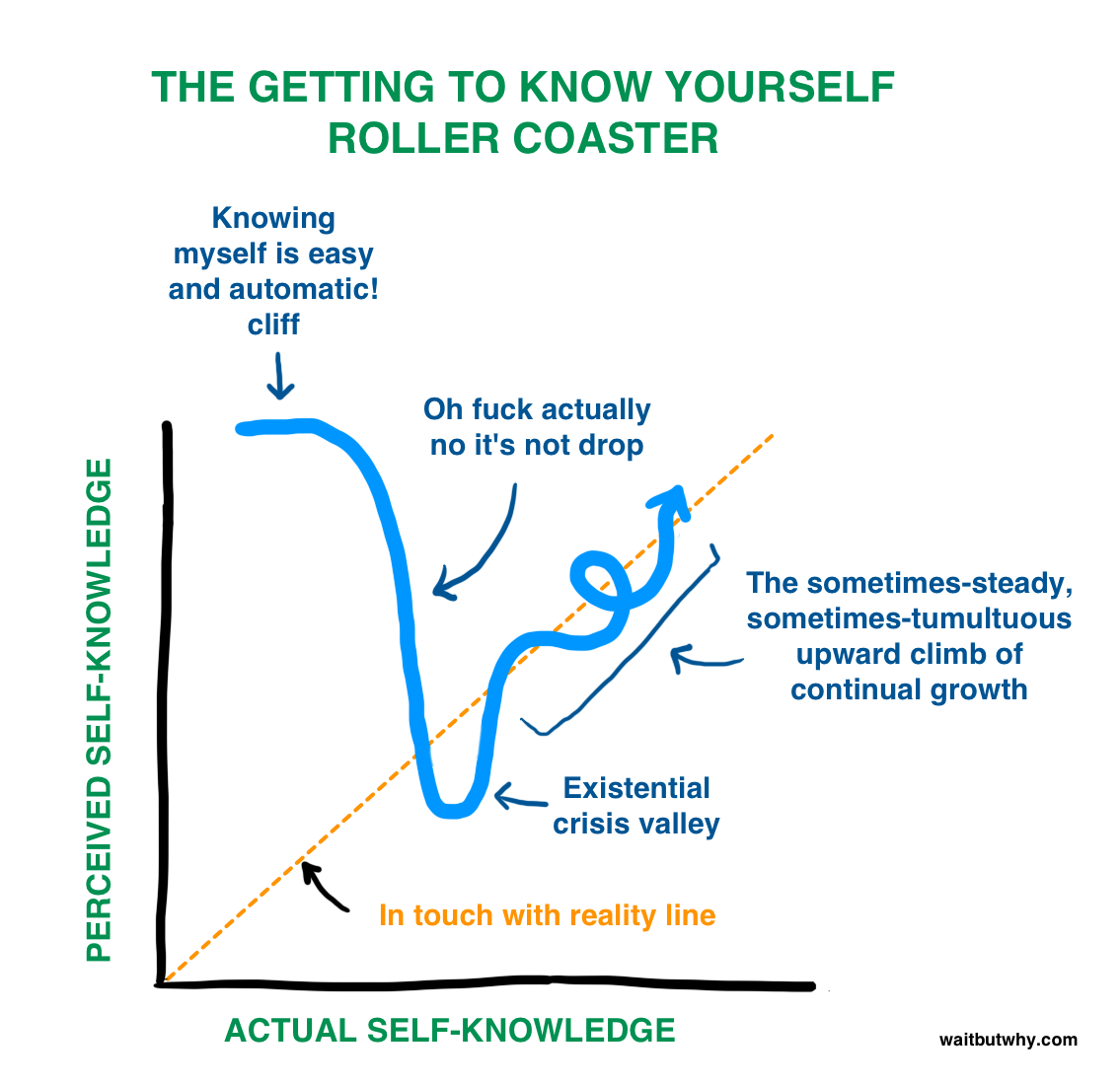
The drop from naive over-confidence to wise, realistic humility never feels good, but pausing the roller coaster while it’s still on that first cliff and avoiding the pain—which turns out to be a lot of people’s move—isn’t a great strategy. Wisdom isn’t correlated with knowledge, it’s correlated with being in touch with reality—it’s not how far to the right you are on the graph, it’s how close you are to the orange line. Wisdom hurts at first, but it’s the only place where actual growth happens. The irony is that the cliff-pausers of the world like to make the wiser, braver valley-dwellers or continual-climbers feel bad about themselves—because they fundamentally don’t get how knowing yourself works. They haven’t reached that stage yet.

Getting to know your real self is super hard and never complete. But if you’ve tumbled off the cliff, you’ve gone through a key rite of passage and progress is now possible. As you climb up the orange line, you’ll slowly but surely begin to repopulate your Yearning Octopus with your real self.

At the moment, it probably won’t be obvious what those missing yearnings of yours are exactly—because they’re on an even deeper floor of your subconscious. They’re in the basement of the basement of the basement—in a place called Denial Prison.

Denial Prison

Our brain’s Denial Prison is a place most of us don’t even know is there—it’s where we put the parts of us we repress and deny.

The authentic yearnings of ours that we’re in touch with—i.e. those that proved to be authentic during interrogation—were easy parts of our true selves to find in our subconscious, lying in plain sight, right below the surface of our consciousness. Even our conscious mind knows these yearnings well, because they frequently make their way upstairs into our thoughts. These are the parts of us we have a healthy relationship with.

But then there are the parts of you that weren’t living on your octopus where they’re supposed to be—instead, you found an imposter in their place. These lost parts of you are often incredibly hard to access, because they’ve been living deep in your subconscious, on a floor so low it’s almost not there at all. Almost.

Some parts of us are banished down on basement #3 because they’re extraordinarily painful for us to acknowledge or think about. Sometimes new parts of us are born only to be immediately locked up in prison as part of a denial of our own evolution—i.e. out of stubbornness. But there are other times when a part of us is in Denial Prison because someone else locked it up down there. In the case of your yearnings, some of them will have been put there by whatever masked intruder had been taking its place. If dad has successfully convinced you that you care deeply about having a prestigious career, he probably has also convinced you that the part of you that, deep down, really wants to be a carpenter isn’t really you and isn’t what you really want. At some point during your childhood, he threw your passion for carpentry into a dark, dank Denial Prison cell.

So let’s gather your courage and head down to the basement of the basement of the basement of your mind and see what we find.

You may pass some unpleasant characters.

Leave them for another time—right now, search for locked-away career-related yearnings. Maybe you’ll find a repressed passion to teach. Or a desire to be famous that your particular tribe has shamed you out of. Or a deep love of long blocks of free, open leisure time that your hornier, greedier teenage self kicked downstairs in favor of a raging ambition.

There will be certain parts of your authentic self you won’t be able to uncover in Denial Prison—it’s pretty dark down there. But be patient—now that you’ve done your audit and cleared space for them on your octopus, they may begin to emerge.

Priority Rankings

The other part of our Yearning Octopus audit will address the hierarchy of your yearnings. Almost as important as the yearnings themselves is the priority they’re given. The hierarchy is easy to see because it’s revealed in your actions. You may like to think a desire to do something bold is high up on your hierarchy, but if you’re not currently working on something bold, it reveals that however important boldness is to you, something else—some source of fear or inertia in you—is currently being prioritized above it.

It’s important to remember that a ranking of yearnings is also a ranking of fears. The octopus contains anything that could make you want or not want to pursue a certain career, and the reverse side of each yearning is its accompanying fear of the opposite. The reverse side of your yearning to be admired is a fear of embarrassment. If you flip over your desire for self-actualization, you’ll see a fear of underachieving. The other half of your craving of self-esteem is a fear of feeling shame. If your actions don’t seem to match what you believe is the internal hierarchy of your yearnings, usually it’s because you’re forgetting to think about the role your fears are playing. What looks like a determined drive for success, for example, might actually be someone running away from a negative self-image or trying to escape feelings like envy or under-appreciation. If your actions seem beholden to yearnings that you don’t believe you actually care that much about, you’re probably not looking closely enough at your fears.

With both yearnings and fears in mind, think about what your internal hierarchy might look like, and return that same important question: “Who made this order? Was it really me?”

For example, we’re often told to “follow our passion”—this is society saying “put your passion yearnings at the top of your hierarchy.” That’s a very specific instruction. Maybe that’s the right thing for you, but it also very well might not be. It’s something you need to independently evaluate.

To get this right, let’s try to do a fresh ranking, from first principles, based on who we really are, how we’ve evolved over time, and what really matters to us most, right now.

This isn’t about which yearnings or fears have the loudest voices or which fears are most palpable—if it were, you’d be letting your impulses take the wheel of your life. The person doing the ranking is you—the little center of consciousness reading this post who can observe your octopus and look at it objectively. This involves another kind of compromise. On one side, you’ll try to tap into all the wisdom you’ve accumulated throughout your life and make active decisions about values—about what you really believe is important. On the other side, it’s about self-acceptance and self-compassion. Sometimes you’ll have strong undeniable yearnings that you’re not super proud of—whether you like it or not, those are part of you, and when you neglect them, they may cause a continual stink and make you miserable. Creating your yearning hierarchy is a give and take between what’s important and what’s you. It’s probably a good goal to give higher priority to your more noble qualities, but it’s okay to throw a bone to some of your not-so-noble sides as well—depending on where you decide to draw the line. There’s a wisdom to knowing when to accept your not-so-noble side and when to reject it entirely.

To get all of this in order, we want a good system. You can play around with what works for you—I like the idea of a shelf:

This divides things into five categories. The absolutely highest priority inner drives get to go in the extra special non-negotiable bowl. The NN bowl is for yearnings so important to you that you want to essentially guarantee that they’ll happen—at the expense of all other yearnings, if necessary. This is why so many of history’s legends were famously single-minded—they had a very intense NN bowl yearning and it led them to world fame, often at the expense of relationships, balance, and health. The bowl is small because it should be used very sparingly—if at all. Like maybe only one thing gets it. Or maybe two or three. Too many things in the NN bowl cancels out its power, making that the same as having nothing in the bowl at all. 

Your group of top shelf yearnings is mostly what will drive your career choices—but top shelf placement should also be doled out sparingly (that’s why it’s not a very large shelf). Shelf placement is as much about de-prioritizing as it is about prioritizing. You’re not just choosing which parts of you are the most important to make you happy, you’re choosing which parts of you to intentionally leave wanting or even directly opposed. No matter what your hierarchy looks like, some yearnings will be left feeling very unhappy and some fears will feel like they’re being continually assaulted. This is inevitable.

That’s why most yearnings should be on the middle shelf, the bottom shelf, or the trash can. The middle shelf is good for those not-so-noble qualities in you that you decide to accept. They deserve some of your attention. And they’ll often demand it—core parts of you won’t go quietly into non-prioritization, and they sometimes can really ruin your life if they’re neglected.

Most of the rest will end up on the bottom shelf. Putting a part of you on the bottom shelf is telling it, “I know you want these things, but for now, I’ve decided other things are more important. I promise to revisit you a little later, after I’ve gotten some more information, and if I change my mind, you’ll get a shelf upgrade then.” The best way to think of the bottom shelf is this: the more yearnings you can convince to accept a bottom shelf rating, the better the chances your top shelf and NN bowl yearnings have of getting what they want. Likewise, the fewer yearnings you put on the top shelf, the more likely those on the top shelf will be to thrive. Your time and energy are severely limited, so this is a zero-sum compromise. The amateur mistake is to be too liberal with the NN bowl and top shelf and too sparing with the large bottom shelf.

Then there’s the trash can, for the drives and fears you flat-out reject—those parts of you that fundamentally violate the person your wisest self wants to be. A good amount of inner conflict emerges from people’s trash cans, and trash can control is a major component of integrity and inner strength. But like the rest of your hierarchy decisions, your criteria for what qualifies as trash should be derived from your own deep thought, not from what others tell you is and is not trash.

As you go through this difficult prioritizing process—inevitably, at times, against the screaming protests of unhappily deprioritized yearnings—remember that you’re the only wise one in the room. Yearnings and fears are impatient and bad at seeing the big picture. Even a seemingly high-minded yearning, like those on the moral tentacle, can’t understand the complete picture in the way you can. Many of the people who have done wonders to make the world better got there on a path that started with selfish motives like wealth or personal fulfillment—motives their moral tentacle probably hated at first. The octopus won’t be the wise adult in the room—that’s your job.
Finally, as we’ll discuss more later, this is not a permanent decision. It’s the opposite—it’s a rough draft written in light pencil. It’s a hypothesis that you’ll be able to test and then revise based on how actually living this hierarchy feels in practice.

Your Want Box is ready to go. Now let’s turn to your Reality Box.

Deep Analysis, Part 2: Your Reality Box

The Want Box deals with what you find desirable. The Reality Box deals with what’s possible.

But when we examined the Want Box, it became clear that it’s not necessarily based on what you actually want—it’s based on what you think you want—what you’re in the habit of wanting.

The Reality Box is the same deal. It doesn’t show you reality, it shows your best crack at what reality might be—your perception of reality.

The goal of self-reflection is to bring both of these boxes as close to accuracy as possible. We want our perceived yearnings to be a true reflection of our authentic inner selves, and we want our beliefs about what’s possible to come close to mirroring what’s actually possible. For our Want Box audit, we looked under the hood of the Want Box and found its settings—your yearnings and fears. When we open the hood of your Reality Box, we see a group of beliefs.

When it comes to your career possibilities, you’re dealing with two sets of beliefs: beliefs about the world and beliefs about your own potential. For a career option to qualify for your Reality Box, your potential in that career area has to measure up to the objective difficulty of achieving success in that area.

Us being us, we’re probably pretty bad at assessing either side of this comparison accurately.

I don’t know how you think about career path difficulty, but in my experience, people often see it like this:

There are traditional careers—stuff like medicine or law or teaching or a corporate ladder, etc.—and these careers have predictable, set paths. If you’re decently smart and work hard, you’ll end up in a successful, stable situation.

Then there are less traditional careers—the arts, entrepreneurship, non-profit work, politics, etc.—and these are wildcards. Success and stability are no guarantee, and to reach great heights, it’s either a lottery ticket game of luck, a genetic lottery game of innate talent, or some combination of the two.

These are perfectly reasonable assumptions—if you live in 1952. Your beliefs about the world of careers and about what it takes to succeed need just as thorough an unmasking as your yearnings did—and I suspect that behind most of them, you’ll find big, fat conventional wisdom. You might first pull off the mask of one of your beliefs and find your parents or your friends or your college career coach—but if you keep going and pull on their face, you’ll usually see that it’s also a mask, and conventional wisdom is there hiding behind it. A general conception, a common opinion, an oft-cited statisticDid you know that 9 out of 10 restaurants fail?!—none of which have actually been verified by you, but all of which are treated as gospel by society.

Today’s world goes through dramatic changes each decade, which usually leaves conventional wisdom wildly outdated. But we’re wired for a more ancient world where almost nothing ever changed, so we all reason like cooks and treat conventional wisdom as equivalent to truth.

These problems then extend to how we view our own potential. When you overrate the impact of innate talent on how people fare in their careers—and you also conflate talent and skill level—it won’t leave you feeling great about your chances at many paths. Because we better understand the trajectory of traditional careers, we’re less prone to do this with them. A first-year medical student sees an experienced surgeon at work and thinks, “I can get there one day—just need to do about 20 years of hard work.” But when a young artist or entrepreneur or software engineer looks at the equivalent of the experienced surgeon in their field, they’re more likely to think, “Wow look how talented they are—I’m nowhere near that good,” and get all hopeless. There’s also the other common notion, that people who thrive in non-traditional careers had some “big break” at some point, like hitting a lucky scratch card jackpot—and I don’t know many people who want to risk their careers on scratch cards.

These are only a few examples of the slew of delusions and misconceptions we tend to have about how great careers happen. So let’s brainstorm how it might actually work:

The Career Landscape

I have no idea, mostly. And I think most people have no idea. Things are just changing too quickly.

But that’s kind of the key point. If you can figure out how to get a reasonably accurate picture of the real career landscape out there, you have a massive edge over everyone else, most of whom will be using conventional wisdom as their instruction booklet.

First, there’s the broad landscape—the set of all the jobs someone could possibly have in today’s society. My current job description is: “Writer of 8,000-to-40,000-word articles about a bunch of different topics, with cursing and stick figures, on a remarkably sporadic schedule.” Think conventional wisdom has any job openings for me with that description? The landscape today is made up of thousands of options—some 40 years old, some made possible only three months ago because of the advent of some new technology—and the way things work today, if there’s an option you want that’s not already out there, you can probably create it for yourself. Pretty stressful, but also incredibly exciting.

Then, there’s each specific career path. A career path is like a game board. The conventional wisdom bookshelf contains instruction booklets for only a small fraction of today’s available game boards—and those that it does have usually tell you how that game was played in the past, even though the current game board has evolved significantly into something with new kinds of opportunities and different rules and loopholes. When you consider a career path today, to make an accurate assessment of what the path looks like and what kinds of strength-weakness profiles it favors, you have to understand what that career’s current game board looks like. Otherwise, it’s like trying to evaluate your chances of being a professional basketball player based on your height and strength without realizing that, say, basketball has evolved and is now played on oversize courts that contain 10 different 7-foot hoops, and the current game favors speed over height and strength.

This is promising news. There are likely dozens of awesome career paths that beautifully match your natural strengths, and it’s likely that most other people trying to succeed on those paths are playing with an outdated rulebook and strategy guide. If you simply understand what the game board really looks like and play by modern rules, you have a huge advantage.

Your Potential

And this brings us to you and your particular strengths. Not only do we assess our strengths based on the wrong game boards (like in our basketball example)—even when we have the right game board in mind, we’re often bad at identifying the real strengths that that game calls for.

When assessing your chances on a certain career path, the key question is:

With enough time, could you get good enough at this game to potentially reach whatever your definition of success is in that career?

I like to view this journey to “good enough at the game to succeed” as a distance. The distance starts with where you are now—point A—and ends with you reaching your definition of success, which we can draw with a star.

The length of the distance depends on where point A is (how far along you are at the current moment) and where the star is (how lofty your definition of success is).

So if you’re a college graduate who majored in computer science and your career goal is to be a middle-of-the-ladder engineer at Google, your distance might look like this:

But if you’ve never done any kind of computer science before, and your career goal is to be the top engineer at Google, you’ve got a much longer road ahead:

If your goal is to create the new Google, the road gets much, much longer.

At this point, conventional wisdom might emerge as a voice in your head and point out that simply getting good enough at a certain skill doesn’t actually guarantee success—you might reach the star on a career path and still find that you haven’t “made it” yet.

That’s mostly wrong, because it’s misunderstanding the star. The star isn’t about a particular skill level—e.g. coding ability or acting skills or business savvy—it’s about the entire game. In traditional careers, the games tend to be more straightforward—if you want to be a top surgeon, and you get incredibly good at surgery, you’ve probably hit your star and you’ll have your career. But the game boards in less traditional careers often involve many more factors. Reaching the “I want to be a famous actor” star doesn’t simply mean getting as good at acting as Morgan Freeman, it means getting as good at the entire actor game as most movie stars get by the time they break through. Acting ability is only one piece of that puzzle—you also need a knack for getting yourself in front of people with power, a shrewdness for personal branding, an insane amount of optimism, a ridiculous amount of hustle and persistence, etc. If you get good enough at that whole game—every component of it—your chances of becoming an A-list movie star are actually pretty high. That’s what hitting the star means.

But conventional wisdom doesn’t get how non-traditional careers work—it only thinks in terms of a narrow aspect of success: talent and hard work. When career paths have game boards with much more going on, conventional wisdom just throws its hands up and calls it “luck.” To conventional wisdom, becoming a movie star requires some talent, but mostly, hitting a rare scratch ticket jackpot.

So how do you figure out your chances of getting to any particular star? It’s all about a simple formula:

Distance = Speed x Time.

In our case, the more apt wording might be:

Progress = Pace x Persistence.

Your outlook on any career quest depends on A) the pace at which you’ll be able to improve at playing that career’s “game” and B) the amount of time you’re willing to persist in chasing that star. Let’s talk about both of these:

Pace

What makes someone slower or faster at improving at a career game? I’d say it comes down to three factors:

Your level of chefness. As we discussed earlier, chefs look at the world with fresh eyes and build conclusions based on what they observe and what they’ve experienced. Cooks arrive at conclusions by following someone else’s recipe—in the case of careers, the recipe is usually conventional wisdom. Careers are complex games that almost everyone starts off bad at—then the chefs improve rapidly through a continual loop…
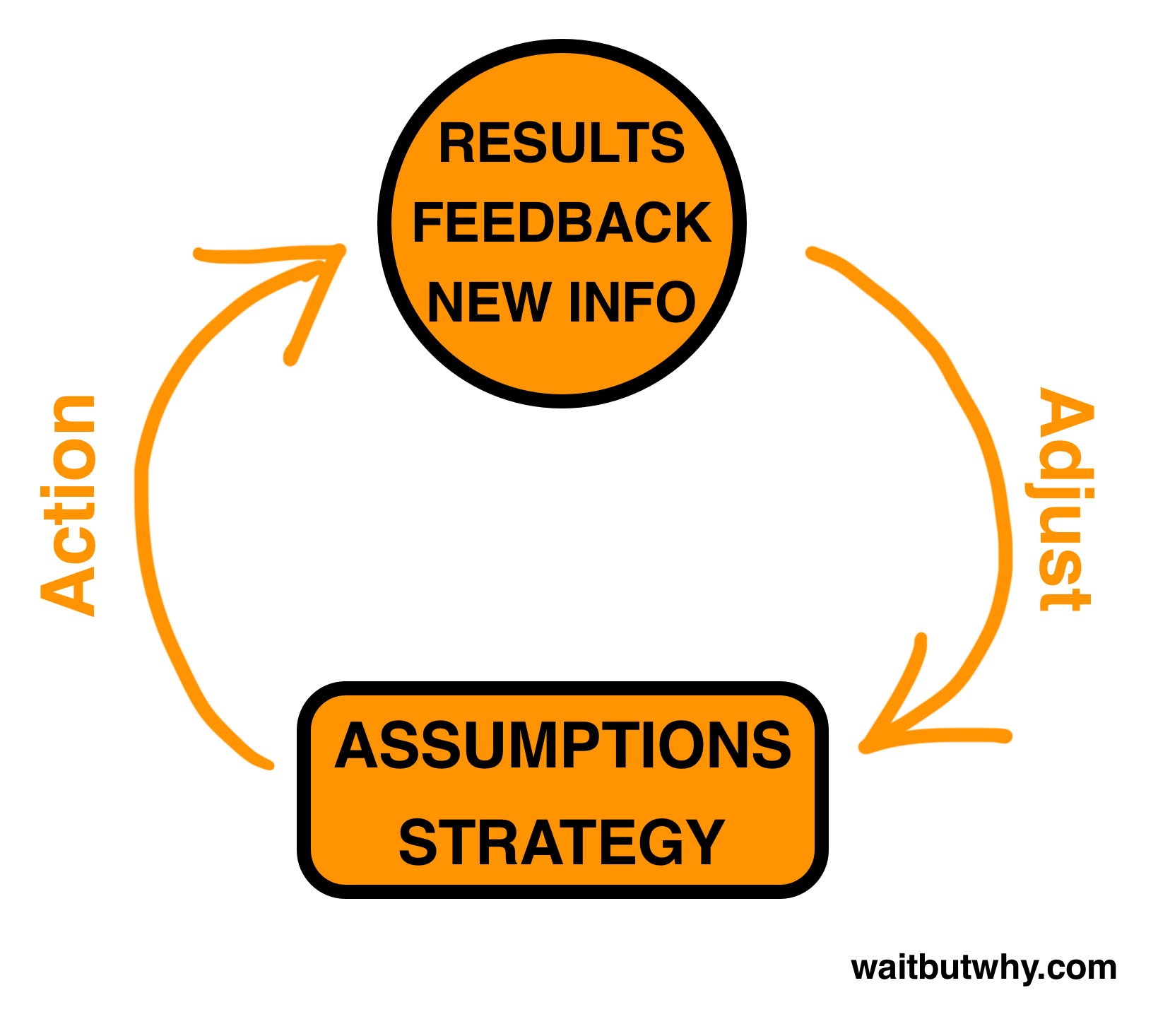
…while cooks improve at a snail’s pace, because their strategy is just following a recipe which itself barely changes. What’s more, in a world where career games are constantly evolving and morphing, the chef’s tactics can evolve in real time and keep up. Meanwhile, the cook’s recipe just grows more and more outdated—a problem they remain oblivious to. This is why I’m pretty convinced that at least for less traditional careers, your level of chefness is the single most important factor in determining your pace of improvement.

Your work ethic. This one is obvious. Someone who works on their career 60 hours a week, 50 weeks a year, is going to move down the path almost four times faster than someone who works 20 hours a week, 40 weeks a year. Someone who chooses a balanced lifestyle will move slower than a single-minded workaholic. Someone with a propensity towards laziness or procrastination is going to lose a lot of ground to someone who’s good at putting in consistent work days. Someone who frequently breaks from work to daydream or pick up their phone is going to get less done in each work hour than someone who practices deep focus.

Your natural abilities. Talent does matter. Smarter, more talented people will improve at a game at a faster rate than less naturally gifted people. But intelligence and talent are only two types of natural ability that come into play here. Cleverness and savvy matter too, and those qualities don’t always correlate with raw intelligence. Depending on the type of career, social skills can be critically important as well. In many careers, likable (or subtly manipulative) people have a big advantage over less likable people—and those who enjoy socializing will put in more people hours over time, and build deeper relationships, than antisocial types.

Other things, like existing connections, existing resources, and existing skills matter, of course, but they’re not components of pace—they’re part of the location of point A.

Persistence

When I say persistence, I’m referring to long-term persistence (as opposed to day-to-day work ethic). Persistence is simpler than pace. The more years you’re willing to commit to chasing a star, the farther along the road towards the star you’ll get. A car going 30 mph that quits driving after 15 minutes gets a lot less far than a car that drives 10 mph for two hours.

And this is why persistence is so important. Someone who has decided they’re only willing to give a dream career a shot for three years before they’ll go for their fallback plan has essentially disqualified themselves from a chance at their dreams. It doesn’t matter how awesome you are—if you’ll give up after two or three years of not breaking through, you’re unlikely to succeed. A few years is just not enough time to traverse the typically long distances it takes to get to the raddest success stars, no matter how impressive your pace.

Your Real Strengths and Weaknesses

With our pace-times-persistence equation in mind, let’s revisit the concept of strengths and weaknesses. It’s not that “strengths and weaknesses” is a bad concept—it’s that we think about it all wrong. When we list our strengths, we tend to list our areas of existing skill more than anything else. Instead, strengths should be all about pace and persistence qualities. Originality or lack thereof should be a critical component of the discussion, making qualities like agility and humility (trademark chef traits) notable strengths, and qualities like stubbornnessStubbornness is a cook quality because it means being a cook to your previous self—i.e. treating your previous self’s opinions and methods and habits as your permanent recipe. or intellectual laziness (classic cook traits) important weaknesses. The subtleties of work ethic, like a knack for deep focus or a propensity to procrastinate, should also be a major part of the discussion, as should natural abilities beyond talent, like savvy and likability. Qualities related to persistence, like resilience and determination and patience, should be thought of as promising strengths, while a social tentacle clamoring to appear successful as quickly as possible should be viewed as a bright red flag.

Most importantly, these items shouldn’t be discussed as a snapshot of where they are now, but rather in terms of your potential for improvement in each of them. If you handed 25-year-old Michael Jordan a basketball for the first time, he’d suck. But calling basketball a “weakness” of his would be getting it very wrong. Instead, you’d want to watch him practice over the next six weeks and evaluate the slope of his improvement. This lesson applies to specific skills—but most general pace and persistence qualities can also be worked on and improved if you focus on them.

Filling in the Reality Box

Your true Reality Box would literally include all career paths for which you think a highly improved version of yourself could, with an entire lifetime of effort, reach the minimum star you’d be comfortable defining as success. This would be an impossibly big list, only ruling out paths that are clearly far too long for you to traverse at your maximum possible pace on the path (like me chasing a career as an Olympic figure skater). But it’s still useful to pause for a minute and reflect on the vast extent of your full Reality Box—just acknowledging how many options are truly open to you can put you in the right mindset.Or totally paralyze you and ruin your happiness!

So to be a bit more efficient, let’s worry about the parts of the Reality Box that might actually end up in your Option Pool (the middle of the Venn diagram where the Want and Reality Boxes overlap). To complete our Reality Box audit with that caveat, we need to evaluate:

1) The general landscape. Take our best crack at evaluating the world’s current career landscape—the full range of options available (or create-able).

2) Specific game boards. For any careers that sound remotely interesting, ponder what the deal might be with that career’s current game board—the parties involved, the way success seems to be happening for others recently, the most up-to-date rules of the game, the latest new loopholes that are being exploited, etc.

3) Starting point. For those paths, evaluate your starting point, based on your current skills, resources, and connections relevant to that field.

4) Success point. Think about end points and where on each line your star should be placed. Ask yourself what’s the minimum level of success you’d need to achieve in order to feel happy about having chosen that career path.

5) Your pace. Make an initial estimate for what your pace of improvement might be on these various game boards, based on your current pace-related strengths and how much you think you can improve at each of them (in other words, how much your speed might be able to accelerate).

6) Your level of persistence. Evaluate the amount of time you think you’ll be willing to put into each of these respective paths.

Now it’s just math. You take your game board and make it a line, you plot starting points and success stars that together generate the various distances in front of you, and for each, you multiply your pace by your level of persistence. If it seems like the product of your pace and persistence for a given career path might be able to measure up to the path’s total length, that career lands in your Reality Box. Of course, it’s impossible to get exact values for any of the above factors, but it’s good to at least know the equation you’re working with.

A from-first-principles Reality Box audit may bring some overly optimistic people down to Earth, but I suspect that for most, an audit will leave them feeling like they have a lot more options than they realized, empowering them to set their sights on a bolder direction.

A good Reality Box reflection warrants yet another Want Box reflection. Reframing a bunch of career paths in your mind will affect your level of yearning for some of them. One career may seem less appealing after reminding yourself that it will entail thousands of hours of networking or multiple decades of pre-success struggle. Another may seem less daunting after changing your mind about how much luck is actually involved. There will be other career paths you hadn’t considered wanting because you hadn’t considered them as real options, but some deep reflection has opened your mind to them.

This brings us to the end of our long, two-part deep dive. After a fairly exhausting box-auditing process, we can return to our VennJohn Venn really pulled something off here. A Venn diagram is the most obvious possible kind of diagram, and somehow, John Venn convinced everyone he invented it. And this is despite openly saying he didn’t invent it. Venn explains: “I began at once somewhat more steady work on the subjects and books which I should have to lecture on. I now first hit upon the diagrammatical device of representing propositions by inclusive and exclusive circles. Of course the device was not new then, but it was so obviously representative of the way in which any one, who approached the subject from the mathematical side, would attempt to visualize propositions, that it was forced upon me almost at once.” diagram.
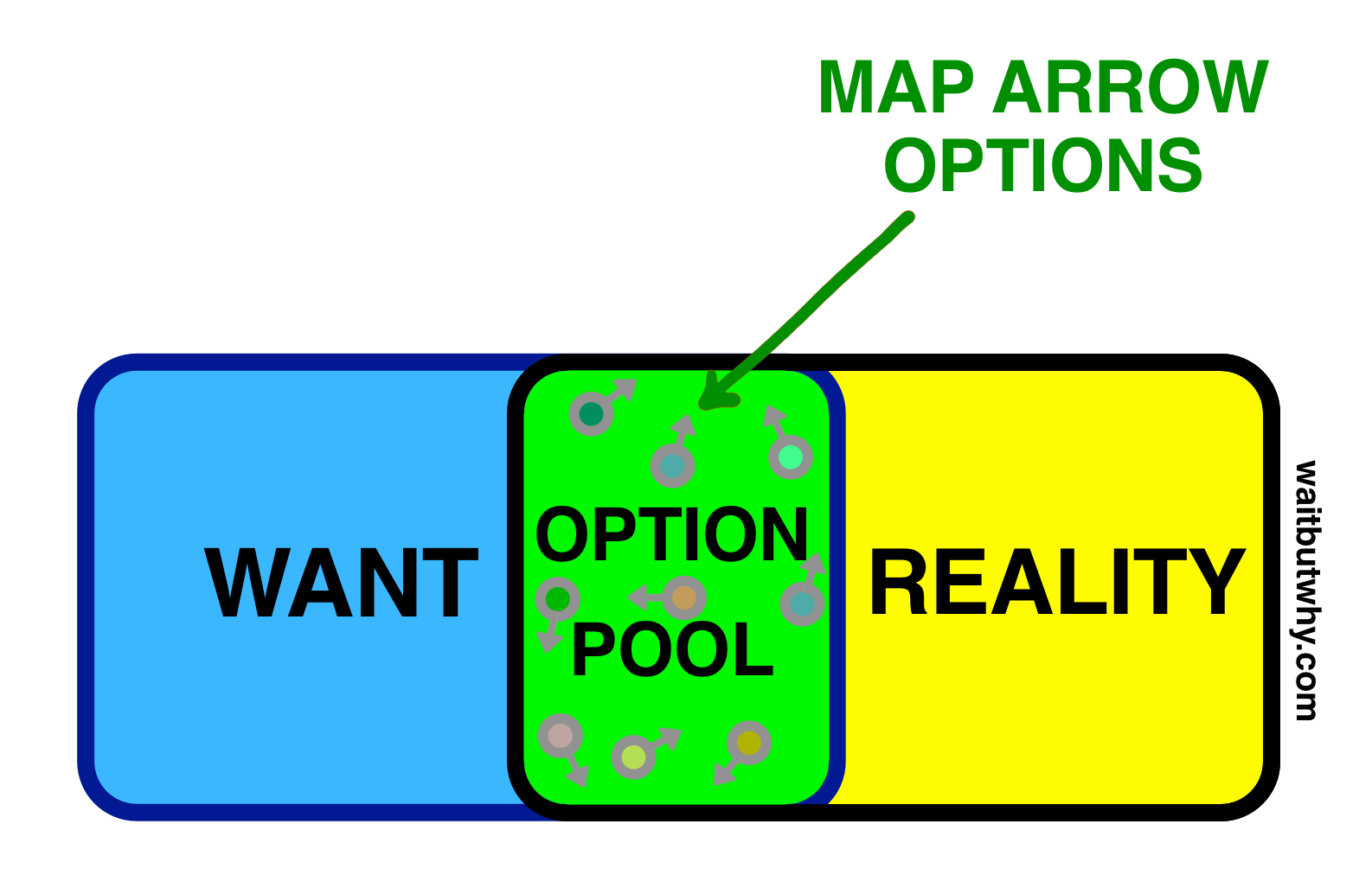
Assuming some things have changed, you have a new Option Pool to look at—a new list of options on the table that seem both desirable to your high-priority rankings and possible to achieve. We’re ready now to return to where we were before we started our analysis: the present moment. With these options in front of us, we’re ready to lift our heads up out of analysis and look forward into the future.

Connecting the Dots into the Future

It’s time to bring back your Career Plans map that I made you put down at the beginning of the post—the one with the arrow or the question mark. If there had been a clear arrow on your map before your audit, check out your new Option Pool. Given everything you’ve reflected upon, does your current career plan still qualify to be there? If so, congrats—you’re ahead of most of us.

If not, well that’s shitty news, but it’s also good news. Remember, going from a false arrow to a question mark is always major progress in life.
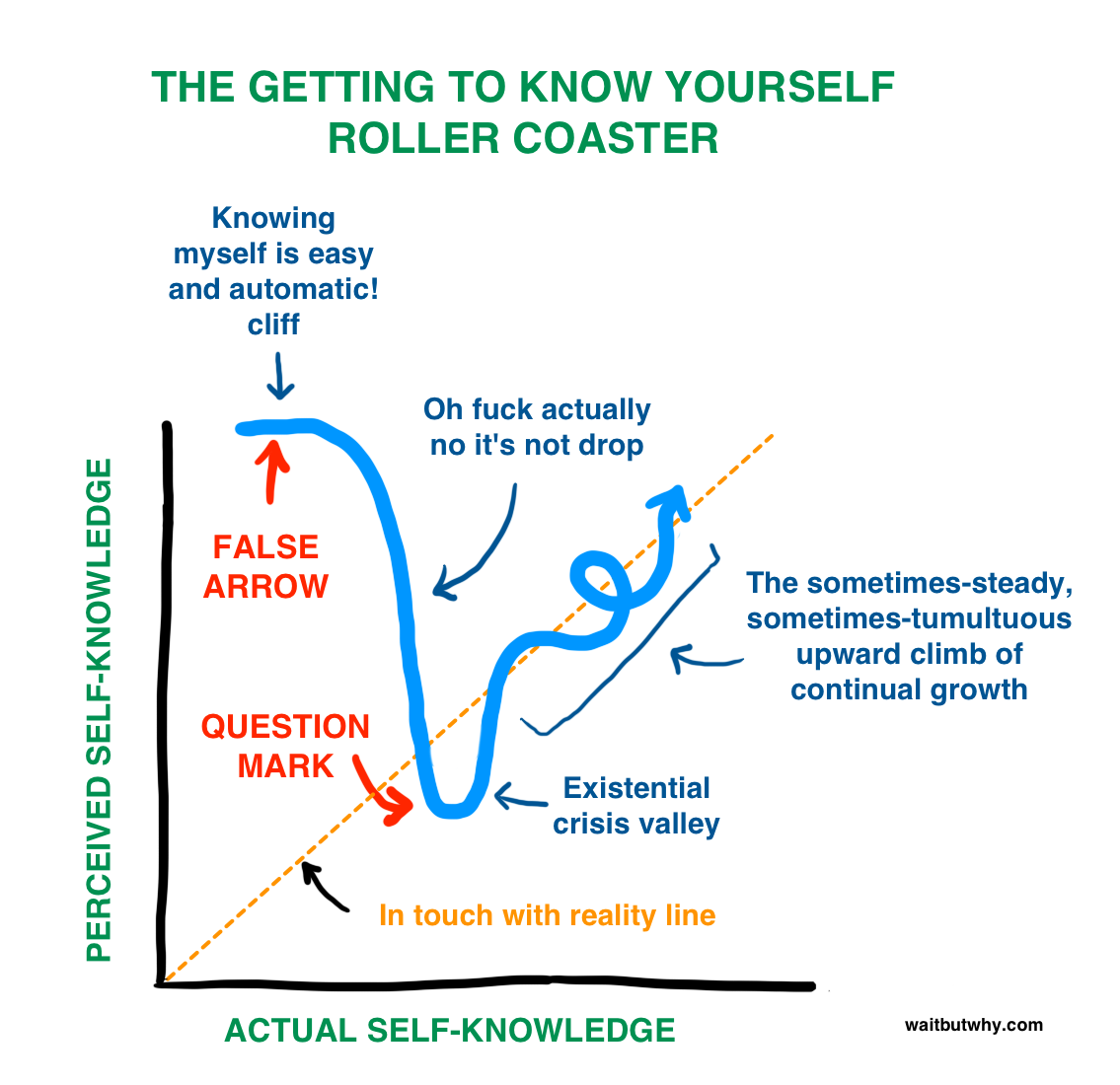
And actually, a new question mark implies having made the key cliff jump on two roller coasters: getting to know yourself and getting to know the world. Major step in the right direction. Cross out the arrow and join the question mark crowd.

Now the question mark crowd has a tough choice. You gotta pick one of the arrows in the Option Pool.

It’s a tough choice—but it should be way less tough than it is. Here’s why:

Careers used to be kind of like a 40-year tunnel. You picked your tunnel, and once you were in, that was that. You worked in that profession for 40 years or so before the tunnel spit you out on the other side into your retirement.
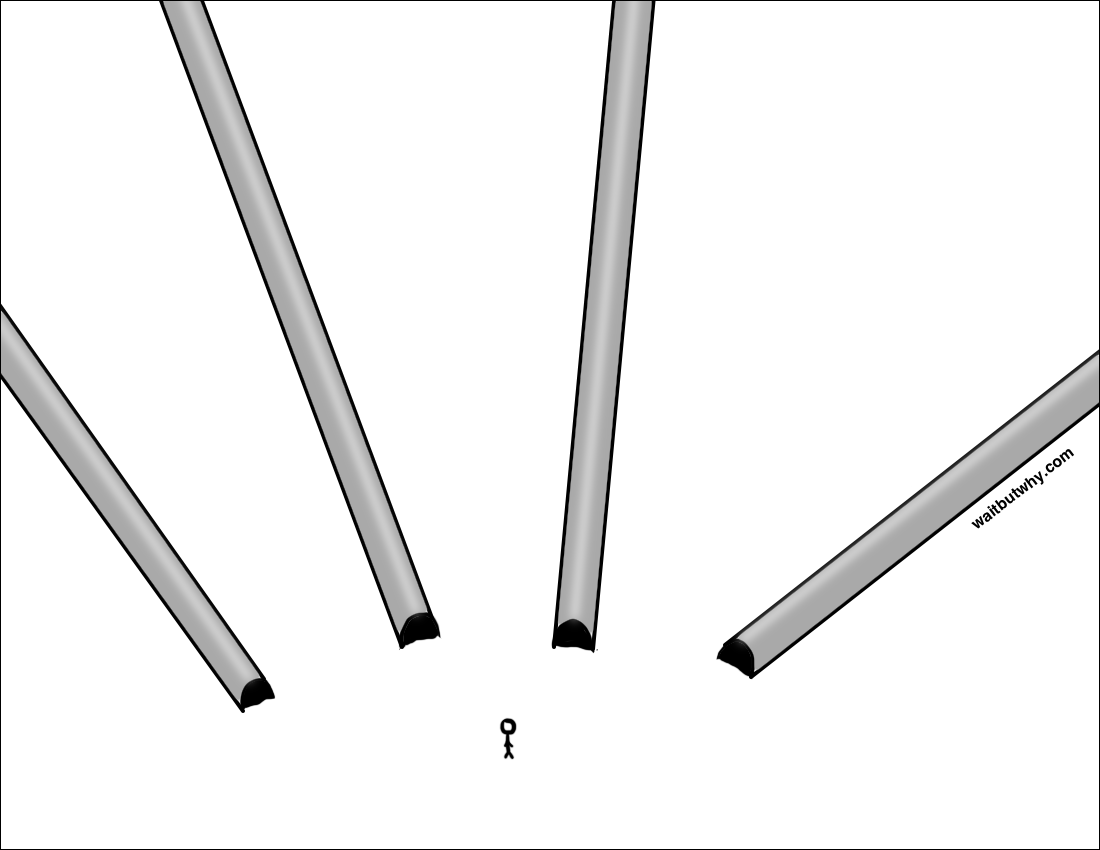
The truth is, careers have probably never really functioned like 40-year-tunnels, they just seemed that way. At best, traditional careers of the past played out kind of like tunnels.

Today’s careers—especially the less traditional ones—are really really not like tunnels. But crusty old conventional wisdom has a lot of us still viewing things that way, which makes the already hard job of making big career path choices much harder.

When you think of your career as a tunnel, it causes an identity crisis in anyone who doesn’t feel sure of who exactly they are and who they’ll want to be decades from now—which is most sane people. It enhances the delusion that what we do for work is a synonym for who we are, making a question mark on your map seem like an existential disaster.

When you think of your career as a tunnel, the stakes to make the right choice seem so high that it explodes the feeling of tyranny of choice. For perfectionist types especially, this can be utterly paralyzing.

When you think of your career as a tunnel, you lose the courage to make a career switch, even when your soul is begging for it. It makes switching careers feel incredibly risky and embarrassing, and it suggests that someone who does so is a failure. It also makes all kinds of multi-faceted, vibrant, mid-career people feel like they’re too old to make a bold switch or start a whole new path afresh.

But conventional wisdom still tells many of us that careers are tunnels. As the icing on its shit cake—on top of helping us yearn for things we don’t actually want, deny yearnings that we feel deep down, fear things that aren’t dangerous, and believe things about the world and our potential that aren’t accurate—conventional wisdom tells us that careers are a tunnel to help us daunt the shit out of ourselves unnecessarily.

Today’s career landscape isn’t a lineup of tunnels, it’s a massive, impossibly complex, rapidly changing science laboratory. Today’s people aren’t synonymous with what they do—they’re impossibly complex, rapidly changing scientists. And today’s career isn’t a tunnel, or a box, or an identity label—it’s a long series of science experiments.

Steve Jobs compared life to connecting the dots, pointing out that while it’s easy to look at your past and see how the dots connected to lead you to where you are, it’s basically impossible in life to connect the dots forwards.

If you look at the biographies of your heroes, you’ll see that their paths look a lot more like a long series of connected dots than a straight and predictable tunnel. If you look at yourself and your friends, you’ll probably see the same trend—according to data, the median time a young person stays in a given job is only 3 years (older people spend a longer time on each dot, but not that much longer—10.4 years on average).

So seeing your career as a series of dots isn’t a mental trick to help you make decisions—it’s an accurate depiction of what’s actually happening. And seeing your career as a tunnel isn’t just unproductive—it’s delusional.

Likewise, you’re limited to focusing mainly on the next dot on your path—because it’s the only dot you can figure out. You don’t have to worry about dot #4 because you can’t anyway—you’re literally not qualified to do so.

By the time dot #4 rolls around, you will have learned stuff about yourself you don’t know now. You’ll also have changed from who you are now, and your Yearning Octopus will reflect those changes. You’ll know a lot more than you currently do about the career landscape and the specific game boards you’re interested in, and you’ll have become a much better game player. And of course, that landscape—and those game boards—will have themselves evolved.

The fantastic website 80,000 Hours (which exists to help young, talented people work through their career choices) has compiled a lot of data to back this up: data on the fact that you’ll change, that the world will change, and that you’ll only learn with time what you’re actually good at. Popular psychologist Dan Gilbert also eloquently describes just how bad we are at predicting what will make us happy in the future.

Pretending you can figure out what dot #2 or #4 or #8 should be now is laughable. Future dots are the worry of a future, wiser you living in a future world. So let’s focus on dot #1.

If we’re thinking of ourselves as scientists and of society as a science lab, we should think of your current freshly revised Want-Reality Venn Diagram as nothing more than an early, rough hypothesis. Dot #1 is your chance to test it out.

Hypothesis testing is intuitive in the dating world. If a friend were toiling over what kind of person she wants to marry but never went out with anyone, you’d tell her, “You can’t figure this out on your couch—you’ve gotta start going on dates, and that’ll teach you what you want in a partner.” If that friend then went on a solid first date and returned home to toil for hours about whether or not this new person was The One, you’d again have to correct her. You’d say, “There’s no way you can know that from just one date! You have to get some experience dating this person to learn what you need to learn to make that decision.”

We can all agree that this hypothetical friend is pretty nuts and is lacking a fundamental understanding of how you find a happy relationship. So let’s not be like her when it comes to picking our career. Dot #1 is a chill situation—it’s just a first date.

This is awesome news—because it makes it a lot less scary to draw an arrow on your map if it’s only an arrow to dot #1 of your future. The real cause of tyranny of choice is accurately seeing the sheer number of options you have in today’s world while delusionally seeing those careers as the 40-year tunnels of yesterday’s world. That’s a lethal combo. Reframing your next major career decision as a far lower-stakes choice makes the number of options exciting, not stressful.

And that’s all great in theory. But now comes the hard part.

Making Your Move

You’ve reflected and reflected and reflected and weighed and measured and predicted and considered. You’ve chosen a dot and drawn an arrow. And now you have to actually make the move.

We’re super bad at this. We’re frightened people. We don’t like icky things and making a bold, real-life step is icky. If there’s any ounce of procrastination susceptibility in us, here’s where it’ll show itself.

The Yearning Octopus can help. As we discussed earlier, your behavior at any given point simply displays the configuration of your octopus. If you’ve decided on a life step and you can’t quite take it, it’s because the parts of you that don’t want to make a move are ranked higher in your subconscious than the parts of you that do. Your conscious mind may have tried to assign lower shelf ratings to the parts of your octopus that lean towards inertia, but your yearnings have rebelled. You’re a CEO not in control of their staff.

To fix this problem, think like a kindergarten teacher. In your class, a faction of the 5-year-olds is rebelling against your wishes. What do you do?

Go talk to the 5-year-olds that are causing the trouble. They’re unpleasant, defiant simpletons, but they can still be reasoned with. Talk to them about why you’ve ranked them lower than others in the octopus hierarchy. Describe to them the insights you gained from your Reality Box reflection. Remind them about how connecting the dots works and about the chillness of dot #1. You’re the teacher—figure it out.

The older I get, the clearer it becomes that our internal battle as the kindergarten teachers of our mind is like 97% of life’s struggle. The world is easy—you’re difficult. If you find yourself continually not executing your plans in life and your promises to yourself, you’ve uncovered your new #1 priority—becoming a better kindergarten teacher. Until you do, your life will be run by a bunch of primitive, short-sighted 5-year-olds, and your whole shit will suck. Trust me, I know.

If your inner analysis does call for a career leap to a new dot, I hope that at some point, you’re able to make the jump.

After the Move

Jumping to a new dot is a liberating feeling, usually side by side with some substantial internal havoc.

First of all, for a while at least, you’ll probably suck at what you’re doing on your new dot. While your wise self will know that’s exactly how it should be, your less wise selves will go into full existential meltdown mode. All of the fears you so thoughtfully deprioritized in your octopus ranking will think someone is murdering them and they’ll start trying to call 911. The yearnings you did prioritize won’t be feeling much gratification yet, and they’ll wonder if they were wrong all along about what they thought they wanted. The yearnings you didn’t prioritize will get out the guitar and start singing love songs for the greener-seeming grass you deprived them of. It won’t be much fun.

Even if things do go well, you’ll be quickly reminded of the fact that the Yearning Octopus is a generally unhappy creature. Core pieces of the octopus will feel neglected or even assaulted, and every day that goes by, you’ll be bearing the opportunity cost of the paths you were considering but chose not to walk down—the versions of you in parallel universes where you made other choices. You’ll think about their hypothetical advancement in the world and worry about what you may have passed up.

As you get wiser, you’ll learn to view a largely unhappy octopus with acceptance. You’ll let it whine and get good at tuning it out, knowing that it’s whining in the exact way you planned for it to be.

The whining octopus is a reminder of why pure, elated happiness is never a reasonable goal. The times you feel pure happiness are temporary, drug-induced delusions—like the honeymoon phase of a new relationship or new job or the high following a long-awaited success. Those moments are the perfect golf shots of a mediocre golfer’s outing—they’re awesome, and you should enjoy the shit out of them—but they’re not the new normal, and they never will be.

A better goal is contentment: the satisfying feeling that you’re currently taking the best crack you can at a good life path; that what you’re working on might prove to be a piece of an eventual puzzle you can feel really proud of. Chasing happiness is an amateur move. Feeling contentment in those times when your choices and your circumstances have combined to pull it off, and knowing you have all that you could ever ask for, is for the wise.

People talk about being present in the moment, but there’s also the broader concept of macro-presence: feeling broadly present in your own life. If you’re on a career dot that, when you’re being really honest with yourself, feels right, you get to stop thinking and stop planning for a while and just dig in. You’ll come back to the big picture later—for now, you can put the macro picture aside, put your head down, and dedicate all of your energy to the present. For a while, you can just live.

These moments don’t always last that long, so sink your teeth in. Put everything you’ve got into the dot you’ve chosen. As far as you know, you might be Michael Jordan holding his first basketball, so start playing.

The Next Dot?

At some point, your good feelings about the macro picture may sour. And when they do, you’ll have to get back into analysis mode and figure out what, in particular, is causing the restlessness.

Sometimes, the macro mission won’t be the problem. It’ll be that the chef in you has decided that the mission itself calls for a strategic dot jump. In these cases, jumping dots isn’t a release of persistence but the stuff of persistence. This is the mission-enhancing type of dot jump.

Other times, you’ll feel a darker kind of restlessness—the suspicion that you may need to change up the macro mission. When this happens, you’ll have to figure out if that feeling is emerging from the wise parts of you or simply from your restless, deprioritized yearnings. A mission-changing dot jump may be in order, but depending on which parts of you are asking for it, it may also be the wrong move.

In these moments, it’s important to consider where you tend to be on this spectrum:
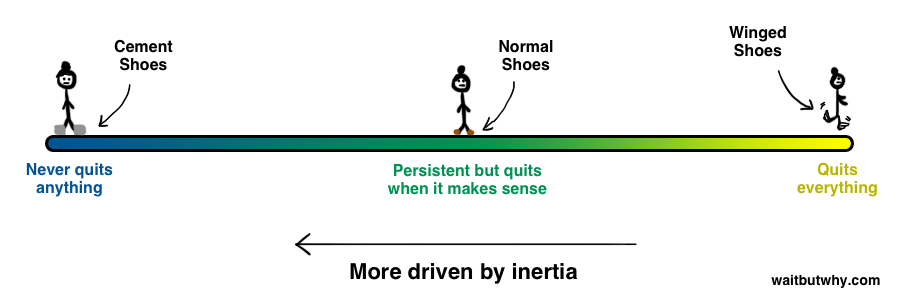
The people on the left side of this spectrum are jump-shy. The cement-footed. Their pitfall is staying way too long in the wrong things. The people on the right are jump-happy—the wing-footed—and they have the opposite pitfall: they’re quick quitters.This spectrum, of course, is also highly relevant in relationships. (You should be especially wary of cement feet—psychologists believe that people at the end of their lives are most likely to regret living by inertia: a commonly voiced regret is “I wish I had quit earlier,” and the most common advice of the elderly is, “Don’t stay in a job you dislike.“)

This is why these internal frameworks are important. They give you the ability to analyze the source of your impulses. In our example, the question is whether your impulse to jump missions is the result of genuine evolution or quick-quitter bias. So think about your diagram. Is your restlessness just the expected incessant whining of an octopus still correctly configured? The weariness from a long trudge on what’s still the right path for you? Or have you learned new information about yourself or the world during the trudge that has corrected some off-base initial assumptions? Or maybe something is fundamentally evolving—some blue or yellow loop activity:

If you feel that things have genuinely changed, you may decide to zoom out even further and think about the big red loop, which deals with fundamentally changing your mission:

If a career is like connecting the dots, we should probably rank “getting wise about dot-jumping” pretty high on our to-do list. The best place to start is by looking at your own past. Studying your own past decisions, with the flashlight of hindsight and accumulated wisdom, is like an athlete studying game tape.

Looking at my own past, I can see a lot of dot jumps (or, while I was still in school, career plan adjustments), and some of them look pretty unwise in retrospect. But the clearer a picture I can see of my past bad decisions and the thought patterns and behavioral habits that built them, the less likely I’ll be to repeat them in the future.

Remembering that you’re kind of dumb is also a critical humbling exercise. The insecurity of humility doesn’t feel very good, and the burden of having to continually invent your own life map is never easy—but insecurity and difficulty are the feelings of driving your own ship. It’s when we feel too good that we run the risk of becoming overconfident, intellectually complacent, and set in our ways. It’s exactly when we think we have life all figured out that we end up losing our way.

___________

Over the course of your life, your good and bad decisions will collaborate to forge your unique life path. Often on this blog, I’ve written about how irrational our fears can be and how badly they can hold us back. But we should probably embrace the fear of end-of-life regret.

I’ve thankfully never been on anything that felt like a deathbed, but it seems like there’s something about the end of life that lets people see things with clear eyes. It seems like facing death makes all of those voices in your head who aren’t actually you melt away, leaving your little authentic self standing there all alone, in reflection. I think end-of-life regrets may simply be your authentic self thinking about the parts of your life you never got to live—the parts of you that someone else kicked down into your subconscious.

My own psyche seems to back this up—looking back on my path so far, the mistakes that bother me most are the ones that happened because someone else took the wheel of my head and overruled the quiet, insecure voice of my authentic self—the mistakes that I knew at the time, deep down, were wrong. My goal for the future isn’t to avoid mistakes, it’s for the mistakes I do make to be my own.

That’s why I went through such an excruciatingly rigorous analysis in this post. I think this is one of those few topics in life that’s worth it. Other voices will never stop fiercely trying to live your life for you—you owe it to that little insecure character in the very center of your consciousness to get this right.

_______

If you like Wait But Why, sign up for our email list and we’ll send you new posts when they come out.

To support Wait But Why, visit our Patreon page.

If you want to download this post for printing and offline sharing, you can buy it here.

___________

For help analyzing your situation:

Some paper to write on: Your octopus. Your priority shelf. Some path distances. Your career dot map.

For those who want to dig in even further: Alicia (WBW Manager of Lots of Things) has put together a more involved group of worksheets.

For further exploration:

The site 80,000 hours—dedicated to helping young, high-potential people make big career choices—is an awesome resource. The site is run by super smart, thoughtful, forward-thinking people, and can be digested in video or book format in addition to on their site.

I’ve been reading Seth Godin’s blog for years. Seth has a lot of wisdom in his head, and he doles it out in little bite-sized nuggets each morning on his blog (which I receive by email). A lot of Seth’s advice applies to career choices. Here’s an example (which I adapted into one of the cartoons in this post).

Eric Barker’s blog is full of actual data that can help with career choices, like this post on what makes a career fulfilling or this one on the importance of mentors.

___________

More Wait But Why human deep dives:

The Marriage Decision: Everything Forever or Nothing Ever Again

Why Procrastinators Procrastinate

And a post about getting wiser

And a few less self-reflect-y Wait But Why posts on:

Awkward social interactions

The history of everything

Colonizing Mars

Read this next

336 comments

Leave a Reply

  1. […] Method: A balance between odd and even numbers is another strategy. Mixing these can sometimes yield better […]

  2. […] How to Pick a Career (That Actually Fits You) […]

  3. […] How to Pick a Career (That Actually Fits You) […]

  4. […] out and reorientThis year, I charted a career plan with my partner and a friend. Together, we talked about what we wanted from life, sent each other […]

  5. Gourgen Avatar
    Gourgen
    Hide

    Thanks for the connecting read. I relate with most of the obstacles and fears that get in the way of finding what personal career goals are real and what could just be a desire implanted in me. I am a philosophy graduate and your writing is similarly very investigative. I am much older now and feel pressured to act but my fears of what others will think of me, how I can overcome addiction to leisure living paycheck to paycheck, how many attempts is a sign I should be aiming for something else, how can I pick my weaker strength because it is more convenient in my lifestyle, is my innocent self going to make me most happy, or the rebel self that didn't act due to loosing focus worth revisiting type questions. Now I know I am not the only one feeling this way trying to make a decision on my own.

  6. […] I take care of the WaitButWhy articles, particularly the one about your existence in weeks and selecting your profession. I printed a spreadsheet to fabricate your possess existence in weeks, and did the similar for the […]

  7. […] Advice to Ten-Year-Old Self: Reflecting on childhood can unveil personal growth and the lessons learned along the way. […]

  8. […] But Why, Tim Urban has advised readers on making major decisions like getting married or picking a career, often using thought experiments as […]

  9. shubham bagri Avatar
    shubham bagri
    Hide

    My brain was in front of me, thank you for this Tim. So so insightful.

  10. […] you day-to-day enjoyment and a long-term sense of purpose. The blog Wait But Why has a phenomenal long read (exceptionally insightful, but also a little not safe for work (NSFW) in its language choices in […]

  11. Den B Avatar
    Den B
    Hide

    It was very exciting to read this material. The only thing that worries me and not only me is that now AI is quickly destroying possible options, up to the complete annihilation of any possibilities. It’s very, very depressing. Good luck everyone.

  12. Chris Blahoot Avatar

    Thought-provoking and THOROUGH as always.

    Worked with my, ahem, “friend” to summarize this into a digestible recap that fits better in my little noggin and is easier to refer back to for a quick refresher. Would love anyone’s feedback on missing/misguided points:

    1. Identify Your True Desires (Yearning Octopus):
    – Reflect deeply on what you truly want in a career, not what others expect of you.
    – Understand the different aspects of your yearnings, such as personal fulfillment, social acceptance, lifestyle preferences, moral values, and practical needs.

    2. Analyze Your Motivations (Interrogation Room):
    – Examine why you want certain things and whether those desires are genuinely yours or imposed by others.
    – Interrogate each yearning to ensure it’s authentic and not influenced by external pressures.

    3. Understand the Career Landscape
    – Look beyond traditional career paths and understand the modern, rapidly changing job market.
    – Recognize that many successful careers today are created rather than followed.

    4. Evaluate Your Potential (Pace x Persistence):
    – Assess your starting point, current skills, and resources.
    – Determine your pace of improvement (your ability to learn and adapt) and your persistence (willingness to stick with it).

    5. Create a Career Map
    – Map out potential career paths that align with both your true desires and realistic possibilities.
    – View your career as a series of experiments (dots) rather than a long, unchangeable tunnel.

    6. Make Informed Experiments (Connecting the Dots):
    – Choose a path (dot) to pursue next based on your reflections and analysis.
    – Understand that it’s a hypothesis you’ll test, not a lifelong commitment.

    7. Embrace Flexibility and Growth (Mission-Enhancing Dot Jump):
    – Be prepared to reassess and change paths as you gain more experience and insights.
    – Focus on continuous learning and adapting to new opportunities and challenges.

  13. Prasanth Avatar
    Prasanth
    Hide

    thank you for creating this.

  14. Miguel Avatar
    Miguel
    Hide

    Before referring to this post, I just would like to state that you, Tim Urban, are a ‘unique brain’, per your expression in Lex Fridman’s podcast. And you have a rare talent to systematize knowledge/wisdom into clear frameworks and concepts. This post is another example of just that. The best framework for career ‘fitness’ choice I’ve ever come across. And my father is a vocational orientation psychologist…so, there’s that. I wish I had access to this framework more than 30 years ago – maybe my professional life would have been stabler…I am a medical doctor, but after finishing general residency I left clinical practice. I have been an actor in theatre and cinema, performance artist, organic farmer, high profile medical executive in Pharmaceutical Industry and medical speciality resident (unfinished)…I turned 50 years old early this month and finally my professional path for the rest of my life is cristal clear: I started a novel recently and that’s what I will be doing in the (hopefully) decades I still have. I have read a lot, lived a lot – now I have things to say to whomever might be reading…my family was my reason to live, but that’s gone, so it’s the ideal moment to engage in a more contemplative life, writing and reading…PS. This is funny, I am super zealous of my privacy – don’t have social media – and never share anything personal in public. But this is the second time in this blog that I share personal data…your posts are so generous and singular that I guess I get carried away…very off character! PS2. You can’t imagine how much I would love to have ‘high rung disagreement’ with you on the ‘woke’ ideology (specially versus alt right, QAnon and MAGA)!!…

  15. […] Tim Urban on how to find a career you like (link) […]

  16. […] Wait But Why: Long-form blog by Tim Urban; you might have seen him at this TED talk around procrastination. Typical posts involve long-form discussions of various topics, including artificial intelligence, outer space, and procrastination, using a combination of prose and rough illustrations. All his articles are great, but one that can help many readers might be this one: How to Pick a Career (That Actually Fits You). […]

  17. Mansi Avatar
    Mansi
    Hide

    Wait but why is this so good?

  18. […] How to Pick a Career (That Actually Fits You) – Wait But Why Blog […]

  19. […] reader of Tim Urban’s Wait But Why, and in 2018, exactly when I was toiling with this the most, he released his article on picking a career path. To this day, it has been the most helpful tool for visualizing and conceptualizing this […]

  20. […] https://waitbutwhy-2024-production.mystagingwebsite.com/2018/04/picking-career.html […]

  21. […] https://waitbutwhy-2024-production.mystagingwebsite.com/2018/04/picking-career.html […]

  22. […] I take care of the WaitButWhy articles, particularly the one about your existence in weeks and selecting your profession. I printed a spreadsheet to fabricate your possess existence in weeks, and did the similar for the […]

  23. […] “Acting ability is only one piece of that puzzle—you also need a knack for getting yourself in front of people with power, a shrewdness for personal branding, an insane amount of optimism, a ridiculous amount of hustle and persistence, etc. If you get good enough at that whole game—every component of it—your chances of becoming an A-list movie star are actually pretty high.” – WaitButWhy […]

  24. […] kan ik allerhande kleine en grote beslissingen nemen die effect hebben op wat er komen gaat. Tim Urban heeft dat supervet […]

  25. […] I take care of the WaitButWhy articles, particularly the one about your existence in weeks and selecting your profession. I printed a spreadsheet to fabricate your possess existence in weeks, and did the similar for the […]

  26. […] How to pick a career – WaitButWhy blog […]

  27. Sammie Avatar
    Sammie
    Hide

    Wow, this was one of the best career advice posts I’ve read. Really blows some career / self-help books out of the water. Took me a while to finish reading, but loved the humor, great resources and lots for me to reflect on.

    https://media1.giphy.com/media/JqBcYunETBib6/giphy-downsized-small.mp4

  28. Hide

    […] Some people are young, just not you. … Read More 536 3239 0 305 comments […]

  29. David Avatar
    David
    Hide

    Chefs are humble? Have you watched a cooking show?

  30. […] Taming The Mammoth: Why You Should Stop Caring What Other People Think10 Types of 30-Year-Old Single GuysHow To Pick A Career (That Actually Fits You) […]

  31. Wyciszenie samochodu Avatar

    Your post is a treasure trove of knowledge! It’s evident that you have a passion for the subject and have taken the time to compile valuable information. Thank you for your hard work!

  32. Chandni Barak Avatar
    Chandni Barak
    Hide

    This article is so wonderful. I have to re-read many sentences. How much time and research did it took for you to write it down here?

  33. K Avatar
    K
    Hide

    A summary/guide for using the tools here would be great! I feel like the info is great, just a little hard for me to follow.

  34. […] Also from that Tim Urban article: […]

  35. […] If you read only one thing today, let it be Tim Urban’s deep dive on how to pick a career that actually fits you 👈 […]

  36. […] Cómo elegir una carrera (que realmente se adapte a ti) […]

  37. ScholarshipsWala Avatar
    ScholarshipsWala
    Hide

    THANKS ADMIN for posting such a nice post i love to read this post thanks. Fifa 18 Game

  38. 征 邢 Avatar
    征 邢
    Hide

    Tim mentioned that someone could have a different octopus with different number of tentacles.
    I wonder what could it be other than the five mentioned in the article…

    Is there anyone having desires other that doesn’t fall into the category of social, personal, moral, practical and lifestyle?

  39. […] first video is about How to Pick Your Career which is the first video under the Wealth Section; one of the four pillars to the good […]

  40. Hu Man Avatar
    Hu Man
    Hide

    I have paused at the denial prison part and damn this is hard bro. Fuck I don’t even know anything about myself now. This is just great! Fuck!

    1. 征 邢 Avatar
      征 邢
      Hide

      Just got through denial prison, good luck bro. Talk to me if you ever need any advice

  41. Willow James Avatar
    Willow James
    Hide

    An octopus has eight tentacles, not five.

  42. […] large portion of Wait But Why readers—our childhood river then feeds into a pond, called college.1 We may have some say in which particular pond we landed in, but in the end, most college ponds […]

  43. […] large portion of Wait But Why readers—our childhood river then feeds into a pond, called college.1 We may have some say in which particular pond we landed in, but in the end, most college ponds […]

  44. […] large portion of Wait But Why readers—our childhood river then feeds into a pond, called college.1 We may have some say in which particular pond we landed in, but in the end, most college ponds […]

  45. […] large portion of Wait But Why readers—our childhood river then feeds into a pond, called college.1 We may have some say in which particular pond we landed in, but in the end, most college ponds […]

  46. […] large portion of Wait But Why readers—our childhood river then feeds into a pond, called college.1 We may have some say in which particular pond we landed in, but in the end, most college ponds […]

  47. […] large portion of Wait But Why readers—our childhood river then feeds into a pond, called college.1 We may have some say in which particular pond we landed in, but in the end, most college ponds […]

  48. […] large portion of Wait But Why readers—our childhood river then feeds into a pond, called college.1 We may have some say in which particular pond we landed in, but in the end, most college ponds […]

  49. […] large portion of Wait But Why readers—our childhood river then feeds into a pond, called college.1 We may have some say in which particular pond we landed in, but in the end, most college ponds […]

  50. […] large portion of Wait But Why readers—our childhood river then feeds into a pond, called college.1 We may have some say in which particular pond we landed in, but in the end, most college ponds […]

  51. […] large portion of Wait But Why readers—our childhood river then feeds into a pond, called college.1 We may have some say in which particular pond we landed in, but in the end, most college ponds […]

  52. Sally B Avatar
    Sally B
    Hide

    Is this a book yet? Blows so many other career books away with its depth of human understanding. Amazing stuff, have bought the pdf, thanks👍

  53. […] Tim Urban, founder of the blog, Wait But Why, on “How to choose a career (that’s actually right for you)” […]

  54. […] by any external measure of your progress.” Tim Urban, founder of the blog, Wait But Why, on “How to Pick a Career (That Actually Fits You)” ”If a career is like connecting the dots, we should probably rank “getting wise about […]

  55. Ivan Drajzl Avatar
    Ivan Drajzl
    Hide

    Thanks for this article. As a teacher, I find it a powerful tool for helping my students.
    PS Enjoy the fatherhood. I become father at 40 myself. It will get easier with time 😉

  56. Anam Avatar
    Anam
    Hide

    Anyone have any good ideas for jobs that provide both novelty and help others? I get bored in typical 9-5s easily and want change (like travel the world! Try something you’ve never tried before!)
    But I also want a sense of meaning because I don’t want to hedonistically chase new experiences…

    Not sure what job satisfies both requirements.

    1. Hu Man Avatar
      Hu Man
      Hide

      nursing

  57. saba Avatar
    saba
    Hide

    Hi, my name is Saba Patel , founder of JUNIOR SCIENTIST CLUB ( https://juniorscientistclub.in/) I work with parents and kids of age group 3 to 13 years. Can I use this article as a blog on my website? It will definitely help a lot of people

  58. Li Avatar
    Li
    Hide

    The part that said (roughly), “We were taught to be a amazing student, but have no idea how to be the CEO in the real world.” really hit me hard. I’m a student myself and as soon as that was mentioned I saw it in every student. We are taught to ask the teacher first if you have a problem, and our daily life is controlled by bells. Left to our own devices (literally), we do and aconplish nothing.

    Really great post overall.

    1. MelancholiaEnshrinesAllTriumph Avatar
      MelancholiaEnshrinesAllTriumph
      Hide

      That is why being a STEM student is so great: in STEM at some point you have to start doing practical more-or-less self-guided lab work. Then the transition is easier because often the amount of self-guidance increases with time (from practise lab -> Masters thesis -> Phd thesis -> post doc -> staff scientist -> professor)

  59. Entropy Avatar
    Entropy
    Hide

    Amazing, I’ve always thought about myself like this, and I wondered if I was wasting my time.

    What’s the point in knowing why? In the end, you reject the parts of you that you don’t like or agree with, and you embrace the parts of you that you actually enjoy or truly agree with. This makes you more of yourself, and less of someone else – its quite liberating, but also extremely scary. When you take off everything everyone else expects of you, thoughts and beliefs that aren’t your own, you might find that whats left behind is something quite unattractive. But this is a necessary step, and this cannot be emphasized enough.

    Many others claim to find happiness having never truly explored the depths of their minds. Yet I wonder if they are truly happy? Maybe their happiness is just what society expects from someone in their position, and they choose to act? An act so ingrained that the person themselves doesn’t even know that they are acting. An act that they have never questioned for themselves. Its frightening, the thought of living as someone you are not. Don’t allow your entire life to become one big habit, something you live day to day because you have to.

    Sorry if this came off as muddled or unclear, I’m absolutely not sober.

  60. Miles Avatar
    Miles
    Hide

    great post, Tim is genuinely one of the most intelligent people on the internet. but my question is; is a human pet a regular pet, or a child?

  61. Brian Avatar
    Brian
    Hide

    Huh, this was an interesting read! I think my most contested tentacle would be my Moral tentacle, with my religion and family probably influencing most of what I feel is important. But I think I’ve done more and more work to make that tentacle’s makeup my own over the last 5 – 10 years. As for the rest of the tentacles….I think I made each of them my own from a young age until now. I’ll do my best not be arrogant, as that’s pretty easy to become, but I think I’m what Tim called “an unusually wise person whose examination reveals an octopus developed mostly by you and kept readily up to date.” Cool~

    1. MelancholiaEnshrinesAllTriumph Avatar
      MelancholiaEnshrinesAllTriumph
      Hide

      I think of religion as an ancient mental framework to make a large number of people behave in a certain way beneficial to a culture/society. But that’s just me.

  62. isabellaesme Avatar
    isabellaesme
    Hide

    Awesome blog. Thanks for sharing this information with us. The energy industry is presently growing in demand. If you are asking, Is energy a good career path you are not alone Many youths also see the opportunity in this industry and are seriously considering pursuing a career in it.

  63. Mn kumar Avatar
    Hide

    Man this is the greatest blog I ever saw and I agree with you to change your life we should to apply for best companies to work for only – https://finasko.com/best-companies-to-work-for/

  64. thanh bùi Avatar
    thanh bùi
    Hide

    Guys, im a translator from vietnamese and im not sure what “dot #1,#2,#4,#8” stand for. Can someone explain pls.

    1. Metamétodo Avatar
      Metamétodo
      Hide

      # here is a symbol for “number”. Like “dot number one, dot number four”, or first dot, fourth dot.

      Or, if your question was about the use of “dot” overall, he’s using them as metaphors for steps, stages. Although I believe this is not the case.

      1. thanh bùi Avatar
        thanh bùi
        Hide

        I think I got it

  65. Zack Glickert Avatar
    Zack Glickert
    Hide

    I think a massive problem with our society is parenting. Parents do not prepare their kids for the real world at all and thats why this article exists. you shouldnt be scared about whats next, you should be ready

  66. Jonathan Apkdownload Avatar

    It’s hard to make a decision as important as this. My point is give it a go, it might take you a few years to find what’s really right for you, or spend your whole life doing a job you don’t love or enjoy. I tried using Indeed Job Search, found it on apkdownload, and I found the current job, I think you can give it a try. Not bad

  67. Dilawar Hussain Shaban Avatar

    Hello this is a great blog had fun reading it learning dance online is a treasure and a great idea to focus on your skills at your convenient time we are the
    leading dance institute in India and we are now streaming online at prices that can only be imagined before with Indias’ best trainers.

  68. Anuchaa Retail Avatar

    Great article! I was surprised when I read this post. This post can be really helpful for anyone and surly it helped me also. Really good work by wow team. I am manager at online shopping website that is Anuchaa Retail but I don’t want be a manager. After reading this I wish I will do follow my dreams whatever I had. Thank you so much this kind of amazing post.

  69. Andres Avatar
    Andres
    Hide

    Speaking truth. Great article! Haven’t gone trough the whole thing, but definitely will.

  70. Carolina Costa Avatar
    Carolina Costa
    Hide

    Hey @timurban80:disqus , can I translate this text to Portuguese? I have a few friends that would love (and need) to read this article. Thank you and all the best for you!

  71. Abbas Mahammed Avatar
    Abbas Mahammed
    Hide

    I’m feeling very blessed tow land over this page and go through this incredibly long post it took me 3 days to read (long breaks in between). The analysis shown here makes perfect sense, I feel a lot less burdened now about my career, I am now able to recognize a lot different kinds of voices and what they are trying to tell me. I was somehow happy to finish reading this post as well because it was so long and every bit of information in this is so valuable, so I have read each paragraph thoroughly to get it straight into my head.

    Thank you will be an understatement to say to WBW for making this post, thank you anyways guys, I can help someone younger than me make better career choices and show them how they can analyze and recognize the chaos in their heads.

    They should teach this is every school. This post has helped me get clearer with my career choice, it made me understand that I am on a right path and nothing to freak out about but there are still some solid changes to be made before I jump into the professional world. Cheers mates!

  72. Matheus Simao Avatar
    Matheus Simao
    Hide

    Thanks for this, changged my life and mindset. Also, made fell less anxious about connecting the next dots.

  73. Max Avatar
    Max
    Hide

    What a write up!!!

    This must have taken forever. I hope you are making money off this somehow

  74. John McIlroy Avatar
    John McIlroy
    Hide

    I’m going with you great uncle.

  75. Isa Avatar
    Isa
    Hide

    sorry i forgot 1 word at the 2nd sentence which removed significance to my comment :
    Maybe for some people this could be common sense. But for me, I truly WISH I had the chance to read this article at 18 years old coz i never took the career decision as important as it really is. The major impact. I just was downsizing its role as a money maker that takes 8h of my day. that’s it. But was not fulfilled and kind of a robot thinking I was in control. But i was so blindsided. The impact on EVERYTHING. That should be emphasized at school. For real the world would be very different if everyone was applying this vision from the youngest age. Thanks a lot to the Chef who took his time to write this down.
    It was long to read even. I had to force my procrastinator monkey to finish it but man it was the best invested time I ever took!!!!!!
    I wish Countries could sponsor you to go from school to schools.

  76. Isa Avatar
    Isa
    Hide

    Maybe for some people this could be common sense. But for me, I truly I had the chance to read this article at 18 years old coz i never took the career decision as important as it really is. The major impact. I just was downsizing its role as a money maker that takes 8h of my day. that’s it. But was not fulfilled and kind of a robot thinking I was in control. But i was so blindsided. The impact on EVERYTHING. That should be emphasized at school. For real the world would be very different if everyone was applying this vision from the youngest age. Thanks a lot to the Chef who took his time to write this down.
    It was long to read even. I had to force my procrastinator monkey to finish it but man it was the best invested time I ever took!!!!!!
    I wish Countries could sponsor you to go from school to schools.

  77. Alex Avatar
    Alex
    Hide

    wouaw…. you just changed my life. THANK YOU FOR THIS ARTICLE ????????‍♀️????????‍♀️????????‍♀️

  78. Umang Rawat Avatar
    Umang Rawat
    Hide

    Trust me, its the best article that I’ve read on choosing a career. Thank you, you have explained it in such a useful way. After choosing between science and commerce, now is the time to make some bigger decisions in life.

  79. Ling Avatar
    Ling
    Hide

    I come back and reread this post every few years, and it’s still always relevant. I’ve recommended it to so many other people as well. It doesn’t answer any questions for you, but somehow there is something comforting about the fact that there is some structure to the madness that you can use as a framework for all of the crazy thoughts that bounce around in your head. Thank you for writing this.

  80. Natasha ❤️ ❤️ ❤️ Avatar
  81. Jackesque Avatar
    Jackesque
    Hide

    Are you perhaps a philosopher, sir? Because you do act as one.

  82. Panta Avatar
    Panta
    Hide

    What would you recommend if the Passion yearning has so many elements, it deserves its own octopus? And about decision paralysis resulting from uncertainty of outcomes?

    My biggest problem is being interested in- and passionate about so many things, I’ve failed to prioritize one or two for a decade and always end up going for and working towards boring but relatively easy to get jobs without much perspective, while tending to my passions as hobbies competing for me free time, because it would be a lot of work to get anywhere with any of my passions so I don’t want to waste that time in case it turns out actually working a job in that field would not be for me after all. I.e. getting a master’s in environmental science because you need that level of education to have a real career, only to find out I don’t like any of the related jobs, I only care about the topic itself.

    I’ve recently realized I can only motivate myself to stick with something if the outcome is calculable and relatively certain, OR if it’s of great interest to me. Complete a [insert topic I don’t really care about but is something I *can* do well if need be] class to get a contractually agreed raise at work? I’ll complete and ace that class in no time. Complete such a class on the (relatively good) chance it will help me get a job? I’ll procrastinate for months and then half-ass it.

    Meanwhile I can also easily stick with something if it’s very interesting to me, IF it doesn’t endanger my standard of living, but to make a passion into a career, I have to spend some years getting an expensive and time consuming education in that field and that’s a very big financial commitment. Unfortunately, employers don’t tend to value self-driven internet research into a topic as much as a university degree. As an autodidact, I’d have to start my own company to make any kind of money, but a) that’s another huge risk and b) I’ve already tried and know I’m terrible at all the customer-getting aspects of running a business and I don’t care for bureaucracy and paperwork. I’m better as either a paid specialist, or directing others to fulfill my vision, but unfortunately I’m not rich enough to start out with lots of employees and as mentioned, I’d need that degree to be a well paid specialist.

    I’m very afraid of wasting valuable time and as a result, I waste time doing nothing because I can’t decide what is most deserving of my time.

    This has turned into a bit of a rant.

    1. Meghana Murthy Avatar
      Meghana Murthy
      Hide

      I feel like we’re the same person. Woud love to connect.

    2. jakubhajost Avatar
      jakubhajost
      Hide

      That’s me. You just described me. Uncanny.

    3. Theo Carney Avatar
      Theo Carney
      Hide

      yeah I think I have a lot of the same blockers. A friend recently gave me some good advice about grad school, which was to look at the job you want to get after grad school and reverse engineer from the job to the grad school program you should attend. She was like “yeah, don’t make my mistake and study psycholinguistics, I’m never gonna use that lol.”

      For me, since I have a lot of interests, I’ve been avoiding reading about grad school. I knew I was thinking about research in the wrong way, but I didn’t know what needed to change. My instinct was to start with one of my numerous interests and read about programs that would develop that interest. But in my gut that seemed like an ineffective waste of time, since I would be researching the graduate program “pond” without understanding A) the job market it flowed out into and B) if any of those jobs were remotely interesting to me and possible to get hired for.

  83. Panta Avatar
    Panta
    Hide

    PS: My problem with filling in the want box is that I’m sure I don’t even know about a lot of jobs that exist and would be a good fit for me.

  84. Andre Santiago (Classic) Avatar

    Kurzgesagt – In a Nutshell

  85. Jane Sorensen Avatar
    Jane Sorensen
    Hide

    Extraordinarily helpful – though I would like to offer two minor changes.
    1) Strike “young” out at every single case where it doesn’t necessarily apply. Children are young. But job seekers, career-ponderers, not so much. Youth is way over-esteemed and far too many resources are discriminatingly thrown at it, as if to punish adults for aging. It’s important that young people take every opportunity to endeavour and learn and break out of their deceptively rigid social guidance system (which thankfully relaxes as you get older, but unfortunately can also disintegrate). Important for young people – and the once-young-but-did-alright – to realize that they’re more privileged than they’ve ever been to assume and enforce that the spoils of youth go only to them — this amounts to many decades of disregarded human potential after their first flush of endeavour and success (or failure) has been traversed, and this is a waste. Endeavour and potential do not end at age 30/35. But presuming they do, esp. given youth’s bias against the aged except as a depot of resources, attenuates more opportunity than it should. (I’d like to take 80,000 Hours to task for this same error.)
    2) the Dot analogy and the dating analogy i.e. “it’s an experiment!” needs an early teaser or spoiler. It’s so very important to overcome the This Is Crucial, Once and For All mindset that society (and recruiters, especially) fobs off onto us, which does exactly what Tim says it does: renders us paralysed or discouraged about mistakes. It’s rare you can plan anything more than a hopeful approximation of where you’ll end up. Focus all your energy on where you can go next, and have at it. Which is what this article proves itself aligned with.

    1. KaliYuga Avatar
      KaliYuga
      Hide

      Options do not end at 30/35, but they decrease massively.
      First because biological time clock is a reality. Second because the systems in place make it harder to choose & change career later in life. This should really not be underestimated. I’m saying this as a 30+ year old. Sure you can change career after 30, but it will cost you a big sacrifice. Many people have kids and a family beyond that age, that they have to feed. People massively underestimate these realities and act as if they are young forever. Major mistake leading to lots of tears.

  86. Dmlsm Avatar
    Dmlsm
    Hide

    Made an account on here just to tell you that this changed my life. Thank you.

  87. Darek Buryński Avatar

    There seems to be too much attention given to the Persistence in the equation progress = pace * persistence. It’s literally just time that you spend, and if it’s your career we are talking about, then that’s a lot of time you are willing to spend, right?

    Which means, pace is much more important because you can improve it

  88. […] How to Pick a Career (That Actually Fits You) […]

  89. yessof Avatar
    yessof
    Hide

    I feel like perceived self-knowledge vs actual self-knowledge graph’s
    axes are mixed up? Surely you start off by thinking that you know a lot
    about yourself and actually you don’t, and then your perception gets
    more accurate over time and the perceived and actual self-knowledge
    start rising together?

  90. Laura Avatar
    Laura
    Hide

    Loved this thanks!!

  91. person Avatar
    person
    Hide

    thankyou

  92. rachel Avatar
    Hide

    This is so good i love this article thank you very informative everyone needs career consulting i go with this article https://bestkoreanguide.com/

  93. John Mark  Avatar
    John Mark
    Hide

    Real quick – This article is fantastic. It has helped me realize that i need to remind myself why I want to become a Coral Biologist. I’ve been struggling to continue motivating myself to study for the GRE. I also have been struggling to see the practicality all the things I have to do to even be considered for graduate admissions. But after spending 3 hours deeply thinking about my motivations, I realize now that this career path of mine is certainly worth pursuing*. Again, thank you for helping me find the path again.

  94. John Mark  Avatar
    John Mark
    Hide

    Real quick – This article is fantastic. It has helped me realize that i need to remind myself why I want to become a Coral Biologist one day. I’ve been struggling to motivate myself to continue studying for the GRE. I’ve also been struggling to see the practicality of it too. But after spending 3 hours deeply thinking about my motivations, I realize now that this career path of mine is certainly worth pursing. Again, thank you for helping me find the path again.

  95. Mudit Bansal Avatar
    Mudit Bansal
    Hide

    I love your articles, but us or we can say people in India doesn’t left with a choice with our career, if we start following xyz career government not gonna support unemployed us unlike USA, we have to follow footpath of traditional career to earn decent wage to earn our likelihood.

    1. s Avatar
      s
      Hide

      stop being a victim

    2. Mradul Jain Avatar
      Mradul Jain
      Hide

      I have something that might help you more.
      You can buy Wren & Martin from this link, : https://www.amazon.in/School-English-Grammar-Composition-Regular/dp/9352530144/ref=asc_df_9352530144/?tag=googleshopdes-21&linkCode=df0&hvadid=397082824064&hvpos=&hvnetw=g&hvrand=1729660241491895550&hvpone=&hvptwo=&hvqmt=&hvdev=c&hvdvcmdl=&hvlocint=&hvlocphy=9040183&hvtargid=pla-318320025506&psc=1&ext_vrnc=hi

    3. Entropy Avatar
      Entropy
      Hide

      You don’t understand the article. Think more about yourself, and why you are who you are. If you feel hopeless, then figure out why. Figure out why a decent wage and “likelihood” is important to you. Once you see what you really are, you can decide what you want to be with whats possible. And if living in India is preventing you from achieving what you want, maybe what you really want is to leave the country?

  96. Targeted Legal Staffing Soluti Avatar
    Targeted Legal Staffing Soluti
    Hide

    As a legal staffing we make sure that the best possible choices for a long term satisfying career.

  97. Trisha-Lee Metro Avatar
    Trisha-Lee Metro
    Hide

    Thank you for putting into words what I have been gratefully and humbly learning about myself recently. What a profound, insightful and helpful article.

  98. Malcom Lewis Avatar
    Malcom Lewis
    Hide

    this was way too long..

  99. Swaggurke Avatar
    Swaggurke
    Hide

    I really like your stuff

  100. Asiya Avatar
    Asiya
    Hide

    Thankyou so much for writing this. It is a way of looking into ourselves as well. Thanku so much for writing free, so that every needy is able to get some help from here. Golden words. It took me a week to do all of the above said seeking into myself.But it was highly self realising and enlightining part of my journey. Love from Kerala, India.❤

  101. Kai Avatar
    Kai
    Hide

    I like what you wrote. Most other people’s articles (including your’s) has sugested looking deep into what you really ARE interested in at some point or another.
    I have a problem picking a career because I actually have a few areas of interest and if someone tells me to look at what I am good at, I can’t do that either ’cause am good at a lot many things. All my skills belong to different fields and so I am really confused. Could you help me with that?

  102. Kioma Bendezu Avatar
    Kioma Bendezu
    Hide

    This information is really pure gold. It may not be a definite truth, but someway it can guide my friends and myself (we are about to finish high school) to decide what we want in detail. Then, would you mind if i translated this to spanish for my peers? i will give credits of course, but we really need something like this right now.

  103. Azeem Abdulla Avatar
    Azeem Abdulla
    Hide

    Man I feel like this guy understands me and it’s like he tells these things in a so simple manner but it is when we actually think about it that we understand that he makes total sense
    Hats off to you @tim urban

  104. Ha Avatar
    Ha
    Hide

    Hello Wait But Why, I find the article deeply moving and want to translate it to Vietnamese. Might I do the translation and public it on my blog? I definitely will refer to your website as my source.
    I am looking forward to your answering.
    Thank you so much.

  105. Ahmed Mahmoud  Avatar
    Ahmed Mahmoud
    Hide

    Amazing insights, but still it leaves you confused, your writings provide guidance but it doesn’t provide an answer 😀 yet it is satisfying to read and outline some useful data to follow, thanks.

  106. Advocates Denver Avatar

    I always think about my wants so i can set up my goal and build my career from it. the illustration is very detailed and it very well delivered as a recruitment agency our main purpose for the candidates is ‘improve their businesses and professional lives.” https://advocatesdenver.com/candidates/

  107. […] you really want an open field when it comes to choosing your career and looking at all the opportunities available out there, you will need a college degree. Having […]

  108. […] I have found when it comes to this sort of stuff is Tim Urban’s incredible blog post “How to Pick a Career (That Actually Fits You)“. It also features the best […]

  109. Mia Woods Avatar
    Mia Woods
    Hide

    My yearning octopus has been causing quite the existential crisis over the last six months. Literally was in tears by the time we got to the ‘Denial Prison’ – talk about stirring up all those crying, conflicting tentacles.
    Have bookmarked this page and am anticipating doing a deep dive over the next few days as we got into the New Year. Thank you so, so much for this, always stunned by your clarity and insight (and stick figures).

  110. Meha Sharma Avatar
    Meha Sharma
    Hide

    I think you should also make videos on Youtube for this! Because many people may find it exhaustive and we all want shortest and quickest ways. Videos will also help understanding more.

  111. GTT Avatar
    GTT
    Hide

    “and those who enjoy socializing will put in more people hours over time, and build deeper relationships, than antisocial types.” I agree with this, but didn’t you rather mean asocial people? Because antisocials are the sociopaths / psychopaths / narcissists / murdering / frauding / robbing kind of people, no?

  112. jorge rodriguez Avatar
    jorge rodriguez
    Hide

    Jesus. Did anyone get a bit of an existential headache trying to wrap your head around this. Great stuff but it’s like going scuba diving in his brain. I had to go piece meal to digest it. Something tells me it would be impossible to turn this into a 15 minute Ted Talk!

    I would get a kick out of printing this out and leaving copies in the career services office of the college i work at! ????

    1. Joe Quinn Avatar
      Hide

      Do it!

    2. Nora Avatar
      Nora
      Hide

      Really found this article useful and informative but also got a problem to read it, especially because the sentences are too long. You have long paragraphs with no dots, only comas, and I have to read them several time to get it. IMO sentences are more powerful and clear with an effective punctuation.

    3. Entropy Avatar
      Entropy
      Hide

      agree 100%, great stuff but it kind of resembles a rant my mind would go off on when I’m trying to go to sleep at 2 am.

  113. I'ᴍ ᴄᴀᴛʙᴏx Avatar
    I’ᴍ ᴄᴀᴛʙᴏx
    Hide

    I’m reading the Chinese translation in Duku1902. I like the Yearning Octopus part, it’s so real and help me think straight.

  114. Samarkhand Avatar
    Samarkhand
    Hide

    I know I’m late posting this but I just had to come out and say that some of the stuff on here is potentially harmful. I don’t care how much pace and persistence you have, luck is hugely more influential in where you land up than the sum of your efforts. It is statistically impossible for anybody who tries to be a successful actor or rock star or elite athlete or entrepreneur, simple as that. Do you have any data to back up your claim? You are encouraging young people to throw away their Lives and careers. While conventional wisdom is untrue in many cases, it would be wise to heed it in this case for sure.

    1. WeightButtY Avatar
      WeightButtY
      Hide

      “Statistically impossible for anybody who tries to be a successful actor or rock star or elite athlete or entrepreneur?”

      There are successful people in all of those fields so it’s certainly not impossible. Statistically unlikely maybe, but that simply means that the star is very far away rather than non-existent.

      “You are encouraging young people to throw away their Lives and careers.”

      Tim is encouraging people to seriously consider (1) what they truly want and (2) the likelihood / difficulty of achieving success. They may still choose to aim for the stars and fall short, but they will be doing so based on a fuller understanding of the risks and rewards than they currently hold.

    2. QuiteContrary Avatar
      QuiteContrary
      Hide

      You’re just wrong. You’re assuming that there’s only job on those paths- the ultimate supreme job.

      If someone wanted to be kindergarten teacher of the year, you wouldn’t say “That’s statistically impossible! You need to pick a different career.”

      It’s the same with all the things you listed. You might not be a Hollywood superstar, but lots and lots of people make a living as bit part actors, and even more as theatre teachers. You may not be able to will yourself into being an “elite” athlete, but if you go on that path, you could pretty easily get a gig as a lower level coach. Entrepreneur is kind of vague anyway, but just as big tech founders are entrepreneurs, so is the guy selling oranges on the street corner.

      Considering the reasonability and likelihood of landing somewhat comfortable on a particular path is already built into the analysis he presented.

      Sure, you can more predictably make more money as a CPA. That’s great for some people. For other people, they’d feel awful all the time and it would be a terrible choice.

    3. VibhuT Avatar
      VibhuT
      Hide

      How can I give you comment a 1000 dislikes?

  115. Cipherpunk Avatar
    Cipherpunk
    Hide

    Okay, I have to ask…did you intentionally make an A* pathfinding joke? Because if you did, you get a slow clap from me.

  116. Adam Avatar
    Adam
    Hide

    Thank you very much for this post Tim. As I was finishing my master’s degree I was completly lost about which option to follow, research was interesting but everybody was burned out, and entrepreneurship has been fun but extremely stressful and I haven’t been getting as much support.

    Right now I’m still trying to figure out what I will do, while at the same time I started a project where I interview others in order to understand the path they followed and why, as well as the challenges they are finding in their paths.
    Because one of the biggest problems is not undertanding yourself but I’m starting to see that by trying to understand other’s motivations you are also forced to face yourself and get a better grasp of what you want and you don’t want.

    I apologize for repeating the post, in the last one the link didn’t work.

    http://thetowerofscience.com/younghumans/

  117. Rosario Soley Avatar
    Rosario Soley
    Hide

    Wooooooo, so so so so interesting!! Gotta love the humor too, Tim, way to go, man, you cool. And you wise, pretty cool combo. Also, the Octopus thing was spot on, *siiiiiiiiiiiiiiiiiiiiiiiiiiiiiiiiiiiiiiiiiiiiiiiiiiiiiiiiiiiiiiiiiiiiiiiiiiiiiiiiiiiiiiiiiiiiiiiiiiiiiiiiiiiiiiiiiiiiggggggggggggggggggggggggggggghhhhhhhhhhhhhhhhhhhhh*
    Thank you for this 🙂

  118. Gina Sopp Avatar
    Gina Sopp
    Hide

    Hi Tim,
    I’m a current college student working on a presentation for our College Intro class. In searching for good art to include, I came upon this website and I’m stoked that I did! This is the perfect thing for anyone in any stage of life because it deals with topics people don’t often consider in choosing careers/life-paths.

    That being said, I’m asking for your permission to use some of your diagrams for my presentation. I don’t want to break any copyright law which is why I’m asking. If I’m allowed to, please let me know how to reference your approval.I already have cited your website as one of the best outside sources!

    Appreciate your hard work and your gift with words…including F bombs lol!

    Gina Sopp
    Student at Columbus State Community College, Ohio

  119. Shobana/Shobs Avatar
    Shobana/Shobs
    Hide

    Thank you. It is like you looked inside me and documented exactly how the confusing stuff happens. I always got lost in it, and then hearing people who seem to have their stuff together say that the mind keeps jumping; I thought it was my lack of focus or inability to manage my mind that left me in a mess. So i kept jumping off before even looking at these thoughts any deeper. That you just wrote this octapus thing like how it happens, and the prioritising diagram … It means so much to me that you did that, and didn’t wait for some massive training before just saying it like you chose to (blue block). And; maybe a bit of misery loves company; that someone out there experienced this thing I experience (looking for validation *sigh). I thought I would totally ask you out or marry you for the first half of the article (LOL) and I thought I would say it too (hahaa) Anyways. Thank you so much again. the real work is in getting this done now. Be well♡

  120. KG Avatar
    KG
    Hide

    Fantastic article. My friend forwarded this on to me and the timing couldn’t have been more perfect. I deeply related to the Yearning Octopus, the shelf analogy and finding my sweet spot between the want and reality boxes. Thanks so much for providing the worksheets as well.

  121. JW Avatar
    JW
    Hide

    Today most women without a doubt are very high maintenance, independent, selfish, spoiled, greedy, picky, narcissists, think they’re God’s gift to men, very money hungry as well, and the list goes on, and on, and on. And lets not forget the women that are real Gold Diggers today that will use men for money.

    1. Tim Avatar
      Tim
      Hide

      What does this even have to do with the article?
      https://media1.giphy.com/media/QjIz1AqkGTszK/giphy.gif

  122. Rafael De Melo Andrade Avatar

    I think even drawing our Personal tentacle on octopus might bee too hard for some of us that doesn’t seem to have clear what our passions are (or at least which passions can be qualified as careers, I do know that spending time with family or hanging out with friends are my passions, but definitely these are not things I can do for living).
    I loved to read this post, but when trying to apply for myself things get a little harder 🙁

    1. Victoria Avatar
      Victoria
      Hide

      Hey Rafael, I think you need to dig deeper than that! Maybe this means you want a job that allows you to have more time with your family or a job that offers you similar things which fulfill you with your friends and family.
      Maybe you enjoy being part of a team, maybe what is most important to you is being part of a great team and not so much the actual work you do. Maybe you enjoy the role you take with your friends and family, and you can draw inspiration from that. For example, if you are super funny and like to make people laugh, maybe that is an avenue to explore a career in. What you are truly passionate about most likely will not translate into one career but can help you figure out new options you might not have thought about or tried.

  123. CentralChaos Avatar
    Hide

    I used a pessimistic mindset when choosing my career. I didn’t focus on what I’d love to do now, but focused on what I would regret most when I’m 80 years old. When I had the perspective of viewing my life on my death bed, with all the regrets I might have had in my life, it became obvious which career path I had to go into – Artificial Intelligence Software Engineer.

    1. A Avatar
      A
      Hide

      Just make sure you’re an AI engineer that also learns about the brain. Current deep learning algorithms will never get us to human-level thinking. Be the engineer or researcher who studies the brain and comes up with a new type of algorithm. The world is counting on you!

      1. Urki Avatar
        Urki
        Hide

        Why do we want the combination of human-level AI and decentralized unbreakable networks of communication again?

  124. TimTheGreedyC*nt Avatar
    TimTheGreedyC*nt
    Hide

    I love how you people still give me all that Patreon money every month even though i don’t do shit for it for the last 2+ years. Sucks to be you.

    1. True Avatar
      True
      Hide

      You nailed it.

    2. B Avatar
      B
      Hide

      How much value have waitbutwhy articles given you? For me it’s way over 50 dollars. Several articles changed my perspective. One article changed my life. I think that’s worth 1 dollar a month no matter what Tim is doing. Plus he’s not not doing anything. He’s writing a massive post on a very important topic.

    3. Dasypus N. Avatar
      Dasypus N.
      Hide

      This does not deserve the compliment of rational opposition.

  125. Shantanu Avatar
    Shantanu
    Hide

    Dear Tim, Consider Seth Godwin on “advice for authors”. Especially point #3 in his post

    https://seths.blog/2006/08/advice_for_auth/

    1. Shantanu Gupta Avatar
      Shantanu Gupta
      Hide

      Seth Godin (over enthusiastic spellchecker)

  126. Lucie Van Hove Avatar
    Lucie Van Hove
    Hide

    Hey Tim! I really love your articles, so when I was looking to throw my career path in a new direction I was very excited to read this article, it even has a work book! However, I got stuck in the article on the same spot as where I got stuck when I read it when it came out. It is the part where you first have to figure out what thrives you in life, even have to go to the basement of your basement to encover all what your mama made you believe, before you can find a job where you are truly happy. And this is very hard, most people don’t succeed to do this even in a lifetime, let alone in a couple of months where you are trying to find a new job. I agree that this could help, but this is not something I succeed in simply by getting the right workbook to fill in. So I got demotivated and I stopped reading, even though I think you probably made some good points in the second part of the article.

  127. Saraa Amber Avatar
    Saraa Amber
    Hide

    Tim, you okay? Haven’t heard from you in a long while. Keep waiting for that email to pop up in my inbox. Days grow long and winters grow longer without you…. A tiny update telling us you’re okay would be appreciated. We hope you’re doing good.

    Signed, your immense fanbase

  128. Jim Avatar
    Jim
    Hide

    Hey author, You might really have something here if you condense it down to 10 minutes of reading instead of 30. Most people in todays world don’t want to even give you the 10 minutes let alone 30. Too Wordy.

    1. Steven Newton Avatar
      Steven Newton
      Hide

      What is this shit? 1) Tim Urban already has something and has had it for a very long time, 2) By your logic, books are too wordy. Tolstoy really needed you as an editor, and 3) Why should Tim or anyone else cater to people with short attention spans which is probably the primary obstacle to learning literally anything?

      1. Andrzej Avatar
        Andrzej
        Hide

        2. Blog is not a book.
        3. It’s not about short attention span. The text is just too long. Many words, not many thoughts.

        1. Grace Tang Avatar
          Grace Tang
          Hide

          No offense but disagreed. I spent a month or so to read thoroughly this article and it definitely is worth my time. I am in the middle of career picking. It has clear steps to dissect this lifelong topic and helps me a lot to define what I want or dive deep to what I really should consider as my career choice. So as long as it inspires reader its length is absolutely not a thing to worry about. I appreciate Tim’s mental effort to write this. Thank you Tim.

          1. camerong Avatar
            camerong
            Hide

            Jim – you’re wrong. Period. Move on. one of the best articles written on the topic, ever. Could easily be a $2000 course.

        2. Calatrava Avatar
          Calatrava
          Hide

          Andrzej, could you offer some of your work about similarly important topic where you lay your thoughts in smaller pages? I would love to read it. If you cannot, you can fuck off.

  129. pigbitinmad Avatar
    pigbitinmad
    Hide

    There are some people who just don’t have choices in life. I got stuck in a bunch of jobs I hated until it is too late. My most recent job is the one I hate most of all. That’s because my full time 24/7 job is looking for other jobs. It leads to walking around every day wanting to punch a wall and feeling like you have a knot in your stomach because you are so angry all the time. I — and many others – have the worst job on the planet. We don’t all need to be designing rockets, but for people who are reasonably intelligent (and used to be reasonably personable and friendly until the process of beating my head repeatedly against a wall every day for 20 years knocked whatever likable qualities I had straight out of my system); it has just become too FRIGGIN hard. I sent out over 100 applications, I get interviewed for 25 of these jobs. And ALWAYS ALWAYS ALWAYS SOMEONE IS BETTER. Sure I would much rather be a DJ or run a bar, or a radio station (a really economically viable business in this day and age….NOT).

    They say a difficult job search can take 8 months. If only I could say I only lost 8 months of my life. I feel like 20 years of my life was wasted on getting a masters degree and still being unemployable because by the time I was done I was 46 years old and considered “old.” 15 years later, it is no better. And I am not the dumbest person on earth by far. At 46 they thought I was going to retire (or quit when something better came along). If they had hired me then, they would have had at least 30 years worth of work out of me. And, when you are over 40 nothing better is going to come along.

    Like I said, I am not looking for a 7 figure salary and the moon. It should not be this difficult for someone like me to get hired somewhere. Something is seriously rotten. And on my death bed I will at least be able to say that even if I hadn’t spent my entire life bitter and angry, I would still be almost dead so who really cares? Everything we do in life is ultimately worthless anyway whether it is rocket science or being a garbage man (and I think garbage men do more good).

  130. Michael Avatar
    Michael
    Hide

    There are some interesting points in this post, but I’m stuck on some possible contradictions. It basically has to do with the difference between the “star on a timeline” vs. “connect the dots” analogies.

    Much of the post seems to recommend finding out what you really really want and then working really hard for a really long time to get it. This is the part about moving from your starting point to your star. As the author says, it takes things like persistence and deep focus, you usually don’t see success for a long time, and most people give up too soon.

    But other parts of the post say that since everything’s changing, don’t look too far ahead. Your star might not be there when you get there–or you won’t want it anymore. Don’t be like the person who analyzes their relationship before the first date, just go out and have a bunch of dates and see what works (this was an odd point to me, considering that the first several thousand words of the post were about doing deep self-analysis before choosing a career). Just keep jumping from dot to dot, reacting to changes in the environment and yourself.

    Can anyone help integrate these different perspectives? I certainly don’t expect to understand everything in this long post perfectly the first time I read it, but I had trouble making these two aspects work together.

    1. bikeride34 Avatar
      bikeride34
      Hide

      First, take apart yourself and question everything, like he is talking about in part one.
      Next, form some kind of end goal that seems to fit with your self-analysis. Start working toward that goal like it’s the 40-year tunnel (except it’s a tunnel made of paper that you can cut a hole into if you need to escape).
      At times, you’re not going to feel good. As a result, you’re going to question whether you are making the right career choice. That doesn’t necessarily mean you should jump dots then and there. Reevaluate yourself (part 1). Look at your experiences being in the tunnel you’re currently in. What made you feel certain ways, and why? Maybe you reanalyze yourself and realize that your inner desires and priorities still seem to line up with your end goal. That just means you’re in a rough spot right now, but staying on track will still pay off for you in the end. So you probably want to keep working towards that first dot.
      But what if when you redraw the octopus, it looks different from the one you first drew? Working towards your first goal may have revealed things about yourself that you didn’t see the first time you drew the octopus. Or maybe you find out that your priority shelf looks different now. Maybe these new realizations don’t go well with the goal you currently have in mind. That’s when it’s time to pick a new goal (switch dots).
      That is my interpretation. Let me know if it still is self-contradicting, or if I’m just wrong.

  131. docfuturity Avatar
    docfuturity
    Hide

    Over a year now….is he still among the living?

    1. Laura Avatar
      Laura
      Hide

      I think he got married recently, he’s still among the living but he’s writing the huge mega post that’s going to solve all the worlds problems which is talking rather longer than anyone expected. I’m looking forward to it but as a myriad of others have mentioned:
      TIM.
      NOT A SINGLE FREAKING UPDATE.
      NO DINNER TABLE.
      NOTHING.
      WHATS GOING ON.

      Lets hope it’s worth it.

  132. WB - Xiao Bizzle Avatar
    WB – Xiao Bizzle
    Hide

    Thank you Tim. This is an excellent post. It took me about a month to read it all the way though, but it was worth it.

  133. disqus_BqHrBfksKl Avatar
    disqus_BqHrBfksKl
    Hide

    Dude. Bro. Brother. My friend thank you so so so fuckin much for this post. This suddenly makes all of my 20s make sense. It has been a constant struggle of different tentacles at war for dominance and me dealing with the relentless internal conflict as a result. This is the single most important piece of information I have come across as I am already on the path to figuring myself out and getting clear who I am, my choices, etc. etc. here onwards.
    Coming across this article is no less than divine timing! THANK YOU you crazy stick figure drawing human. I love you and your work!

  134. Spanac Avatar
    Spanac
    Hide

    did he die? 🙁

    1. Sen Choi Avatar
      Sen Choi
      Hide

      🙁

    2. Kirigaya Kazuto Avatar
      Kirigaya Kazuto
      Hide

      RIP

    3. CartoonsTheory Avatar
      CartoonsTheory
      Hide

      R.I.P.!!!!!?? 🙁 D:

  135. Steven Blanchette Avatar
    Steven Blanchette
    Hide

    “A good amount of inner conflict emerges from people’s trash cans, and trash can control is a major component of integrity and inner strength.”

    As good a one sentence description for why so much shit happens in the world (lack of trash can control), even by mostly good people, as I’ve ever seen. That’s some good philosophical stuff.

  136. Richard Avatar
    Richard
    Hide

    Interesting post. I’m in my 40’s, but made the decision to quit a life of accounting to go back to school and get a degree. That ended up being more complicated than I expected with several changes of my major as I learned what I did and didn’t like. I finally figured out I have always admired illustrators and just never thought I had enough talent to do it myself. I took a few art classes and surprisingly I’m pretty great. I’m now happier than I’ve ever been so looking back on it, it was worth it to go through all the headache to get here. I wish I had received better counseling when I was younger so I didn’t have to do this so much later in life. I just kept being told I could be whatever I want. Not really helpful when you have no idea what that is.

  137. BDubs Avatar
    BDubs
    Hide

    Coming up on an entire year without a new post. Used to love reading this website, but it’s essentially dead at this point. I’d prefer 5-6 miniature posts a year than one mega post every sometimes.

    1. Bavadin Avatar
      Bavadin
      Hide

      Maybe try to change your perception of him to an author instead of a blogger. That seems to be more of the direction that he is taking his work for this most recent project, and it is completely reasonable for an author to take over a year to write a book. Some authors (looking at you Rothfuss and Martin) even get away with taking upwards of eight years to write their works, though they definitely get their fair share of complains.

      1. Philip Muir Avatar
        Philip Muir
        Hide

        I agree, but at this stage that shouldn’t really be his fans’ place to do so. WBW is Tim’s bread and butter. It is his launching pad. Thousands of people like you and me are regularly checking this site for progress, but…nothing. One post in TWO YEARS now (the Neuralink post was 20 April 2017). That’s without any other activity on the site whatsoever. If anyone should know about branding and audience engagement, it should be Tim, and there has been absolutely no engagement with the readers of his articles.
        There’s no formal contract that Tim has to abide with, but we engaged with this site for what it offers us, and it is now offering nothing except re-reading his excellent-but-aging articles.
        The biggest bugbear for me is not the lack of recent articles, it’s the ‘vibe’ that WBW had (and it’s ‘vibers’ were and remain INCREDIBLY loyal), that has simply ebbed away. I don’t think I’m overstating it in saying that WBW had the potential to be one of the core cultural refuges of reason in the insane Trump years, and that opportunity has vanished into the ether.

    2. SputnicK Avatar
      SputnicK
      Hide

      I discovered this blog in mid-2016 and it immediately became one of my favorite websites. I refreshed the page here every few days or so. But Tim has consistently under delivered. A year and no new blog post? No new mini post? Not even a “dinner table” to tide us over? I’ve tried to deny it, but at this point I’m convinced this dude does not give a single shit about his fans. Even if he was publishing a novel for his next post he could still give an update every once in a while. But he just says “soon” for months and months without ever showing he is even making progress.

      I hope this website dies and everyone forgets about it because for someone who has been so successful Tim does not know to how to treat his fans. I think the dude only cares about money now. He still retweets his Ted Talk from 2016 like a single fan of his has not already watched it. He’s washed up. And I’m through with following him.

      /endrant

      1. KG Avatar
        KG
        Hide

        He doesn’t owe you anything. And you have no idea what is happening in his life right now. Everyone has the right to privacy and to “disappear” when they need to. You are bringing about no good in this world by writing such rude and inconsiderate messages. You should ask yourself why someone’s blog plays such a big role in your life.

        1. SputnicK Avatar
          SputnicK
          Hide

          You think he reads the comments? As I wrote above I haven’t followed his blog for over two years now, because there is no new content and it’s effectively a dead website.

          You should ask yourself why you need to offer me advice when I’m not asking for it.

    3. Lyah Paiva Avatar
      Lyah Paiva
      Hide

      I disagree :/ I love those mega super deep posts. Though that everyone feel the same kk

  138. Stephan Salas Avatar
    Stephan Salas
    Hide

    Hey Tim, did you by change read “System Dynamics: by John Sterman. This is very Sterman-y. Not to say it isn’t original, but you sir, in my view, should be a systems expert.

    But you already knew that Tim 🙂

  139. Lilly Avatar
    Lilly
    Hide

    Yes to all of it, except . . . retirement orchard is more like retirement bramble-bush-scrub-woods. Unless you’ve made enough to live off interest or found a job with a retirement plan, you have to live off social security. And if you took any financial hits in your life, like a long term marriage that left you destitute after the divorce or being downsized or outsourced, your social security could be a pittance. Like mine is. Medicare? Okay. If I get a heart attack that kills me, I’m covered. Haha! Oh well. So, young people, think ahead!

  140. Jeremy Avatar
    Jeremy
    Hide

    Hi Tim,
    I just wanted you to know this post has had a profound impact on me thinking about my job and my career in general. After reading it, I gave notice (a five month notice…but it still counts) at my current job, and haven’t looked back since. Thank you and keep up the great work.

  141. Barbara Murtaugh Avatar
    Barbara Murtaugh
    Hide

    Hi Tim,
    I love your writing and you post great articles that are very helpful (and entertaining) to us in this community. There were some great pearls of wisdom in this article, but it was SO LONG!! I had a hard time getting through because I just started zoning out while reading it. Maybe just something to keep in mind for future articles? Just keep sharing your wisdom! Thanks!

    1. Bruno Rodrigues Avatar
      Bruno Rodrigues
      Hide

      no dude! that the beauty of these posts! They are complete, that’s why they are long and so good.
      I recently learned to speed read. I would recommend you learn too!

  142. Lucy Walker Avatar
    Lucy Walker
    Hide

    What’s going on? Why hasn’t he posted anything since April? I’m new – is this normal??

    1. Barbara Murtaugh Avatar
      Barbara Murtaugh
      Hide

      Yes it’s normal. There’s no set schedule, just when inspiration strikes. But it’s worth the wait!

  143. ByCracky Avatar
    ByCracky
    Hide

    TIM! WHERE ARE YOUUUU :'(.

    1. mohitjain Avatar
      mohitjain
      Hide

      Yes.. Where are you??!

    2. waqar Avatar
      Hide

      Yes Tim where are you ……………………. 🙁

  144. SophisticTruth Avatar
    SophisticTruth
    Hide

    Comfortably Middle Class Drone Needs Reprogramming article. Great for people who’ve been zombie-moding through life at the behest of their parents. Sucks for people who wish they had SOMETHING they’d care about enough to pursue a career in.

    I’ve always wanted that eureka moment so many others have. The “THIS IS THE THING I EXIST TO DO!”, and it has never came. I’m already insanely introspective (OCD & a tough upbringing does that), and I’m not only not great at maths, I’m flat-out awful to the point of diagnosable maths learning impairment. So astro-physicist is out.

    I thought I finally had a eureka moment a year ago but that has already faded. The education to get me up to speed is frustrating and saps my joy for the field. That’s in large part because of the quality of the education, but still. I’ve already got tertiary qualifications, it’s doing my head in having to be back in school on what feels like a waste of time, teaching nothing useful, or teaching stuff I mastered years ago.

    Unfortunately being a student is one of my best mediocre talents, since I love learning for learning’s sake. NOBODY WILL PAY A LIFE-LONG STUDENT. Need money to exist. Bleh. Also not high enough class to have the privilege to pull that off anyway.

    Ah well, at least I had another epiphany. I realised I was far better at drawing then I recalled, and long past the perfectionist frustration of trying to be insanely good to impress others. But again, my enjoyment of drawing and painting comes from doing it for myself. Doing it for money/work? Would kill it for me.

    I’m pretty sure I would have survived pre-history well enough by it’s standards. Hunt for food, help tribe maintain the camp, watch out for my nearest & dearest. Unfortunately my genetics seem to have never gotten the post-stone age agricultural revolution update patch. I’m trying to survive in a modern network with an out-of-date OS.

    I don’t care about money beyond basic survival, I find attention seeking disgusting and weak. I think people obsessed with making an ‘impact’ or ‘changing the world’, for good or ill somewhat possessing of hubris and maybe arrogant (although I’d certainly want to leave the world a better place, I’m happy to just not get in the way and make it worse).

    I’d love to be an explorer. Oh wait the Age of Discovery is long past, the large-scale exploration of space is far distant, and I’ll never have the acumen or opportunities to go on what few little exploratory missions to the few vaguely mapped/surveyed corners of our planet are left.

    It genuinely sucks feeling like a redundant surplus body. I either couldn’t care less about most careers, or I’ll realistically not be able to do the ones I want to.

    1. Spencer Avatar
      Spencer
      Hide

      I’m aware that this is from awhile ago but I recently felt a very similar way, until I had my own epiphany spurred by this article. (I’m not trying to get up on my soapbox here and preach to you about what you should do, I simply thought that maybe I could help out) Your second to last paragraph seemed to be your subconscious wants and desires bubbling towards the surface. Tim discussed how much larger your “realistic” box really is and within that expanded box there are things you can do that maintain an essence of exploration. You could be a national park ranger, a scientist who studies remote areas of the world, and hell maybe you could even hop on a rocket ship headed towards Mars one day. You just have to make the first step in making it so. I think that’s what this post was all about, for people who feel lost and directionless like you and I, to re-evalute, remove societies influence and do exactly what we want. If you want to explore the world and continue learning, do exactly that! (being a scientist comes to mind) Don’t let your inertia and previous failures hold you back from what you think would fulfill you. It seems like your failures and negativity surrounding the subject has completely taken over your very apparent ambition.

      “The older I get, the clearer it becomes that our internal battle as
      the kindergarten teachers of our mind is like 97% of life’s struggle.
      The world is easy— you’re difficult.”

  145. Greg Avatar
    Greg
    Hide

    Wow lots of great ideas. Unfortunately, can’t share with my kids because of the profanities and statments like “d*** in my hands” Author – expand your reach. Drop useless profanities.

    1. theramblingfool Avatar
      theramblingfool
      Hide

      Maybe if your children are old enough where career advice is relevant, they are resilient enough to survive the use of light expletives used in conveying a constructive message. Obviously, a parent is the master of their own parenting, but food for thought.

    2. TeacherDeeDee Avatar
      TeacherDeeDee
      Hide

      I agree. I teach high school and would have liked to direct my students to this article, but the profanity is too much for my taste and my job description!

      1. Joe O'Gilligan Avatar
        Joe O’Gilligan
        Hide

        You think high school students don’t hear worse than this just talking to their friends? It adds to the humor and makes the content relatable and more likely to be read and absorbed by your students. There are plenty of “career advice” textbooks you can share with your students if you insist on putting them through the dry, boring stuff that they’ll forget before they leave your class room.

  146. Never Marry A Career Woman Avatar
    Never Marry A Career Woman
    Hide

    Career women really suck altogether since they have the worst attitude problem, no manners, very selfish, greedy, picky, and very money hungry as well since they really think they’re all that too. Total losers.

    1. Jennifer Yi-Ping Tseng Avatar
      Jennifer Yi-Ping Tseng
      Hide

      What a bias! This is simply a hate comment.

      1. Anon Avatar
        Anon
        Hide

        Nah this is unfortunately true, I don’t like working with other women at times. You just don’t like the truth. Feminism is cancer.

      2. MGTOW Avatar
        MGTOW
        Hide

        Career women are the worst of all. MGTOW is the very smart and safe way for many of us single men to go now which it will really save our life altogether.

        1. BTDT Avatar
          BTDT
          Hide

          MGTOW: Life knocks you down hard and you chose to blame women for your problems rather than get back in the game. Same as when a woman gets cheated on and she then thinks all men are cheaters. It’s easy to criticize from the sidelines.

          I spent plenty of time down there in the pits of hell with you, but life ain’t strong enough to knock me down. But, you do you.

          1. The Truth Speaks Avatar
            The Truth Speaks
            Hide

            Well it is just too very bad that women today are certainly a lot different from the past since they didn’t have all this greed and selfishness that they have now, especially the ones that really think they’re all that today altogether which they really are joke to begin with. Have a lot of fun with your cats.

  147. Anthony Avatar
    Anthony
    Hide

    Great read, and maybe potentially helpful for me. I have to admit I felt defeated by the end because my most fundamental issues still remain. I can’t think of even a SINGLE dot that lies between want and reality. Those 2 boxes are so far away from each other I can’t imagine there being any overlap.

    I want to be a writer to share my ideas with others. Reality is that not only am I an atrocious writer (I’ve tried), but no one would give a damn about my ideas.

    I want to be an artist, but I’m on the weak side of mediocre in that regard after years of practice. Even if I was great, no one would be interested in what I would like to express.

    This just goes on and on and on. I’m already great at introspection (this is one of my greatest talents), but this merely gave me a different way to frame/organize my introspection. I don’t really have any significantly different results. I hate my current job, but I feel I’d hate literally every other “conventional” job I’ve heard of even more.

    I view work as a sacrifice to live and enjoy free time. I feel like viewing it as anything but a great sacrifice is not possible. Anything I could possible enjoy turns to ash when put to the lens of doing it for money. I can’t really put in a reasonable amount of effort into anything I hate that much.

    1. waqar Avatar
      Hide

      Anthony, I read ur comment fully. I like what u write and slowly u will get good at ur talent.

      Give it some honest time everyday till u are able to switch fully.

    2. Elena Linda Garcia Avatar
      Elena Linda Garcia
      Hide

      So, you can found a company that promotes artists and writer that have the talent you would have wanted to have, and make possible for them to get the light… be happy by procuration, feel useful, work for yourself, and be happy.

    3. H McMahon Avatar
      H McMahon
      Hide

      Anthony,

      I totally understand what you mean.

      Atrocious? I think that writing isn’t ever really good or bad. Tim Urban is NOT a writer. Not when you compare him to Stephen King. Yet here we all are, reading. Stephen King isn’t a writer if you compare him to Shakespeare, but he’s the idol of us mere mortals as well as New York Times Bestselling Authors. It’s all a matter of perspective. Personally, I read reruns of Tim’s blog several times a week, and I’ve read Shakespeare exactly 4 times in my entire life, once for High School. Writing isn’t necessarily a talent. No one is good at it. Not really.

      As for your ideas, I’m already curious. 🙂

      Art is hard. And there’s no way to be bad at it, really. If you’re bad at it, it’s because you’re comparing yourself to something or someone else. Look at Picasso. He just made it up as he went along! Look at Polluck! Splattered paint on a canvas. But here we are.

      Ideas are always worth spreading. People are fascinating and unique and beautiful. You don’t have to be AMAZING the moment you pick up a paintbrush or be Shakespeare the first time you touch a keyboard.

      As for conventional…. screw conventional.

      Do what you want. What you love. People can see when you do what you love. It gives them hope that they can do it to.

  148. Amr Koptan Avatar
    Amr Koptan
    Hide

    Tim ur a genius, as always..

  149. bradmclellan Avatar
    bradmclellan
    Hide

    Mind blown, Tim.! My apologies for my lack of brevity but I found this read on the right day, right time.

    So I like many others graduated from college with a nice clear arrow, in my case to turn pro and begin a career in bike racing in all the massive Classics and Grand tours over in Europe along side my close friends and amateur teammates like Tyler Hamilton, Jonathan Vaughters, etc. Life as a professional cyclist was the direction I was yearning for the time and putting a permanent smile on my octopus. However, I was living in France at the time,yet back home dotcom bubble was picking up momentum. Phone rings on a fog Oct afternoon and it’s my parents. I could hear their voices clearly which meant they’d removed their masks off…a day latter my bags are packed, legs aren’t pedaling anymore, rather they’re walking into the United Terminal in Lyon. I return to the peninsula in the Bay Area and quickly land a sales job. I become a top performer that spanned 20 years, supported by a wonderful wife and loving our two boys (now 9/13). However all the while locked in my denial prison was a high functioning addict/alcoholic. Fortunately, I’ve escaped that prison and have been sober for going on two years. So to close, I’m laid off from my last last job, selling youth software for a division of Sports Illustrated back in Feb (still gratefully sober), told that due to my over performance my severance would cover me until this fall. (that didn’t suck). So it hit me as I left the building that I was now free, truly to begin the upward climb, along with doing the hard work to repopulate myself with the yearning of my real self.

    Thanks again Tim…this was a gift that needed no wrapping, just words of kindness and wisdom.

    All the best,
    Brad

  150. MiltonDValler Avatar
    MiltonDValler
    Hide

    I wonder if having a family/children alters the analysis.
    Raising a family IS a full time career for 20 years. So you may get stuck in a job you don’t like to keep the doh rolling in.

    I’m 65, never had kids and I have never been so happy to get up and do my job every day.
    For me, creativity is the key to my joy.

  151. Harish Kumar Avatar

    Superb ideas. thank you for sharing.

  152. Lucas Latyki Avatar
    Lucas Latyki
    Hide

    Tim, do you allow the translation and reproduction of your articles?

  153. andreajva Avatar
    Hide

    At 54, VP of my company, I can say without doubt, life happens. Almost no one knows what they want to do, ever, sans sitting on the couch eating potato chips and watching TV. What I really wanted to do was bang on the drums all day. Even if someone did think they knew what they wanted to do in their youth, no matter how passionate they thought the they were about it, they have no actual idea what doing whatever it is they wanted to do was like day in and day out. Hence, you never know what you got until you go it. As my dad always told me, it doesn’t matter what you do in life, be it a garbage man, or a janitor, as long as you’re the best damn something you can be. And I would add, be happy at whatever it is you get stuck doing. And if you REALLY don’t like it, try something else as quickly as humanely possible before time catches up with you. As we get older, TIME REALLY DOES ZIP BY FASTER WITH AGE. That is no joke. I’m beginning to think it’s a physics problem honestly. Can’t believe I’m 54. It took 38 years to get my drivers license by the time I reached 16, and another 17 years to reach the legal drinking age from there. Everything else is a blur from my 20’s to my 50’s.

    1. OsamSal Avatar
      OsamSal
      Hide

      OMG, that’s exactly what my dad used to tell me: “As my dad always told me, it doesn’t matter what you do in life, be it a garbage man, or a janitor, as long as you’re the best damn something you can be.”

    2. Dennis Estenson Avatar

      I’ve thought about the apparent acceleration of time due to age & in addition to probable biophysical/neurological and possible sociological factors, I do believe it’s a mathematical inevitability.

      When we are young, each day is a significant percentage of our life thus far. As we age, each day becomes a smaller portion of our total life experience.

      As the 40-year old I am today, it takes 8 days to experience the same percentage of my life thus far as a single day did when I was 5. A day to me now, is like 3 hours was as a 5 year old.

  154. Chantel H. Tupper Avatar
    Chantel H. Tupper
    Hide

    I love this post! I would love to share parts of it with my career class, is there a way to get a cleaner version – one without the f-bombs?!?!

    1. Bob_Dole Avatar
      Bob_Dole
      Hide

      Copy, paste, and edit out the F-bombs?

  155. John Robey Avatar
    John Robey
    Hide

    https://uploads.disquscdn.com/images/f7208a137f80077a3a2bdcffd242bf6910d0c608d8471515ad3b229879a02065.gif

  156. Peter Cosmetatos Avatar
    Peter Cosmetatos
    Hide

    Tim, inside this really really long ramble there’s a fantastically useful post yearning to be released! I’m a professionally fairly content 49 year old (it took a long time and some good fortune, as I never had a plan or the benefit of the lucid thinking trying to break out through this post), and I’m also a parent of an amazing 19 year old – I think this topic really does deserve the WBW treatment. But it would have been worth investing some more time to boil it all down into fewer words, in my opinion. Thanks nonetheless.

    1. Steven Blanchette Avatar
      Steven Blanchette
      Hide

      Leaving aside the topic of our dwindling attention spans, it is true that an unfortunate side effect of the last few years of blogging and social media is the false belief (new bad conventional wisdom) that editors are no longer needed. I believe the opposite: everyone needs an editor (and not just for writing!), and that should be one of the most sought after jobs in the future. Career path for some here maybe? A great editor challenges the author to get to the core of what they want to say, amongst other important contributions. In other words, someone you trust to call you on your shit and make you better. This reply needed an editor, too!

  157. jay Avatar
    jay
    Hide

    I always wanted to be dead naturally since school times .. Still after 14 years into career and happy life wants to be dead in Youth but euthenesia is not legal for anyone who don’t want to live lol..

  158. Nico Vlaming Avatar
    Nico Vlaming
    Hide

    Thanks for the awesome post.

  159. Oscar Gillette Avatar
    Oscar Gillette
    Hide

    UMMMMM WHY WAS “I THINK I MIGHT BE AN ATHEIST” IN THE SAME CATEGORY AS “I AM HOPELESSLY IN LOVE WITH MY SISTERS HUSBAND” AND “I THINK I AM A BAD PERSON” BEING AN ATHEIST IS OK AND NOT TO BE MISUSED LIKE THAT!

    1. Nony Avatar
      Nony
      Hide

      No, it’s just a common denial prison phrase that might be in people’s minds, especially those that were raised to follow a particular religion.

      1. Rachel Glass-Sluckin Avatar
        Rachel Glass-Sluckin
        Hide

        Heheheheheh

      2. ABSquare Avatar
        ABSquare
        Hide

        Being in denial is refusing to accept reality, not the other way around.

  160. Reaver Avatar
    Reaver
    Hide

    Tim this is amazing, the only dissapointment I have is that I work through these themse being 35. Nah wrong, apparently I found it at adequate time and my expirience is my unique experience.
    I was copying it all to Onenote and working carefully through this but Alicia’s worksheet is soooo helpful in the process. Kudos for all of this.

    1. Nico Vlaming Avatar
      Nico Vlaming
      Hide

      I’m 35 too!

      1. Gabriel Martin Avatar
        Gabriel Martin
        Hide

        Same here 🙂

    2. Kirill Konovalov Avatar
      Kirill Konovalov
      Hide

      I am 31, but it doesn’t matter considering the extended longevity and our high chances to reach out the moment of being 100 y.o. WE still have time and we still can suddenly die, but it’s better to die doing something meaningful rather than being blind over your way till the end of your life.

    3. Bob_Dole Avatar
      Bob_Dole
      Hide

      I’m just about to turn 40 (!) and I’m having a serious rethink about my priorities and looking at a career change (actually have been for about three years!) I’ve only skimmed the article so far but I will definitely work through it soon.

  161. Abigail Torres Avatar
    Abigail Torres
    Hide

    Thank you so much for this post! I had an existential crisis while reading it, but it made me feel more confident about my current career choice. I wish educators and college orientation in high school teached this kind of stuff and motivated students to actually dig deep in themselves to know themselves better and make accurate career choices. Anyways, this post is of great help for anyone, it helped me set my priorities and realize that I still have a lot of oppotunity areas to work in. Thanks for the great advice!

  162. BarnZarn Avatar
    BarnZarn
    Hide

    So… what tentacles influence you the most. Personally, I would have to say, Practical, then Personal, then Lifestyle, Moral, then Social. Poor social tentacle 🙁

  163. Daffa Earlyansyah Avatar
    Daffa Earlyansyah
    Hide

    Thank U Tim, this is really a great topic. I’m an undergraduate students and currently thinking abt changing my major, this post really help me. I’d love to read from u soon!!!

  164. Daffa Earlyansyah Avatar
    Daffa Earlyansyah
    Hide

    F*ck U Tim, this is really a great topic. I’m an undergraduate students and currently thinking abt changing my major, this post really help me. I’d love to read from u soon!!!

  165. rogerdpack Avatar
    Hide

    be careful “following your passion” since you might end up with a job that’s highly addictive, uh oh! then withdrawals from your daytime addiction will hurt your life…

  166. Thank me :P Avatar
    Thank me 😛
    Hide
    1. Joseph Avatar
      Joseph
      Hide

      First day with Javascript, huh kiddo?

  167. SP10 Avatar
    SP10
    Hide

    Thank you so much for this.

  168. JustinBrock Avatar
    Hide

    After reading this post, I actually do feel like I have a good handle on what I need to do to make my Pentapus happy and make my Reality fulfilling. Step one was calling it Pentapus and not an Octopus. Anyway, I’m not joking, this post really helped me. Thanks Tim!
    _______________________________
    Here is a free Training webinar 4 Keys To Set and Achieve any Goal

  169. The Panic Monster Avatar
    The Panic Monster
    Hide

    RAAAAAAAAAAAAAAAAAAAAAAAAAAAAAAAAAAAAAAAH!!!!!!!!
    IF YOU DON’T POST SOMETHING NOW ALL YOUR READERS ARE GONNA LEAVE AND ALL YOUR PATREON SUPPORTERS ARE GONNA LEAVE AND THE WORLD’S GONNA END!!!
    GET TO WORK TIM GET TO WORK!

  170. z30a Avatar
    z30a
    Hide

    Hi Tim, did you leave WBW?

  171. Lucas Avatar
    Lucas
    Hide

    Already picked a career and got promoted and still no new posts 🙁

  172. zenian Avatar
    zenian
    Hide

    Yuhu I finish this more than awesome post! Thank you so much Tim, I’ve got a lot of new things and perspectives to consider. This framework will help me for sure! -Your Fan

  173. Jesús Normando Salcedo Avatar
    Jesús Normando Salcedo
    Hide

    Great post. Thank you Tim such an amazing work. This made me see a lot of things I’ve never paid attention before. This is my first post from you and I’m sure is not the last one.

  174. Isaac Treves Avatar
    Isaac Treves
    Hide

    Anyone revisit this site occasionally for nostalgia’s sake?
    There’s a painful evolution.
    Tim was a fantastic science educator. My favorite: https://wait-but-why-production.mystagingwebsite.com/2014/05/fermi-paradox.html
    He was also hilarious.
    https://wait-but-why-production.mystagingwebsite.com/2014/12/10-types-odd-friendships-youre-probably-part.html

    Over time, he got more and more famous. He developed a huge following.
    Then he met Elon Musk.
    Here’s where things went south. Tim started covering everything Elon does with a child-like glee. Some of it I really enjoyed — for example, SpaceX. I felt the child-like glee.
    Some of it I hated – Neuralink. I couldn’t get into it, because the level of sci-fi fantasy was way too much (and I’m a Neuroscientist so I tend to be more critical)

    And that’s exactly the problem. Good science journalists always question their sources. Tim may be a great educator, but he lost that open-mindedness that is so crucial when teaching people. No hypothesis is 100% correct. No hypothesis should be held up on a pedestal. No battle plan survives first contact with the enemy.

    Tim also lost some clarity about his writing. He forgot what makes his work so loved — the illustrations, the light heartedness, his ability to transform and explain. This latest piece on Career Advice is a monstrosity. Page after page after page. It could be written in like 1000 words. Why do we write? To get out our own feelings, yes. But also to make a difference and to help others. This piece feels like Tim trying to shove his own opinions down our throats.

    Why am I being so harsh? Because, well, I want Tim to do better. But also as a lesson to us to not become close-minded, narrowed in our writing. And to never venerate a rich techno-crat.

    1. Former Supporter Avatar
      Former Supporter
      Hide

      Little did we know that his $12,000/month target was a retirement fund.

    2. Will Avatar
      Will
      Hide

      I agree about the Neuralink post maybe being a bit optimistic (but I’m pretty sure Tim acknowledged that at some point if I’m not mistaken). I disagree about the other parts of your comment.

      His pieces are still huge joys to read and always bring a fresh perspective. I would imagine this post has helped thousands of people navigate the complexities of their thoughts and figure out a better life trajectory. If it was too long it was only because Tim was being more rigorous in his writing. If you wrote what he wrote in 1000 words, you would miss out on a ton of the depth. It’s no more redundant than a book is, and some redundancy is good in order for the reader to remember the points (as long as the points are expressed a bit differently each time).

      I didn’t get the sense that he was shoving opinions down our throats. He’s offering a perspective for evaluating out desires, he’s not really declaring anything. If it didn’t work for you, that’s all good, but it certainly gave me a new way to view my complicated set of desires. I’m sure it also did for many others.

      My only disappointment about the blog are that posts come so sparingly. But we are not in positions to complain because he is offering a service that we are not paying for. Unless you are on patreon. So then I guess my only complaint about the blog is that Tim should update his patreon followers more!

    3. Khue Huynh Avatar
      Khue Huynh
      Hide

      I’ve been stuck in my thoughts for too long with no way out, I’ve read lots of writings on career advice but none helped. And this post did. Maybe this post does not really work for you but it definitely works for me and others, I can’t say how inspired I am.

    4. Open Avatar
      Open
      Hide

      You probably hugely despise the channel Kurzgesagt

  175. Rebecca B Avatar
    Rebecca B
    Hide

    This is the first time I’ve read anything on your site, I heard about it on a video on youtube (Video Influencers) and you were mentioned in passing. I am VERY impressed with your article on choosing a career path, it’s awesome, helpful and NEW information, which I find to be rare on the internet. THANK YOU for choosing this as your career right now!

  176. Julia Avatar
    Julia
    Hide

    Powerful, useful, amazing article! Going to share with friends and family, and going to see if I can get them to go through Alicia’s worksheets with me.

  177. Julie Y. Kim Avatar
    Julie Y. Kim
    Hide

    My question: what if there is a career that satisfies the “non-negotiable” but nothing else in the shelfs and a career that doesnt satisfy the “non-negotiable” but satisfies everything in the shelfs???

    1. CSKING Avatar
      CSKING
      Hide

      What I got out of this framework is that the NN bowl is for the yearnings (and hence the respective chosen career path) that you want guaranteed to achieve even at the cost of other all the other yearnings in your shelf. Sure that’s why it’s your choice to decide whether to put a yearning in the NN bowl or leave it empty, something that is really really important to you that for it to succeed even at the cost of your other desires in life (the other tentacles) you’re willing to leave all the rest of the things on the table for it to succeed.

      for example, Tesla left relationships, socializing, entertainment, his health and living conditions (like when he lived on crackers for years) so that he could dedicate all of his time for his studies and science (He put personal -> passion yearning in the NN bowl)

  178. Mark Suckerberg Avatar
    Mark Suckerberg
    Hide

    Would that we could all make a great living off of one blog post a year…

  179. CADARIA Avatar
    CADARIA
    Hide

    This is another absolutely brilliant piece. You have such an amazing ability to make complex situations simple. I will review my own career path and share with all the struggling Millenniums I know.

    I just love coming to this site as I know I will always leave thoughtful and wiser.

    Hurrah

    Cherrie from Trinidad and Tobago.

    1. CADARIA Avatar
      CADARIA
      Hide

      That should be Millennials.

  180. Ab Avatar
    Ab
    Hide

    I have a job, that – if one believes the predictions – has a pretty good chance of being automated in the future. I’ve grown fond of it, it gives me tremendous satisfaction, however I am, at times, completely paralyzed by the fear of future.
    I could try and get Master’s degree to improve my chances of not being unemployed the future, but I am afraid I am too old for going back to the uni (I will be 30 in September).

    1. Luke Wenskowski Avatar
      Luke Wenskowski
      Hide

      There’s a Microsoft course called “Introduction to Artificial Intelligence (AI)” – it’s available on edX and you can finish it with a MS certificate. It takes some time, dedication and money, but in this day and age we need to be lifelong learners. It’s really not that hard. They start with the basics. What I’m saying is… If you love your job and you’re good at it, maybe you can become one of the few who will help program and / or supervise AI in that area in the future. If you can’t beat them, join them 🙂 Also… most jobs in our lifetimes will become automated only at the basic level – the bigger of an expert you become, the bigger the chance you won’t be out of business for a long time. So yeah, that Master’s degree is definitely a good start (and definitely not the last thing you can accomplish). I’d go both ways, if I were you. I know I am in my field(s) 🙂

      1. mark Avatar
        mark
        Hide

        I think AI will be the undoing of humanity.

    2. Alex Avatar
      Alex
      Hide

      Hi Ab, I just started a Masters degree at age 30 so that I could make a career change, and I was pleasantly surprised at how easy it was to get back into study mode. You don’t realise it, but years of work have taught you things that provide you with an advantage at university over younger students which more than makes up for the time spent away from university. Don’t let the fear of having been away from studying for some years put you off 🙂

  181. Dan Zehner Avatar
    Hide

    This is one of many WBW posts that have helped some amazingly complex parts of my life become clearer. Thank you Tim, for taking the necessary time to make this post. Keep up the great work!!

  182. Lorelie Castro Avatar
    Lorelie Castro
    Hide

    Wow! Your article is really helpful and on point. This is one of the best articles that I have ever read. I couldn’t agree more with you when you said that some mistakes in choosing a career were caused by influential people in our lives; they are usually our parents. Beliefs were implanted in our lives when we were still young that programmed us to do certain things which we thought we really wanted. We can’t blame your parents, for they did it out of love; they want the best things for us. However, choosing to stay in the path we don’t like is our fault – having no courage to question the things that are happening in our lives and make a leap to get out of this wrong decision. No one is to be blamed except oneself because nobody forces us to death for us to follow their belief system. When we become an adult, we should be capable and wise enough to break the system that has been implanted in our lives and start to follow our own dreams. I am a career shifter and I was able to make a change by asking for other people’s advice and reading some helpful articles on the internet. By doing so, I got to make a significant shift in my career. Here are the articles that helped me:
    https://www.infotechresume.com/career-change-tips/
    https://www.businessnewsdaily.com/8752-career-change-tips.html
    https://www.livecareer.com/career/advice/jobs/career-change

  183. MelancholiaEnshrinesAllTriumph Avatar
    MelancholiaEnshrinesAllTriumph
    Hide

    Guys, after reading this Opus Magnum do you realize that a lot of commercial advertising is actually trying to influence your decisions by reprogramming your octopus?

  184. billcollings Avatar
    billcollings
    Hide

    WOW! Impressive with all your unique choices and descriptions. I’ve kept this window open for over a week until I carefully read and thought about each group of your thoughts. Luckily, my “finding myself and career” experience was simpler than most so most of your “Yearning Octopus” tentacles didn’t apply. In my late teens I used careers that I knew were not for me to eventually narrow down my life choices for the first 10+ years to follow an adventurous path in life without any sort of security other than having enough self confidence to get up and keep going should I fail and fall on my face. At least 90% of the human race face exactly those type of thoughts, decision making processes and self evaluations. Sometime simplicity leads us to where we are going and enable us to celebrate life all along each of our paths in life.

  185. Phạm Hoàng Hà Avatar
    Phạm Hoàng Hà
    Hide

    Great article Tim. I have one question for you as well as anyone here: When you do this investigation, is there any risk that you will fall deeper into your pre-built narrative about “why you are what you are”? How do you know if your analysis of yourself is valid?

  186. writer jey Avatar
    writer jey
    Hide

    I’m a blogger see, I like to think of myself as a writer as I tend to read and get on with life. But, WBW is as you say long as fuck, as I was going through this post – I decided to just check how many words I’ve written in my blog, it seems like a rough lot of 6k (the whole of it) discussing life, philosophy and advertising.

    But, this post has about 15.6k words, and some good visual cues too.

    Please tell me what’s the research process is like and how long does it take to write a post?

    1. Femmeke Avatar
      Femmeke
      Hide

      Is blogging your job? If writing is your job (newspaper, editor for website / magazine) I think between 1500 and 4000 words a week would be considered normal. More than 4000 starts being really high achieving. What do other people think?

  187. Miguel Almena Avatar
    Miguel Almena
    Hide

    Powerful Post. Definitely see myself in the Basement of the basement of the basement.

  188. Peter Gaber Avatar
    Peter Gaber
    Hide

    Great article, as always. As stated before me, it feels like it was written just for me, at least for me ten years ago.
    Thank you.

  189. J I C Avatar
    J I C
    Hide

    Man I feel like this has been writen for me personally at the exact time I need to get my heas out of my ass and IT IS PAINFUL
    Great article though thanks for helping me decide

  190. alexmarkjones Avatar
    alexmarkjones
    Hide

    Tim! Love it… I’ve been wrangling with the same topic (albeit with FAR less in depth intelligent analysis).. But instead of tunnels and dots, I went with the highway and the wilderness 🙂 https://bit.ly/2LCRiVy

  191. Brad Avatar
    Brad
    Hide

    What is this obsession you have with cursing? Do you think if you sprinkle some curses in your posts it makes you seem more cool, or real, well rounded, grounded, or something? You’re an intelligent person so I’m pretty sure you must have gave it a bit of thought, and concluded that cursing somehow enhances your message or image…anyway, just curious, no big deal.

    1. Laurent Breillat Avatar
      Laurent Breillat
      Hide

      Not by the same author, but here’s something I found very true about cursing :
      https://markmanson.net/potty-mouth

    2. dude man bro Avatar
      dude man bro
      Hide

      It’s called comedy, you obtuse ignoramus.

      1. Brad Avatar
        Brad
        Hide

        What a wonderful world we live in…just keeps getting better and better.

        1. inspireants Avatar
          Hide

          A curse a day, keeps the boredom away …. or something like that ….

    3. KevinH Avatar
      KevinH
      Hide

      I, for one, actually feel more comfortable with all the cursing. Cursing is only bad in the fucking Middle Ages, doesn’t really apply now. My children can fucking curse while helping fuckin’ strangers and inventing fuckin’ world-changing technologies and shits, and they won’t get any fucking bar of soap in their friggin’ mouths.

    4. Warren McClure Avatar
      Warren McClure
      Hide

      “real” is closest, I think. When I’m teaching a friend a thing they need to be corrected on, swearing at the end of the thought helps keep things light for our generation. “Uh, I’m only saying this because I know you’d want me to, but there’s an important difference between those two words, ya fuck.” It just is a shorthand verbal, “yo, we’re chill, everyhting’s OK, just doing a different kind of friend thing, right now.” Dogs sneeze during a play fight to tell us and each other that it’s just play, not serious; exact same concept, just made human and current : )

      1. Brad Avatar
        Brad
        Hide

        Ok, thanks…your explanation makes sense and is appreciated…they’re just words, i guess….mostly harmless. I don’t enjoy them…to me they invoke negative feelings because of how I’ve heard them used in the past, used during feelings of anger, disrespect, hostility, etc. I guess if as you say, no negative feelings are associated with how the younger generation uses those words it’s not so bad. I wish they could have picked “nicer” words to get real with. “Cool” is still around…what about nifty, keen, far out, 23 skidoo,…I’d like to see those make a comeback. Oh, well.

  192. Ralph Fischer Avatar
    Ralph Fischer
    Hide

    Quote: “So yeah, your Yearning Octopus is complicated. And no human in history
    has ever satisfied their entire octopus—that’s why you’ll never find it
    fully smiling.”

    I think Buddha came pretty close to it, when he finally was enlightened.

  193. Haji Avatar
    Haji
    Hide

    This is awesome Tim. A friend of mine shared this with me and I’ll do the same. Everyone needs to understand these simple yet quirky principles.

    Haji

  194. Kelsey Avatar
    Kelsey
    Hide

    I find it funny that when you get to interrogating your yearnings, you end up asking ‘but why do I want to leave the world better than I found it?”

    I ended up deciding not to tug on any of my moral yearnings’ faces too hard – I believe they definitely do come from external places in large part, but I really object to the idea that that makes them less valuable or real somehow. Maybe some beliefs we shouldn’t question too hard, at least when we’re making real decisions. The wisdom of society is probably the only kind of moral framework most people will be able to hold comfortably – I know I couldn’t build one from basic principles.

    Also Tim, this post is amazing, and I really appreciate it. I don’t think it’s too long at all, just that some people won’t want (or need) to engage with it no matter how it’s written. For the people who need it, it’s immediately recognisable as extremely helpful, and the way you break it down made it far more likely that I was going to sit and actually introspect rather than read it and assume I’d magically apply the lessons in some subconscious way. So thank you 🙂

  195. Sophie Poirot Avatar
    Sophie Poirot
    Hide

    I’m angry and frustrated but I have a hope that I will find out where all of it is coming from. Thanks for completing this article!

  196. David Lee Madison Avatar
    David Lee Madison
    Hide

    Wow, still reading; but MAN! – Love your stuff! I’ve spent my life learning to harness different aspects of myself, align them and direct them towards a given goal. I’d describe myself as a Chef who USES cook recipes in order to speed towards Chefly goals. I spent four years NOT saving for a car; after reading the book, “Rich Dad Poor Dad” in order to try and come up with a way to get a pickup truck. His book taught me the power of learning to spend your money like an investor; rather than like a child who buys candy the first chance he or she gets.

    The pickup truck seemed to the one ASSET that would unlock all other assets for the time being. Like I said, I spent FOUR years looking for a way to buy or rent or lease or borrow or steal a truck. In the doing so of that; I learned how to search for and find and recognize and combine different resources.

    If truth be told; I think of myself as a Life Alchemist. I took myself from living on the streets, to having an apartment; from a boring or fearful or anxiety-producing unhappy 9-5er to a self-employed and sometimes subcontractor who is much more hopeful and expectant of the so-called ‘good life’.

    I can heartily agree with the benefits of being a Chef… it teaches you to think and analyze things for yourself; and to apply what you learn to the solving of personal problems. By extension, it seems, you start to be the fountain of a certain wisdom for those who have not yet found a degree of their own ‘Chef-ness’.

    Great post, as usual. I love to write myself; and have been doing so for over a decade… on topics like the ones you write about, Tim; but HATS OFF TO YOUR IMAGINATION,RESEARCH, and ORGANIZATION…. I read your stuff and feel COMPELLED to keep reading. That’s often rare for me. So thanks again.

    ~ The Guardian ~

  197. Quan Avatar
    Hide

    Good one Tim.

  198. m Avatar
    m
    Hide

    I’ve spent a whole lot of time (think: years) trying to figure out the want box, but I just can’t seem to make any progress. How do you really unpack what you like/want? What do you do if you just can’t seem to figure it out?

    1. Lenki Avatar
      Lenki
      Hide

      Hey don’t know if this will help and I’m not sure if you mean want as in a job. But on the site 80,000 hours there’s an article (https://80000hours.org/career-guide/job-satisfaction/) about what a dream job is made up of.

  199. Inji Avatar
    Inji
    Hide

    Tim,

    I like you. I like you a lot. Oh, you precious soul! Happy to find you exist on the same speck of time and space that I do!

  200. David Avatar
    David
    Hide

    Despite the smug condescension and disdain against “conventional wisdom” (tradition) and older relatives, this article wasn’t to bad…in giving a boat-load of unsolicited career advice…oh yeah, so coolly laced with modern vulgarities. And NO…not all “college ponds” are ever remotely the same…there are Vast difference you are oblivious to.

    1. Arthur McTavish Avatar
      Arthur McTavish
      Hide

      So you click onto an article titled “how to pick a career” and get pissed off that it gives you career advice?

    2. draco Avatar
      draco
      Hide

      dude…what works for one doesn’t have to work for another…people are just looking for the parts which can help them out n ignoring the rest…stop being so salty…

  201. Omer Avatar
    Omer
    Hide

    All life is just happening in your mind, you don’t need to choose anything, you don’t need to be professional on some subject to live a satisfy life. Just enjoy the moment with connecting the dots in your construction of mind, all you have is now and go with the choices as you like which you will have in the moment and be free from the reality that described by others!

  202. Benjy Avatar
    Benjy
    Hide

    Really good article!

  203. Arzu Avatar
    Arzu
    Hide

    Do not know how to thank you. I have been lost for 3 years in search of a future career. This post is a HUGE help. I guess I’m finding myself step by step. Exploring yourself deeply and getting to know the real you was always what I believed that should be the path for improving one’s life. Thank you!

  204. Jacinta Avatar
    Jacinta
    Hide

    Thank you Mr Tim Urban. I came across this article today and it was so timely. Actually the coffee shop comic is what brought me to the site! Just wanted to say thanks for being so honest and dedicated to getting your ideas across, because it’s made all the difference in helping me with what I’m going through now as a 25-year-old (who is not interested in starting basketball!)

  205. Ruslan Kosmach Avatar
    Ruslan Kosmach
    Hide

    Michael Jordan got into NBA at 21. So pretty sure he didn’t suck at 25 🙂

    I admit, I had to look this up though.

  206. Jib Avatar
    Jib
    Hide

    Pretty concerned about the fact that it was not named the “Non-Negotia-bowl”

  207. Matt Avatar
    Matt
    Hide

    Great post Tim, came at a time when I could use it. Glad to have you back as well

  208. Julz Gapon Avatar
    Julz Gapon
    Hide

    What you’ve said here could single handedly put all career counsellors out of business. I really wish I had this information when I was an unnecessarily stressed-out high schooler. I would gladly wait months to get posts of this quality.

  209. Tom Hallam Avatar
    Tom Hallam
    Hide

    Or in many less words according to Ray Dalio:
    “The Key is to work out:
    A) What you want
    B) What is true
    Then make a plan to get A in light of B.”

    1. Bat Avatar
      Bat
      Hide

      https://uploads.disquscdn.com/images/87ab5a7da8428dd94d10fd17f18df095f3689dcb12c64962f33a324a3fd66fb5.png

      1. MelancholiaEnshrinesAllTriumph Avatar
        MelancholiaEnshrinesAllTriumph
        Hide

        We do hope that you are of the “cement shoe” type.

        Seriously, that situation is not entirely uncommon. You could try to drag the reality box to where you want it. Elon Musk wants to go to Mars – boxes don’t overlap today. But he’s dragging the yellow box with all his power and the help of 7000 SpaceX employees towards the blue box. So seek for fellows with the same goal and start an enterprise.

  210. Bat Avatar
    Bat
    Hide

    Too bad, my skill in eng give me headache each time I try to read article more than 10 pages so… tl;dr for today, maybe later!

    But… hum… it seems this analysis is from USA’s society, regarding the first paragraphs and the draws, especially when I see the “Atheist” think represented as an ugly monster… it’s offensive.

    Anyway, cool work, I’ll try to translate that in French… later ^^ .

    1. Adélaïde Snape Leroy Avatar
      Adélaïde Snape Leroy
      Hide

      Are you French too? I also got shocked by the atheist monster, but i don’t think that’s offensive, it just pictures the reality of the situation in the US. Being an atheist there seems to be tough, you often can’t openly show it, hence the monster hidden in atheists’ subconscious. I doubt many French would be confronted to this problem, but we may have other hidden monsters that Americans don’t. It’s all cultural.

      1. Bat Avatar
        Bat
        Hide

        (I’ll translate in eng later)

        J’en conclu que tu es fr? ^^

        Oui en effet, le point de vue américain avec le diabolisation de l’athéisme fait que ce dessin existe… comme quoi, les méthodes de propagande marche très bien envers les influençables.

        De notre côté, cela peut prendre d’autres forme, oui, c’est ce que l’on apellerait le Manichéisme au sens large du terme, dans ces moment-là, la trahison est libératrice ^^ .

      2. Guy Avatar
        Guy
        Hide

        I think it perpetuates the stereotype that atheists lack direction, meaning, and morality.

  211. Nicolas Stabilini Avatar
    Nicolas Stabilini
    Hide

    Great article. Two things:
    1) Many many psychologists will be angry with you. This post make me save thousands of $$$ in those ugly people.
    2) Don’t take care of those neanthertals who can’t read a mini-online-book.

  212. Lora Avatar
    Lora
    Hide

    What happened to the old personality test that shows what fields a person would be most successful in?

    1. Hal Avatar
      Hal
      Hide

      The one I remember was the Strong Interest Inventory (https://www.cpp.com/en-US/Products-and-Services/Strong), I took in high school. There are still temperament and personality tests (DiSC and Myers-Briggs) but the Strong was too generic to be very useful.

  213. Navjot Nanda Avatar
    Navjot Nanda
    Hide

    Hey Tim! Good to see you after such long time. Absolutely Loved the post. But I was wondering about the long post you’ve been working on for forever now, Is It about topic of Virtual Reality? Asking this as you’ve Foreshadowed about that post many times, and since your posting schedule “isn’t exactly regular” I was (and I’m sure many others are) hoping to know the answer, so that at least we know what to and what not to expect, Just a YES or NO that’s it. And seeing as you read the comments since you’ve replied to many, I just hope this comment finds you And that you reply it!! 🙂

  214. collinmanderson Avatar
    collinmanderson
    Hide

    Best quote: “Our internal battle … of our mind is like 97% of life’s struggle. The world is easy—you’re difficult. If you find yourself continually not executing your plans in life and your promises to yourself, you’ve uncovered your new #1 priority”

  215. Raghav Lakhotia Avatar
    Raghav Lakhotia
    Hide

    Tim says that WBW readers tend to have a lot in common. In my personal experience as a digital nomad living and meeting people in New York, LA, San Francisco, London, Sydney and Melbourne, I’ve found this to be extremely accurate! I’ve made friends with strangers who are also super passionate about WBW, and the topics covered on WBW.

    I was wondering if people here would be interested in creating city-specific WBW WhatsApp groups, so we can organise meet-ups regularly? If you are interested, please reply with your city and WhatsApp number.

    1. Akosahenk Avatar
      Akosahenk
      Hide

      seriously, you are asking strangers to share their phone numbers publicly?

      1. Raghav Lakhotia Avatar
        Raghav Lakhotia
        Hide

        yeah not the best idea I guess, in retrospect – how do you suggest accomplishing this? Perhaps using a Telegram link?

        1. Inji Avatar
          Inji
          Hide

          Or, you can give your mediocre email. I cannot meet up, I live in the far far country though. But definitely would like to connect via my phone

        2. 征 邢 Avatar
          征 邢
          Hide

          Would love to do this and really interested in digital nomad life. Still on?

    2. Julz Gapon Avatar
      Julz Gapon
      Hide

      Sounds like a good idea 🙂

    3. Sarah Avatar
      Sarah
      Hide

      I would be interested! Maybe use the Meetup website instead of WhatsApp?

  216. JML Avatar
    JML
    Hide

    I just spent today doing this. I cannot tell you how much I appreciate your thought process. And I love Seth Godin and am glad he has a blog on finding a mentor because I have never, ever been able to find a good one. So thank you from the bottom of my heart.

  217. Colleen Webber Avatar

    I’m so glad to see WBW is back! Please tell me there will eventually be a Yearning Octopus stuffed animal in your store one day

  218. someguy Avatar
    someguy
    Hide

    Anybody take the time to go through the steps and happen to have organized it in a spreadsheet or workbook form already? If so, a clean copy would be deeply appreciated.

  219. Cesar Vicente Avatar
    Cesar Vicente
    Hide

    Mmm kinda lame post…I miss the old days of WBW when every one or two weeks there was a nice 30min-1h read article about something about science or psychology…this article witht this amount of content should have been a 10min read not 2h…rip WBW

    1. Konrad Czarski Avatar
      Konrad Czarski
      Hide

      Some complex topics can’t be covered with 10 min articles.